

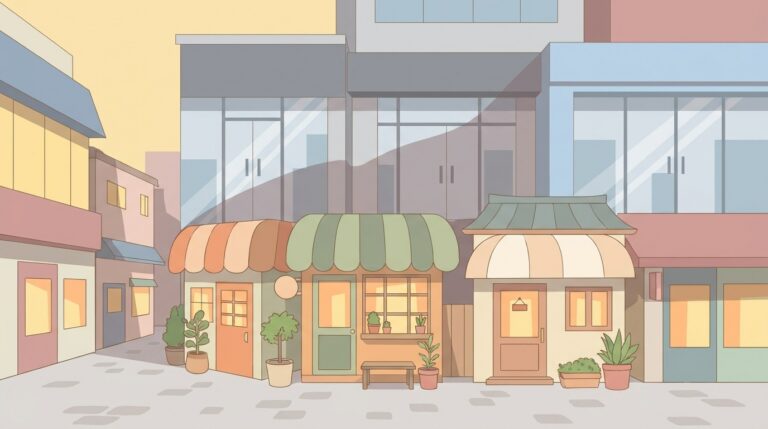
Phase 1: Empathy (Story-Driven Opening)
안녕하세요! 매일한글 에디터입니다. (Hello! This is your Daily Hangul editor.)
Picture this: Last year, you stumbled across an enchanting, secluded cobblestone alley behind an old metro stop in Seoul. It had an eccentric vinyl-record bar, a 40-year-old handmade teacup workshop, and a fragrant sesame oil boutique run by an elderly grandmother who always slipped a complimentary yakgwa cookie into your pocket. Excited to relive that magic, you visit the same alley today—only to freeze in disbelief. The warm red brick facades have vanished. In their place stand neon franchise cafes, a ubiquitous convenience store chain, and identical cosmetic franchise shops, all blasting the exact same billboard hits. Even worse? Half the upper floors have papered-up windows displaying bleak for-rent signs because sky-high rents scared both artisans and visitors away.
This heartbreaking shift is what Koreans refer to as 젠트리피케이션 (jenteuripikeisyeon / gentrification) or the poignant native phrase 둥지 내몰림 (dungji naemollim—literally ‘being pushed out of one’s nest’). When giant corporate franchises dominate every corner, a neighborhood loses its distinct pulse, foot traffic evaporates, and a vicious cycle of commercial decay begins. As an intermediate B2 learner, moving beyond textbook pleasantries means having the language tools to talk about these vibrant cultural real-world tensions. Today, backed by real student feedback and boots-on-the-ground observations across Seoul’s shifting alleys, we will equip you with authentic, sophisticated expressions to articulate this phenomenon like a true local culture insider.
Phase 2: Deep Dive into 3 Core Expressions
1. 개성을 잃다 (Gaeseong-eul ilta)
- Pronunciation: [Gae-seong-eul il-ta] (Think ‘Gae’ as in ‘get’ with a ‘g’, ‘seong’ like ‘song’, ‘il-ta’ like ‘ill-tah’)
- Meaning: Literally “to lose individuality/personality,” used to describe a neighborhood, venue, or artistic scene that has lost its authentic identity to commercial conformity.
- K-Culture Moment: Seen frequently in urban lifestyle documentaries or Youtube vlogs covering areas like Hongdae or Garosu-gil, where creators lament: “골목이 예전의 개성을 잃어버려서 너무 아쉬워요.” (Golmog-i yejeon-ui gaeseong-eul ireobeoryeoseo neomu aswiwoyo. / It is such a shame that this alley has lost its former distinct charm.)
- Editor’s Insight: 개성 (gaeseong) is treasured among younger Koreans today. While textbook lessons teach ‘다양성’ (diversity) or ‘독특함’ (uniqueness), ‘개성을 잃다’ implies an active loss of soul due to over-commercialization.
- Situation Spectrum: Casual: ✅ | Semi-formal: ✅ | Formal: ✅
- 🤔 Think About It: In English, we often say an area “became cookie-cutter” or “lost its vibe.” How does phrasing it as “losing its personality” (개성을 잃다) reflect the way Koreans personify neighborhoods as living communities?
2. 발길이 끊기다 (Balgil-i kkeunkida)
- Pronunciation: [Bal-gil-i kkeun-ki-da] (Pronounce ‘bal’ like the first syllable of ‘ballad’, ‘gil’ like ‘guild’, and ‘kkeun’ with a tight, tense ‘k’ sound)
- Meaning: Literally “footsteps are cut off”; naturally signifies that visitors, regular patrons, or pedestrians have stopped coming altogether.
- K-Culture Moment: In current affairs programs or local news segments examining deserted shopping districts like Sinchon or Myeongdong during rent crises, shopkeepers say: “손님들 발길이 뚝 끊겼어요.” (Sonnim-deul balgil-i ttuk kkeunkyeosseoyo. / Customers’ foot traffic has completely snapped and stopped.)
- Editor’s Insight: The verb 끊기다 (to be severed/snapped) creates a vivid, dramatic image. Adding the adverb ‘뚝’ (ttuk) emphasizes how abruptly foot traffic vanished once the original indie creators departed.
- Situation Spectrum: Casual: ✅ | Semi-formal: ✅ | Formal: ✅
- 🤔 Think About It: Notice the connection to physical human presence: ‘발길’ (foot-path/footsteps). Why do you think Korean uses physical bodily traces rather than abstract statistics like ‘소비자 감소’ (consumer decrease) in daily conversation?
3. 악순환이 반복되다 (Aksunhwan-i banbokdoeda)
- Pronunciation: [Ak-sun-hwan-i ban-bok-dwoe-da] (‘Ak’ sounds like ‘lock’ without the ‘l’, ‘sun’ like ‘soon’, ‘hwan’ like ‘Juan’ with an ‘h’)
- Meaning: “A vicious cycle repeats itself.” Describes systemic loops where high rent drives out creators, chain stores homogenize the area, visitors get bored and leave, resulting in vacant storefronts.
- K-Culture Moment: Debated in urban development podcasts or K-Dramas featuring small neighborhood struggles like Itaewon Class, where local entrepreneurs confront the reality of commercial monopolization.
- Editor’s Insight: B2 level speakers distinguish themselves by using structured conceptual nouns like 악순환 (vicious cycle / 惡循環) instead of vague phrases like ‘나쁜 일이 계속 생겨요’ (bad things keep happening).
- Situation Spectrum: Casual: ⚠️ (Sounds a bit analytical; soften with ~잖아 / ~더라고요) | Semi-formal: ✅ | Formal: ✅
- 🤔 Think About It: What constitutes an ‘악순환’ in your hometown’s downtown district? Can you construct this cause-and-effect relationship using intermediate Korean connectives like -(으)면 and -아/어지다?
Phase 3: Textbook Korean vs. Real Korean
Situation 1: Expressing that a neighborhood is overrun by identical corporate chains
- 📖 교과서 한국어 (Textbook): 이 거리는 대기업 매장이 많아져서 다른 곳과 비슷해졌습니다. (I geori-neun daegieop maejang-i man-ajyeoseo dareun got-gwa biseut-haejyeotseumnida. / This street became similar to other places because large enterprise stores increased.)
- 🗣️ 진짜 한국어 (Real-life): 여기 완전 대기업 프랜차이즈에 먹혀서 특색이 싹 다 사라졌어요. (Yeogi wanjeon daegieop peurancha-ijeu-e meokhyeoseo teuksaeg-i ssak da sarajyeosseoyo. / This place has been totally swallowed up by corporate chains, and its unique character was wiped out completely.)
- 💡 왜 다를까? (Why the difference?): Real Koreans express frustration using figurative verbs like ‘먹히다’ (to be eaten/swallowed whole by) and emphasizing adverbs like ‘완전’ (totally) and ‘싹 다’ (all and clean gone), conveying the emotional reality of neighborhood homogenization.
Situation 2: Explaining why an alleyway has become a ghost town
- 📖 교과서 한국어 (Textbook): 손님이 줄어들어서 가게들이 영업을 중단하고 있습니다. (Sonnim-i jureodeureoseo gagedeul-i yeong-eob-eul jungdanhago itseumnida. / Because customers decreased, shops are suspending business.)
- 🗣️ 진짜 한국어 (Real-life): 임대료가 너무 뛰니까 골목 상권 다 죽고 손님 발길도 뚝 끊겼잖아. (Imdaeryo-ga neomu ttwinikka golmok sanggwon da jukgo sonnim balgil-do ttuk kkeunkyeotjana. / Because rent skyrocketed so fast, the alley’s commercial scene completely died, and customer foot traffic suddenly snapped.)
- 💡 왜 다를까? (Why the difference?): In natural discourse, Koreans describe market collapse visceral terms: ‘임대료가 뛰다’ (rent leaps/jumps) and ‘상권이 죽다’ (a commercial district dies), sharing shared lamentation via the sentence-ending ‘~잖아’ (as you already know).
Phase 4: K-Culture Deep Dive & Non-Verbal Manners
4-1. Nunchi & Mindful Gestures
When walking through an alleyway in Seoul undergoing gentrification—such as Mullae-dong’s ironworks art village or Euljiro’s printing alleys—you will frequently witness contrasts between vintage craftsman shops and gleaming new pop-up stores.
* The Empathetic Gaze: If an iconic old bakery or stationery shop displays a closure notice, avoid pointing directly at the sign or taking cheerful selfie snaps in front of it. Koreans express quiet solidarity by tilting the head slightly, offering a subtle click of the tongue (쯧 – ‘jjeut’, a gentle expression of sympathy), and sighing softly: “아이고, 여기도 결국 문 닫네…” (Aigo, yeogido gyeolguk mun danne… / Oh dear, even this place is finally closing down…).
* Respecting the Local Creator: When entering a boutique studio or indie micro-cafe run by a local creator (로컬 크리에이터), don’t treat it like an impersonal self-service franchise. Make brief, polite eye contact, nod gently at roughly a 15-degree angle, and say “안녕하세요!” before whipping out your phone camera.
4-2. Cultural Code Analysis: The ‘Hipjiro’ and ‘Seongsu-dong’ Paradigm
In popular culture (from K-dramas like Itaewon Class to street-culture reality shows), the soul of Korean trendsetting lies in ‘골목상권’ (alleyway micro-economies). When young artists moved into cheap industrial spaces in Euljiro (nicknamed ‘Hipjiro’) or Seongsu-dong’s old shoe factories, they created an edgy, nostalgic aesthetic celebrated worldwide. However, the subsequent influx of corporate capital often displaces those exact trailblazers. Understanding this dynamic gives you backstage access to Korean conversations on urban preservation, community roots, and genuine indie culture versus prefabricated marketing.
Phase 5: Real-Life Roleplay Scenario
Setting: A quiet back-alley in Mangwon-dong. Min-su (민수), an indie ceramic artist and local creator, is wrapping bubble wrap around handcrafted mugs outside his studio.
- Min-su: 어, 왔어? 마침 짐 정리하던 중이었는데. (Eo, wasseo? Machim jim jeongnihadeon jung-ieonneunde.)
🎭 Sighing while wiping dust from a cardboard box.
(Oh, you’re here? I was just organizing and packing up my stuff.) - Learner (You): 민수 씨, 진짜 나가는 거예요? 여기 오픈한 지 겨우 2년 됐잖아요. (Minsu ssi, jinjja naganeun geoyeyo? Yeogi opeunhan ji gyeou i-nyeon dwaetjanayo.)
🎭 Looking around with concern at the stripped-down walls.
(Min-su, are you really leaving? It’s only been two years since you opened.) - Min-su: 건물주가 이번에 월세를 두 배로 올려달라더라고. 건너편에 대형 프랜차이즈 카페 들어온 뒤로 시세가 미쳤어. (Geonmulju-ga ibeone wolse-reul du bae-ro ollyeodalladeorago. Geonneopyeon-e daehyeong peurancha-ijeu kape deureoon dwiro sisega michyeosseo.)
🎭 Shaking his head with a bitter smile.
(The landlord told me to double the monthly rent this time. Ever since that mega franchise cafe opened across the street, the market rate went insane.) - Learner (You): 대기업 매장들만 들어오면 결국 이 골목도 개성을 잃어버릴 텐데… (Daegieop maejangdeul-man deureoomyeon gyeolguk i golmok-do gaeseong-eul ireobeoril tende…)
🎭 Frowning slightly while gesturing toward the alley.
(If only large chain stores move in, this alley will eventually lose its unique character…) - Min-su: 맞아. 프랜차이즈 간판으로 덮이면 결국 개성도 사라지고, 손님들 발길도 끊기게 마련이거든. (Maja. Peurancha-ijeu ganpan-euro deop-imyeon gyeolguk gaeseong-do sarajigo, sonnim-deul balgil-do kkeunkige maryeon-igeodeun.)
🎭 Taping up a cardboard box with a loud rip.
(Exactly. Once it’s covered in franchise billboards, the uniqueness disappears, and visitors are bound to stop coming altogether.) - Learner (You): 맞아요. 상권이 침체되는 악순환이 반복되는 것 같아요. 다른 크리에이터분들은 어때요? (Majayo. Sanggwon-i chimchedoeneun aksunhwan-i banbokdoeneun geot gat-ayo. Dareun keurieiteo-bundeul-eun eottaeyo?)
🎭 Leaning in with sincere curiosity and support.
(Right. It feels like a vicious cycle of district stagnation repeating itself. How are the other creators doing?) - Min-su: 옆 공방 언니도 다음 달에 외곽으로 작업실 옮긴대. 여기도 이제 그냥 평범한 번화가처럼 변하겠지. (Yeop gongbang eonni-do daeum dar-e oegwag-euro jageopsil olmgindae. Yeogido ije geunyang pyeongbeomhan beonhwagacheoreom byeonhagetji.)
🎭 Looking down the street wistfully.
(The artisan at the next leather studio says she’s moving her workshop to the outskirts next month too. This street will probably just turn into another ordinary, generic downtown strip.) - Learner (You): 제가 새로운 작업실 찾을 때까지 SNS로 민수 씨 작품 홍보 적극적으로 도울게요! (Jega saeroun jageopsil chajeul ttaekkaji SNS-ro Minsu ssi jakpum hongbo jeokgeukjeog-euro doulgeyo!)
🎭 Offering a firm, warm two-handed handshake.
(I will actively help promote your creations on social media until you settle into a new workshop!)
🔀 Interactive Decision Point
How do you respond to Min-su’s situation next?
* Option A (Best): “민수 씨 같은 로컬 크리에이터가 없으면 골목의 색깔 자체가 사라져요. 끝까지 응원할게요!” (Without local creators like you, the alley’s very color fades away. I’ll support you until the end!)
* Feedback: Perfect empathy and nuanced vocabulary (색깔 as character, 로컬 크리에이터). Strengthens genuine rapport.
* Option B (Bad): “그냥 대기업 카페랑 같이 일해 보는 건 어때요? 돈 많이 벌잖아요.” (Why not just collaborate and work with the chain cafe? They make lots of money.)
* Feedback: Fails to understand the indie ethos and ignores the reality that chain corporations displace independent artists.
* Option C (Risk): “건물주 찾아가서 따져요! 법적으로 신고해 버려요!” (Go confront the landlord and pick a fight! Report them legally!)
* Feedback: While well-intentioned, legal rent thresholds in commercial law can be complicated. Aggressive confrontation without knowing lease contracts might cause unnecessary legal friction.
Phase 6: 10-Second Emotion Shadowing Drill
Practice these lines out loud! Pay attention to the / pauses and channel the emotion markers:
[🥺 안타깝고 아쉬운 목소리로 / With deep regret and disappointment]
“어느 동네에 가나 / 똑같은 간판만 보이니까 / 골목만의 색깔이 / 싹 사라졌어요.”
(Eoneu dongne-e gana / ttokgateun ganpan-man boinikka / golmok-man-ui saekkkari / ssak sarajyeosseoyo.)-
[😤 씁쓸하고 단호하게 / With bitter realization and conviction]
“임대료가 폭등하면 / 로컬 크리에이터가 쫓겨나고 / 결국 발길이 끊기는 / 악순환이 반복돼요.”
(Imdaeryo-ga pokdeunghamyeon / rokeol keurieiteo-ga jjotgyeonago / gyeolguk balgil-i kkeunkineun / aksunhwan-i banbokdwaeyo.) -
[🤝 따뜻하고 다정하게 / With comforting warmth and encouragement]
“골목 상권이 살아나려면 / 대기업과 로컬 창작자의 / 공존이 / 꼭 필요해요.”
(Golmok sanggwon-i saranaryeomyeon / daegieop-gwa rokeol changjakja-ui / gongjon-i / kkok piryohaeyo.)
Phase 7: K-Culture Mini Dictionary
- 둥지 내몰림 (Dungji naemollim)
- Literal Translation: Nest Eviction / Being forced out of the nest.
- Real-world usage: The pure Korean term for gentrification. Heavily utilized in municipal policy, community town halls, and news broadcasts to evoke emotional protection for original tenants.
- 골목상권 (Golmok-sanggwon)
- Literal Translation: Alleyway Commercial District.
- Real-world usage: Distinct from massive department store zones or underground malls. It refers to organic clusters of small restaurants, artisanal cafes, and family shops nestled inside historic residential alleys.
- 로컬 크리에이터 (Rokeol keurieiteo)
- Literal Translation: Local Creator.
- Real-world usage: Young entrepreneurs, designers, and brewers who draw inspiration from regional traditions, revitalizing neglected districts with bespoke local concepts.
- 공실률 (Gongsil-ryul)
- Literal Translation: Vacancy Rate.
- Real-world usage: The percentage of unoccupied commercial storefronts. Often paired with ‘치솟다’ (to soar): “임대료가 오르자 공실률이 치솟았다” (As rents climbed, the vacancy rate soared).
Phase 8: Survival Kit for Travelers & Culture Explorers
TOP 3 Phrases to Navigate Local Alleys
- “여기 원래 있던 가게 어디로 옮겼는지 아세요?”
- Romanization: Yeogi wonrae itdeon gage eodiro olmgyeonneunji aseyo?
- Pro Tip: If a beloved neighborhood cafe suddenly vanished, ask nearby elderly shopkeepers this phrase. They frequently know the new studio address.
- “이 동네만의 특색 있는 독립서점이나 공방 추천해 주실 수 있나요?”
- Romanization: I dongne-man-ui teuksaek inneun dongnip-seojeom-ina gongbang chucheonhae jusil su innayo?
- Pro Tip: Use this at tourist info desks or neighborhood guesthouses to bypass sterile commercial malls and find vibrant creator hubs.
- “프랜차이즈 말고 로컬 브랜드 제품인가요?”
- Romanization: Peurancha-ijeu malgo rokeol beuraendeu jepum-ingayo?
- Pro Tip: Shows respect to craft shop owners, validating their creative effort and distinguishing their work from mass-manufactured souvenirs.
Editor’s Travel Note
To find authentic local alleyways before generic franchises move in, stay away from major search engine top sponsored lists. Instead, open your Naver Map app for authentic local alley discovery and search keywords like “독립서점” (independent bookstore), “소품샵” (curated lifestyle shop), or “동네책방” (neighborhood bookshop). You’ll discover hidden enclaves in places like Huam-dong, Mullae-dong, and Seochon where neighborhood creators still thrive.
Phase 9: “One Step Deeper” (Reflective Essay)
In traditional Korean culture, a neighborhood isn’t merely real estate; it is a tapestry woven of ‘정’ (Jeong)—the invisible, affectionate bond built over decades between neighbors, laundry owners, and small eateries. When rapid gentrification flattens these micro-ecosystems into uniform chain storefronts, society doesn’t just lose small businesses; it loses social memory and human warmth. When identical signs take over, the vibrant story of that neighborhood is reduced to a sterile corporate spreadsheet.
💬 Your Turn: Have you ever seen your favorite neighborhood spot back home get replaced by a bland chain store? Share your story below in Korean using today’s expression: “골목이 개성을 잃어서 아쉬워요”!
Phase 10: FAQ & Common Mistakes
Q: What is the exact difference between ‘젠트리피케이션’ and ‘둥지 내몰림’?
A: ‘젠트리피케이션’ is the direct phonetic loanword from English, used extensively in academic, journalistic, and economic debates. ‘둥지 내몰림’ is the official Korean substitute created to evoke the painful human image of birds pushed out of their rightful nests. Both refer to the same socio-economic process, but ‘둥지 내몰림’ carries a warmer, more empathetic nuance.
Q: Can I use ‘발길이 끊기다’ when talking about friends visiting my home?
A: Yes, but it sounds overly dramatic and slightly poetic! If your close friends haven’t visited your apartment lately, saying “친구들 발길이 끊겼어” sounds humorously melodramatic, like your home is a deserted heritage site. In daily personal contexts, simply say “친구들이 요즘 통 안 놀러 와요” (Friends haven’t been coming over at all lately).
Q: Is all franchise expansion considered bad in Korea?
A: Not necessarily. Franchise stores offer reliable employment, late-night convenience, and standardized sanitation. The critical debate among locals focuses on balance and coexistence (공존): ensuring mega-franchises don’t predatory-price local mom-and-pop legacy stores out of existence.
🚨 Common Mistakes Alert
- Mistake 1: Saying “개성을 잃어버렸어요” when referring to a person losing their wallet.
- Correct Action: 개성 means personality/character, not personal belongings (개인 소지품 / 지갑). Use “지갑을 잃어버렸어요.”
- Mistake 2: Confusing ‘악순환’ (vicious cycle) with ‘선순환’ (virtuous cycle).
- Correct Action: Remember the prefix 악 (惡 = bad/evil) versus 선 (善 = good/virtuous). If local creators and visitors support each other mutually, call it a 선순환!
- Mistake 3: Pronouncing 끊기다 as [kkeun-hi-da].
- Correct Action: Because of Korean aspirate consonant merger (ㅎ + ㄱ = ㅋ), it is pronounced crisp and clear as [끈키다 / kkeun-ki-da].
Phase 11: Action Missions & Community Challenge
- 🥉 Bronze Mission (Solo Practice): Read the Phase 6 Shadowing Drill aloud 3 times, focusing on articulating the [끈키다] pronunciation correctly.
- 🥈 Silver Mission (Social Media): Post a photo of your favorite small indie cafe on Instagram or Threads and write a one-sentence Korean caption: “골목상권만의 개성을 지켜주세요!” (Please protect the unique character of our alleyway districts!).
- 🥇 Gold Mission (Real-Life Application): Next time you visit a small neighborhood store or handicraft market in Korea, pay compliment to the owner using B2 phrasing: “가게 분위기가 정말 개성 있고 예뻐요!” (Your shop’s atmosphere is truly unique and beautiful!).
- 🎮 K-Culture Mission: Watch Episode 3 of the drama Itaewon Class (이태원 클라쓰) and listen for how character Park Sae-royi deals with commercial real-estate bullies attempting to squash his small pub.
Phase 12: Interactive Quiz Challenge
Test your intermediate mastery! Click the spoilers below to check your answers.
1. Situation Judgment Quiz
A trendy street that used to have quaint pottery shops and vintage book cafes is now filled with identical franchise convenience stores and bubble tea chains. As a result, tourists have stopped visiting. Which sentence best summarizes this situation?
* (A) 대기업 매장이 들어와서 손님들의 발길이 더 많아졌어요.
* (B) 프랜차이즈 때문에 개성을 잃고 발길마저 끊기는 악순환이 생겼어요.
* (C) 둥지 내몰림 덕분에 골목 상권이 아주 활기차졌어요.
🔍 Click to Reveal Answer & Explanation
Correct Answer: (B)
Explanation: Option (A) is factually incorrect because visitors stopped coming. Option (C) incorrectly claims that gentrification (둥지 내몰림) makes alleys energetic. Option (B) accurately utilizes all three key expressions learned today (개성을 잃다, 발길이 끊기다, 악순환).
2. Fill in the Blanks
Complete the sentence using the correct verb form of ‘to lose character’ and ‘foot traffic ceases’:
“간판이 다 똑같아지면 골목은 __________(개성을 잃다), 손님들의 __________(발길이 끊기다).”
🔍 Click to Reveal Answer & Explanation
Correct Answer: 개성을 잃고 / 발길이 끊겨요 (or 끊깁니다)
Explanation: Use connective -고 to join the two clauses: “간판이 다 똑같아지면 골목은 개성을 잃고, 손님들의 발길이 끊겨요.”
3. True or False Cultural Quiz
Statement: The Korean term ‘둥지 내몰림’ refers to migratory birds losing their nests during seasonal environmental changes in the Han River.
🔍 Click to Reveal Answer & Explanation
Correct Answer: False (X)
Explanation: While literally meaning ‘being driven from the nest,’ 둥지 내몰림 is the established sociopolitical Korean term for gentrification—original small tenants and artists being priced out by soaring commercial rents.
🎬 Watch Our Daily Videos! (Daily Hangul Official Instagram)
Review the expressions you learned in this article with our fun daily short videos! Check out native pronunciation and real-life nuances in action.
- Instagram @dailyhangul_en







