

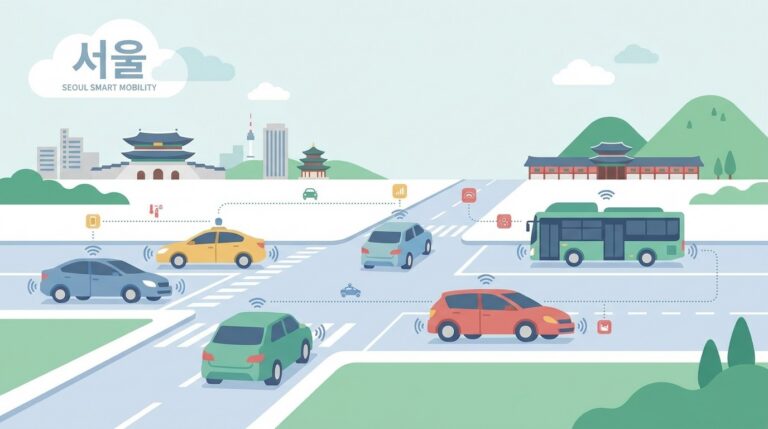
Phase 1: Empathy (Story-Immersive Opening)
안녕하세요! 매일한글 에디터입니다. (Hello! This is your Daily Hangul Editor.)
Picture this: You are sitting in a glass-walled conference room overlooking the bustling high-tech corridor of Pangyo Techno Valley—often dubbed South Korea’s Silicon Valley. Across the table sit senior software architects and corporate legal counsels from one of Korea’s premier mobility giants. The atmosphere is tense. A prototype Software-Defined Vehicle (SDV) utilizing End-to-End (E2E) neural network autonomy encountered an edge case near an intersection in Gangnam. An autonomous emergency brake was deployed, but an occluded urban delivery scooter barely escaped a collision.
The debate ignites: Was the onboard perception stack solely responsible, or did the ultra-low latency Vehicle-to-Everything (V2X) telecommunications infrastructure fail to broadcast the roadside unit (RSU) cooperative perception message in time? As a high-level specialist operating at the C2 mastery level, you aren’t just expected to understand standard conversational Korean; you must command the high-stakes lexicon of liability apportionment, sensor fusion blind spots, and real-time infrastructure handshakes.
Many advanced Korean learners hit a wall when crossing from conversational fluency to sector-specific professional Korean. When technical precision meets corporate legal subtleties, using a generic textbook term like “센서가 안 보였어요” (The sensor didn’t see it) instantly dilutes your authority. Drawing from our executive bilingual coaching logs and feedback from foreign tech consultants in Seoul, this guide gives you the elite linguistic agility needed to command boardroom discussions, navigate Korea’s strict Product Liability Act, and articulate how V2X complements onboard edge perception with absolute precision.
Phase 2: Core Expressions Deep Dive
1. 사각지대를 보완하다 (Sagakjidae-reul bowanhada)
- Pronunciation: [Sah-gak-ji-dae-reul boh-wan-hah-dah] (Sounds like sah-gahk + jee-deh + boh-wahn-hah-dah)
- Meaning: Literally “to complement blind spots” | Pragmatic Nuance: In technical autonomy discussions, this specifically denotes using external data sources (like V2I or V2V) to compensate for hardware or sensory occlusions.
- K-Culture Moment: Often heard in high-stakes corporate boardroom scenes in dramas like Stranger (비밀의 숲) or Queen of Tears (눈물의 여왕), where executives analyze technical crash reports or corporate liabilities.
- Editor’s Insight: While “없애다” (to eliminate) sounds colloquial and overly absolute, “보완하다” (to complement/remedy) captures professional engineering and legal precision by acknowledging redundancies in system engineering.
- Situation Spectrum: Casual: 🚫 | Semi-formal: ⚠️ | Formal: ✅
- 🤔 Think About It: Why does Korean engineering discourse prefer “보완” (complementing/rectifying gaps) over absolute terms like “완벽한 해결” (perfect resolution)? How does this reflect legal risk management?
2. 과실 비율을 산정하다 (Gwasil biyul-eul sanjeonghada)
- Pronunciation: [Gwa-sil bee-yul-eul sahn-jeong-hah-dah] (Gwah-sheel like ‘guard shield’ without rd/d + bee-yool + sahn-jeong-hah-dah)
- Meaning: Literally “to calculate the ratio of fault” | Pragmatic Nuance: To legally determine and apportion comparative negligence between software vendors, telecommunication carriers, and drivers.
- K-Culture Moment: A staple phrase used by insurance adjusters and elite defense attorneys in legal dramas like Extraordinary Attorney Woo (이상한 변호사 우영우).
- Editor’s Insight: In casual speech, people say “누구 잘못인지 따지다” (figuring out whose fault it is). In formal liability arbitration, you must use “과실 비율을 산정하다” to preserve institutional credibility.
- Situation Spectrum: Casual: 🚫 | Semi-formal: ⚠️ | Formal: ✅
- 🤔 Think About It: Comparative negligence in Korea heavily shapes autonomous driving legislation. How does your native language distinguish colloquial blame from statutory liability calculation?
3. 초저지연 통신망과 연동되다 (Chojeojiyeon tongsinmanggwa yeondongdoeda)
- Pronunciation: [Cho-jeo-ji-yeon tong-shin-mang-gwa yeon-dong-dwe-dah] (Cho-juh-jee-yuhn + tong-shin-mahng-gwah + yuhn-dong-dweh-dah)
- Meaning: Literally “to be interlocked with an ultra-low latency telecommunication network” | Pragmatic Nuance: Denoting seamless, mission-critical integration where microsecond-level data exchange directly updates the vehicle’s dynamic driving task.
- K-Culture Moment: Frequently heard during keynote presentations at events like the Seoul Mobility Show or government press briefings on national 5G/6G V2X standards.
- Editor’s Insight: The verb “연동되다” implies an automated, systemic handshake. It is far more sophisticated than simply saying “인터넷에 연결되다” (connected to the internet).
- Situation Spectrum: Casual: 🚫 | Semi-formal: ✅ | Formal: ✅
- 🤔 Think About It: Korea was the first to commercialize 5G nationwide. How does Korea’s hyper-connected telecommunications pride reflect in its automotive tech vocabulary?
Phase 3: Textbook Korean vs. Real Korean
Situation 1: Explaining that sensors failed due to a physical obstruction
- 📖 교과서 한국어: 센서 앞에 장애물이 있어서 보지 못했습니다. (Sensors couldn’t see because there was an obstacle in front.)
- 🗣️ 진짜 한국어: 물리적 은폐로 인한 라이다 센서의 사각지대를 도로 인프라(V2I) 통신 데이터로 실시간 보정했습니다. (Mul-li-jeok eun-pye-ro in-han ra-i-da sen-seo-ui sa-gak-ji-dae-reul do-ro in-peu-ra tong-sin de-i-teo-ro sil-si-gan bo-jeong-haet-seum-ni-da. / We corrected the LiDAR blind spot caused by physical occlusion in real-time using V2I infrastructure communication data.)
- 💡 왜 다를까?: Senior mobility researchers avoid primitive terms like “못 보다” (couldn’t see) in favor of domain terms such as “물리적 은폐” (physical occlusion) and “실시간 보정” (real-time calibration).
Situation 2: Debating product liability versus telecommunication fault
- 📖 교과서 한국어: 자동차 회사 책임인지 통신사 책임인지 모릅니다. (We don’t know if it’s the car company’s responsibility or the telecom’s responsibility.)
- 🗣️ 진짜 한국어: E2E AI의 제어권 이관 지연인지, V2X 패킷 손실에 따른 통신사 귀책사유인지 법리 검토가 선행되어야 합니다. (E2E AI-ui je-eo-gwon i-gwan ji-yeon-in-ji, V2X pae-kit son-sil-e tta-reun tong-sin-sa gwi-chaek-sa-yu-in-ji beop-ri geom-to-ga seon-haeng-doe-eo-ya ham-ni-da. / Prior legal review is required to determine whether this stems from control handoff latency in the E2E AI or telecom culpability due to V2X packet loss.)
- 💡 왜 다를까?: Legal-engineering executives distinguish liability types cleanly using legal terminology like “귀책사유” (attributable fault/culpability) and “법리 검토” (legal/jurisprudential review).
Phase 4: K-Culture Deep Dive & Non-Verbal Manners
4-1. Nunchi & Boardroom Body Language in Korean High-Tech
In an elite Korean corporate setting (like Pangyo or Gangnam), presenting liability critiques requires subtle non-verbal navigation (눈치, Nunchi). When pointing out systemic failures in an SDV platform during a joint audit:
* The 45-Degree Document Glance: Never point your finger directly at an engineer’s architecture diagram or a legal counterpart’s contract draft. Rest your index finger flat against your technical notebook, tilting your upper body slightly forward.
* De-escalating Head Tilt: When questioning whether onboard sensors missed a pedestrian, frame it as a shared structural hurdle rather than individual negligence. Use open palm gestures (손바닥을 위로 향하기) and a restrained nod to signal that you are protecting the team from collective regulatory exposure.
4-2. Cultural Code Analysis: The Pangyo Ecosystem & Legal Accountability
In Korean corporate mobility, collective responsibility collides with strict regulatory scrutiny under the Ministry of Land, Infrastructure and Transport (국토교통부). Korea’s hyper-dense urban layout—narrow alleyways, aggressive multi-lane roundabouts, and motorcycle couriers—means that self-contained autonomous vehicles (Level 4/5) face extreme operational challenges. Hence, Korea has prioritized Cooperative Intelligent Transport Systems (C-ITS). In Korean tech dramas like Start-Up (스타트업), tech teams often face intense scrutiny over system bugs. In real Korean boardrooms, acknowledging that “individual sensors have limitations that must be augmented by collective civic infrastructure” reflects a deep cultural value: communal alignment over individualist hubris.
Phase 5: Real-World Roleplay Scenario
Setting: A mobility arbitration center at the Pangyo Autonomous Driving Center. Team Lead Min-woo (Autonomous Driving Engineering Lead) and Attorney Kang (Corporate Legal Counsel) are reviewing telemetry logs.
- Turn 1 (Min-woo):
- Korean: 어제 상암 자율주행 시범지구에서 발생한 급제동 건, 로그 분석 결과 나왔습니까?
- Romanization: Eoje Sang-am ja-yul-ju-haeng si-beom-ji-gu-e-seo bal-saeng-han geup-je-dong geon, ro-geu bun-seok gyeol-gwa na-wat-seum-ni-kka?
- English: Do we have the telemetry log analysis results for the emergency braking incident in the Sangam Autonomous Pilot Zone yesterday?
🎭 행동 지문: 태블릿 화면의 데이터 그래프를 넘기며 안경을 고쳐 쓴다. (Scrolls through data graphs on his tablet while adjusting his glasses.)
- Turn 2 (Attorney Kang):
- Korean: 네, 현장 교차로 우회전 시 개별 센서의 사각지대에 보행자가 진입했던 것으로 확인되었습니다.
- Romanization: Ne, hyeon-jang gyo-cha-ro u-hoe-jeon si gae-byeol sen-seo-ui sa-gak-ji-dae-e bo-haeng-ja-ga jin-ip-haet-deon geot-eu-ro hwag-in-doe-eot-seum-ni-da.
- English: Yes, it was confirmed that a pedestrian entered the onboard sensor’s blind spot during an unprotected right turn at the intersection.
🎭 행동 지문: 심각한 표정으로 사고 시점 CCTV 캡처본을 회의 테이블 중앙에 내려놓는다. (Places a CCTV capture from the time of the incident on the center of the table with a grave expression.)
- Turn 3 (Min-woo):
- Korean: 다행히 노변 기지국(RSU)의 V2I 통신이 사각지대 정보를 초저지연으로 전송해 제동을 트리거했군요.
- Romanization: Da-haeng-hi no-byeon gi-ji-guk(RSU)-ui V2I tong-sin-i sa-gak-ji-dae jeong-bo-reul cho-jeo-ji-yeon-eu-ro jeon-song-hae je-dong-eul teu-ri-geo-haet-gun-yo.
- English: Fortunately, the Roadside Unit (RSU)’s V2I communication transmitted the blind-spot telemetry with ultra-low latency, triggering the brakes.
🎭 행동 지문: 가슴을 쓸어내리며 안도의 한숨을 쉰다. (Gently clutches his chest and sighs in relief.)
- Turn 4 (Attorney Kang):
- Korean: 하지만 급제동으로 인해 후미 추돌 사고가 발생했으므로 제조물 책임법상 결함 여부가 쟁점이 될 수 있습니다.
- Romanization: Ha-ji-man geup-je-dong-eu-ro in-hae hu-mi chu-dol sa-go-ga bal-saeng-haet-seu-mweo-ro je-jo-mul chaeg-im-beop-sang gyeol-ham yeo-bu-ga jaeng-jeom-i doel su it-seum-ni-da.
- English: However, since the sudden braking induced a rear-end collision, whether this constitutes a defect under the Product Liability Act will be the core issue.
🎭 행동 지문: 볼펜 끝으로 계약 조항 문서를 톡톡 두드린다. (Taps the edge of his pen thoughtfully on the contractual terms document.)
- Turn 5 (Min-woo):
- Korean: E2E 신경망 모델의 자체 오판이 아니라, 인프라 협력 주행 데이터에 근거한 방어 기제였음을 증명해야겠네요.
- Romanization: E2E sin-gyeong-mang mo-del-ui ja-che o-pan-i a-ni-ra, in-peu-ra hyeop-ryeok ju-haeng de-i-teo-e geun-geo-han bang-eo gi-je-yeoss-eum-eul jeung-myeong-hae-ya-get-nae-yo.
- English: We must establish that this wasn’t an internal misjudgment by the E2E neural network, but a defensive action based on cooperative perception data.
🎭 행동 지문: 결연한 표정으로 로그 타임스탬프를 형광펜으로 긋는다. (Highlights the telemetry timestamp with a determined expression.)
- Turn 6 (Attorney Kang):
- Korean: 맞습니다. 만약 V2X 통신 지연이나 인프라 왜곡이 개입했다면 지자체와 통신사의 과실 비율도 따져봐야 합니다.
- Romanization: Mat-seum-ni-da. Man-yak V2X tong-sin ji-yeon-i-na in-peu-ra wae-gok-i gae-ip-haet-da-myeon ji-ja-che-wa tong-sin-sa-ui gwa-sil bi-yul-do tta-jyeo-bwa-ya ham-ni-da.
- English: Precisely. If V2X communication latency or infrastructural distortion intervened, we must also apportion the fault ratio to the municipality and telecom carrier.
🎭 행동 지문: 민우의 메모를 유심히 살피며 고개를 끄덕인다. (Examines Min-woo’s notes intently while nodding.)
- Turn 7 (Min-woo):
- Korean: OTA로 배포된 직전 소프트웨어 버전의 V2X 프로토콜 적합성 인증 기록을 국토부에 즉각 제출하겠습니다.
- Romanization: OTA-ro bae-po-doen jik-jeon so-peu-teu-we-eo beo-jeon-ui V2X peu-ro-to-kol jeok-hap-seong in-jeung gi-rok-eul guk-to-bu-e jeuk-gak je-chul-ha-get-seum-ni-da.
- English: I will immediately submit the V2X protocol conformance certification records for the software version distributed via OTA to the Ministry.
🎭 행동 지문: 노트북 자판을 신속하게 두드리며 전송 버튼을 누른다. (Swiftly types on his laptop keyboard and presses submit.)
- Turn 8 (Attorney Kang):
- Korean: 좋습니다. 기술 검증 데이터를 토대로 초기 법리 대응 논리를 신속히 구축합시다.
- Romanization: Jot-seum-ni-da. Gi-sul geom-jeung de-i-teo-reul to-dae-ro cho-gi beop-ri dae-eung non-ri-reul sin-sok-hi gu-chuk-hap-si-da.
- English: Excellent. Let us construct our initial legal defense based on this technical verification data at once.
🎭 행동 지문: 서류철을 덮고 단호하게 미소를 짓는다. (Closes the portfolio and smiles resolutely.)
🔀 Interactive Branch Point
At this moment, an independent investigator asks your opinion regarding the V2X sensor fusion logs. How do you respond?
- Option A: “단순 센서 오류입니다. 소프트웨어를 재부팅하면 해결될 경미한 문제입니다.” (It’s a simple sensor error. It is a minor issue that can be solved by rebooting the software.)
- Option B: “차량 단독 센서의 사각지대를 V2X 인프라 통신망이 실시간으로 상호 보완한 정상적인 방어 운전 메커니즘으로 판단됩니다.” (I evaluate this as a normal defensive driving mechanism where the V2X infrastructure telecommunication network complemented the onboard sensor’s blind spot in real time.)
- Option C: “이건 전적으로 통신사 망 지연 문제이므로 차량 제조사는 아무런 책임이 없습니다.” (This is entirely an issue of telecom network latency, so the vehicle manufacturer has no liability whatsoever.)
Feedback:
* Option A (Bad): Dismissive and technically incorrect. In high-level Korean arbitration, trivializing an SDV braking incident as a “simple sensor error” implies negligence in quality assurance.
* Option B (Best): Flawless C2-level framing. It accurately synthesizes technical dynamics (V2X infrastructure complementation) with legal defense criteria (normal defensive driving mechanism).
* Option C (Risk): Overly combative and prematurely defensive. Blaming external partners without completed forensic log verification can sever critical joint venture relationships in Korea’s mobility ecosystem.
Phase 6: 10-Second Emotion Shadowing Drill
Practice these high-impact sentences using the slash (/) pause indicators and emotional milestones.
[🧐 날카롭고 분석적으로 - Analytical & Incisive]- Korean: 개별 차량 센서의 물리적 한계를 / 초저지연 V2X 인프라가 / 실시간으로 보완하고 있습니다.
- Romanization: Gae-byeol cha-ryang sen-seo-ui mul-li-jeok han-gye-reul / cho-jeo-ji-yeon V2X in-peu-ra-ga / sil-si-gan-eu-ro bo-wan-ha-go it-seum-ni-da.
- English: Ultra-low latency V2X infrastructure / is complementing in real-time / the physical limitations of individual vehicle sensors.
[⚖️ 신중하고 단호하게 - Deliberate & Resolute]- Korean: 단순 제어권 이관 지연인지 / 통신 패킷 손실인지에 따라 / 과실 비율 산정이 / 완전히 달라집니다.
- Romanization: Dan-sun je-eo-gwon i-gwan ji-yeon-in-ji / tong-sin pae-kit son-sil-in-ji-e tta-ra / gwa-sil bi-yul san-jeong-i / wan-jeon-hi dal-la-jim-ni-da.
- English: Depending on whether it was a simple handoff delay / or communication packet loss / the calculation of the fault ratio / changes completely.
[🤝 정중하면서도 확신에 차서 - Courteous & Confident]- Korean: 국토부 가이드라인에 맞춘 / OTA 소프트웨어 검증 기록을 / 신속히 제출하여 / 법적 리스크를 선제적으로 방어합시다.
- Romanization: Guk-to-bu ga-i-deu-ra-in-e mat-chun / OTA so-peu-teu-we-eo geom-jeung gi-rok-eul / sin-sok-hi je-chul-ha-yeo / beop-jeok ri-seu-keu-reul seon-je-jeok-eu-ro bang-eo-hap-si-da.
- English: Let us proactively defend against legal risks / by promptly submitting / the OTA software verification logs / aligned with the Ministry guidelines.
Phase 7: K-Culture Mini Dictionary
- 초저지연 (Cho-jeo-ji-yeon)
- Translation: Ultra-low latency
- Usage: Essential in 5G/6G automotive communications. In Korean high-tech boardrooms, achieving “초저지연” is the paramount KPI for autonomous safety.
- 제조물 책임법 (Je-jo-mul Chaeg-im-beop)
- Translation: Product Liability Act
- Usage: The legal cornerstone for automotive safety disputes in Korea. Dictates whether an autonomous crash is judged as a product defect or operator error.
- 소프트웨어 정의 차량 (SDV / So-peu-teu-we-eo Jeong-ui Cha-ryang)
- Translation: Software-Defined Vehicle
- Usage: The core buzzword in modern Korean automotive R&D (Hyundai, Kia, 42dot), referring to vehicles whose features are primarily enabled and updated via software and OTA.
- 정밀 도로 지도 (Jeong-mil Do-ro Ji-do)
- Translation: High-Definition (HD) Map
- Usage: Highly regulated in South Korea due to national security laws. Frequently discussed alongside V2I infrastructure for sub-decimeter vehicle positioning.
Phase 8: Survival Kit for High-Tech Travelers & Professionals
Professional Mobility Top 3 Phrases
- 통신 지연 시간(레이턴시) 로그를 확인할 수 있을까요?
- Romanization: Tong-sin ji-yeon si-gan(re-i-teon-si) ro-geu-reul hwag-in-hal su iss-eul-kka-yo?
- Pro Tip: Use this during technical audits to request telecommunication latency data politely yet authoritatively.
- 사각지대 감지 기능이 V2X 인프라와 정상적으로 동기화되었습니까?
- Romanization: Sa-gak-ji-dae gam-ji gi-neung-i V2X in-peu-ra-wa jeong-sang-jeok-eu-ro dong-gi-hwa-doe-eoss-seum-ni-kka?
- Pro Tip: Perfectly demonstrates C2 technical mastery when examining sensor fusion synchronization.
- 과실 책임 소재를 명확히 하기 위해 데이터 로그 원본을 확보해야 합니다.
- Romanization: Gwa-sil chaeg-im so-jae-reul myeong-hwak-hi ha-gi wi-hae de-i-teo ro-geu won-bon-eul hwak-bo-hae-ya ham-ni-da.
- Pro Tip: The definitive phrase when leading forensic investigations after an autonomous driving incident.
Editor’s Travel Note: Navigating Korea’s Smart Mobility Hubs
- If you are visiting testing facilities in Sangam (Seoul) or Pangyo (Gyeonggi-do), avoid using standard international navigation apps which have limited functionality due to local geo-mapping regulations. Instead, ensure your team utilizes the official 카카오맵 지도 앱 다운로드 (KakaoMap app download) or 네이버 지도 대중교통 안내 (Naver Map transport guide) to monitor real-time smart bus transit and dynamic traffic routing powered by municipal C-ITS.
Phase 9: “한 발 더 깊이” (Deep Cultural Reflection)
In Western legal tradition, liability is predominantly viewed through the lens of individual agency—apportioning fault sharply between the driver, manufacturer, or third party. In Korea, however, the implementation of autonomous mobility reflects the philosophy of Gongdongche (공동체, collective community). V2X is not merely treated as an extra telemetry sensor; it represents the civic infrastructure embracing the vehicle. The roadway (V2I), neighboring citizens (V2P), and peer vehicles (V2V) form a unified communicative organism.
Consequently, when an autonomous vehicle encounters an edge case, Korean regulatory discourse often asks: Did the infrastructure do its civic part to support the vehicle’s safe passage? This collaborative mindset is why South Korea heavily funds municipal C-ITS rollouts alongside SDV innovation. As high-level speakers of Korean, mastering these linguistic subtleties demonstrates your understanding of this communal technological ecosystem.
💬 Your Turn: In your home country, if an autonomous vehicle makes an emergency stop based on external telecom data and causes a rear-end bump, who bears the primary liability? How does that compare to the Korean cooperative approach? Share your thoughts below in advanced Korean or English!
Phase 10: FAQ & Common Pitfalls (FAQ Schema)
Q: Why is V2X terminology considered crucial for legal discussions in Korea rather than just technical ones?
A: Under Korea’s Product Liability Act (제조물 책임법), vehicle manufacturers can mitigate defect liability if they prove that an unexpected sensor blind spot was addressed by real-time infrastructure warnings (V2X) and that the vehicle acted within established safety protocols.
Q: What is the difference between ‘사각지대를 없애다’ and ‘사각지대를 보완하다’ in executive meetings?
A: While “없애다” (to eradicate) sounds amateurish and promises an impossible 100% fail-safe environment, “보완하다” (to complement/mitigate gaps) denotes redundancy engineering and aligns with standard professional terminology used in regulatory compliance.
Q: How do Korean engineers refer to the handover of control between autonomous systems and human drivers?
A: The industry standard term is “제어권 이관” (Je-eo-gwon i-gwan). Using casual phrases like “운전 바꾸기” (changing driving) sounds inappropriate in any formal technical audit.
🚨 Common Mistakes Alert
- Mistake: Using “인터넷 연결” (internet connection) when describing vehicle telemetry.
- Correct Action: Use “초저지연 통신망 연동” (ultra-low latency network integration) to reflect mission-critical standards.
- Mistake: Saying “누구 탓이에요?” (Whose fault is it?) during an incident review.
- Correct Action: Say “과실 비율 산정 및 책임 소재 파악이 필요합니다” (Calculation of fault ratio and identification of liability locus are required).
- Mistake: Confusing “자율주행차 결함” (vehicle defect) with “통신 지연 장애” (telecommunication latency impairment).
- Correct Action: Separate the hardware/software defect (제조물 결함) from the external telecom network latency (망 지연 귀책사유).
Phase 11: Action Mission & Engagement
- 🥉 Bronze Level: Read the Phase 6 Emotion Shadowing Drill aloud 3 times, paying close attention to natural pauses (
/) and professional intonation. - 🥈 Silver Level: Record a 30-second voice note introducing the concept of “사각지대를 보완하는 V2X 기술” and share it with a language exchange partner or on your study feed.
- 🥇 Gold Level: Write a 4-sentence analytical memo in Korean arguing whether an autonomous driving crash caused by network latency is the responsibility of the vehicle OEM or the telecommunications carrier, using at least 3 terms from Phase 7.
- 🎮 K-Culture Mission: Watch an episode of a modern Korean legal drama (such as Extraordinary Attorney Woo or Hyena) and spot any scene where “과실 비율” or “책임 소재” is debated. Note how their physical posture reflects boardroom hierarchy.
Phase 12: Interactive Quiz Challenge
Test your mastery of C2 mobility and liability Korean! Click each toggle to reveal the solution and analysis.
Question 1 (Contextual Judgment): Choose the most professional response during an SDV legal audit.
Scenario: A regulator asks why the vehicle didn’t brake before seeing the pedestrian directly.
- A) 센서가 고장 났지만 운이 좋아서 멈췄습니다.
- B) 차량 센서의 사각지대 정보를 V2I 노변 기지국으로부터 초저지연으로 수신하여 사전 대응했습니다.
- C) 통신사가 알아서 브레이크를 밟아 준 것입니다.
Answer: B
* Explanation: Option B articulates the cooperative interaction between vehicle perception and V2I infrastructure with sophisticated domain vocabulary. Option A is informal and damaging to engineering reputation, while Option C shows a complete misunderstanding of autonomous brake actuation.
Question 2 (Fill in the Blank): Complete the sentence with the appropriate legal-engineering term.
“자율주행 중 발생한 연쇄 추돌 사고의 (________)을 산정하기 위해 E2E AI 제어 기록과 V2X 통신 패킷을 전수 조사하고 있습니다.”
- A) 과실 비율 (Fault ratio)
- B) 가격 차이 (Price difference)
- C) 승차 인원 (Passenger count)
Answer: A (과실 비율)
* Explanation: In the context of investigating an autonomous chain collision, “과실 비율을 산정하다” (calculating the fault ratio) is the precise legal expression needed.
Question 3 (True or False Cultural Quiz): V2X infrastructure integration in Korea.
Statement: In South Korea’s autonomous vehicle framework, safety is viewed entirely as the sole responsibility of individual vehicle onboard sensors, and municipal infrastructure (C-ITS) plays no official legal role.
- True (참)
- False (거짓)
Answer: False (거짓)
* Explanation: South Korea places tremendous structural and legislative emphasis on Cooperative Intelligent Transport Systems (C-ITS), meaning municipal V2I infrastructure is legally and operationally designed to complement onboard sensor limitations.
🎬 Watch Our Daily Videos! (Daily Hangul Official Instagram)
Review the expressions you learned in this article with our fun daily short videos! Check out native pronunciation and real-life nuances in action.
- Instagram @dailyhangul_en







