

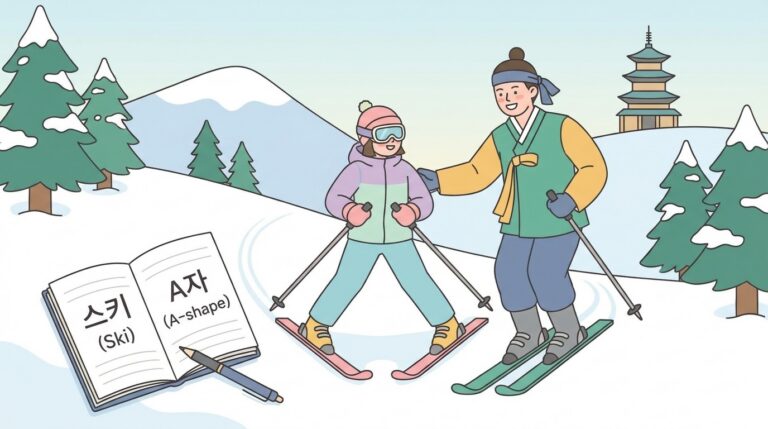
Phase 1: Empathy (Storytelling Opening)
안녕하세요! 매일한글 에디터입니다. (Hello! I’m your Daily Hangul editor.)
Picture this: You are standing at the peak of a snowy mountain in Pyeongchang, Gangwon-do. The crisp winter air fills your lungs, and the glittering white slopes look straight out of an iconic K-drama like Winter Sonata or Goblin. You strapped into your rental skis, ready for that cinematic, gliding descent. But as you look down the slope, reality suddenly strikes. The incline feels like a sheer cliff, your knees begin to shake inside your rigid ski boots, and your brain screams: How on earth do I stop without crashing into that food stand at the bottom?!
If you’ve ever felt that instant wave of slope panic, you are definitely not alone. Every winter, thousands of international visitors head to Gangwon-do’s premier resorts—from Elysian Gangchon to Vivaldi Park and Yongpyong—eager to conquer Korean powder. Yet, the biggest hurdle beginner and intermediate skiers face isn’t going fast; it’s knowing how to safely hit the brakes and tumble without injury. Many learners tell us, “I knew how to push forward, but when my instructor shouted Korean commands, I froze and ended up face-planting into a snowdrift!”
Mastering how to fall safely (낙법, nakbeop) and carve an A-shape snowplow wedge (보겐, bogen) will transform your mountain anxiety into effortless fun. Backed by real ski school curricula and feedback from hundreds of learners, this guide is your personal survival kit. By the end of this lesson, you’ll communicate smoothly with Korean ski instructors, keep your knees safe, and shred Gangwon’s snowy trails with pure confidence!
Phase 2: Core Expressions Deep Dive
1. 넘어질 때는 엉덩이로 넘어지세요 (Neomeojil ttaeneun eongdeong-iro neomeojiseyo)
- Pronunciation: [Neoh-meo-jil ttae-neun ung-deong-ee-ro neoh-meo-jee-seh-yoh] (Think of ung as in “hung”, and deong as in “tongue”).
- Meaning: Literal: “When falling, fall onto your hips/buttocks.” | Nuance: “If you feel yourself losing balance, sit down sideways on your hips rather than using your hands.”
- K-Culture Moment: In winter reality variety shows like 2 Days & 1 Night or Running Man, whenever cast members try winter sports, the resident coaches always yell this exact sentence before anyone even touches the lift.
- Editor’s Insight: The marker ~(으)로 (-ro) indicates direction or method. Korean instructors emphasize using your hip muscle padding to protect your fragile wrists and tailbone from impact against hard-packed ice.
- Situation Spectrum: Casual: ⚠️ (Use ‘넘어질 땐 엉덩이로 넘어져’) | Semi-formal: ✅ | Formal: ✅
- 🤔 Think About It: In many Western ski schools, instructors say “drop your weight to the side.” Why do you think Korean uses the very direct, anatomically specific noun ‘엉덩이’ (buttocks) to prompt rapid, unmistakable muscle memory?
2. 스키 플레이트 앞을 A자로 모아보세요 (Seuki peulleiteu apeul E-i-jaro mo-aboseyo)
- Pronunciation: [Seu-kee pleh-ee-teu ah-peul ey-ee-jah-ro moh-ah-boh-seh-yoh] (A is pronounced simply as the English letter name “A”).
- Meaning: Literal: “Gather the front of your ski plates into an A-shape.” | Nuance: “Make a snowplow wedge by bringing your ski tips together to slow down.”
- K-Culture Moment: Seen in classic YouTube vlogs of K-pop idols learning winter sports during their off-season contents—idols nervously repeating “A-ja, A-ja!” while focusing intensely on their ski tips.
- Editor’s Insight: In Korean ski terminology, the German word Pflugbogen is often shortened to just bogen (보겐), but for beginners, instructors universally call it “A자” (A-shape). Pushing your heels outward creates this V/A wedge.
- Situation Spectrum: Casual: ⚠️ | Semi-formal: ✅ | Formal: ✅
- 🤔 Think About It: Koreans love visual alphabet analogies (like V-line jawlines, S-line silhouettes, and A-line skirts). How does visual shape-naming change how quickly your body reacts compared to technical jargon?
3. 속도를 줄이면서 천천히 멈출 수 있어요 (Sokdoreul jurimyeonseo cheoncheonhi meomchul su isseoyo)
- Pronunciation: [Sohk-doh-reul joo-ree-myeon-seoh cheon-cheon-hee meom-chul soo eess-uh-yoh] (Myeon-seo sounds like “myun-suh”).
- Meaning: Literal: “While reducing speed, you can stop slowly.” | Nuance: “You can smoothly decelerate and come to a gentle stop.”
- K-Culture Moment: In wholesome healing travel shows like Camping Club, experienced members offer calm, reassuring instructions using this grammar pattern to soothe nervous beginners.
- Editor’s Insight: The grammar point
-(으)면서(while doing something) is vital at the B1 intermediate level. Here it emphasizes continuous simultaneous action: don’t slam the brakes instantaneously; control the glide while decelerating. - Situation Spectrum: Casual: ⚠️ | Semi-formal: ✅ | Formal: ✅
- 🤔 Think About It: Does your native language express simultaneous physical actions with compound verbs or conditional conjunctions? How does combining the two motions into one verb phrase alter your focus?
Phase 3: Textbook Korean vs. Real-Life Korean
Situation 1: When you are about to crash or lose balance
- 📖 교과서 한국어 (Textbook): 균형을 잃었을 때는 넘어지지 않도록 주의하십시오. (Gyunhyeongeul ireosseul ttaeneun neomeojiji antorok ju-uihasipsio. / “When you lose balance, take care not to fall down.”)
- 🗣️ 진짜 한국어 (Real-Life): 위험하면 버티지 말고 그냥 털썩 주저앉으세요! (Wiheomhamyeon beotiji malgo geunyang teolsseok jujeo-anjeuseyo! / “If it’s dangerous, don’t fight it—just plop right down on the snow!”)
- 💡 왜 다를까? (Why is it different?): Textbook Korean warns you not to fall, which actually causes rigid panic. On real Gangwon slopes, instructors want you to surrender your pride immediately using the vivid mimetic word ‘털썩’ (teolsseok, a soft, sudden plop) to avoid twisting a knee.
Situation 2: Applying pressure to the edges of your skis
- 📖 교과서 한국어 (Textbook): 스키의 후미 부분을 양옆으로 넓혀 제동을 겁니다. (Seuki-ui humi bubuneul yang-yeopeuro neolhyeo jedong-eul geomnida. / “Widen the rear sections of the skis laterally to apply braking force.”)
- 🗣️ 진짜 한국어 (Real-Life): 발뒤꿈치를 바깥으로 꾹 밀어내세요! (Baldwikkumchireul bakkateuro kkuk mireonaeseyo! / “Push your heels firmly outward!”)
- 💡 왜 다를까? (Why is it different?): Real instructors do not use technical words like ‘제동’ (braking mechanics) or ‘후미’ (tail end). Instead, they target the body part you directly control: your heels (발뒤꿈치).
Phase 4: K-Culture Deep Dive & Non-Verbal Manners
4-1. 눈치 (Nunchi) & Non-Verbal Manners on the Slope
Korean ski resorts operate under high-speed harmony. Because Gangwon slopes can get bustling during weekend peak hours, having high nunchi (tact and situational awareness) is essential for mutual safety:
1. Never Stop Under Blind Drops: When practicing your falling or A-shape stops, never sit in the middle of a slope directly below a ridge where oncoming skiers cannot see you. Move promptly to the edge.
2. The Pole-Drop Courtesy: If someone falls in front of you, don’t just swerve around them without looking back. A quick hand gesture (raising your gloved open palm) and asking “괜찮으세요?” (Gwaenchaneuseyo? / “Are you okay?”) demonstrates top-tier slope etiquette.
3. Wrist Straps in Lift Lines: When queuing for the lift with rental gear, keep your ski poles tucked neatly under your arm rather than swinging loose. Striking someone’s padded winter coat with a metal pole tip is an etiquette faux pas!
4-2. Cultural Code: The ‘After-Ski’ Culture of Gangwon
Unlike the alpine European après-ski scene dominated by schnapps and lounges, the Korean après-ski ritual is all about sizzling comfort food. After two hours of tensing your thigh muscles on beginner slopes like “Yellow” or “Pink,” ski groups head directly to resort food courts or nearby towns for boiling hot eomuk-tang (fish cake soup skewered on long wooden sticks), crisp pajeon (scallion pancakes), or charcoal-grilled Gangwon hanwoo (Korean beef). The shared hardship of tumbling down the slopes together cements social bonding—what Koreans call jeong (정).
Phase 5: Real-Life Roleplay Scenario
Setting: The beginner slope (초심자 슬로프) at a scenic ski resort in Gangwon-do. You are standing with Coach Min-woo (민우 코치님), a cheerful and attentive ski instructor wearing a neon resort jacket.
- 민우 코치: 자, 리프트 타기 전에 기본 동작부터 완벽하게 익힐게요. 긴장 푸시고요! (Ja, ripeuteu tagi jeone gibon dongjakbuteo wanbyeokhage ikhilgeyo. Ginjang pusigoyo!)
🎭 Smiling encouragingly while checking the bindings on your ski boots.
“Now, before we take the lift, let’s master the basic movements. Shake off the tension!” -
You: 네, 코치님! 솔직히 조금 무서워요. 미끄러질까 봐 걱정돼요. (Ne, kochinim! Soljik-hi jogeum museowoyo. Mikkeureojilkka bwa geokjeongdwaeyo.)
🎭 Gripping your ski poles tightly with slightly trembling hands.
“Yes, Coach! Honestly, I’m a little scared. I’m worried about slipping.” -
민우 코치: 당연한 거예요. 그래서 제일 먼저 안전하게 넘어지는 법부터 배울 거예요. (Dang-yeonhan geoyeyo. Geuraeseo jeil meonjeo anjeonhage neomeojineun beopbuteo baeul geoyeyo.)
🎭 Tapping his own hips with his insulated ski mittens.
“That’s completely natural. That’s why we will first learn how to fall safely.” -
You: 넘어질 때 손으로 땅을 짚으면 안 되나요? (Neomeojil ttae soneuro ttang-eul jipeumyeon an doenayo?)
🎭 Tilting your head curiously, looking down at the packed snow.
“When I fall, shouldn’t I catch the ground with my hands?” -
민우 코치: 절대 안 돼요! 손목을 다칠 수 있어요. 넘어질 때는 폴을 놓고 엉덩이로 옆으로 털썩 주저앉으셔야 해요. (Jeoldae an dwaeyo! Sonmogeul dachil su isseoyo. Neomeojil ttaeneun poreul noko eongdeong-iro yeopeuro teolsseok jujeo-anjeusyeoya haeyo.)
🎭 Demonstrating a safe sideways hip drop into the snow, then jumping up gracefully.
“Never do that! You could hurt your wrists. When falling, release your poles and plop down on your hips sideways.” -
You: 아, 엉덩이로요! 그럼 속도를 줄이고 멈출 때는 어떻게 해요? (A, eongdeong-iroyo! Geureom sokdoreul jurigo meomchul ttaeneun eotteoke haeyo?)
🎭 Nodding in comprehension, positioning your skis parallel.
“Ah, onto the hips! Then how do I slow down and stop?” -
민우 코치: 스키 플레이트 앞쪽은 주먹 하나 크기로 모으고, 뒤쪽을 넓혀서 A자로 만들어 보세요! (Seuki peulleiteu apjjogeun jumeok hana keugiro mo-eugo, dwijjogeul neolhyeoseo E-i-jaro mandeureo boseyo!)
🎭 Spreading his heels wide apart into a solid snowplow wedge shape.
“Gather the ski tips so there’s one fist’s space between them, and widen the tails into an A-shape!” -
You: 이렇게요? 발뒤꿈치를 바깥으로 밀어내니까 속도가 확 줄어드네요! (Ireokeyo? Baldwikkumchireul bakkateuro mireonaenikka sokdoga hwak jureodeuneyo!)
🎭 Pushing outward through the heels, feeling the edges bite the snow and coming to a smooth halt.
“Like this? Pushing my heels outward makes the speed drop instantly!”
🔀 Interactive Choice Point
You suddenly gain too much momentum on a minor slope incline and head toward another beginner! What do you do?
- Option A: Throw your hands forward to grab the person in front of you while shouting loudly.
- Option B: Immediately slide your heels out into an exaggerated, wide ‘A-shape’ (A자) and press your inner edges firmly.
- Option C: Lock your legs stiff and lean straight backward while closing your eyes.
[Feedback]
- Option A (Bad): Grabbing someone else will result in a double collision and severe wrist/shoulder injuries!
- Option B (Best): Perfect! Spreading your heels into a wide A-shape instantly creates braking friction. If that's not fast enough, drop sideways to your hips!
- Option C (Risk): Leaning back shifts weight to the tail of your skis, causing you to accelerate uncontrollably downhill!
Phase 6: 10-Second Emotion Shadowing Drill
Practice these lines out loud with the assigned rhythm and vocal nuance! The slashes (/) represent natural pauses:
[😨 살짝 겁먹었지만 진지하게 / Slightly scared but focused]
넘어질 때는 / 손목 말고 / 엉덩이로 넘어질게요!
(Neomeojil ttaeneun / sonmok malgo / eongdeong-iro neomeojilgeyo!)
“When falling, / not on my wrists, / I’ll fall on my hips!”-
[⛷️ 집중해서 자신감 있게 / Determined and confident]
발뒤꿈치를 밀어서 / A자 모양으로 / 속도를 줄여요.
(Baldwikkumchireul mireoseo / E-i-ja moyang-euro / sokdoreul juryeoyo.)
“Pushing out the heels, / in an A-shape, / I slow down.” -
[🎉 안도하며 환호하듯 / Relieved and cheering]
코치님, / 저 혼자 힘으로 / 완전히 멈췄어요!
(Kochinim, / jeo honja himeuro / wanjeonhi meomchwosseoyo!)
“Coach, / on my own, / I came to a complete stop!”
Phase 7: K-Culture Mini Dictionary
- 보겐 (Bogen) | Noun | From German Pflugbogen; the fundamental snowplow technique where skis form an inverted V to control speed and steer. In Korea, coaches often interchange “A자 만들기” and “보겐 연습”.
- 낙법 (Nakbeop) | Noun | Originally a martial arts term (judo/hapkido) for “breakfall technique.” In winter sports, it refers to the deliberate, safe method of sliding down onto the padded sides of your thighs/buttocks to avert broken bones.
- 초심자 슬로프 (Chosimja Seullopu) | Noun | Beginner / Bunny hill. Chosimja literally means “first-mind person” (complete novice). Don’t feel shy asking for this slope; it has the gentlest gradient and widest run.
- 장비 렌탈 (Jangbi Rental) | Noun | Ski gear rental. Outside the resort gates, private rental shops (외부 렌탈샵) usually offer newer designer ski suits and carves at lower prices than resort counters, often including lift pass packages.
Phase 8: Traveler’s Survival Kit
Survival Expressions TOP 3
-
너무 빨라서 멈추질 못하겠어요!
(Neomu ppallaseo meomchujil mothagesseoyo!)
“I’m going too fast and can’t stop!”
💡 Pro Tip: Yell this if you are drifting out of control on the slope so others have time to clear the way. -
다시 일어나는 법 좀 도와주세요.
(Dasi ireonaneun beop jom dowajuseyo.)
“Please help me learn how to stand back up.”
💡 Pro Tip: When skis cross, standing up alone can be exhausting. Resort safety patrols (패트롤) will happily assist. -
리프트 탑승권은 어디서 교환하나요?
(Ripeuteu tapseunggweoneun eodiseo gyohwanhanayo?)
“Where do I exchange my voucher for the lift pass?”
💡 Pro Tip: Most Gangwon resorts use RFID chip cards; you will need to pay a small deposit (보증금) of 1,000 to 2,000 KRW, refunded when you return the card to the automated machine.
Editor’s Travel Note
- Transportation: Skip the hassle of local buses. Book convenient round-trip foreign tourist shuttle buses directly via the Klook Gangwon Ski Shuttle Service or Trazy with departures from Hongdae and Myeongdong.
- Navigation: Google Maps does not provide walking routes or precise lodge points inside Korean ski centers. Use the Naver Map ski resort navigation guide to pinpoint gear rental lockers, ticket booths, and meeting points.
- Payment & Connectivity: 100% of resort cafeterias and rental counters accept international Visa/Mastercard, Apple Pay, and T-money transit cards. Keep your phone inside a zipped inner chest pocket—the Gangwon sub-zero wind will drain your lithium phone battery in minutes!
Phase 9: “한 발 더 깊이” (One Step Deeper)
In Korean society, the concept of Gongdongche Uisik (공동체 의식, community awareness) is woven into sports and leisure. While skiing in Western resorts often celebrates individualistic freedom and blazing your own backcountry lines, Korean ski culture thrives on mutual responsibility. When an instructor emphasizes safe falls (nakbeop) and controlled snowplows (bogen), they aren’t just protecting you—they are training you to be a considerate guardian of everyone sharing the slope. A controlled stop isn’t a sign of hesitation; it is the ultimate badge of respect for your fellow winter travelers.
💬 Your Turn: Have you ever experienced a sudden panic while learning a new sport abroad? What visual cue or word helped you regain control? Share your snow stories in the comments below!
Phase 10: FAQ & Common Mistakes (FAQ Schema)
Q: What should I do if my ski tips cross while trying to make an A-shape?
A: If your tips cross, do not attempt to force them straight while standing. Immediately lower your center of gravity and sit down sideways onto the snow. Once stationary, untangle your tips with your hands or unclip your uphill binding using your pole tip.
Q: Can I take ski lessons in English at Gangwon resorts?
A: Yes! Resorts like Yongpyong, Alpensia, and Vivaldi Park have certified international ski schools with fluent English-speaking instructors. Booking in advance through official resort reservation pages or foreign-traveler booking apps is recommended.
Q: Why do Korean instructors keep telling me to drop my poles when I fall?
A: Instinct makes people grasp their ski poles tightly when tumbling, which causes the sharp metal tips to point outward or jam into the snow, frequently leading to sprained thumbs or punctured jackets. Dropping your poles allows you to slide smoothly onto your padded hips.
🚨 Common Mistakes on the Korean Slope
- Mistake: Trying to brace your fall by planting both palms flat onto the hard-packed icy slope.
Correct Action: Clench loose fists near your chest and roll onto the side of your thigh and hip. - Mistake: Leaning backwards when frightened, lifting ski tips off the snow.
Correct Action: Flex your ankles forward into the tongues of your ski boots and keep your hands forward as if holding a steering wheel. - Mistake: Sitting resting in the middle of a narrow slope run after recovering from a fall.
Correct Action: Quickly slide or crawl to the boundary netting on the far edge before dusting off your snow pants.
Phase 11: Action Missions & Community Engagement
- 🥉 Bronze Mission (Solo Practice): Stand in your living room wearing thick socks. Practice pushing both heels outward while keeping your toes angled together. Say aloud 3 times: “A자 모양으로 멈춰요!” (E-i-ja moyang-euro meomchwoyo!)
- 🥈 Silver Mission (Social Share): Snap a photo or video of your winter travel outfit or gear. Post an Instagram Story tagging
@DailyHangulwith the caption: “넘어질 때는 엉덩이로! Ready for Gangwon slopes! ⛷️” - 🥇 Gold Mission (Real-Life Challenge): On your upcoming trip to a Korean ski resort, greet your ski instructor and state clearly: “기본 A자 멈추는 법부터 배우고 싶어요!” (Gibon E-i-ja meomchuneun beopbuteo baeugo sipeoyo! / “I want to learn the basic A-shape stopping method first!”)
🎮 K-Culture Media Mission: Watch Episode 11 of Winter Sonata or find a ski resort variety vlog. Spot whenever someone falls into the snow—do they execute proper nakbeop onto their hips, or do they commit a classic rookie mistake?
Phase 12: Interactive Quiz Challenge
1. Situation Quiz: You are accelerating faster than expected on a beginner slope. What is the most effective command to recall for slowing down?
– (A) 스키를 나란히 모으세요 (Keep skis parallel)
– (B) 발뒤꿈치를 밀어서 A자로 만드세요 (Push heels out to make an A-shape)
– (C) 손을 짚고 앞으로 넘어지세요 (Put your hands down and fall forward)
2. Fill-in-the-Blank: Complete the sentence with the natural Korean word for falling onto your hips:
“넘어질 때는 손목 다치지 않게 __________로 넘어지세요.”
3. True or False: In Korea, resting right in the middle of an active slope after a fall is considered standard resting etiquette.
– (True / False)
Click here to check answers & explanations!
- Answer: (B)
Explanation: Pushing your heels outward creates the snowplow wedge (A자 / 보겐), which activates your inner metal edges and decelerates you safely. -
Answer: 엉덩이 (eongdeong-i / buttocks/hips)
Explanation: The full sentence is: “넘어질 때는 손목 다치지 않게 엉덩이로 넘어지세요.” (When falling, fall on your hips so you don’t hurt your wrists.) -
Answer: False
Explanation: Resting in the center of a run creates a collision risk. Good slope nunchi requires moving to the safe outer edges of the piste immediately after standing up.
🎬 Watch Our Daily Videos! (Daily Hangul Official Instagram)
Review the expressions you learned in this article with our fun daily short videos! Check out native pronunciation and real-life nuances in action.
- Instagram @dailyhangul_en







