

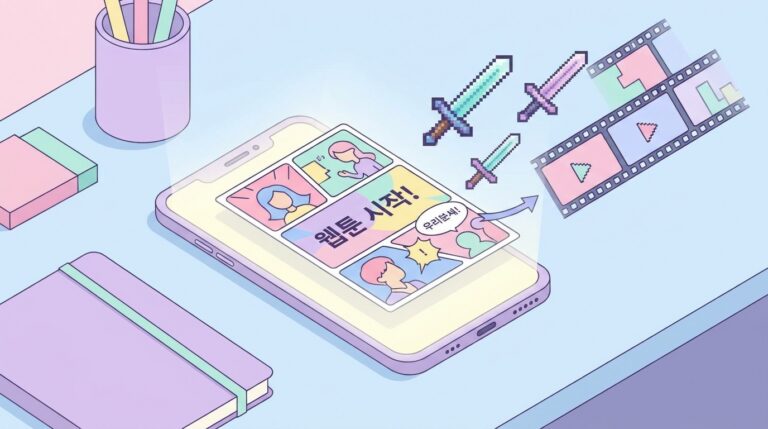
Talk Like a True K-Webtoon Insider: The OSMU Boom
Phase 1: Empathy & Storytelling Opening
안녕하세요! 매일한글 에디터입니다. (Annyeonghaseyo! Maeil Hangul editeorimnida. / Hello! I am the Daily Hangul editor.)
Picture this: You are sitting at a trendy cafe in Hongdae, surrounded by university students buzzing about the latest episode of an anime. You catch the name Solo Leveling (나 혼자만 레벨업). Your ears perk up! You read the original web novel on KakaoPage years ago, devoured the webtoon adaptation, and now you are playing the mobile RPG while watching the anime. You want to jump into the conversation and say, “This web novel expansion is the ultimate trend right now! The synergy between the game and animation is legendary!”
Instead, you hesitate. You find yourself searching for dry textbook words like 미디어 산업 (media industry) or 원작 각색 (original adaptation). Your Korean friends look puzzled, not because your grammar is wrong, but because no Korean pop-culture fan talks like a corporate annual report!
Talking about K-Culture media franchises—known globally as One Source Multi-Use (OSMU)—is one of the most exciting ways to connect with native speakers today. Based on real feedback from intermediate learners who felt stuck between formal vocabulary and real-world geek culture, this guide will unlock natural, vivid expressions so you can discuss adaptations, original plots, and casting rumors with true confidence.
Phase 2: Core 3 Expressions Deep Dive
1. 원작을 뛰어넘다 (Wonjageul ttwieoneomda)
- Pronunciation: [Won-ja-geul ttwieo-neom-da] (Think of won like the Korean currency, twi like “tweet” without the ‘t’, and neom-da sounding like “numb-da”).
- Meaning: Literal: “To jump over the original work.” / Real Nuance: To surpass the original source material in quality, pacing, or emotional impact.
- K-Culture Moment: When a webtoon elevates a web novel through mind-blowing artwork, or when an anime adaptation adds fluid action sequences that the static panels could never fully convey.
- Editor’s Insight: Fans hold original novels (원작, wonjak) in sacred regard. Saying an adaptation “surpassed the original” is the highest praise possible in Korean fandom communities.
- Situation Spectrum: Casual: ✅ | Semi-formal: ✅ | Formal: ⚠️
- 🤔 Think About It: In English, we often say “the book was better than the movie.” Why do you think Korean fans created a specific verb phrase celebrating when the adaptation actually beats the book?
2. 실사화되다 / 영상화되다 (Silsahwadoeda / Yeongsanghwadoeda)
- Pronunciation: [Sil-sa-hwa-dwe-da / Yeong-sang-hwa-dwe-da] (Sil-sa rhymes with “salsa”, hwa sounds like “hwat”, and dwe-da sounds like “dway-da”).
- Meaning: Literal: “To be actualized into real-life images” (Live-action) / “To be turned into moving video/screen media.”
- K-Culture Moment: Used whenever studios announce that hits like Omniscient Reader’s Viewpoint or Moving are getting live-action K-dramas or movies.
- Editor’s Insight: 영상화 covers both animation and live action, whereas 실사화 specifically means real human actors are cast. Be careful: 실사화 often triggers anxiety among fans about whether the actors will match the 2D character designs!
- Situation Spectrum: Casual: ✅ | Semi-formal: ✅ | Formal: ✅
- 🤔 Think About It: How does your native language differentiate between animated adaptations and live-action remakes?
3. 요즘 완전 대세예요 (Yojeum wanjeon daeseyeyo)
- Pronunciation: [Yo-jeum wan-jeon dae-se-ye-yo] (Yo-jeum sounds like “yo-zoom”, wan-jeon like “one-john”, and dae-se like “day-say”).
- Meaning: Literal: “These days it is completely the dominant trend.” / Real Nuance: “It is the undisputed big thing right now!”
- K-Culture Moment: Explaining how webtoon-based merchandise, pop-up stores, and games are dominating the pop-culture landscape in Seoul.
- Editor’s Insight: 대세 (daese) refers to the prevailing cultural tide. Adding 완전 (wanjeon – totally/completely) gives your sentence that energetic, natural intermediate flair.
- Situation Spectrum: Casual: ✅ | Semi-formal: ✅ | Formal: 🚫
- 🤔 Think About It: 대세 comes from Chinese characters meaning “large momentum.” It reflects how quickly Korean trends sweep through society collectively.
Phase 3: Textbook Korean vs. Real Korean
Situation 1: Describing the multimedia explosion of a web novel
- 📖 교과서 한국어 (Textbook): 이 소설은 여러 미디어 매체로 다양하게 전환되어 인기를 얻고 있습니다. (I soseoreun yeoreo midieo maechero dayanghage jeonhwandoeeo ingireul eotgo itseumnida. / This novel has been diversified into various media platforms and gained popularity.)
- 🗣️ 진짜 한국어 (Real-life): 웹소설에서 웹툰, 애니, 게임까지 확장하는 게 요즘 완전 대세예요! (Websoseoreseo webtun, aeni, geimkkaji hwakjanghaneun ge yojeum wanjeon daeseyeyo! / Expanding from web novels to webtoons, anime, and games is totally the trend right now!)
- 💡 왜 다를까? (Why the difference?): Real Koreans abbreviate animation to 애니 (aeni) and use dynamic phrases like 대세예요 rather than stiff academic jargon like 전환되어.
Situation 2: Expressing anxiety about casting in an upcoming drama
- 📖 교과서 한국어 (Textbook): 드라마 제작진이 배역을 원작과 유사하게 선정하기를 바랍니다. (Deurama jejakjini baeyeogeul wonjakgwa yusahage seonjeonghagireul baramnida. / I hope the drama production staff selects actors similar to the original.)
- 🗣️ 진짜 한국어 (Real-life): 제발 이번 실사화는 싱크로율 대박이었으면 좋겠어요. (Jebal ibeon silsahwaneun singkeuroyul daebagieosseumyeon jokgesseoyo. / Please, I hope the casting match for this live-action is insane!)
- 💡 왜 다를까? (Why the difference?): Native fans use 싱크로율 (synchronization rate) and 대박 (jackpot/insane) to talk about how closely an actor visually and emotionally matches the 2D original character.
Phase 4: K-Culture Deep Dive & Non-Verbal Manners
4-1. Nunchi & Fan Manners: The Art of “고증” (Historical/Source Fidelity)
When discussing IP adaptations with Korean friends, always show respect for 원작 팬 (original source fans). Original web novel purists often spend hundreds of chapters supporting an author before mainstream webtoon readers arrive.
* Body Language & Nunchi: When an adaptation is announced, do not immediately celebrate loudly if the room contains hardcore novel readers. Instead, tilt your head slightly, make attentive eye contact, and ask with genuine curiosity: “원작 고증 잘 살렸을까요?” (Wonjak gojeung jal sallyeosseulkkayo? / Do you think they honored the original details properly?). Validating their protective feelings establishes you as an empathetic, culturally aware fan.
4-2. Culture Code Analysis: The KakaoPage & Naver Webtoon OSMU Ecosystem
In Korea, OSMU is no longer an experiment; it is the industry standard. Platforms like KakaoPage pioneered the 기다리면 무료 (“Wait until free”) business model, hooking millions on text novels. When a novel hits astronomical views, studios commission top-tier illustration studios (like Redice Studio behind Solo Leveling) to create webtoons. If that succeeds, global animation and Netmarble game developments follow automatically. Discussing this ecosystem shows you understand the economic engine powering modern Hallyu.
Phase 5: Real-Life Roleplay Scenario
- Setting: A character-themed webtoon cafe near Hongdae Station.
- Characters: Minji (a devoted web novel collector) and Alex (an intermediate Korean learner who discovered the series via anime).
-
Turn 1 (Minji): 민지: 알렉스, 혹시 이번에 ‘나 혼자만 레벨업’ 게임 새로 나온 거 해봤어? (Alex, hoksi ibeone ‘Na Honjaman Rebeleop’ geim saero naon geo haebwasseo? / 🎭 Shows her phone screen with excited eyes / Alex, by any chance, did you try the new Solo Leveling game that just came out?)
- Turn 2 (Alex): 알렉스: 아직 못 해봤어요! 애니메이션만 다 봤는데, 게임도 재미있어요? (Ajik mot haebwasseoyo! Aenimeisyeonman da bwanneunde, geimdo jaemiisseoyo? / 🎭 Leans forward with genuine interest / Not yet! I only finished the anime. Is the game fun too?)
- Turn 3 (Minji): 민지: 연출이 웹툰 액션을 그대로 가져와서 진짜 소름 돋아. (Yeonchuri webtun aeksyeoneul geudaero gajyeowaseo jinjja soreum doda. / 🎭 Gives slight goosebumps gesture on her arm / The cinematography ported the webtoon action directly, it literally gave me chills.)
- Turn 4 (Alex): 알렉스: 웹소설에서 웹툰, 게임까지 확장하는 게 요즘 완전 대세네요! (Websoseoreseo webtun, geimkkaji hwakjanghaneun ge yojeum wanjeon daeseneyo! / 🎭 Nods in agreement with a broad smile / Expanding from web novel to webtoon and game is totally the big trend these days!)
- Turn 5 (Minji): 민지: 맞아. 근데 원작 팬 입장에서는 가끔 설정 바뀔까 봐 조마조마해. (Maja. Geunde wonjak paen ipjangeseoneun gakkeum seoljeong bakkwilkka bwa jomajomahae. / 🎭 Sighs softly, swirling her iced americano / Right. But from an original novel fan’s perspective, I get nervous that they might alter the lore.)
- Turn 6 (Alex): 알렉스: 원작 고증을 잘 살리는 게 제일 중요하죠. (Wonjak gojeungeul jal sallineun ge jeil jungyohajyo. / 🎭 Validating Minji’s concern with a calm nod / Staying faithful to the original source details is the most important thing, right?)
- Turn 7 (Minji): 민지: 역시 알렉스는 뭘 좀 아네! 이번 드라마 실사화도 싱크로율 좋았으면 좋겠어. (Yeoksi Alex-neun mwol jom ane! Ibeon deurama silsahwado singkeuroyul joasseumyeon jokgesseo. / 🎭 Claps hands together in delight / As expected, Alex, you really know your stuff! I hope the live-action drama casting match is great too.)
- Turn 8 (Alex): 알렉스: 원작을 뛰어넘는 명작이 나오길 기대해 봐요! (Wonjageul ttwieoneomneun myeongjagi naogil gidaehae bwayo! / 🎭 Raises coffee cup for a mini cheer / Let’s look forward to a masterpiece that surpasses even the original!)
🔀 Interactive Decision Point
After Minji mentions she is nervous about lore changes in Turn 5, what should Alex say?
* Choice A: “원작 소설은 이제 옛날 거니까 무시해도 되죠!” (The original novel is old news now, so who cares if they ignore it!)
* Choice B: “원작 고증을 잘 살리는 게 제일 중요하죠.” (Staying faithful to the original source details is the most important thing, right?)
* Choice C: “애니메이션만 잘 만들면 웹소설은 안 읽어도 상관없어요.” (As long as the anime looks good, not reading the novel does not matter at all.)
- Feedback:
- Choice A (Bad): Big mistake! Web novel purists built the franchise. Dismissing the source material will make your friend defensive.
- Choice B (Best): Perfect empathetic response! Demonstrates deep cultural understanding of fandom loyalty and earns major cultural points.
- Choice C (Risk): While common among casual viewers, saying this to an original fan shuts down the deeper conversation.
Phase 6: 10-Second Emotion Shadowing Drill
Practice these lines out loud. Match the emotion and follow the / breath breaks!
[🔥 열정적이고 흥분해서 / Passionate & Excited]
“웹소설에서 / 웹툰, 게임까지 확장하는 게 / 요즘 완전 대세예요!”
(Web-so-seol-e-seo / web-tun, ge-im-kka-ji hwak-jang-ha-neun ge / yo-jeum wan-jeon dae-se-ye-yo!)-
[🤔 진지하고 공감하며 / Serious & Empathetic]
“원작 고증을 / 제대로 살려야 / 팬들이 만족하죠.”
(Won-jak go-jeung-eul / je-dae-ro sal-lyeo-ya / paen-deul-i man-jok-ha-jyo.) -
[🤩 기대감에 차서 / Filled with High Hopes]
“이번 실사화는 / 싱크로율이 / 완전 대박이었으면 좋겠어요!”
(I-beon sil-sa-hwa-neun / sing-keu-ro-yul-i / wan-jeon dae-ba-gi-eoss-eu-myeon jok-gess-eo-yo!)
Phase 7: K-Culture Mini Dictionary
- 원작 (Wonjak) | Original Source Material
- Essential noun for referring to the original book, web novel, or comic before it was adapted.
- 싱크로율 (Singkeuroyul) | Synchronization / Fidelity Rate
- Used percentage-wise (e.g., “싱크로율 200%!”) to evaluate how identical an actor looks and behaves compared to the original 2D character.
- 인생작 (Insaengjak) | Life-defining Work / All-time Favorite
- A compound of 인생 (life) and 작품 (work). If someone says Solo Leveling is their 인생작, treat it with ultimate reverence!
- 원작 파괴 (Wonjak Pagoe) | Destruction of the Original Lore
- A dreaded slang term used when an adaptation changes essential character motivations or cuts major fan-favorite scenes.
Phase 8: Traveler’s Survival Kit
Survival Phrases for Webtoon Pop-up Stores & Seoul Anime Plazas
- “이 웹툰 단행본 혹시 재고 있나요?” (I webtun danhaengbon hoksi jaego innayo?)
- Meaning: Do you have the physical book edition of this webtoon in stock?
- Pro Tip: Physical volumes of webtoons are called 단행본 (danhaengbon).
- “굿즈 구매 수량 제한이 있어요?” (Gutjeu gumae suryang jehani isseoyo?)
- Meaning: Is there a purchase limit per person for these merchandise items?
- Pro Tip: Popular pop-ups in The Hyundai Seoul or Hongdae often cap items at 2-3 per person.
- “원작 포토카드 특전 아직 남아있나요?” (Wonjak potokadeu teukjeon ajik namainnayo?)
- Meaning: Are the original artwork bonus photocards still available?
- Pro Tip: 특전 (teukjeon) means special promotional gift bonus.
Editor’s Travel Note
Heading to Seoul for webtoon hunting? Head straight to AK Plaza Hongdae or the animation alleys of Yongsan. Before you go, explore the digital catalog by using the Naver Webtoon official mobile platform to check current serialized rankings, or install KakaoPage to read the original serialized web novels. If you are navigating subway exits with shopping bags of merchandise, verify train intervals using the Naver Map transit navigation app.
Phase 9: A Step Deeper: The Korean Fandom Mindset
In western media adaptations, fans often expect directors to deliver a radically new, subversive auteur vision. In Korea, however, successful IP expansions thrive on collective co-ownership. Korean web novels evolve through daily real-time comments; readers actively debate plot twists while the author is still typing upcoming chapters. When that work transforms into a webtoon or anime, the fandom expects reverence toward the community journey they built together. To say a work respects the 원작 is to say it respects the fans who gave it life.
💬 Your Turn: What is your ultimate 인생작 (life-defining work)? If it were adapted into a Korean drama or anime, which actor would have a 100% 싱크로율? Share your thoughts below in Korean or English!
Phase 10: FAQ & Common Mistakes
Q: What is the difference between 실사화 (silsahwa) and 영상화 (yeongsanghwa)?
A: 영상화 is an umbrella term for adapting text into any video format, including 2D animation, 3D CGI, and movies. 실사화 specifically means live-action with real human actors and sets.
Q: Can I use “원소스 멀티유즈” directly when speaking Korean?
A: While understood in business or university media classes, native Korean fans rarely say the full English phrase in casual chats. Instead, use natural descriptive Korean: “웹소설로 시작해서 웹툰, 애니까지 다 나오는 게 대세예요.”
Q: Is calling an adaptation “원작 파괴” offensive to say to friends?
A: It is not offensive to friends, but it is a harsh critique of the production company or director. Only use it when you both agree that the movie completely ruined the original novel’s plot!
🚨 흔한 실수 (Common Mistakes) Warning Board
- Mistake 1: Calling every drawn story “만화” (manhwa).
- Correction: Digital scrolling format is strictly 웹툰 (webtun). Paper books or retro comics are 만화책 (manhwachaek).
- Mistake 2: Saying “원작을 이겼어요” (It defeated the original).
- Correction: Use the established idiom 원작을 뛰어넘었어요 (It surpassed the original).
- Mistake 3: Using “싱크로율” to describe storyline faithfulness.
- Correction: 싱크로율 is almost exclusively used for visual and aesthetic matching (actor looks vs. character art). For plot faithfulness, say 고증을 잘 살렸다.
Phase 11: Action Mission & Engagement
- 🥉 Bronze Mission (Solo Practice): Stand before the mirror and shadow the phrase: “이번 실사화는 싱크로율이 대박이에요!” 3 times with high energy.
- 🥈 Silver Mission (Social Share): Find a webtoon you love on Instagram or X, and leave a Korean comment: “웹툰도 대박인데 실사화 영상도 기대돼요!”
- 🥇 Gold Mission (Live Usage): Next time you talk with a Korean tutor or language exchange partner, ask them: “‘나 혼자만 레벨업’처럼 웹소설에서 웹툰으로 성공한 작품 또 뭐가 있어요?”
- 🎮 K-Culture Mission: Open a Korean webtoon app. Find the comment section of chapter 1. Look for the words 원작, 소설, and 싱크로율. Count how many top comments mention them!
Phase 12: Interactive Quiz Challenge
Test your new skills! Pick your answers, then reveal the toggle.
- Situational Judgment: Your friend asks why you prefer the webtoon over the original web novel. What is the most natural praise?
- A) “원작을 완전히 파괴해서 좋아요.”
- B) “그림 연출이 좋아서 원작을 뛰어넘은 것 같아요.”
- C) “실사화 배우가 안 나와서 좋아요.”
- Fill-in-the-Blank: Choose the correct pair of words:
“요즘은 웹소설 원작이 웹툰과 애니로 _______되는 게 완전 _______예요!”- A) 파괴 / 반대
- B) 영상화 / 대세
- C) 번역 / 단행본
- True / False Culture Check:
- Statement: Calling an adaptation “원작 고증을 잘 살렸다” means the director made up an entirely new ending that ignored the original novel.
👉 Click to view answers and explanations!
- Answer: B
- Explanation: “그림 연출이 좋아서 원작을 뛰어넘은 것 같아요” (The art direction is so good that I feel it surpassed the original) is natural, polite, and enthusiastic praise. A means “I like it because it destroyed the original,” which makes no sense!
- Answer: B (영상화 / 대세)
- Explanation: The sentence reads: “Nowadays, original web novels being adapted into screen media (영상화) is completely the dominant trend (대세)!”
- Answer: False
- Explanation: “고증을 잘 살렸다” means the adaptation stayed meticulous and faithful to the established details, setting, and rules of the source novel.
🎬 Watch Our Daily Videos! (Daily Hangul Official Instagram)
Review the expressions you learned in this article with our fun daily short videos! Check out native pronunciation and real-life nuances in action.
- Instagram @dailyhangul_en







