

Phase 1: Empathy (Story-Driven Opening)
안녕하세요! 매일한글 에디터입니다. (Hello! This is your Daily Hangul editor.)
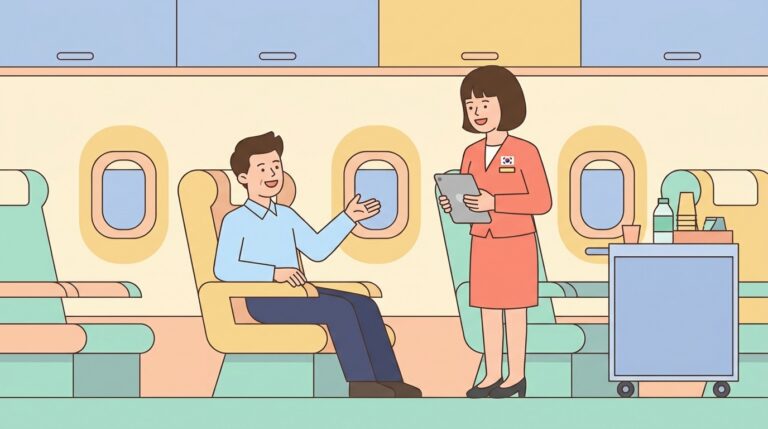
Picture this: you have just buckled up for a long-haul flight to Seoul. The cabin lights dim, the hum of the jet engine settles in, and you find that trending K-drama you’ve been dying to watch on the in-flight entertainment screen. You excitedly plug in the complimentary earphones, hit play, and… nothing. Or worse: a loud buzzing sound in your left ear while the right ear is completely dead. You look around, see the flight attendant walking down the aisle, and panic strikes. How do you explain the problem without sounding rude or causing a scene?
You don’t need complex grammar to solve this. With just one or two natural A2-level sentences, you can handle this situation with absolute confidence and grace. Our real learner feedback shows that mastering this single interaction builds massive confidence for your entire trip to Korea!
Phase 2: 3 Core Expressions Deep-Dive
1. 이어폰이 안 나와요 (Ieoponi an nawayo)
- Pronunciation: [I-eo-pon-i an na-wa-yo] (Think: “Earphone-ee ahn nah-wah-yo”)
- Meaning: Literal: “The earphones do not come out.” | Nuance: “The earphones aren’t working / No sound is coming out.”
- K-Culture Moment: You’ll hear Koreans say “안 나와요 (an nawayo)” constantly—whether water isn’t running from a dispenser in a restaurant or an episode won’t play on a streaming app.
- Editor’s Insight: In Korean, when an audio or visual device fails to output sound or picture, native speakers say it “doesn’t come out” (안 나와요). It feels much softer and more natural than declaring something “broken” (고장났어요).
- Situation Spectrum: Casual: ⚠️ | Semi-formal: ✅ | Formal: ✅
- 🤔 Think About It: In English, we focus on the object being defective (“It is broken”). Why do you think Korean focuses on the result (“sound isn’t coming out”)?
2. 새것으로 바꿔 주실 수 있나요? (Saegeoseuro bakkwo jusil su innayo?)
- Pronunciation: [Sae-geo-seu-ro bak-kwo ju-sil su in-na-yo?] (Think: “Seh-gaw-soo-ro back-kwo joo-sheel soo een-nah-yo?”)
- Meaning: Literal: “Could you change it with a new thing?” | Nuance: “Could you please replace it with a new one?”
- K-Culture Moment: When shopping in Myeongdong or exchanging defective goods in convenience stores, this polite request pattern opens every door.
- Editor’s Insight: The ending “~주실 수 있나요?” is the gold standard for polite passenger-to-crew requests. It honors the flight attendant while making your need crystal clear.
- Situation Spectrum: Casual: 🚫 | Semi-formal: ✅ | Formal: ✅
- 🤔 Think About It: Notice the helper verb 주다 (juda – to give). Korean requests often frame assistance as giving a gift of service.
3. 고장 나서 그러는데… (Gojang naseo geureoneunde…)
- Pronunciation: [Go-jang na-seo geu-reo-neon-de] (Think: “Go-jahng nah-saw geu-raw-nun-deh…”)
- Meaning: Literal: “It broke down, so that’s why…” | Nuance: “It’s not working, so I’m asking…”
- K-Culture Moment: Protagonists in K-dramas use “~서 그러는데” when asking a favor from a stranger without appearing demanding or abrupt.
- Editor’s Insight: This is the ultimate Korean cushion phrase! Placing “그러는데 (geureoneunde)” before your main question softens the entire atmosphere, signaling: “I don’t mean to trouble you, but here is my situation.”
- Situation Spectrum: Casual: ⚠️ | Semi-formal: ✅ | Formal: ✅
- 🤔 Think About It: How does providing an emotional buffer change how the listener receives your request?
Phase 3: Textbook Korean vs. Real-Life Korean
Situation 1: Explaining that your earphones don’t work
- 📖 교과서 한국어 (Textbook): 이 이어폰은 고장입니다. 교환을 원합니다. (I ieoponeun gojang-imnida. Gyohwaneul wonhamnida. / “These earphones are broken. I desire an exchange.”)
- 🗣️ 진짜 한국어 (Real-Life): 저기요, 이어폰 소리가 안 나와요. (Jeogiyo, ieopon soriga an nawayo. / “Excuse me, sound isn’t coming out of the earphones.”)
- 💡 왜 다를까? (Why is it different?): Textbook phrasing sounds like an official complaint filing. Real native Korean focuses on descriptive symptoms rather than demanding terms like “desire an exchange.”
Situation 2: Asking for a replacement
- 📖 교과서 한국어 (Textbook): 새 이어폰을 주십시오. (Sae ieoponeul jusipsio. / “Give me new earphones.”)
- 🗣️ 진짜 한국어 (Real-Life): 혹시 새걸로 하나 바꿔 주실 수 있으세요? (Hoksi saegeollo hana bakkwo jusil su isseuseyo? / “By any chance, could you swap this for a new one?”)
- 💡 왜 다를까? (Why is it different?): The adverb “혹시 (hoksi – by any chance)” adds instant politeness and humility to your request.
Phase 4: K-Culture Deep Dive & Non-Verbal Manners
4-1. 눈치 (Nunchi) & Flight Gestures
In a tightly shared space like an airplane cabin, Korean Nunchi (social awareness) shines. Instead of frantically pressing the overhead call button or calling out loudly across the aisle, make gentle eye contact when the crew walks past during regular cabin rounds. When presenting the faulty earphones, hold them with both hands or rest them softly on your palm. Handing items with two hands shows profound respect in Korean etiquette.
4-2. Cultural Code: The Culture of 배려 (Consideration)
Koreans place high value on 배려 (baeryeo)—thoughtfulness toward service workers. Flight attendants in Korea are widely respected professionals. When you frame your request gently with “고장 나서 그러는데…” (It’s malfunctioning, so that’s why…), the crew will appreciate your consideration and happily assist you right away.
Phase 5: Real-Life Roleplay Scenario
Setting: Onboard a flight to Incheon. Flight attendant Minji is walking down the aisle checking passenger comfort.
- Passenger: 저기요, 승무원님! (Jeogiyo, seungmuwonnim!)
🎭 행동 지문: Raise hand slightly to waist level and offer a warm nod.
Translation: Excuse me, flight attendant! -
Minji (Crew): 네, 손님! 무엇을 도와드릴까요? (Ne, sonnim! Mueoseul dowadeurilkkayo?)
🎭 행동 지문: Steps closer with a welcoming smile.
Translation: Yes, passenger! How may I assist you? -
Passenger: 이어폰이 고장 나서 그러는데, 소리가 안 나와요. (Ieoponi gojang naseo geureoneunde, soriga an nawayo.)
🎭 행동 지문: Gently holds up the headphone cable with both hands.
Translation: It’s just that the earphones are faulty; no sound is coming out. -
Minji (Crew): 아, 그러세요? 불편을 드려 죄송합니다. (A, geureoseyo? Bulpyeoneul deuryeo joesonghamnida.)
🎭 행동 지문: Gently tilts head in sincere apology.
Translation: Oh, really? We apologize for the inconvenience. -
Passenger: 혹시 새것으로 바꿔 주실 수 있나요? (Hoksi saegeoseuro bakkwo jusil su innayo?)
🎭 행동 지문: Asks with a soft, polite tone.
Translation: By any chance, could you replace it with a new one? -
Minji (Crew): 네, 바로 새 제품으로 가져다드리겠습니다. 잠시만 기다려 주세요. (Ne, baro sae jepumeuro gajyeodadeurigesseumnida. Jamsiman gidaryeo juseyo.)
🎭 행동 지문: Bows lightly and heads to the galley.
Translation: Yes, I will bring you a new pair right away. Please wait a brief moment. -
Passenger: 네, 감사합니다! (Ne, gamsahamnida!)
🎭 행동 지문: Bows head slightly in appreciation.
Translation: Yes, thank you! -
Minji (Crew): 여기 새 이어폰 있습니다. 편안한 비행 되세요! (Yeogi sae ieopon itseumnida. Pyeon-anhan bihaeng doeseyo!)
🎭 행동 지문: Hands over the fresh, packaged earphones using both hands.
Translation: Here are your new earphones. Enjoy your flight!
🔀 Interactive Choice Point
What would you say if the flight attendant asks if you also need an arrival card?
* A: 입국신고서도 한 장 주세요. (Ipguksingoseodo han jang juseyo.)
* B: 종이 줘. (Jongi jwo.)
* C: 나 필요 없어요. (Na piryo eopseoyo.)
- Choice A (Best): Polite, natural A2 Korean. Perfect tone for in-flight service!
- Choice B (Bad): Impolite banmal (casual talk) to a service professional. Avoid!
- Choice C (Risk): Uses casual ‘나 (na)’ instead of polite ‘저 (jeo)’. It sounds cold and blunt.
Phase 6: 10-Second Emotion Shadowing Drill
Practice matching the cadence and emotion markers below. The slash (/) marks a natural breath pause.
[🥺 정중하고 곤란한 표정으로 / Hesitant & Polite]- 저기요, / 이어폰이 고장 나서 그러는데… (Jeogiyo, / ieoponi gojang naseo geureoneunde…)
[🎧 차분하게 문제 설명하며 / Calmly Explaining the Issue]- 한쪽에서 / 소리가 안 나와요. (Hanjjok-eseo / soriga an nawayo.)
[🙏 미소를 머금고 공손하게 / Warmly & Courteously Asking]- 새걸로 / 바꿔 주실 수 있나요? (Saegeollo / bakkwo jusil su innayo?)
Phase 7: K-Culture Mini Dictionary
- 이어폰 (Ieopon) | Earphones / Headphones | Used everywhere in daily Korean life, whether discussing wireless earbuds or in-flight headsets.
- 승무원 (Seungmuwon) | Flight Attendant / Cabin Crew | Address them politely by adding “-님 (-nim)” to make 승무원님 (Seungmuwonnim).
- 고장 (Gojang) | Breakdown / Malfunction | Often combined with “-나다 (-nada)” to mean broken: “고장 났어요 (It’s broken).”
- 교환 (Gyohwan) | Exchange / Replacement | Primarily seen on shopping receipts and airline service forms; in spoken Korean, people prefer “바꿔 주세요 (Please change it).”
Phase 8: Traveler’s Survival Kit
Survival TOP 3
- 담요 하나 더 주실 수 있나요? (Damyo hana deo jusil su innayo?)
- Pro Tip: Cabin temperatures get chilly. Use this to ask for an extra blanket.
- 물 한 잔만 주세요. (Mul han janman juseyo.)
- Pro Tip: The essential phrase for requesting a simple cup of water during long flights.
- 입국신고서 한 장 더 주세요. (Ipguksingoseo han jang deo juseyo.)
- Pro Tip: Made a spelling mistake on your arrival form? Use this to request another clean sheet.
Editor’s Travel Note
Before takeoff, make sure to finish your Incheon Airport official mobile guide installation and pre-download offline transit maps. In-flight WiFi can be patchy, so having key phrases saved in your smartphone notes will keep your arrival completely stress-free!
Phase 9: “One Step Deeper” (Cultural Reflection)
In Western languages, directness is often viewed as clarity and efficiency: “This doesn’t work, give me another.” But in Korean culture, abrupt requests can feel confrontational. Phrases like “~서 그러는데” act as linguistic cushions, showing that you value relational harmony over blunt transactions. By explaining your circumstance first, you invite the other person into a cooperative interaction.
💬 Your Turn: Have you ever hesitated to speak up when something didn’t work on a plane or at a hotel abroad? How would having this phrase ready change your travel experience? Share in the comments below!
Phase 10: FAQ & Avoiding Misunderstandings
Q: Can I just say “이어폰 바꿔 주세요 (Ieopon bakkwo juseyo)”?
A: Yes, it is grammatically correct and polite enough. However, adding “~주실 수 있나요? (Could you…?)” makes you sound considerably gentler and more considerate to the cabin crew.
Q: What should I call the flight attendant in Korean?
A: Avoid shouting “저기요 (Jeogiyo)” across rows. When they are near your seat, a soft “승무원님 (Seungmuwonnim)” accompanied by a slight head bow is the most respectful form of address.
Q: What if they bring earphones with two prongs and my screen only has one jack?
A: Simply show the plug and say: “잭이 안 맞아요 (Jaegi an majayo – The jack doesn’t fit).” The crew will provide an airplane audio adapter.
🚨 흔한 실수 (Common Mistakes)
- Mistake 1: Calling out “언니! (Eonni!)” or “아가씨! (Agassi!)” to female crew.
- Correct Action: Always use 승무원님 (Seungmuwonnim).
- Mistake 2: Tugging the crew’s sleeve or uniform to get attention.
- Correct Action: Raise your hand slightly to shoulder level and make eye contact.
- Mistake 3: Using plain dictionary forms like “바꾸다 (bakkuda)”.
- Correct Action: Always conjugate with politeness: 바꿔 주실 수 있나요?
Phase 11: Action Missions
- 🥉 Bronze Level: Stand in front of your mirror and practice saying “이어폰이 안 나와요 (Ieoponi an nawayo)” three times with natural eye contact.
- 🥈 Silver Level: Record your voice shadowing the Phase 6 drill and post your audio clip on language-exchange apps like HelloTalk or your Instagram story.
- 🥇 Gold Level: On your upcoming flight with a Korean carrier (or during flight simulation practice), successfully request an item or swap a defective headset entirely in Korean!
- 🎮 K-Culture Mission: Watch an episode of a Korean drama featuring an airport or flight scene (such as Where Stars Land). Spot at least one polite request ending in “~주세요” or “~주실 수 있나요?” and write it down!
Phase 12: Interactive Quiz Challenge
1. Situational Judgment
You plug your earphones in, but you only hear sound in the left ear. How should you politely explain the problem to the flight attendant?
* A) 이어폰 버려요. (Ieopon beoryeoyo.)
* B) 한쪽 소리가 안 나와요. (Hanjjok soriga an nawayo.)
* C) 새것을 내놓으세요. (Saegeoseul naenoh-euseyo.)
2. Fill-in-the-Blank
Fill in the missing particle and verb ending:
“새것(____) 바꿔 주실 수 (____)?”
3. True / False Cultural Check
- Q: It is considered polite in Korea to click the flight attendant call button repeatedly until someone arrives.
👉 Click to reveal answers & explanations!
- Answer: B
- Explanation: “한쪽 소리가 안 나와요 (Sound isn’t coming out of one side)” precisely and politely describes the issue.
- Answer: 으로 / 있나요
- Sentence: 새것으로 바꿔 주실 수 있나요? (Saegeoseuro bakkwo jusil su innayo?)
- Answer: False
- Explanation: Pressing the call bell repeatedly is considered disruptive to other passengers and stressful for the crew. Wait for a cabin walkthrough or press it just once gently.
- Explanation: Pressing the call bell repeatedly is considered disruptive to other passengers and stressful for the crew. Wait for a cabin walkthrough or press it just once gently.
🎬 Watch Our Daily Videos! (Daily Hangul Official Instagram)
Review the expressions you learned in this article with our fun daily short videos! Check out native pronunciation and real-life nuances in action.
- Instagram @dailyhangul_en






