

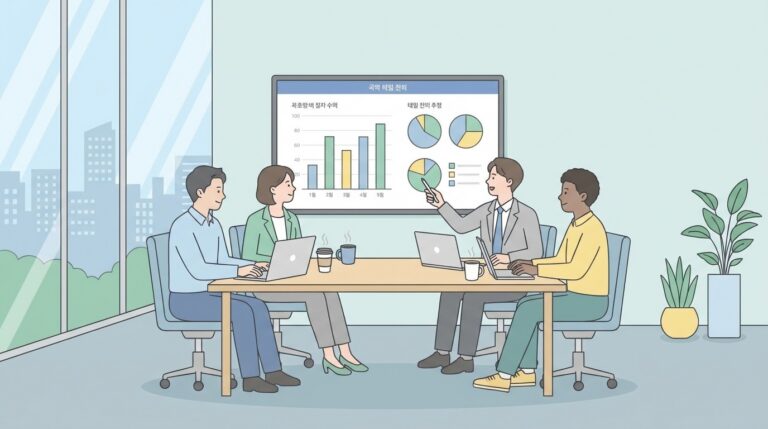
Phase 1: Empathy (Immersive Story Opening)
안녕하세요! 매일한글 에디터입니다. (Hello! I’m your Daily Hangul editor.)
Picture this: You are sitting at your desk in a sleek Gangnam office tower at 7:30 PM. Just as you were about to wrap up, your screen lights up with an alarming financial alert. The USD/KRW exchange rate suddenly spiked by 6%, and an enterprise third-party API your team integrates has abruptly discontinued its legacy tier, shifting to a premium dollar-denominated model overnight. You recalculate the spreadsheets—your project is staring down a 15% budget overrun midway through development.
Your palms start sweating. In K-dramas like Misaeng (미생) or Agency (대행사), this is the exact moment dramatic violin strings swell as an executive slams a binder onto the conference table shouting, “이걸 지금 보고라고 가져온 거야?” (Is this what you’re bringing me as a report?!). You dread walking into Team Lead Min’s office. You wonder: If I deliver this bad news, will I be seen as incompetent? How do I explain that global currency markets and foreign vendor contracts are out of my control without sounding like I’m making lame excuses?
Take a deep breath. In Korean corporate culture, bad news is not an instant career death sentence—badly communicated bad news is. Korean executives highly prize seonjejeok bogo (선제적 보고, proactive reporting) and daean jeshi (대안 제시, presenting prepared alternatives). When you master the linguistic precision and nuanced etiquette of delivering budget overrun reports, this crisis shifts from a managerial failure into a brilliant showcase of your composure, strategic thinking, and leadership. This guide draws directly on coaching real expatriate tech PMs in Seoul who turned budget nightmares into successfully secured emergency funds.
Phase 2: Top 3 Core Expressions Deep Dive
1. 불가피하게 예산 초과가 예상되어 긴급히 보고드립니다 (한글)
- Pronunciation: Bulgahpihage yesan chogwaga yesangdoeeo gingeubhi bogodeurimnida. (Sound analogy: imagine saying “Bool-gah-pee-ha-geh yeh-sahn cho-gwa-gah yeh-sang-dweh-uh geen-geup-hee bo-go-deu-rim-nee-dah”)
- Meaning:
- Literal: Inevitably, budget excess is anticipated, so I urgently report.
- Nuance: “Due to factors genuinely beyond our control, a budget overrun is projected, so I am bringing this to your attention immediately before it escalates.”
- K-Culture Moment: The signature opening line used by crisp, sharp project managers in business dramas right before delivering quarterly risk assessments.
- Editor’s Insight: The word 불가피하게 (bulgahpihage – inevitably/unavoidably) is your shield. It immediately frames the overrun not as poor personal oversight or careless math, but as an exogenous event beyond internal operational control, while 예상되어 (yesangdoeeo – is anticipated) shows you caught it before the ship sank.
- Situation Spectrum: Casual 🚫 | Semi-formal ⚠️ | Formal ✅
- 🤔 Think About It: Notice how the sentence does not say “I spent too much money.” Why do Korean business communications prefer passive/anticipatory constructions over first-person fault statements?
2. 외부 요인으로 인한 변동 폭을 최소화하고자 대안을 마련했습니다 (한글)
- Pronunciation: Oebu yoin-euro inan byeondong pogeul choesohwahagoja daeaneul maryeonhaessseumnida. (Sound analogy: “Weh-boo yo-een-eu-roh ee-nahn byun-dong poh-geul chweh-soh-hwa-hah-go-jah deh-ahn-eul mah-ryun-het-seum-nee-dah”)
- Meaning:
- Literal: In order to minimize the swing range caused by external factors, we prepared alternatives.
- Nuance: “We didn’t just panic over the currency spike; we’ve already engineered actionable fallback solutions to contain the damage.”
- K-Culture Moment: Heard in boardroom presentations when a project lead redirects a tense interrogation into a strategic solution pitch.
- Editor’s Insight: Combining 외부 요인 (external factors) with 대안 (alternatives) shifts the executive’s brain from accusation mode to decision-making mode. It demonstrates that you respect your supervisor’s time by coming with solutions, not just problems.
- Situation Spectrum: Casual 🚫 | Semi-formal ⚠️ | Formal ✅
- 🤔 Think About It: In your home culture, do you bring the problem first and brainstorm together, or do you always bring prepared solutions before speaking up?
3. 프로젝트의 안정적인 완주를 위해 추가 리소스 승인을 요청드립니다 (한글)
- Pronunciation: Peurojekteu-ui anjeongjeogin wanojureul wihae chuga risoseu seung-ineul yocheongdeurimnida. (Sound analogy: “Pro-jek-teu-ee ahn-jung-juh-gin wahn-joo-reul wee-heh choo-gah ree-so-seu seung-een-eul yo-chung-deu-rim-nee-dah”)
- Meaning:
- Literal: For the stable completion of the project, we request approval for additional resources.
- Nuance: “To bring this ship safely across the finish line with our agreed quality, we formally request authorization for additional budget/support.”
- K-Culture Moment: The climax of a negotiation scene where the protagonist asks the executive board for trust and an expanded budget line.
- Editor’s Insight: Notice the word 완주 (wanju), which evokes completing a full marathon. Using wanju rather than simple kkeun-maechim (finishing) appeals to collective perseverance and shared organizational goals.
- Situation Spectrum: Casual 🚫 | Semi-formal ⚠️ | Formal ✅
- 🤔 Think About It: How does phrasing financial requests as “protecting the project’s completion” change the ethical weight compared to saying “we need 15% more cash”?
Phase 3: Textbook Korean vs. Real Korean
Scenario 1: Explaining the 15% overrun risk
- 📖 교과서 한국어 (Textbook Korean):
환율이 올라서 예산이 15% 초과될 것입니다. (Hwan-yuri ollaseo yesani sibo-peosenteu chogwadoel geosimnida.)
“Because the exchange rate rose, the budget will exceed by 15%.” - 🗣️ 진짜 한국어 (Real Korean):
최근 급격한 환율 변동과 API 정책 변경으로 인해, 초기 예산 대비 약 15% 내외의 오버런 위험이 감지되어 선제적으로 공유드립니다. (Choegeun geupgyeokhan hwan-yul byeondong-gwa API jeongchaek byeongyeong-euro inhae, chogi yesan daebi yak sibo-peosenteu nae-oe-ui obeoreon weiheomi gamjidoeeo seonjejeog-euro gong-yudeurimnida.)
“Due to recent sharp exchange rate fluctuations and API policy changes, an overrun risk of around 15% against the initial budget has been detected, which we are proactively sharing.” - 💡 왜 다를까? (Why is it different?): Textbook Korean sounds blunt and careless, almost like you are stating an unavoidable doom that you accept passively. Native business Korean uses risk-detection terminology (gamjidoeeo, seonjejeog-euro gong-yudeurimnida) to emphasize diligence and control.
Scenario 2: Asking for additional contingency budget
- 📖 교과서 한국어 (Textbook Korean):
추가 예산을 더 주십시오. (Chuga yesaneul deo jusipsio.)
“Please give us more additional budget.” - 🗣️ 진짜 한국어 (Real Korean):
일정 지연을 방지하고 퀄리티를 유지하기 위해, 예비비 15% 추가 편성을 검토해 주실 수 있으실지요? (Iljeong jiyeoneul bangjihago kwollitireul yujihagi wihae, yebibi sibo-peosenteu chuga pyeonseong-eul geomtohae jusil su isseusiljiyo?)
“To prevent schedule delays and maintain output quality, could you possibly review allocating an additional 15% contingency reserve?” - 💡 왜 다를까? (Why is it different?): Demanding money directly (deo jusipsio) sounds demanding and immature in a hierarchical corporate structure. Real professionals frame the request around risk mitigation (iljeong jiyeon bangji) and request executive review (geomtohae jusil su isseusiljiyo).
Phase 4: K-Culture Deep Dive & Non-Verbal Manners
4-1. 눈치 (Nunchi) & Business Body Language
When reporting a 15% budget overrun, your physical posture carries as much weight as your spoken Korean:
1. The 45-Degree Stance & Paper Direction: If bringing printed reports or a tablet to Team Lead Min’s desk, place both hands on the edges of the document and angle the text toward them before you speak. Never slide papers across the desk with one hand.
2. Vocal Cadence: Lower your pitch slightly and slow your cadence by about 10%. Rushed, high-pitched speech conveys anxiety and lack of preparedness. Measured, lower tones convey that although an external crisis has hit, your mind is clear and organized.
3. Eye Contact & Nods: Maintain polite eye contact when detailing facts, but modestly cast your eyes down toward the briefing sheet when expressing regret for the budget revision (simnyeo-reul kkichyeodeuryeo joesonghamnida). It indicates profound deference and respect for senior oversight.
4-2. Cultural Code Analysis: “Bogo-ui Mihak” (보고의 미학)
In Korean corporate work culture, there is a famous concept known as 보고의 미학 (The Aesthetics of Reporting). In fast-paced industries like Seoul’s Pangyo Tech Valley, bad news hidden until the end of the quarter is considered gross negligence, even if caused by global exchange rate storms. Conversely, coming forward midway with clear calculations, visual risk assessment tables, and three distinct contingency choices (Plan A, B, C) actually builds immense executive trust. You transform from an overwhelmed subordinate into a dependable frontline risk manager.
Phase 5: Real-World Roleplay Scenario
- Setting: A quiet glass-walled breakout room at a Pangyo gaming company. 4:30 PM.
- Character (NPC): Team Lead Min (민 팀장) – Pragmatic, numbers-oriented, values upfront honesty and hates eleventh-hour surprises.
Turn 1
* Alex (PM):
팀장님, 잠시 10분 정도 긴급 상의드릴 사안이 있어 찾아뵈었습니다.
(Timjangnim, jamsi sip-bun jeongdo gingeup sang-uideuril sa-ani isseo chajaboe-eosseumnida.)
“Team Lead Min, I’ve stopped by because there is an urgent matter I need to consult with you on for about ten minutes.”
🎭 행동 지문: Holding a briefing binder with both hands, speaking in a calm, respectful tone.
Turn 2
* Team Lead Min:
네, 알렉스 씨. 마침 시간 괜찮아요. 무슨 일이죠? 표정이 무거운데.
(Ne, Alex-ssi. Machim sigan gwaenchanayo. Museun irijyo? Pyojeongi mugeo-unde.)
“Sure, Alex. I have time right now. What’s going on? You look quite serious.”
🎭 행동 지문: Puts down pen, leans forward attentively.
Turn 3
* Alex (PM):
현재 프로젝트 중반부 진행 중, 급격한 환율 급등과 핵심 API의 유료화 정책 변경으로 인해 불가피하게 초기 책정 예산 대비 약 15% 초과가 예상됩니다.
(Hyeonjae peurojekteu jungbanbu jinhaeng jung, geupgyeokhan hwan-yul geupdeung-gwa haeksim API-ui yuryohwa jeongchaek byeongyeong-euro inhae bulgahpihage chogi chaekjeong yesan daebi yak sibo-peosenteu chogwaga yesangdoemnida.)
“During our mid-project milestone, due to an abrupt exchange rate surge and monetization policy shifts for our core API, an overrun of roughly 15% against our initial budget is inevitably projected.”
🎭 행동 지문: Politely lays the one-page budget comparison report on the table with both hands.
Turn 4
* Team Lead Min:
15%요? 적지 않은 금액인데… 환율과 API 변경이면 우리가 통제할 수 없던 변수긴 하네요. 그래서 지금 복안이 있습니까?
(Sibo-peosenteuyo? Jeokji aneun geumaeginde… Hwan-yul-gwa API byeong-yeong-imyeon uriga tongjehal su eopdeon byeonsugin hanaeyo. Geuraeseo jigeum bogani isseumnikka?)
“15%? That’s not a small amount… If it’s foreign exchange and API policy, those were indeed variables beyond our control. So, do you have a plan in mind right now?”
🎭 행동 지문: Browses the highlighted numbers with a critical gaze.
Turn 5
* Alex (PM):
네, 외부 충격을 최소화하기 위해 세 가지 대안을 정리했습니다. 1안은 기능 일부 축소, 2안은 대체 오픈소스 API 전환, 3안은 예비비 15% 확보 후 원안 유지입니다.
(Ne, oebu chung-gyeog-eul choesohwahagi wihae se gaji daeaneul jeongrihaessseumnida. Iraneun gineung ilbu chukso, i-aneun daeche opeunsoseu API jeonhwan, sam-aneun yebibi sibo-peosenteu hwakbo hu won-an yuji-imnida.)
“Yes, to minimize external impact, I have organized three alternatives. Option 1 trims non-essential features, Option 2 migrates to open-source APIs, and Option 3 secures a 15% contingency reserve to maintain the original scope.”
🎭 행동 지문: Points systematically to comparison columns on the sheet.
Turn 6
* Team Lead Min:
오픈소스 전환은 품질 리스크가 있고… 일정 준수가 최우선이니 3안이 가장 현실적이겠군요.
(Opeunsoseu jeonhwaneun pumjil riseukeuga itgo… Iljeong junsuga choe-useon-ini sam-ani gajang hyeonsiljeogigessgunyo.)
“Migrating to open source carries quality risks… Since maintaining the release schedule is our top priority, Option 3 seems the most realistic.”
🎭 행동 지문: Nodding slowly, visibly relieved by the organized options.
Turn 7
* Alex (PM):
감사합니다. 프로젝트의 성공적인 완주를 위해 이번 주 임원 회의 안건으로 추가 리소스 승인 안을 상정해 주실 수 있으실지요?
(Gamsahamnida. Peurojekteu-ui seong-gongjeogin wansureul wihae ibeon ju im-won hoe-ui an-geon-euro chuga risoseu seung-in aneul sangjeonghae jusil su isseusiljiyo?)
“Thank you. To bring the project to a successful conclusion, could you submit the request for additional resource approval to this week’s executive committee agenda?”
🎭 행동 지문: Maintaining warm, steady eye contact with hands neatly clasped.
Turn 8
* Team Lead Min:
좋습니다. 알렉스 씨가 정리한 이 비교표 그대로 품의서 올릴 테니, 수치 근거만 보강해 주세요. 수고 많았어요.
(Joeuseumnida. Alex-ssiga jeongrihan i bigyopyo geudaero pum-uiseo ollil teni, suchi geungeoman boganghae juseyo. Sugo manasseoyo.)
“Sounds good. I will submit the formal request form using this exact comparison chart you prepared, so just bolster the numerical evidence. Great work handling this.”
🎭 행동 지문: Smiles with reassurance and taps Alex’s shoulder.
🔀 Interactive Branching Points
How will you respond if Team Lead Min asks: “Can’t we just absorb this without asking executives for more money?”
- Choice A: “안 됩니다. 환율이 올라서 돈이 없는데 어떻게 진행합니까?” (No way. The exchange rate went up and we have no money, so how could we proceed?)
- Outcome (Bad 🚫): Destructive. Sounds confrontational, petulant, and deflects responsibility entirely onto external conditions without showing professional decorum.
- Choice B: “현재 예산 범위 내에서 강행할 경우, QA 테스트 축소로 인한 서비스 장애 리스크가 40% 이상 증가합니다. 안정적인 런칭을 위해 예비비 편성이 가장 안전한 선택지입니다.” (If we force it within current budget limits, service outage risks due to reduced QA testing increase by over 40%. Allocating contingency reserves is the safest path for a stable launch.)
- Outcome (Best ✅): Persuasive and brilliant! Translates money into measurable project risk (outages, quality drops), making executive buy-in easy.
- Choice C: “팀장님께서 알아서 결정해 주시면 따르겠습니다.” (Whatever you decide, Team Lead, I will just follow.)
- Outcome (Risk ⚠️): Weak. Shows obedience, but demonstrates a lack of initiative and technical conviction as a project lead.
Phase 6: 10-Second Emotion Shadowing Drill
Practice these lines out loud. Focus on the breathing pauses marked by / and channel the emotional cues!
[💼 차분하고 신중하게 - Calm and judicious]
외부 환율 급등으로 인해 / 불가피하게 / 예산 초과 위험이 감지되었습니다.
(Oebu hwan-yul geupdeung-euro inhae / bulgahpihage / yesan chogwa weiheomi gamjidoeeosseumnida.)
“Due to the sharp rise in foreign exchange rates / inevitably / an overrun risk has been detected.”-
[📊 객관적이고 단호하게 - Objective and confident]
단순한 비용 증가가 아닌 / 품질 유지와 일정 준수를 위한 / 필수적 투자입니다.
(Dansunhan biyong jeong-gaga anin / pumjil yujiwa iljeong junsureul wihan / pilsujeok tujaimnida.)
“Rather than a simple cost increase / for quality maintenance and schedule adherence / this is an indispensable investment.” -
[🤝 진정성을 담아 설득력 있게 - Sincere and persuasive]
프로젝트의 성공적인 완주를 위해 / 예비비 15% 승인을 / 정중히 검토 부탁드립니다.
(Peurojekteu-ui seong-gongjeogin wansureul wihae / yebibi sibo-peosenteu seung-ineul / jeongjunghi geomto butakdeurimnida.)
“For the successful completion of the project / for approval of a 15% contingency reserve / we politely request your favorable review.”
Phase 7: K-Culture Mini Dictionary
-
오버런 (Obeoreon) | Budget Overrun / Cost Overrun
Widely adopted English loanword used in Korean IT and business environments. While the pure Korean term is 예산 초과 (yesan chogwa), native PMs and directors frequently say “오버런 발생 가능성” (potential for overrun) in weekly scrum and sprint reviews. -
품의서 (Pum-uiseo) | Internal Approval Document / Formal Memorandum
The sacred document of Korean corporate governance! Before any unbudgeted money moves, a written pum-uiseo detailing rationale, numbers, and impact must be circulated across stakeholders for electronic stamps (gyeol-jae). -
선제적 대응 (Seonjejeok Dae-eung) | Proactive Response / Preemptive Action
The highest virtue praised by Korean management. If bad news hits, having a seonjejeok dae-eung mindset proves you were paying attention rather than asleep at the wheel. -
환차손 (Hwanchason) | Foreign Exchange Loss
When sudden exchange rate spikes make dollar-priced vendor tools or APIs cost significantly more Korean Won, accountants and executives file this under hwanchason. Using this precise term instantly elevates your B2 professional authority.
Phase 8: Survival Kit for Travelers & Global Professionals
Business Survival Phrases TOP 3
- 잠시 상의드릴 사안이 있습니다. (Jamsi sang-uideuril sa-ani isseumnida.)
“I have an issue I would like to consult with you on briefly.”
Pro Tip: The golden polite phrase to request an impromptu 1-on-1 with any Korean senior colleague. - 대안을 세 가지 준비했습니다. (Daeaneul se gaji junbihaessseumnida.)
“I have prepared three alternatives.”
Pro Tip: Magic words that immediately lower your manager’s blood pressure during a crisis. - 품의서 양식을 공유해 주실 수 있습니까? (Pum-uiseo yangsig-eul gong-yuhae jusil su isseumnikka?)
“Could you share the approval request template with me?”
Pro Tip: Shows you know how Korean administrative bureaucracy works and are ready to do the paperwork.
Editor’s Travel & Expat Note
If you are operating a startup or managing global corporate branches in Korea, make sure to check out the official 서울글로벌센터(Seoul Global Center) 비즈니스 지원 서비스 page for foreign professionals. They provide free bilingual consultations regarding Korean business law, contract adjustments, and currency hedging assistance.
Phase 9: A Step Deeper (한 발 더 깊이)
In Western individualist workplaces, responsibility is often delineated strictly along job descriptions: “Vendor pricing is not my department.” However, in Korean organizational life, which is deeply rooted in collective responsibility and uri (우리 – we/our group), an obstacle to the project is treated as an obstacle to the entire team’s harmony and survival. When you speak about budget overruns, phrasing it not as “their API price increase caused my problem” but as “an external shock our project team must overcome together” resonates profoundly with Korean leadership. It shows that you see yourself as an integral organ of the collective body.
💬 Your Turn: Have you ever experienced an unexpected budget shock or currency spike in your work or travel? How would your boss react if you came with three prepared alternatives? Tell us your experience in the comments below!
Phase 10: FAQ & Avoiding Misunderstandings
Q: Should I wait until the exact final API invoice arrives before reporting the budget overrun?
A: Absolutely not! In Korean office culture, this is considered a “fatal late report” (neukjang bogo). Even if the numbers are estimates, alert your manager the moment a probable variance exceeding 10% is projected, explicitly labeling it as an “estimated risk forecast” (chujeong yosojung).
Q: Can I use informal business Korean (해요체) when reporting an overrun to my manager?
A: It depends on company culture, but when discussing financial revisions, liabilities, or resource requests, always default to 하십시오체 (hasipsio-che – formal high) ending in -seumnida / -seumnikka. It reflects solemnity, professional seriousness, and institutional respect.
Q: What is the biggest difference between saying “죄송합니다” (I am sorry) and “양해를 구합니다” (I ask for your understanding)?
A: If you say joesonghamnida repeatedly during an external macro event (like a central bank interest rate hike), executives might subconsciously assign fault to you. Instead, acknowledge the inconvenience politely (simnyeoreul kkichyeodeuryeo songguhan maeum-imnida) while using yanghaereul guhamnida (we seek your kind understanding) as you present solid alternatives.
🚨 흔한 실수 (Common Mistakes) Warning Board
- Mistake: Blaming the vendor angrily: “API 회사가 갑자기 돈을 올려서 망했습니다!” (The API company suddenly raised prices, so we’re screwed!)
- Correct Action: Keep it analytical and objective: “API 서비스 정책 개편으로 인한 원가 상승 요인이 발생했습니다.” (Cost increase factors have arisen due to policy reorganizations by the API vendor.)
- Mistake: Asking open-ended questions: “어떻게 할까요?” (What should we do?)
- Correct Action: Never ask a Korean executive to do your homework. Bring options: “1안과 2안 중 일정 준수를 위해 1안을 추천드립니다.” (Between Option 1 and Option 2, I recommend Option 1 to safeguard our timetable.)
- Mistake: Forgetting to mention the specific percentage.
- Correct Action: Koreans respect data-backed clarity. Always explicitly state the variance: “초기 예산 대비 약 15% 수준의 추가 리소스가 소요됩니다.” (An additional resource level of approximately 15% against the initial budget will be required.)
Phase 11: Action Mission & Engagement
- 🥉 Bronze Mission (Solo Practice): Stand in front of your mirror and practice saying Phase 6’s three shadowing lines smoothly without looking at the romanization within 30 seconds!
- 🥈 Silver Mission (Social Challenge): Post in your Korean study group or on social media: write one sentence explaining an unexpected life expense using 불가피하게 (… inevitably)!
- 🥇 Gold Mission (Real Application): Use the phrase “잠시 상의드릴 사안이 있습니다” in your actual Korean workplace or during your next 1-on-1 language exchange session to initiate an important topic.
- 🎮 K-Culture Mission: Watch an episode of the drama Misaeng (미생) or Search: WWW (검색어를 입력하세요 WWW) and listen for how project managers announce an unexpected crisis or submit a formal pum-uiseo!
Phase 12: Interactive Quiz Challenge
1. Situational Judgment
You discover that a currency fluctuation will cause a 15% budget overrun. What is the most culturally adept first action in a Korean company?
* A) Wait until next month’s comprehensive audit to see if the currency rate drops back down.
* B) Email your CEO directly without informing your immediate Team Lead Min.
* C) Prepare a brief comparative memo with alternative solutions and schedule an immediate 10-minute consultation with your Team Lead.
🔍 Check Answer & Explanation
Correct Answer: C
Why? Waiting creates a crisis blindspot, while bypassing your immediate manager (geonneottigi) violates organizational hierarchy. Preparing options and scheduling a concise consultation with your direct lead is the textbook definition of stellar professional etiquette!
2. Fill-in-the-Blank
Complete the professional sentence:
“프로젝트의 성공적인 ( ______ )를 위해 추가 리소스 승인을 요청드립니다.”
(Hint: The word metaphorically means finishing a complete marathon!)
🔍 Check Answer & Explanation
Correct Answer: 완주 (Wanju)
Explanation: 완주 (Wanju) signifies running the entire course across the finish line. Framing resource requests around “successful completion” emphasizes shared dedication to the project’s goal.
3. True or False Cultural Quiz
Statement: In Korean business reports, using English loanwords like 오버런 (Overrun) or 리소스 (Resource) is considered impolite and strictly prohibited in tech firms.
* True
* False
🔍 Check Answer & Explanation
Correct Answer: False
Explanation: Modern Korean IT, startup, and global tech corporate cultures frequently and naturally integrate industry standard loanwords like 오버런 (overrun), 리소스 (resource), and 어젠다 (agenda) into high-level discussions alongside formal grammatical endings.
🎬 Watch Our Daily Videos! (Daily Hangul Official Instagram)
Review the expressions you learned in this article with our fun daily short videos! Check out native pronunciation and real-life nuances in action.
- Instagram @dailyhangul_en







