

Phase 1: Empathy & Story Opening
안녕하세요! 매일한글 에디터입니다. (Hello! I’m your Daily Hangul editor.)
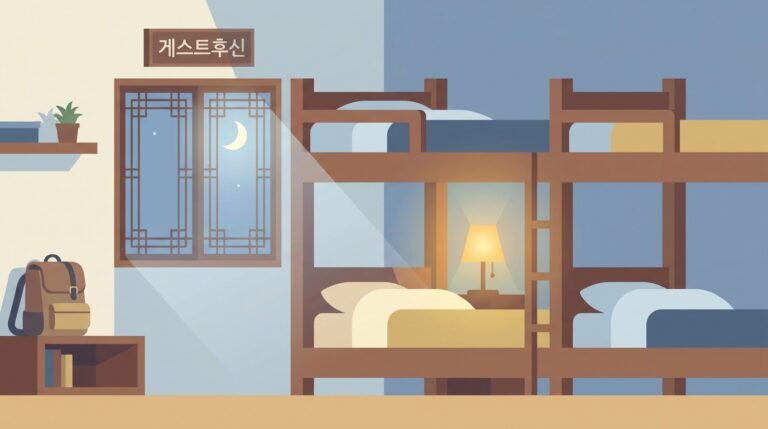
Picture this: After an exhilarating evening enjoying a rooftop pork belly barbecue party at a cozy guesthouse in Jeju or Hongdae, you make your way back up to your 6-bed dormitory room around 10:45 PM. The atmosphere is calm. Some travelers are already tucked into their bunk beds scrolling through photos, while others are quietly brushing their teeth. As you step in, the friendly guesthouse staff smiles warmly and whispers: “다인실 도미토리 방이라 밤 11시 이후에는 소등해야 해요” (Since it’s a shared dormitory room, lights out is at 11 PM).
If you are traveling in Korea for the first time, your mind might race: Does “소등” mean complete darkness? Can I still charge my phone? What if I need to pack my bag for an early morning train to Busan? Staying in Korean guesthouses (게스트하우스, affectionately nicknamed ge-ha) is one of the most budget-friendly, social, and culturally immersive ways to experience Korea. However, multi-person dormitories come with shared etiquette rules that require specific, practical language. This guide is crafted directly from real international traveler experiences and feedback from seasoned Korean guesthouse managers, giving you both the exact Korean phrases and the unspoken cultural manners you need to feel right at home.
Phase 2: Core Expressions Deep Dive
1. 다인실 도미토리 방이라 밤 11시 이후에는 소등해야 해요 (Dainsil domitori bang-ira bam yeolhan-si ihue-neun sodeunghaeya haeyo)
- Pronunciation: [Dah-een-sheel doh-mee-toh-ree bang-ee-rah bahm yuhl-hahn-shee ee-hoo-eh-noon soh-deung-hae-yah hae-yoh] (Think of ‘sodeung’ like ‘so-dung’, meaning extinguishing lights)
- Meaning: Literal: “Because it is a multi-person dormitory room, after 11 PM, (we) must turn off the lights.” | Real Nuance: “Since we share this room with others, official lights-out is at 11:00 PM for everyone’s comfort.”
- K-Culture Moment: You will hear this phrase announced by the guesthouse manager during the evening check-in briefing or written on the bulletin board next to the door in travel reality shows like Hyori’s Homestay or Youth Over Flowers.
- Editor’s Insight: The word 소등 (sodeung) comes from Sino-Korean roots (消 extinguish + 燈 lamp). The grammar pattern -아/어야 해요 (-a/eoya haeyo) conveys gentle yet clear necessity (“have to / must”). When paired with -(이)라 [-(i)ra] (short for “because it is”), it softens an order into a logical communal rule.
- Situation Spectrum: Casual ⚠️ | Semi-formal ✅ | Formal ✅
- 🤔 Think About It: In many Western hostels, lights remain at the discretion of whoever is awake, or each bed has individual blackout curtains. In Korea, why does the host proactively set a unified communal lights-out time?
2. 불 꺼도 될까요? (Bul kkeodo doelkkayo?)
- Pronunciation: [Bool kkuh-doh dwel-kkah-yoh?] (Sound cue: ‘Bul’ sounds like ‘bull’, ‘kkeo’ sounds like the start of ‘curtain’)
- Meaning: Literal: “Is it okay even if I turn off the light?” | Real Nuance: “Do you mind if I turn off the main lights now?”
- K-Culture Moment: Seen frequently in K-dramas featuring university roommates (like Hello, My Twenties! / Age of Youth) when one student is ready to sleep and courteously asks the others before flicking the wall switch.
- Editor’s Insight: This uses the essential permission pattern -어도 될까요? (-eodo doelkkayo? – “May I…?” or “Is it okay to…?”). It is polite, considerate, and completely natural for an A2 learner.
- Situation Spectrum: Casual ⚠️ | Semi-formal ✅ | Formal ✅
- 🤔 Think About It: Notice how the subject “I” (제가, jega) is dropped. In Korean, dropping self-referential pronouns often sounds more considerate and less demanding.
3. 조용히 해 주실 수 있나요? (Joyonghi hae jusil su innayo?)
- Pronunciation: [Joh-yong-hee hae joo-sheel soo een-nah-yoh?]
- Meaning: Literal: “Can you do quietly for me?” | Real Nuance: “Could you please keep it down a little bit?”
- K-Culture Moment: Used in study cafés (독서실), libraries, or late-night dorms when someone is on speakerphone or packing a crinkly plastic bag at 1 AM.
- Editor’s Insight: Combining -어 주다 (-eo juda, to do something as a favor) with -(으)ㄹ 수 있다 (can/ability) makes this an indirect and non-confrontational request. You are asking for a gracious favor rather than scolding them.
- Situation Spectrum: Casual 🚫 | Semi-formal ✅ | Formal ✅
- 🤔 Think About It: How does phrasing a boundary as a polite favor change the emotional temperature of a shared room?
Phase 3: Textbook Korean vs. Real-World Korean
Scenario 1: Asking when lights out is
- 📖 교과서 한국어 (Textbook Korean):
몇 시에 전등을 소등합니까? (Myeot sie jeondeung-eul sodeunghamnikka? – “At what hour do you extinguish the electric lamps?”) - 🗣️ 진짜 한국어 (Real-World Korean):
소등 시간이 몇 시예요? (Sodeung sigani myeot siyeyo? – “What time is lights out?”) - 💡 왜 다를까? (Why the difference?):
Textbooks often teach archaic vocabulary like jeondeung (electric lamp) in stiff formal-ㅂ니까grammar. Real guesthouse travelers use the simple noun compound 소등 시간 (lights-out time) with friendly standard-예요.
Scenario 2: Asking if you can turn on the small bedside lamp
- 📖 교과서 한국어 (Textbook Korean):
침대 머리맡의 작은 보조등을 켜도 허락되겠습니까? (Chimdae meorimateui jageun bojodeung-eul kyeodo heorakdoegesseumnikka?) - 🗣️ 진짜 한국어 (Real-World Korean):
스탠드 잠깐 켜도 돼요? (Seutaendeu jamkkan kyeodo dwaeyo? – “Can I turn on the desk lamp for a moment?”) - 💡 왜 다를까? (Why the difference?):
Koreans use loanwords like 스탠드 (seutaendeu – lamp/stand) and the practical word 잠깐 (jamkkan – just a second / briefly) to signal that they will not disrupt their roommates for long.
Phase 4: K-Culture Deep Dive & Non-Verbal Etiquette
4-1. 눈치 (Nunchi) & Dormitory Gestures
In a Korean dormitory, non-verbal etiquette is just as important as your spoken Korean:
* The Low Smartphone Angle: If you are using your phone in bed after 11 PM, lower the screen brightness completely and angle it toward the wall or downward. Even faint blue light shining onto another person’s bunk can trigger quiet annoyance.
* Plastic Bag Sensitivity: Rustling convenience store plastic bags late at night is considered a major dorm faux pas. Korean travelers often unpack snacks or toiletries into soft fabric pouches before 11 PM.
* Whisper Posture (속삭임): When speaking after lights out, place one hand near the side of your mouth and lean in closely. Pair it with a slight polite head nod (목례, mongnye) if you accidentally make eye contact with someone trying to rest.
4-2. Cultural Code: The Guesthouse Party (게하 파티) Transition
Korea has a unique ge-ha (게하) culture where social interaction and strict sleeping discipline co-exist. Many guesthouses host lively chimaek (chicken and beer) or barbecue gatherings in a dedicated communal lounge until around 10:30 PM. But once 11:00 PM strikes, an invisible switch flips. The social energy shifts outside or into soundproof common rooms, while the dormitory rooms transform into quiet sanctuary zones. Respecting this clean boundary is the hallmark of a savvy traveler in Korea.
Phase 5: Real-Life Roleplay Scenario
Setting: Gwangalli Beach Guesthouse in Busan. 10:55 PM. You (Alex) have just returned to your 4-bed dorm room after watching the drone show over the beach. Minji, the guesthouse staff manager, enters quietly to do the evening check.
- Minji (Staff):
안녕하세요! 오늘 투어는 즐거우셨어요?
(Annyeonghaseyo! Oneul tueoneun jeulgeousyeosseoyo?)
“Hello! Did you enjoy your tour today?”
🎭 [Steps in quietly with a warm, hushed smile, holding a clipboard] -
Alex (You):
네, 정말 좋았어요! 경치가 최고였어요.
(Ne, jeongmal joasseoyo! Gyeongchiga choegoyeosseoyo.)
“Yes, it was really great! The scenery was the best.”
🎭 [Whispers back while putting down your tote bag] -
Minji (Staff):
다행이네요. 저희가 다인실 도미토리 방이라 밤 11시 이후에는 소등해야 해요.
(Dahaeng-ineyoh. Jeohuiga dainsil domitori bang-ira bam yeolhan-si ihue-neun sodeunghaeya haeyo.)
“Glad to hear that. Since this is a shared dormitory room, lights out is at 11 PM.”
🎭 [Points gently to the clock on the wall and the main switch] -
Alex (You):
아, 벌써 시간이 그렇게 됐네요. 알겠습니다.
(A, beolsseoh sigani geureoke dwaenneyo. Algesseumnida.)
“Ah, it’s already that time. Understood!”
🎭 [Nods with an understanding expression] -
Minji (Staff):
혹시 짐 정리하실 거 더 남아 있으신가요?
(Hoksi jim jeongnihasil geo deo nama isseusingayo?)
“By any chance, do you have any more packing left to do?”
🎭 [Tilts head with thoughtful concern] -
Alex (You):
아니요, 거의 다 끝났어요. 침대 스탠드만 써도 되나요?
(Aniyo, geoui da kkeutnasseoyo. Chimdae seutaendeuman sseodo doenayo?)
“No, I’m almost finished. Is it okay if I just use my bed lamp?”
🎭 [Points softly to the small reading light over the bunk] -
Minji (Staff):
네, 개인 스탠드는 편하게 쓰셔도 돼요. 1층 로비는 24시간 열려 있어요!
(Ne, gaein seutaendeuneun pyeonhage sseusyeodo dwaeyo. Il-cheung robineun isipsigan yeollyeo isseoyo!
“Yes, feel free to use your personal lamp. The 1st floor lobby is open 24 hours!”
🎭 [Smiles reassuringly, speaking in a low voice] -
Alex (You):
감사합니다. 편안한 밤 되세요!
(Gamsahamnida. Pyeon-an-han bam doeseyo!
“Thank you. Have a restful night!”
🎭 [Bows slightly as Minji softly closes the door]
🔀 Interactive Decision Point
It’s 11:30 PM. The main light is off. A roommate is watching K-drama reels on their phone without headphones, and the sound is keeping you awake. What do you do?
- Option A: Call out across the room: “야! 조용히 해!” (Ya! Joyonghi hae! – Hey! Be quiet!)
- Option B: Approach gently, whisper with a polite hand gesture: “저기 죄송한데, 이어폰 써 주실 수 있나요?” (Jeogi joesonghande, ieopon sseo jusil su innayo? – Excuse me, sorry, but could you please use earphones?)
- Option C: Stay silent, suffer in annoyance, and write an angry 1-star review on Naver Maps the next morning.
Feedback:
* Choice A (Bad): Using banmal (informal speech like “야”) with a stranger in Korea will immediately escalate tension and ruin the room’s harmony.
* Choice B (Best!): Perfect! Starting with “저기 죄송한데” (polite buffer) and requesting “이어폰 써 주실 수 있나요?” solves the problem with zero awkwardness and maximum Korean manners.
* Choice C (Risk): Suffering in silence ruins your vacation sleep! Korean travelers are very responsive to polite, gentle requests.
Phase 6: 10-Second Emotion Shadowing Drill
Read these out loud! Focus on the rhythm slashes (/) and adopt the indicated emotion:
[🤫 조심스럽고 나지막하게 / In a gentle, polite whisper]
저기요… / 불 꺼도 / 될까요?
(Jeogiyo… / bul kkeodo / doelkkayo?)-
[😊 차분하고 친절하게 / Calmly and obligingly]
네, / 지금 / 끄셔도 돼요.
(Ne, / jigeum / kkeusyeodo dwaeyo.) -
[🥺 정중하고 미안한 마음을 담아서 / Courteous and slightly apologetic]
죄송하지만, / 조금만 / 조용히 해 주실 수 있나요?
(Joesonghajiman, / jogeumman / joyonghi hae jusil su innayo?)
Phase 7: K-Culture Mini Dictionary
- 소등 (Sodeung) [Noun]: Extinguishing lamps / lights out. Commonly seen as 소등 시간 (sodeung sigan – lights out time) on hostel ruleboards.
- 다인실 (Dainsil) [Noun]: Multi-person room. From da (many) + in (people) + sil (room). Often contrasts with 1인실 (irinsil – single room) or 2인실 (ininsil – double room).
- 게하 (Geha) [Noun / Slang]: The universal Korean abbreviation for Guesthouse (게스트하우스). You will hear: “오늘 게하 파티 가?” (Are you going to the guesthouse party today?).
- 배려 (Baeryeo) [Noun]: Thoughtful consideration for others. This is the ultimate cultural pillar behind dormitory rules and public transit manners in Korea.
Phase 8: Traveler’s Survival Kit
Top 3 Guesthouse Survival Expressions
- 와이파이 비밀번호가 뭐예요? (Waipai bimilbeonhoga mwoyeyo? – What is the Wi-Fi password?)
Pro Tip: Look at the back of the dorm room door first; it’s almost always posted there! - 수건 한 장 더 주실 수 있나요? (Sugeon han jang deo jusil su innayo? – Could I have one more towel, please?)
Pro Tip: Most Korean guesthouses provide small hand-sized towels (페이스타월) rather than large bath sheets. - 헤어드라이어 어디에 있어요? (Heeodeuraieo eodie isseoyo? – Where is the hair dryer?)
Pro Tip: Hair dryers are often restricted after 11 PM inside dorm rooms due to noise, but allowed in the powder room or lobby.
Editor’s Travel Note
- App Recommendation: Make sure to complete your Naver Map app download before checking in. Unlike Google Maps, Naver Map lists detailed customer reviews, photos of dorm bunk curtains, soundproofing notes, and exact curfew times for Korean accommodations.
- Late Night Arrival: If your KTX or flight arrives past 10:00 PM, always message the host via the booking app or KakaoTalk in advance using: “밤 10시 이후에 체크인해도 될까요?” (Is it okay to check in after 10 PM?).
Phase 9: “One Step Deeper” (Reflective Thought)
In Korean society, shared living arrangements are deeply governed by 공동체 의식 (gongdongche uisik – community consciousness) and 배려 (baeryeo – mutual consideration). Unlike individualistic cultures where rights are claimed primarily by the individual, Korean public spaces emphasize protecting the collective peace. Turning off the dorm light at 11 PM is not meant as a restrictive curfew; rather, it is a shared mutual promise ensuring that everyone—whether waking up at dawn to catch the sunrise at Seongsan Ilchulbong or recovering from a long hike—gets an undisturbed night of rest.
💬 Your Turn: Have you ever stayed in a shared dormitory or hostel abroad? How do dorm etiquette and lights-out curfews in your home country compare to Korea’s communal approach? Drop your story in the comments below!
Phase 10: FAQ & Common Mistakes
Q: Can I charge my phone or laptop after the lights are turned off?
A: Yes, absolutely! Almost all modern Korean dorm beds feature individual electrical outlets (220V) and a small USB port right by the pillow. You can charge your devices freely as long as you do not make loud clicking noises or turn on blinding screens without dimming them.
Q: What should I do if I arrive after the 11 PM lights-out time?
A: Enter the room on tiptoe, avoid turning on the overhead light, and use your phone’s flashlight pointed at your shoes or the floor. If you haven’t showered yet, check if the dormitory has a separate communal bathroom outside the sleeping quarters, as running water inside the room after 11 PM may wake your roommates.
Q: What if I need to pack my luggage for an early 6 AM flight?
A: Do your heavy packing—especially anything involving zippers and plastic bags—in the common lounge before going to bed. Keep only your clothes for tomorrow and your toothbrush by your bed so you can grab your backpack and exit in under two minutes in the morning.
🚨 Common Mistakes Board
- Mistake 1: Speaking at normal volume because “the other person isn’t asleep yet.”
- Correct Action: After 11 PM, default to a whisper even if others have their eyes open.
- Mistake 2: Using the loud hair dryer in the bedroom after lights out.
- Correct Action: Move down to the common room or lobby powder area to dry your hair.
- Mistake 3: Flipping the main ceiling switch back on at 6 AM.
- Correct Action: Use your personal bed lamp or phone torch until the majority of the room is awake.
Phase 11: Action Missions
- 🥉 Bronze Mission (Solo Shadowing): Say “다인실 도미토리 방이라 밤 11시 이후에는 소등해야 해요” out loud 3 times in front of the mirror, matching the gentle rhythm of a Korean guesthouse manager.
- 🥈 Silver Mission (Social Media Micro-Review): Share a photo of your travel accommodation on Instagram or Threads and caption it in Korean: “오늘 게하 도착! 11시 소등이라 일찍 자요 😴” (Arrived at the guesthouse today! Lights out at 11, so sleeping early).
- 🥇 Gold Mission (Real-Life Mastery): The next time you stay in a guesthouse in Korea, take the initiative to ask your roommate: “불 꺼도 될까요?” (May I turn off the light?) before switching it off.
🎮 K-Culture Mission: Watch an episode of a Korean travel vlog (search “제주도 게하 브이로그” on YouTube). Listen carefully and see if you can spot when travelers discuss “소등 시간” or “게하 파티”!
Phase 12: Interactive Quiz Challenge
Question 1: Situation Judgment
It is 11:05 PM in a 4-person dormitory. You are ready to sleep, but the main ceiling light is still on. What is the most polite phrase to say to your roommates?
* A) 불 꺼! (Bul kkeo!)
* B) 불 꺼도 될까요? (Bul kkeodo doelkkayo?)
* C) 왜 불 안 꺼요? (Wae bul an kkeoyo?)
Click here to reveal the answer!
Answer: B) 불 꺼도 될까요?
Explanation: Option A is rude informal speech (반말). Option C sounds confrontational (“Why aren’t you turning off the light?”). Option B politely asks for mutual consent using -어도 될까요?.
Question 2: Fill in the Blank
Complete the sentence using the Korean word for “lights out”:
“다인실이라 밤 11시에는 ________ 해야 해요.”
* Hint: It contains Sino-Korean characters for extinguish (消) and light (燈).
Click here to reveal the answer!
Answer: 소등 (Sodeung)
Full Sentence: 다인실이라 밤 11시에는 소등해야 해요. (Since it’s a shared room, we must turn off the lights at 11 PM.)
Question 3: Cultural True or False
Statement: In Korean guesthouses, because you paid for your dorm bed, it is culturally acceptable to take phone calls at normal volume inside the room after 11 PM as long as you speak English.
Click here to reveal the answer!
Answer: False!
Explanation: Regardless of language, phone calls should be taken in the hallway or 1st-floor lobby after lights out to maintain 배려 (baeryeo – mutual consideration) for resting guests.
🎬 Watch Our Daily Videos! (Daily Hangul Official Instagram)
Review the expressions you learned in this article with our fun daily short videos! Check out native pronunciation and real-life nuances in action.
- Instagram @dailyhangul_en







