

Phase 1: 공감 (Story Immersion Opening)
안녕하세요! 매일한글 에디터입니다. (Hello! I’m your Daily Hangul editor.)
Picture this: You are standing in the middle of a trendy alleyway in Seongsu-dong, Seoul. You came specifically to visit the viral bakery café you spotted in your favorite K-drama. Your phone battery is down to 4%, and Google Maps is notoriously spinning in circles because Korean streets are packed with intricate back-alleys. You look up, and all you see is a sleek glass bank building with an ATM sign. You know the café is somewhere right around here, but you don’t know how to ask the friendly local holding an iced coffee whether it’s next door, behind, or right in front of the building.
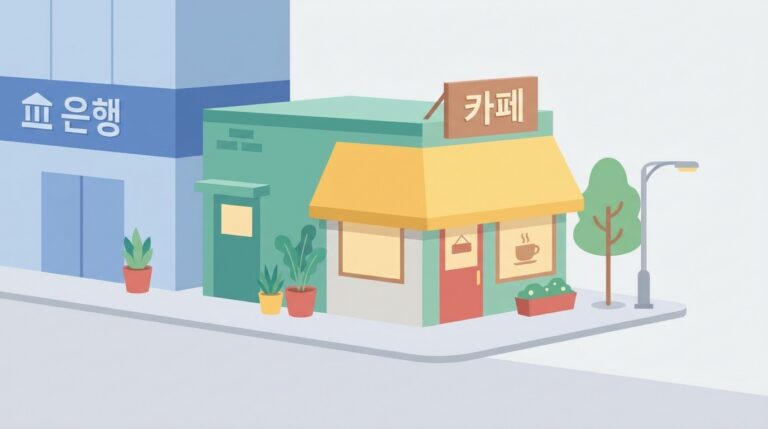
Getting lost in a foreign country can feel intimidating, but finding your way shouldn’t be stressful. In fact, asking for everyday landmarks is the ultimate rite of passage for every beginner traveler. Today, we are breaking down the golden formula for spatial directions—starting with the life-saving sentence: 은행 옆에 카페가 있어요 (Eunhaeng yeop-e kape-ga isseoyo – There is a cafe next to the bank). Based on real feedback from hundreds of our beginner students at Daily Hangul, mastering this one sentence structure will instantly unlock your ability to navigate convenience stores, subway exits, and hidden gems with pure confidence!
Phase 2: 핵심 표현 3선 심층 분석 (Deep Dive: 3 Core Expressions)
1. 옆에 있어요 (Yeop-e isseoyo)
- Pronunciation: [Yeop-e isseoyo] (Sounds like the English word “Yup” with a soft ‘p’, followed by “eh ee-sseo-yo”)
- Meaning: Literal: “It exists on the side/beside.” / Real Nuance: “It is right next to it.”
- K-Culture Moment: Think of romantic comedy K-dramas where the main character shyly confesses: “I will always stay right beside you” (항상 네 옆에 있을게 / Hangsang ne yeop-e isseulge).
- Editor’s Insight: In Korean spatial logic, you place the reference landmark first and then attach the direction word: Landmark + 옆에 (yeop-e) + 있어요 (isseoyo).
- Situation Spectrum:
- Casual: ✅ (옆에 있어 / Yeop-e isseo)
- Semi-formal (Polite): ✅ (옆에 있어요 / Yeop-e isseoyo)
- Formal: ✅ (옆에 있습니다 / Yeop-e itseumnida)
- 🤔 Think About It: In English, you say “next to the bank” (direction before landmark), but in Korean, you say “Bank next-to” (은행 옆에). Why do you think Korean establishes the big landmark before specifying the relative position?
2. 앞에 있어요 (Ap-e isseoyo)
- Pronunciation: [Ap-e isseoyo] (Sounds like “Ah-peh ee-sseo-yo”)
- Meaning: Literal: “It exists in front.” / Real Nuance: “It is right in front / facing forward.”
- K-Culture Moment: In variety shows like Running Man, when players shout into their walkie-talkies: “He is right in front of the convenience store!” (편의점 앞에 있어요! / Pyeon-ui-jeom ap-e isseoyo!).
- Editor’s Insight: ‘앞’ (Ap) means front. Koreans frequently use subway station exits as their primary front-facing landmark: “Exit 3 앞” (in front of Exit 3).
- Situation Spectrum:
- Casual: ✅ (앞에 있어 / Ap-e isseo)
- Semi-formal (Polite): ✅ (앞에 있어요 / Ap-e isseoyo)
- Formal: ✅ (앞에 있습니다 / Ap-e itseumnida)
- 🤔 Think About It: When meeting a friend in your hometown, what is your default reference point? In Korea, public transport exits are the universal meeting spots.
3. 뒤에 있어요 (Dwi-e isseoyo)
- Pronunciation: [Dwi-e isseoyo] (Sounds like “Dwee-eh ee-sseo-yo”)
- Meaning: Literal: “It exists in the back.” / Real Nuance: “It is behind it / tucked behind the building.”
- K-Culture Moment: When meeting up for delicious late-night Korean BBQ, someone texts: “The restaurant is tucked right behind the hotel!” (호텔 뒤에 있어요! / Hotel dwi-e isseoyo!).
- Editor’s Insight: Many hidden aesthetic Korean cafes are nestled in back alleys behind major high-rises. Don’t fear the word ‘뒤’ (back)—it usually leads to the coolest spots!
- Situation Spectrum:
- Casual: ✅ (뒤에 있어 / Dwi-e isseo)
- Semi-formal (Polite): ✅ (뒤에 있어요 / Dwi-e isseoyo)
- Formal: ✅ (뒤에 있습니다 / Dwi-e itseumnida)
- 🤔 Think About It: English uses prepositions (behind, in front), while Korean uses directional nouns tagged with location markers. How does this change your mental visualization of space?
Phase 3: 교과서 한국어 vs 진짜 한국어 (Textbook vs. Real-Life Korean)
Situation 1: Asking someone where a nearby cafe is located
- 📖 교과서 한국어 (Textbook Korean):
카페가 어느 방향에 위치하고 있습니까? (Kape-ga eoneu banghyang-e wichi-hago itseumnikka? – In which direction is the cafe situated?) - 🗣️ 진짜 한국어 (Real-Life Korean):
혹시 근처에 카페 있어요? (Hoksi geuncheo-e kape isseoyo? – Excuse me, is there a cafe nearby?) - 💡 왜 다를까?: Native speakers rarely use formal scholastic words like ‘위치하다’ (to be located) in street inquiries. Adding ‘혹시’ (by any chance) instantly softens your question, making you sound friendly and natural.
Situation 2: Pointing out that a shop is right beside you
- 📖 교과서 한국어 (Textbook Korean):
은행의 측면에 해당 매장이 존재합니다. (Eunhaeng-ui cheukmyeon-e haedang maejang-i jonjaehamnida. – The establishment exists on the lateral side of the bank.) - 🗣️ 진짜 한국어 (Real-Life Korean):
바로 은행 옆이에요! (Baro eunhaeng yeop-ieyo! – It’s right next to the bank!) - 💡 왜 다를까?: Real Koreans love using ‘바로’ (baro – right / directly) to emphasize proximity. It saves time and paints a crystal-clear picture.
Phase 4: K-Culture 딥다이브 & 비언어적 매너 (K-Culture Deep Dive & Non-Verbal Manners)
4-1. 눈치 (Nunchi) & Gestures
When asking for directions in Korea, non-verbal etiquette is just as vital as your spoken grammar:
* The Two-Hand Open Palm Gesture: Never point with a single index finger directly at a person or an elder when indicating direction. Instead, extend your arm with your palm facing slightly upward and all fingers together. This is considered exceptionally respectful.
* The Humble Head Tilt: When approaching a stranger on the sidewalk, bow your head slightly (about 15 degrees) and say “저기요…” (Jeogiyo… / Excuse me…). It signals that you are mindful of their personal space and daily routine.
4-2. Cultural Code Analysis: The Landmark Culture of Korean Cities
In Korean megacities like Seoul and Busan, building numbers are rarely spoken out loud in daily life. Instead, city navigators rely heavily on major anchors: 은행 (Bank), 지하철역 (Subway Station), 편의점 (Convenience Store), and 올리브영 (Olive Young). Because commercial real estate is clustered tightly, locals will almost always describe an address in relation to these four pillars: “It’s right behind the convenience store” (편의점 뒤예요) or “Next to the bank” (은행 옆이에요).
Phase 5: 실전 롤플레이 시나리오 (Real-Life Roleplay Scenario)
Setting: A bustling street outside Seongsu Station Exit 3 on a crisp autumn afternoon. You are searching for ‘Café Haru’.
Character: Minsu (민수), a warm-hearted 20-something local holding a planner.
- Turn 1 (You): 🎭 Politely approaching with a slight bow
저기요, 혹시 카페 하루가 어디에 있어요? (Jeogiyo, hoksi kape haru-ga eodi-e isseoyo? – Excuse me, by any chance, where is Café Haru?) - Turn 2 (Minsu): 🎭 Pausing and smiling warmly
아, 카페 하루요? 저기 큰 은행 보이세요? (A, kape haru-yo? Jeogi keun eunhaeng bo-ise-yo? – Ah, Café Haru? Do you see that big bank over there?) - Turn 3 (You): 🎭 Nodding after squinting down the road
네! 파란색 은행 보여요. (Ne! Paransaek eunhaeng boyeoyo. – Yes! I see the blue bank.) - Turn 4 (Minsu): 🎭 Using an open palm to indicate the right side
그 은행 바로 옆에 카페가 있어요. (Geu eunhaeng baro yeop-e kape-ga isseoyo. – Right next to that bank, there is the cafe.) - Turn 5 (You): 🎭 Confirming with relief
은행 옆이요? 은행 뒤가 아니에요? (Eunhaeng yeop-iyo? Eunhaeng dwi-ga anieyo? – Next to the bank? Not behind the bank?) - Turn 6 (Minsu): 🎭 Shaking hand gently to reassure you
네, 뒤가 아니라 오른쪽 옆 골목 입구예요! (Ne, dwi-ga anira oreunjjok yeop golmok ipgu-yeyo! – Yes, not behind, it is at the entrance of the alley right on the side!) - Turn 7 (You): 🎭 Clasping hands together in gratitude
정말 감사합니다! 좋은 하루 보내세요! (Jeongmal gamsahamnida! Joeun haru bonaeseyo! – Thank you so much! Have a nice day!) - Turn 8 (Minsu): 🎭 Waving pleasantly
네, 조심해서 가세요! 맛있게 드세요! (Ne, josimhaeseo gaseyo! Mas-itge deuseyo! – Sure, take care! Enjoy your treats!)
🔀 Interactive Decision Fork (What would you say next?)
Imagine Minsu finishes talking. What will you do?
* Choice A: Point with your index finger at his face and ask: “진짜?” (Jinjja? – Really?)
* Choice B: Smile, bow lightly, and say: “감사합니다! 은행 옆으로 갈게요!” (Gamsahamnida! Eunhaeng yeop-euro galgeyo! – Thank you! I will go to the side of the bank!)
* Choice C: Just turn around immediately without saying anything and pull out your phone.
Feedback:
* Choice A (Risk): Pointing directly with one finger and using casual talk (‘진짜?’) to a stranger can come across as aggressive and rude.
* Choice B (Best): Perfect! You expressed polite gratitude and demonstrated that you understood the location direction clearly.
* Choice C (Bad): Koreans value closing social interactions courteously; walking away abruptly leaves the helper feeling ignored.
Phase 6: 10초 감정 섀도잉 드릴 (10-Second Emotion Shadowing Drill)
Practice saying these out loud with rhythm pauses (/) and real emotional engagement!
[🤔 Curious & Hesitant]
저기요… / 은행 옆에 / 카페가 있어요?
(Jeogiyo… / eunhaeng yeop-e / kape-ga isseoyo?)-
[💡 Bright Realization]
아! / 은행 뒤가 아니라 / 바로 옆이군요!
(A! / eunhaeng dwi-ga anira / baro yeop-igunyo!) -
[😊 Relieved & Cheerful]
찾았다! / 저기 편의점 앞에 / 친구가 있어요!
(Chajatda! / jeogi pyeon-ui-jeom ap-e / chin-gu-ga isseoyo!)
Phase 7: K-Culture 미니 사전 (Mini Dictionary: 4 Keywords)
- 옆 (Yeop) | Side / Beside | Used for anything adjacent. In social slang, “내 옆자리” (nae yeop-jari) means the empty seat right next to you at a concert or café.
- 앞 (Ap) | Front | Used for physical front space. In K-pop culture, “앞줄” (ap-jul) refers to the coveted front row at a concert.
- 뒤 (Dwi) | Back / Behind | Refers to rear space. Common in everyday Korean drama banter: “내 뒤에 숨어!” (Nae dwi-e sum-eo! – Hide behind me!).
- 위 / 아래 (Wi / Arae) | Above / Below (Up / Down) | Essential for multi-story Korean buildings. “위층” (wi-cheung) is upstairs; “지하/아래층” (jiha/arae-cheung) is downstairs.
Phase 8: 여행자를 위한 생존 키트 (Traveler’s Survival Kit)
Top 3 Survival Direction Phrases
- 어디에 있어요? (Eodi-e isseoyo?)
- Meaning: Where is it?
- Pro Tip: Simply attach any noun to the front: “화장실 어디에 있어요?” (Where is the restroom?).
- 여기서 멀어요? (Yeogi-seo meoreoyo?)
- Meaning: Is it far from here?
- Pro Tip: If they say “가까워요” (Gakkawoyo), you can walk! If they say “멀어요” (Meoreoyo), consider a taxi.
- 오른쪽 / 왼쪽 (Oreunjjok / Oenjjok)
- Meaning: Right side / Left side.
- Pro Tip: Remember ‘오’ (O) for Open/Right, and ‘왼’ (Oen) for Left.
Editor’s Travel Note
- Foreign map apps like Google Maps often struggle with pedestrian walking routes in South Korea due to national security map data laws. Make sure you install the Naver Map navigation app or KakaoMap before departing. These apps display every subway exit number and landmark building down to the centimeter!
Phase 9: “한 발 더 깊이” (One Step Deeper: Thought Reflection)
Notice how the Korean language builds space: the overarching environment or reference point always comes before the specific item. Instead of prioritizing the self or the target object first, Korean anchors the shared, collective landmark: 은행(Bank) + 옆(Side) + 에 있어요(Exists). This reflects a holistic cultural viewpoint where an entity is understood through its relationship with its immediate surroundings rather than as an isolated dot. Understanding this linguistic habit will help you see Korean society through a much more connected, contextual lens.
💬 Your Turn: What landmark do you use most often in your hometown when giving directions? Let us know in the comments below!
Phase 10: FAQ & 오해 방지 (FAQ Schema)
Q: What is the difference between ‘에’ (e) and ‘에서’ (eseo)?
A: Use ‘에’ when indicating where something simply exists, sits, or is located (e.g., 옆에 있어요 – It is next to). Use ‘에서’ when an action or dynamic activity takes place at that location (e.g., 카페에서 커피를 마셔요 – I drink coffee at the cafe).
Q: Does ‘있어요’ (isseoyo) mean both ‘I have’ and ‘There is’?
A: Yes! In Korean, the verb ‘있다’ (itda) expresses both existence (“There is a bank”) and possession (“I have a friend”). The context and particles make the distinction natural.
Q: How do I say ‘inside’ and ‘outside’?
A: You can use ‘안’ (an) for inside and ‘밖’ (bak) for outside! Follow the exact same formula: “은행 안에 있어요” (It is inside the bank) and “은행 밖에 있어요” (It is outside the bank).
🚨 Common Mistakes Board
- ❌ Mistake 1: Saying “옆에 은행 있어요” to mean “It is next to the bank.”
- Correct Action: Place the landmark first: “은행 옆에 있어요.”
- ❌ Mistake 2: Forgetting the location particle ‘에’ (e).
- Correct Action: Always glue ‘에’ to the position noun: “앞에”, “뒤에”, “옆에”.
- ❌ Mistake 3: Confusing ‘위’ (wi – up/above) with ‘뒤’ (dwi – behind).
- Correct Action: Remember that ‘Dwi’ starts with a ‘D’ sound like “Down the back”.
Phase 11: 액션 미션 & 참여 유도 (Action Missions)
- 🥉 Bronze Mission (Solo Practice): Look around your desk right now. Say one sentence in Korean stating what is next to your computer: “컴퓨터 옆에 [Object] 있어요!”
- 🥈 Silver Mission (Social Connection): Leave a comment under this post practicing the phrase with your local city landmark (e.g., “도서관 옆에 카페가 있어요”). We review every single comment!
- 🥇 Gold Mission (Real-Life Mastery): Next time you visit a Korean café or grocery store, ask the staff where an item is using “[Item] 어디에 있어요?” without using English!
- 🎮 K-Culture Mission: Watch one episode of any current K-drama on Netflix. Listen carefully for someone saying “앞에” (in front of) or “옆에” (beside) during a meetup scene!
Phase 12: 인터랙티브 퀴즈 챌린지 (Interactive Quiz Challenge)
1. Situational Judgment: You want to tell your friend that you are waiting in front of the bank. Which sentence should you send?
* A) 은행 뒤에 있어요.
* B) 은행 앞에 있어요.
* C) 은행 옆에 있어요.
2. Fill-in-the-Blank: Complete the sentence: “The convenience store is behind the school.”
* 학교 [____] 편의점이 있어요. (dwi-e / ap-e)
3. True or False: In Korean street etiquette, pointing with one index finger across an elder’s face is considered warm and polite.
* (True / False)
👉 Click to reveal answers & explanations!
- Answer: B (은행 앞에 있어요)
- Explanation: ‘앞’ (Ap) means front. ‘뒤’ is behind, and ‘옆’ is next to/beside.
- Answer: 뒤에 (dwi-e)
- Explanation: ‘뒤’ (dwi) means back/behind, so “학교 뒤에” means “behind the school.”
- Answer: False
- Explanation: Pointing with a single finger is considered impolite. Always use an open palm gesture when guiding or indicating directions in Korea!
- Explanation: Pointing with a single finger is considered impolite. Always use an open palm gesture when guiding or indicating directions in Korea!
🎬 Watch Our Daily Videos! (Daily Hangul Official Instagram)
Review the expressions you learned in this article with our fun daily short videos! Check out native pronunciation and real-life nuances in action.
- Instagram @dailyhangul_en







