

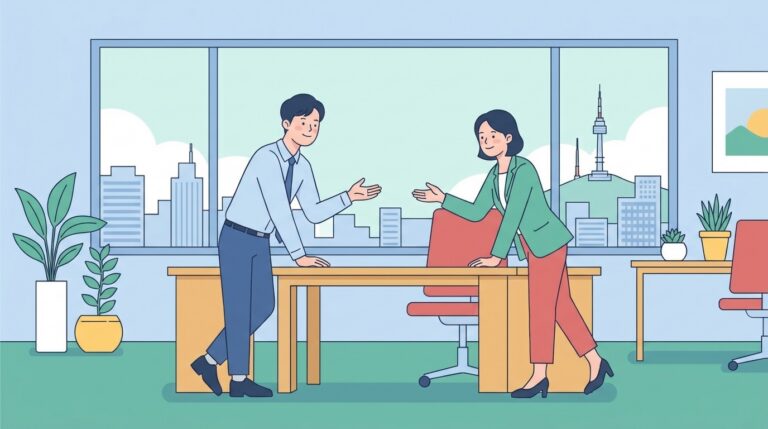
Mediating Workplace Conflicts: Giving Room for Explanations with the SBI Method
Phase 1: Empathy (Story-Driven Opening)
안녕하세요! 매일한글 에디터입니다. (Annyeonghaseyo! Maeil Hangul editeo-imnida. / Hello! It is your Daily Hangul editor.)
Imagine this scenario: You are sitting in a glass-walled conference room in Yeouido, Seoul. A critical project milestone was delayed because your colleague, Min-woo, skipped a review protocol. In many Western workplaces, you might immediately jump into direct inquiry: “Why didn’t you follow the guideline?” But in a Korean corporate setting, asking “Why” so directly can instantly sound like an interrogation, causing your colleague to freeze up, lose face, and shut down.
Conflict mediation in Korean office culture requires high-context emotional intelligence. When applying the SBI (Situation-Behavior-Impact) feedback model in Korean, the most delicate step is closing the loop: inviting the other person to share the background difficulties that forced their decision. If you do not offer this bridge, even a well-intentioned conversation can sour into an uncomfortable hierarchy clash. Over the past decade, I have coached dozens of foreign managers and team members in Korea who turned potential office feuds into deep workplace camaraderie simply by mastering the art of asking for the other person’s sajeong (underlying circumstances). Let’s master the empathetic phrases that will make you a truly respected team player in any Korean company!
Phase 2: Deep Dive into 3 Essential Expressions
1. 어떤 사정이 있으셨는지 편하게 말씀해 주세요. (Eotteon sajeongi isseusyeotneunji pyeonhage malsseumhae juseyo.)
- Pronunciation: [Eot-teon sa-jeong-i it-sseu-syeot-neun-ji pyeon-ha-ge mal-sseum-hae ju-se-yo.] (Think of ‘sajeong’ sounding like ‘sah-jung’ with a soft, flowing melody.)
- Meaning: Literal: “Please comfortably tell me what circumstances you had.” / Real Nuance: “I trust that you had valid reasons for what happened; please feel free to share your side of the story.”
- K-Culture Moment: In the classic office drama Misaeng (Incomplete Life), when an experienced manager wants to protect an overwhelmed junior without excusing the error, he closes the door and asks about their sajeong to uncover organizational bottlenecks.
- Editor’s Insight: The word 사정 (sajeong) means “personal or contextual circumstances that could not be avoided.” Using this word immediately tells the listener: “I do not assume you made a careless mistake; I acknowledge external pressures existed.”
- Situation Spectrum: Casual: ⚠️ | Semi-formal: ✅ | Formal: ✅
- 🤔 Think About It: Does your native culture distinguish between an “excuse” and a “situation” (sajeong)? How does validating the person’s circumstance before the outcome change the atmosphere?
2. 그렇게 진행할 수밖에 없었던 이유가 있었을 것 같아요. (Geureoke jinhaenghal subakke eopseotdeon iyuga isseosseul geot gatayo.)
- Pronunciation: [Geu-reo-ke jin-haeng-hal su-ba-kke eop-sseot-deon i-yu-ga it-sseot-sseul geot ga-ta-yo.] (The phrase ‘su-bakke eopseotdeon’ rolls quickly, like saying ‘shoe-buck-eh-up-seot-deon’.)
- Meaning: Literal: “It seems like there was a reason you had no choice but to proceed that way.” / Real Nuance: “I suspect you were between a rock and a hard place, and I want to understand that pressure.”
- K-Culture Moment: A senior lead in a fast-paced K-drama startup talks to a designer who rushed a release before QA testing, neutralizing guilt by validating their tight deadline.
- Editor’s Insight: The grammatical structure
-을 수밖에 없었다(-eul subakke eopseotda) means “had no other alternative.” Pairing it with-것 같아요(-geot gatayo, “it seems like”) softens your tone to the utmost polite standard, preventing defensive posturing. - Situation Spectrum: Casual: ⚠️ | Semi-formal: ✅ | Formal: ✅
- 🤔 Think About It: Why does Korean workplace grammar favor softening expressions like “it seems like” over definitive assertions when discussing problems?
3. 제가 미처 놓친 배경이나 고충이 있다면 설명해 주시겠어요? (Jega micheo notchin baegyeong-ina gochungi itdamyeon seolmyeonghae jusigesseoyo?)
- Pronunciation: [Je-ga mi-cheo no-chin bae-gyeong-i-na go-chung-i it-da-myeon seol-myeong-hae ju-si-get-sseo-yo?]
- Meaning: Literal: “If there is context or distress that I failed to notice, could you explain it to me?” / Real Nuance: “I might not see the full picture of your workload or obstacles. Please fill in the blind spots so we can solve this together.”
- K-Culture Moment: Seen in executive boardroom mediations where a project director wants to offer a graceful exit to a struggling department head without public humiliation.
- Editor’s Insight: The adverb 미처 (micheo) translates to “up to that point / yet,” taking the blame onto yourself for not having noticed earlier. The noun 고충 (gochung) refers to bitter, unspoken personal struggles.
- Situation Spectrum: Casual: 🚫 | Semi-formal: ✅ | Formal: ✅
- 🤔 Think About It: Notice how the speaker places the fault of “missing the context” on themselves. How does this self-effacing approach preserve workplace harmony?
Phase 3: Textbook Korean vs. Real Korean
Situation 1: Inquiring about a missed process or deadline
- 📖 Textbook Korean: 왜 그렇게 처리했습니까? 이유를 말하세요. (Wae geureoke cheorihaetseumnikka? Iyureul malhaseyo. / Why did you process it like that? State your reason.)
- 🗣️ Real Korean: 혹시 그렇게 결정하시게 된 피치 못할 사정이 있으셨을까요? (Hoksi geureoke gyeoljeonghasige doen pichi mothal sajeongi isseusyeosseulkkayo? / Could there have been unavoidable circumstances that led you to make that decision?)
- 💡 Why the Difference? In Korean office pragmatics, direct question words like 왜 (wae / why) feel like an overt accusation. Using 피치 못할 사정 (pichi mothal sajeong / unavoidable circumstances) protects the colleague’s face while still requiring an explanation.
Situation 2: Opening a one-on-one reconciliation meeting
- 📖 Textbook Korean: 당신의 변명을 들어보겠습니다. (Dangsin-ui byeonmyeong-eul deureobogetseumnida. / I will listen to your excuse.)
- 🗣️ Real Korean: 담당자로서 겪으셨던 고충을 편하게 들려주시면 좋겠습니다. (Damdangjaro-seo gyeokkeusyeotdeon gochung-eul pyeonhage deullyeojusimyeon joketseumnida. / As the lead on this, I would really appreciate hearing the hurdles you faced.)
- 💡 Why the Difference? 변명 (byeonmyeong) implies illegitimate excuses and creates defensiveness. Acknowledging their role as 담당자 (damdangja / person in charge) and inviting them to share their 고충 (gochung / hurdles) creates psychological safety.
Phase 4: K-Culture Deep Dive & Non-Verbal Manners
4-1. Nunchi (눈치) & Gestures
When mediating conflict in a Korean meeting, non-verbal cues carry over half the communicative weight:
* Body Angle: Never sit squarely across from the person with arms crossed. Angle your chair at a 45-degree angle or sit side-by-side at a collaboration table. This non-verbally signals, “We are looking at the problem together, not facing off against each other.”
* Gaze & Head Tilt: Direct, unblinking eye contact can be perceived as an aggressive challenge. Soften your gaze toward their collarbone or nose bridge, nodding slowly (고개 끄덕임) with a slight head tilt while they unpack their challenges.
* Two-Handed Beverage Gesture: If you offer coffee or tea before the talk, hand it over with both hands (두 손으로 건네기). It instantly establishes respect and disarms tension.
4-2. Cultural Code Analysis: The Ethics of Sajeong (사정) in K-Workplaces
In Western business literature, process compliance is paramount. But in Korean corporate culture—heavily influenced by relational responsibility (정, jeong)—an employee’s 사정 (sajeong) holds genuine legitimacy. Demonstrating that you are an open-minded listener who considers human limitations before institutional rules earns you deep organizational loyalty (의리, uiri). Leaders who only look at metrics without listening to sajeong are often labeled 꼰대 (kkondae / rigid authoritarian).
Phase 5: Real-World Roleplay Scenario
Setting: A quiet huddle room on the 12th floor of a Pangyo tech campus. You are leading a cross-functional project. Ji-won (지원 대리), the design lead, missed a key wireframe deadline without notifying the team.
- Turn 1 (You): 지원 대리님, 어제 공유해 주시기로 한 시안이 아직 안 올라와서 조금 걱정했어요. (Jiwon daerinim, eoje gong-yuhae jusigiro han siani ajik an ollawaseo jogeum geokjeonghaesseoyo.)
🎭 Smiling gently, keeping hands relaxed on the table without looking at your watch.
(Translation: Ji-won, I got a little worried because the draft we agreed to share yesterday hadn’t been uploaded yet.) -
Turn 2 (Ji-won): 아… 네, 팀장님. 죄송합니다. 어제까지 끝내려고 했는데 그렇게 못 됐습니다. (A… ne, timjangnim. Joesonghamnida. Eojekkaji kkeunnaeryeogo haenneunde geureoke mot dwaetseumnida.)
🎭 Looking down at her tablet, voice trembling slightly with guilt.
(Translation: Ah… yes, Team Lead. I apologize. I tried to finish it by yesterday, but it didn’t work out.) -
Turn 3 (You): 사과받으려고 부른 자리가 아니에요. 그렇게 진행할 수밖에 없었던 이유가 있었을 것 같아요. (Sagwabad-euryeogo bureun jariga anieyo. Geureoke jinhaenghal subakke eopseotdeon iyuga isseosseul geot gatayo.)
🎭 Leaning forward with an empathetic, open expression.
(Translation: I didn’t call you in to get an apology. I suspect there must have been reasons you had no choice but to handle it this way.) -
Turn 4 (Ji-won): 실은… 클라이언트 쪽에서 지난 화요일 밤에 메인 레이아웃을 전면 수정해 달라고 요청이 와서요… (Sireun… keullaieonteu jjok-eseo jinan hwayoil bame mein reiauseul jeonmyeon sujeonghae dallago yocheongi waseoyo…)
🎭 Letting out a sigh of relief as she shares the hidden roadblock.
(Translation: The truth is… the client requested a total redesign of the main layout late Tuesday night…) -
Turn 5 (You): 아, 그런 돌발 요청이 있었군요. 제가 미처 놓친 배경이나 고충이 더 있다면 편하게 말씀해 주세요. (A, geureon dolbal yocheongi isseotgunyo. Jega micheo notchin baegyeong-ina gochungi deo itdamyeon pyeonhage malsseumhae juseyo.)
🎭 Nodding thoughtfully, writing down the client’s unexpected request on your notepad.
(Translation: Ah, there was such an unexpected request. If there is more background context or hurdles I failed to catch, please feel free to tell me.) -
Turn 6 (Ji-won): 개발팀 일정에 방해될까 봐 혼자 밤새워 처리하려다 보니 공유 타이밍을 놓쳤습니다. 죄송합니다. (Gaebaltim iljeong-e banghaedoelkka bwa honja bamsaewo cheoriharyeoda boni gong-yu taiming-eul notchyeotseumnida. Joesonghamnida.)
🎭 Looking directly into your eyes now, her defensive posture completely gone.
(Translation: I was worried about disrupting the dev team’s schedule, so I tried to fix it alone overnight and missed the chance to update you.) -
Turn 7 (You): 어떤 사정인지 충분히 이해했습니다. 다음부터는 혼자 끙끙 앓지 마시고 바로 알려주세요. 같이 풀어가요. (Eotteon sajeong-inji chungbunhi ihaehaetseumnida. Daeumbuteoneun honja kkeungkkeung alji masigo baro allyeojuseyo. Gachi pureogayo.)
🎭 Offering a warm, reassuring smile while passing a cup of coffee.
(Translation: I fully understand your situation now. Next time, don’t suffer alone in silence—let me know right away. We’ll solve it together.) -
Turn 8 (Ji-won): 네, 배려해 주셔서 정말 감사합니다. 오늘 퇴근 전까지 수정본을 바로 공유하겠습니다! (Ne, baeryeohae jusyeoseo jeongmal gamsahamnida. Oneul toegeun jeonkkaji sujeongboneul baro gong-yuhagetseumnida!)
🎭 Bowing slightly with genuine commitment and relief.
(Translation: Thank you so much for your consideration. I will share the revised draft before leaving the office today!)
🔀 Interactive Branching Decision
If you were in Turn 3, how would you respond?
* Option A: “왜 미리 보고 안 했어요? 납기일 못 지키면 큰일 나는 거 몰라요?” (Wae miri bogo an haesseoyo? Napgiil mot jikimyeon keunil naneun geo mollayo? / Why didn’t you report earlier? Don’t you know missing deadlines is a catastrophe?)
Feedback: Bad. This is a toxic accusation. It destroys psychological safety and guarantees your colleague will hide future roadblocks from you.
* Option B: “알겠습니다. 다음부터는 알아서 잘 처리하세요.” (Algetseumnida. Daeumbuteoneun araseo jal cheorihaseyo. / Understood. Just handle it properly by yourself next time.)
Feedback: Risk. Passive-aggressive and cold. It dismisses their perspective and leaves the structural cause unsolved.
* Option C: “사과받으려고 부른 자리가 아니에요. 그렇게 진행할 수밖에 없었던 사정을 먼저 듣고 싶어요.” (Sagwabad-euryeogo bureun jariga anieyo. Geureoke jinhaenghal subakke eopseotdeon sajeong-eul meonjeo deutgo sipeoyo. / I didn’t call you to get an apology. I want to hear your circumstances first.)
Feedback: Best. Exemplary SBI feedback! Validates the person, separates emotion from the operational issue, and creates space for open dialogue.
Phase 6: 10-Second Emotional Shadowing Drill
Practice reciting these three sentences out loud. Focus on the emotional cues and slash marks (/) indicating rhythmic breath pauses.
[🤝 온화하고 진심 어린 경청의 어조로 / With warm and sincere listening tone]
어떤 사정이 있으셨는지 / 편하게 말씀해 주세요. (Eotteon sajeongi isseusyeotneunji / pyeonhage malsseumhae juseyo.)[🕊️ 상대방의 방어벽을 허물어주는 부드러운 억양 / Soft inflection disarming defensiveness]
그렇게 진행할 수밖에 없었던 이유가 / 분명히 있었을 것 같아요. (Geureoke jinhaenghal subakke eopseotdeon iyuga / bunmyeonghi isseosseul geot gatayo.)[🧘♂️ 내 부족함을 먼저 인정하며 다가가는 태도 / Humbly acknowledging one's own blind spots]
제가 미처 파악하지 못한 / 현장의 고충이 있다면 / 편하게 들려주시겠어요? (Jega micheo pa-akhaji mothan / hyeonjang-ui gochungi itdamyeon / pyeonhage deullyeojusigesseoyo?)
Phase 7: K-Culture Mini Dictionary
- 사정 (Sajeong / Unavoidable Personal Circumstances)
- Nuance: More than a plain reason (이유, iyu); it highlights extenuating personal or situational factors that forced someone’s hand.
- Usage: “피치 못할 사정으로 참석하지 못했습니다.” (I was unable to attend due to unavoidable circumstances.)
- 고충 (Gochung / Hidden Difficulties or Distress)
- Nuance: Deep-seated, bitter struggles experienced on the front lines that managers or clients rarely see.
- Usage: “실무자의 고충을 귀담아들어야 합니다.” (We must carefully listen to the struggles of frontline workers.)
- 피치 못할 (Pichi mothal / Inevitable / Irresistible)
- Nuance: A classic Sino-Korean idiom meaning “having no possible choice or exit path.”
- Usage: “피치 못할 사정이 생겨 미팅을 연기합니다.” (Due to inevitable circumstances, we are postponing the meeting.)
- 역지사지 (Yeok-ji-sa-ji / Walking in Another’s Shoes)
- Nuance: Four-character idiom (사자성어) meaning “swapping places to understand the other person’s context.”
- Usage: “역지사지의 마음으로 동료의 입장을 배려합시다.” (Let us consider our colleagues’ situations with empathetic perspective.)
Phase 8: Traveler and Professional Survival Kit
Top 3 Workplace Survival Expressions
- 잠깐 이야기 나눌 수 있을까요? (Jamkkan iyagi nanul su isseulkkayo? / Could we chat briefly?)
- Pro Tip: Use this to initiate a private 1-on-1 rather than discussing sensitive feedback in the open office plan.
- 말씀해 주셔서 감사합니다. (Malsseumhae jusyeoseo gamsahamnida. / Thank you for sharing that with me.)
- Pro Tip: Say this immediately after the colleague explains their hardship, acknowledging their vulnerability before offering solutions.
- 제가 도울 수 있는 부분이 있을까요? (Jega doul su inneun bubuni isseulkkayo? / Is there anything I can do to support you?)
- Pro Tip: Pivots the conversation from mediation into collaborative problem-solving.
Editor’s Travel & Business Note
When navigating Korean business environments, written communication tools are just as critical as face-to-face etiquette. Many Korean teams use messenger platforms like KakaoWork or Dooray. When booking private meeting rooms or finding quiet cafes in business districts like Teheran-ro or Gwanghwamun for sensitive 1-on-1s, be sure to use the Naver Map navigation application rather than generic global maps, as it provides real-time building floor layouts and quiet cafe spots.
Phase 9: A Step Deeper (Critical Thinking Essay)
In Korean society, saving face—known as chemyeon (체면)—is closely tied to psychological safety. When an error occurs, an individual often experiences intense shame because they feel they have compromised their team’s collective reputation. If a mediator immediately demands mechanical accountability, the employee enters a fight-or-flight state. By actively inviting them to explain their sajeong and gochung, you grant them an honorable bridge to explain the system’s breakdown without destroying their personal worth. This transforms feedback from a punitive ritual into a bond-building moment.
💬 Your Turn: In your work culture, how do colleagues typically react when a manager asks for the “background story” behind a mistake? Do people view it as an opportunity or an interrogation? Share your thoughts in the comments below!
Phase 10: FAQ & Mistake Prevention
Q: Does asking for someone’s sajeong mean I am letting them off the hook for poor work?
A: Not at all! In the SBI framework, you first clearly state the Situation and Behavior, along with its measurable Impact. Asking for sajeong simply ensures you diagnose the root cause accurately. You are separating the colleague’s character from the operational obstacle.
Q: Can I use “왜 그랬어요?” (Wae geuraesseoyo?) if I say it with a sweet, friendly voice?
A: It is still risky in workplace mediation. In Korean, 왜 (wae) triggers a subconscious defensive reflex regardless of vocal tone. Opt for “어떤 어려움이 있으셨어요?” (What difficulties did you encounter?) instead.
Q: How do I respond if their explanation sounds like a genuine, lazy excuse?
A: Validate the feeling first: “그런 고충이 있으셨군요.” (I see you faced that hardship.) Then anchor back to the SBI impact: “하지만 팀 납기에 차질이 생긴 점은 우리가 같이 대안을 찾아야 합니다.” (However, we still need to find a solution for the disruption to our delivery schedule.)
🚨 Common Mistakes Warning Board
| Incorrect Usage | Why It Hurts Communication | Correct Action |
|---|---|---|
| 변명하지 마세요. (Stop making excuses.) | Highly provocative; damages relationship permanently. | 사정을 먼저 들어보고 싶습니다. (I want to hear your circumstances first.) |
| 왜 매뉴얼대로 안 했어요? (Why didn’t you follow the manual?) | Sounds like a police investigation. | 규정대로 진행하기 어려웠던 배경이 있었나요? (Was there context making it difficult to follow regulations?) |
| 알았으니까 됐어요. (Whatever, forget it.) | Passive-aggressive dismissal of their efforts. | 어떤 상황인지 알겠습니다. 다음 대안을 찾아보죠. (I understand the situation. Let’s find the next alternative.) |
Phase 11: Action Mission & Challenge
- Bronze Level (Solo Drill): Stand in front of a mirror. Practice saying “어떤 사정이 있으셨는지 편하게 말씀해 주세요” three times with open palms and a gentle head nod.
- Silver Level (Social Practice): Write down a real workplace conflict you experienced recently. Translate your opening line into Korean using the “미처 놓친 고충” frame and share it with your language partner or in the comments.
- Gold Level (Real-World Execution): Next time a Korean colleague misses a deadline or is late for a meeting, hold back “왜” and open with: “피치 못할 사정이 있으셨죠?” Notice how quickly their defensive expression relaxes!
- 🎮 K-Culture Mission: Watch Episode 3 of the office drama Misaeng. Observe how Chief Oh listens to Section Chief Kim’s slip-ups before deciding on a reprimand. Notice the physical posture and phrasing used.
Phase 12: Interactive Quiz Challenge
Test your intermediate business communication skills! Click the dropdown below to check your answers.
- Situational Judgment: You need to give feedback to an intern who submitted a report full of typos. What is the most constructive opening line?
- (a) 보고서가 엉망인데 왜 이렇게 썼어요? (The report is a mess; why did you write it like this?)
- (b) 많이 바쁘셨나 봐요. 작성하면서 어떤 어려움이나 고충이 있었나요? (You must have been busy. What difficulties or hurdles did you face while drafting?)
- (c) 변명은 듣고 싶지 않으니 다시 써오세요. (I don’t want to hear excuses, rewrite it.)
- Fill in the Blank: Fill in the missing honorific word to invite your colleague’s explanation politely:
“제가 미처 파악하지 못한 ______이/가 있다면 편하게 말씀해 주세요.”
(Hint: A 2-syllable noun meaning hidden struggles or distress.) -
True or False Culture Check: In a Korean business conflict, looking directly and intensely into your colleague’s eyes without blinking conveys honesty and empathy. (True / False)
👉 Click to reveal answers & explanations!
- Answer: (b)
- Explanation: Option (b) provides psychological safety by acknowledging heavy workload and asking for their 고충 (gochung) rather than attacking their competence.
- Answer: 고충 (Gochung)
- Explanation: 고충 refers to internal or situational hurdles that are not immediately visible from the outside.
- Answer: False
- Explanation: Intense, unbroken eye contact during workplace feedback feels aggressive and intimidating in Korean cultural norms. A softened gaze with occasional polite nodding is preferred.
- Explanation: Intense, unbroken eye contact during workplace feedback feels aggressive and intimidating in Korean cultural norms. A softened gaze with occasional polite nodding is preferred.
🎬 Watch Our Daily Videos! (Daily Hangul Official Instagram)
Review the expressions you learned in this article with our fun daily short videos! Check out native pronunciation and real-life nuances in action.
- Instagram @dailyhangul_en







