

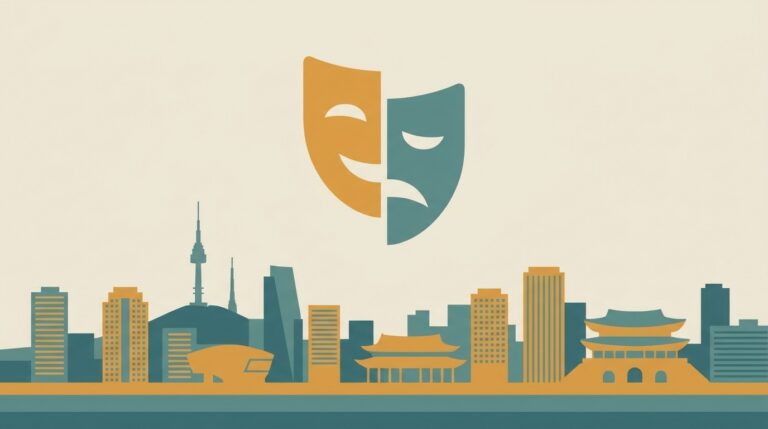
Phase 1: Empathy (Story-Immersive Opening)
안녕하세요! 매일한글 에디터입니다. (Hello! I’m your Daily Hangul editor.)
Picture this: You are watching Bong Joon-ho’s Parasite. The Kim family is huddled in their semi-basement apartment, frantically folding pizza boxes while foul-smelling street fumigation gas pours through their open window. It’s undeniably suffocating, yet Ki-taek keeps talking with a dry, comedic deadpan, and suddenly, you find yourself chuckling. A second later, guilt creeps in: “Wait… is it okay to laugh at this misery?”
If you have ever felt that exact whiplash while watching Korean films or dramas, welcome to the quintessential Korean art of black comedy. In Korean storytelling, laughter and devastating tragedy are not opposites; they are inextricably tangled. For advanced (C1) Korean learners, mastering this tonal duality is the ultimate breakthrough. You stop merely translating lines and start grasping the heavy socio-structural anxieties lurking beneath the punchlines. Based on years of mentoring cinephiles and advanced students, I’ve designed this guide to help you navigate class critique, biting satire, and the bittersweet pathos that defines contemporary Korean media.
Phase 2: Top 3 Core Expressions in Depth
1. 웃프다 (Utpeuda)
- Pronunciation: [Ut-peu-da] (Sounds like “Oot-peo-dah” – imagine uttering a heavy sigh right after laughing)
- Meaning: A blend of 웃기다 (funny) and 슬프다 (sad). It literally means “funny yet tragic,” describing an absurdly bitter reality.
- K-Culture Moment: In D.P. or Squid Game, when characters in desperate financial ruin or brutal military hierarchy exchange ridiculous jokes just to survive the psychological weight of their day.
- Editor’s Insight: Standard dictionaries took years to accept this portmanteau, but in contemporary discourse, it is the bedrock of Korean dark comedy. When an underpaid intern buys an iced Americano with their last 2,000 won to endure overtime, it is truly 웃프다.
- Situation Spectrum: Casual: ✅ | Semi-formal: ✅ | Formal: ⚠️
- 🤔 Think About It: Does your native culture use humor as an emotional shock absorber for systemic hardships, or is tragedy kept strictly separate from comedy?
2. 뼈 때리다 (Ppyeo ttaerida)
- Pronunciation: [Ppyeo ttae-ri-da] (Think of the explosive ‘p’ sound like “pyaw-tteh-ri-da”)
- Meaning: Literally “to hit the bone.” It signifies hitting someone right where it hurts by delivering a brutally accurate, uncomfortable truth.
- K-Culture Moment: When a sharp satire exposes the illusion of meritocracy—like a mentor telling a struggling youth that working three part-time jobs just keeps them trapped in the “dirt spoon” cycle.
- Editor’s Insight: Korean social satire rarely pulls punches. When a witty satirical remark cuts through social pretenses and exposes raw systemic class dynamics, native speakers will wince, laugh, and say: “방금 대사 진짜 뼈 때린다.” (That line really hit the bone.)
- Situation Spectrum: Casual: ✅ | Semi-formal: ✅ | Formal: 🚫
- 🤔 Think About It: How does calling out systemic flaws through sharp humor differ from a direct academic confrontation?
3. 웃자고 한 말에 죽자고 덤비다 (Utjago han mare jukjago deombida)
- Pronunciation: [Oot-ja-go han ma-re juk-ja-go deom-bi-da]
- Meaning: Literally “pouncing with deadly intent at words meant for a laugh.” It refers to taking a dark joke or defensive quip with utter life-or-death seriousness.
- K-Culture Moment: In tense boardroom or dinner scenes across Korean class dramas where an elite character makes an insensitive, joking remark about poverty, and an underprivileged character snaps back with raw ferocity.
- Editor’s Insight: This proverb captures the tightrope of Korean social interaction. When satire touches upon extreme real-world inequality (청년실업, 부동산 격차), humor can instantly collapse into lethal offense.
- Situation Spectrum: Casual: ✅ | Semi-formal: ✅ | Formal: ⚠️
- 🤔 Think About It: Where is the boundary in your society between harmless self-deprecation and crossing a line into deep personal trauma?
Phase 3: Textbook Korean vs. Real Korean
Situation 1: Describing a drama that uses humor to critique deep social inequality
- 📖 교과서 한국어 (Textbook):
“이 드라마는 계급 갈등의 비극을 유머러스한 방식으로 비판합니다.”
(I deuramaneun gyegeup galdeung-ui bigeug-eul yumeoreoseuhan bangsik-euro bipanhapnida. / This drama critiques the tragedy of class conflict in a humorous manner.) - 🗣️ 진짜 한국어 (Real-world C1):
“현실은 시궁창인데 헛웃음 터지게 만드는 블랙 코미디의 진수예요.”
(Hyeonsireun sigungchang-inde heos-useum teojige mandeuneun beullaek komidi-ui jinsuyeyo. / The reality is utter gutter, yet it forces out an involuntary dry laugh—it’s the epitome of black comedy.) - 💡 왜 다를까? (Why the shift?):
Advanced native speakers rarely use textbook academic terms like “유머러스하다” in casual film discussions. Instead, visceral contrasts like “현실은 시궁창” (reality is a cesspool) juxtaposed with “헛웃음” (hollow/wry chuckle) capture the actual emotional punch of the work.
Situation 2: Reacting to a brutally sarcastic line about economic mobility
- 📖 교과서 한국어 (Textbook):
“그 대사는 청년 세대의 힘든 처지를 날카롭게 풍자하고 있습니다.”
(Geu daesaneun cheongnyeon sedae-ui himdeun cheojireul nalkaropge pungjahago itseumnida. / That dialogue sharply satirizes the difficult situation of the youth generation.) - 🗣️ 진짜 한국어 (Real-world C1):
“와, 그 대사 너무 뼈 때려서 순살 될 뻔했어요.”
(Wa, geu daesa neomu ppyeo ttaeryeoseo sunsal doel ppeonhaesseoyo. / Wow, that line hit the bone so hard I almost turned boneless.) - 💡 왜 다를까? (Why the shift?):
Modern Korean youth slang uses vivid hyperbole. “순살” (boneless chicken) is a witty, sarcastic exaggeration of “뼈 맞았다” (being struck in the bone by the truth).
Phase 4: K-Culture Deep Dive & Non-Verbal Manners
4-1. 눈치 (Nunchi) & Gestures: The Art of the Bitter Chuckle
When watching or debating Korean dark satire with native Koreans, pay attention to the micro-expressions:
* The 헛웃음 (Heot-useum – Hollow Snort): When an absurdity is too tragic to process, Koreans don’t shed tears immediately. Instead, they emit a slight, breathy puff through the nose while tilting the head downward. It signals: “This is absurd, yet entirely real.”
* The Subdued Sigh-Smile: Nodding slowly with downcast eyes while biting the bottom lip slightly indicates you recognize the social critique without being flippant about someone’s genuine suffering.
* Social Nunchi Rule: Never laugh boisterously at jokes about real-world economic disparity (e.g., 반지하 living or delivery worker exploitation) around someone whose real life reflects that reality. Black comedy is a shield for the struggling, not a weapon for spectators.
4-2. Cultural Code Analysis: From Talchum to Bong Joon-ho
Why is Korean media so obsessed with tragicomic realism? The root lies in the historical concept of 해학 (Hae-hak – traditional humor) and 풍자 (Pung-ja – satire).
During the Joseon Dynasty, commoners wore masks in Talchum (mask dances) to openly ridicule corrupt yangban (noblemen). They didn’t just lament their suffering (Han, 한); they converted that sorrow into dynamic, irreverent laughter (Heung, 흥). Today, this legacy lives on in modern masterworks like Parasite, D.P., and The Glory. Rather than pure escapism, Korean storytelling uses humor as an act of defiance against rigid structural walls.
Phase 5: Real-World Roleplay Scenario
Setting: Outside the Busan Cinema Center during BIFF. You and your Korean film club friend, Min-woo (민우), are having spicy tteokbokki at a street stall after watching a gritty indie dark comedy.
- Turn 1 (Min-woo): “오늘 본 영화 진짜 숨 막히지 않았냐? 주인공이 빚더미에 앉았는데 치킨 튀기며 농담하는 장면에서 다들 터지더라.”
(Oneul bon yeonghwa jinjja sum makhiji anatnya? Juingong-i bitdeomie anjanneunde chikin twigimyeo nongdamhaneun jangmyeon-eseo dadeul teojideora.)
🎭 헛웃음을 지으며 나무젓가락을 뜯는다
(Wasn’t today’s movie suffocating? When the protagonist was drowning in debt yet joking while frying chicken, everyone cracked up.) -
Turn 2 (You): “맞아요. 마냥 웃기만 하기엔 가슴 한구석이 찌릿하게 아프더라고요. 완전 웃펐어요.”
(Majayo. Manyang utgiman hagien gaseum hanguseog-i jjirit-hage apeudeoragoyo. Wanjeon utpeosseoyo.)
🎭 고개를 살짝 끄덕이며 공감하는 눈빛을 보낸다
(Right. It was too heartbreaking to just laugh purely. It was completely bittersweet and tragicomic.) -
Turn 3 (Min-woo): “맞아, 그게 바로 우리 사회의 씁쓸한 단면이지. 근데 주인공 아버지가 한 말 기억나?”
(Maja, geuge baro uri sahoe-ui sseupsseulhan danmyeon-iji. Geunde juingong abeojiga han mal gieongna?)
🎭 어묵 국물을 한 모금 들이켜며
(Exactly, that’s the bitter cross-section of our society. But do you remember what the protagonist’s father said?) -
Turn 4 (You): “‘가장 완벽한 계획은 무계획이다’라는 대사 말씀하시는 거죠?”
(‘Gajang wanbyeokhan gyehoeg-eun mugyehoek-ida’raneun daesa malsseumhasineun geojyo?)
🎭 진지한 표정으로 민우의 눈을 마주친다
(You mean the line, ‘The best plan is no plan at all’, right?) -
Turn 5 (Min-woo): “어, 그거 듣는 순간 진짜 뼈를 맞다 못해 순살이 되는 줄 알았어.”
(Eo, geugeo deunneun sungan jinjja ppyeoreul matda mot-hae sunsari doeneun jul arasseo.)
🎭 과장된 제스처로 가슴을 부여잡으며
(Yeah, the moment I heard that, it hit me so hard in the bone I thought I’d turn completely boneless.) -
Turn 6 (You): “비극적인 현실을 정면으로 마주하는 대신, 유머로 방어벽을 치는 느낌이었어요.”
(Bigeukjeogin hyeonsireul jeongmyeon-euro majuhaneun daesin, yumeoro bang-eobyeog-eul chineun neukkim-ieosseoyo.)
🎭 나직하고 차분한 어조로 분석한다
(It felt like putting up a defense shield with humor instead of facing the tragic reality head-on.) -
Turn 7 (Min-woo): “크, 너 한국 영화 해석하는 눈이 거의 평론가 수준인데? 한잔 더 할래?”
(Keu, neo hanguk yeonghwa haeseokhaneun nuni geoui pyeongnonga sujun-inde? Hanjan deo hallae?)
🎭 소주병을 들어 올리며 활짝 웃는다
(Whoa, your eye for analyzing Korean film is practically film critic level! Want another glass?) -
Turn 8 (You): “좋죠! 이런 명작을 보고 그냥 집에 가면 잠 못 자요.”
(Jotjyo! Ireon myeongjag-eul bogo geunyang jibe gamyeon jam mot jayo.)
🎭 잔을 부딪치며 미소 짓는다
(Love to! After watching a masterpiece like this, there’s no way I could just go home and sleep.)
🔀 Interactive Choice Point
How would you summarize the movie’s social message to impress Min-woo?
* Option A: “그냥 웃긴 코미디 영화였는데 왜 그렇게 심각하게 생각해요?” (It was just a funny comedy movie, why think so seriously?)
* Feedback (Bad): Dismisses the multi-layered social structural criticism of the genre and creates awkward silence.
* Option B: “한국의 경제적 양극화를 통렬하게 비판하면서도 페이소스를 잃지 않은 수작이었어요.” (It was an exceptional work that preserved deep pathos while scathingly critiquing Korea’s economic polarization.)
* Feedback (Best): Flawless C1 articulation! Blends advanced critical vocabulary with genuine cultural appreciation.
* Option C: “주인공들이 게을러서 가난한 건데 영화가 너무 감성팔이 하네요.” (The characters are poor because they are lazy; the movie is just emotionally manipulative.)
* Feedback (Risk): Ignores systemic critique and risks appearing culturally tone-deaf to structural inequalities in Korea.
Phase 6: 10-Second Emotion Shadowing Drill
Practice these lines with pause marks (/) and emotional intent:
[씁쓸하고 자조적인 어조로 (Bittersweet and self-deprecating)]
“웃긴데 / 눈물이 나는 건 / 대체 왜일까요?”
(Utginde / nunmuri naneun geon / daeche waeilkkayo? / It’s funny, / but why / are tears welling up?)-
[헛웃음을 터뜨리며 (With a hollow, ironic scoff)]
“현실이 너무 막장이니까 / 이젠 화도 안 나고 / 그냥 헛웃음만 나와요.”
(Hyeonsiri neomu makjang-inikka / ijen hwado an nago / geunyang heos-useumman nawayo. / Because reality is such an utter trainwreck / I’m not even angry anymore / only hollow laughter escapes.) -
[감탄하며 깊은 공감을 담아 (Impressed and deeply resonating)]
“농담 속에 뼈가 숨어 있어서 / 듣는 순간 / 가슴이 철렁했어요.”
(Nongdam sog-e ppyeoga sum-eo isseoseo / deunneun sungan / gaseumi cheolleonghaesseoyo. / There was such a sharp truth hidden in the joke / that the moment I heard it / my heart sank.)
Phase 7: K-Culture Mini Dictionary
- 해학 (Hae-hak) | Pathos-laden Humor / Satirical Warmth
- Nuance: Unlike destructive sarcasm, 해학 finds warm, forgiving humor within extreme suffering and human frailty.
- 자조 (Ja-jo) | Self-Mockery / Self-Deprecation
- Nuance: Used when marginalized or exhausted individuals crack self-critical jokes as a psychological survival mechanism.
- 흙수저 (Heuk-su-jeo) | “Dirt Spoon” (Lowest Socio-economic Bracket)
- Nuance: Derived from the spoon-class theory; widely featured in K-dramas to represent characters with zero familial wealth.
- 웃픔 (Ut-peum) | Tragicomic Reality (Noun form of 웃프다)
- Nuance: The noun capturing the state of an emotional paradox—a tragedy so acute it manifests as dark comedy.
Phase 8: Traveler’s Survival Kit
Survival Expressions TOP 3
- “이 영화 자막 지원되나요?”
- (I yeonghwa jamak jiwondoenayo?)
- Pro Tip: Ask this at indie cinema counters if you want to know if English subtitles are included.
- “GV(관객과의 대화) 티켓 아직 남아있나요?”
- (GV tiket ajik nam-a-itnayo?)
- Pro Tip: “GV” (Guest Visit) refers to Q&A sessions with the director and actors, where real structural themes are deeply discussed.
- “스포일러 없이 결말 뉘앙스만 알려주실 수 있나요?”
- (Seupoilleo eopsi gyeolmal nyu-angseuman allyeojusil su itnayo?)
- Pro Tip: Perfect when asking a clerk whether a movie ends on a dark or uplifting note without spoiling the plot.
Editor’s Travel Note
For true cinema lovers exploring Seoul, skip the megabox chains for an afternoon and head to the Cinematheque KOFA in Mapo-gu. You can easily plan your visit by checking screenings directly on the Korean Film Archive official website. Afterward, take Subway Line 6 to Sangsu-dong to absorb the neighborhood’s artistic indie vibe over a hot bowl of soup.
Phase 9: A Step Deeper (Reflective Insight)
In Western literary traditions, tragedy and comedy are frequently partitioned into distinct genres: Hamlet suffers, while Falstaff banters. In Korean cultural history, however, the concept of 한 (Han)—deep-seated historical grief and unresolved injustice—has perpetually transformed into 흥 (Heung)—infectious communal vitality and laughter. This dynamic is not about denying grief; it is about surviving it. When Korean characters laugh in semi-basements or battlefield trenches, it is not cynicism. It is the ultimate resilience of the human spirit refusing to be crushed by structural tyranny.
💬 Your Turn: What is one scene in a Korean film or drama where you couldn’t decide whether to laugh or cry? Drop your thoughts below!
Phase 10: FAQ & Avoiding Misunderstandings
Q: Can I use the expression “웃프다” in formal academic essays or business presentations?
A: While widely recognized, “웃프다” remains an informal colloquial blend. For formal criticism, thesis papers, or professional presentations, replace it with academic phrases such as “비극과 희극의 교차” (intersection of tragedy and comedy) or “해학적 비장미” (humorous tragic pathos).
Q: Why do Koreans sometimes laugh during scenes of intense social injustice in cinema?
A: It is rarely malicious amusement. Rather, it is a shared recognition of irony. Koreans call this “어처구니가 없어서 나오는 웃음” (laughing out of pure disbelief). It functions as a collective release valve for everyday systemic pressures.
Q: Is calling someone a “흙수저” (dirt spoon) considered offensive?
A: Yes, if directed at another person! Calling someone else a “흙수저” sounds demeaning and derogatory. However, native speakers frequently refer to themselves as “흙수저” in self-deprecating humor (자조) to bond over shared economic struggles.
🚨 Common Mistakes Warning Board
- Mistake 1: Laughing aloud when an elderly or working-class character speaks in dialect in a realistic tragedy.
- Correct Action: Recognize that dialect (사투리) in serious K-content often signifies authentic working-class groundedness, not deliberate buffoonery.
- Mistake 2: Using “뼈 때리다” towards a senior colleague or boss (상사).
- Correct Action: Keep this idiom among peers or juniors. Telling a superior “부장님 뼈 때리시네요” will sound wildly disrespectful.
- Mistake 3: Confusing “풍자” (social/political satire) with “조롱” (mockery/derision).
- Correct Action: Use 풍자 when the target is structural power, and avoid 조롱, which targets personal vulnerability.
Phase 11: Action Missions
- 🥉 Bronze Mission (Solo Shadowing): Read aloud the Phase 6 drills 5 times, focusing on mimicking the dry, hollow scoff of the 헛웃음.
- 🥈 Silver Mission (Social Media Micro-Review): Post a short review of your favorite Korean drama on your Instagram or X using the sentence: “이 드라마는 완전 웃프고 뼈 때린다!”
- 🥇 Gold Mission (Real-world Discussion): At your next language exchange or Korean film meetup, use the phrase “비극과 유머가 교차해서 여운이 깊었어요” to explain your takeaway from a movie.
- 🎮 K-Culture Mission: Rewatch the famous birthday party sequence in Parasite or the game scenes in Squid Game. Identify three distinct moments where dark humor abruptly cuts into genuine horror.
Phase 12: Interactive Quiz Challenge
Test your mastery of Korean dark satire!
1. Situational Judgment Quiz
Your Korean friend shares that they spent their entire bonus on a tiny one-room apartment deposit, leaving them with only 5,000 won for dinner. What is the most empathetic, culturally natural C1 response?
* A) “정말 바보 같은 선택이네요!”
* B) “진짜 웃프다… 오늘 저녁은 내가 살게!”
* C) “풍자적인 인생을 살고 계시군요.”
👉 정답 및 해설 보기 (Click to view answer)
정답: B
해설: “웃프다” perfectly captures the painful yet absurd financial reality, and offering a comforting meal shows warm peer solidarity. Option A is offensive, and Option C is stiff and unnatural.
2. Fill-in-the-Blank Quiz
Complete the sentence with the correct slang expression:
“그 비평가의 한마디는 우리 사회의 위선을 너무 예리하게 지적해서, 듣는 내내 머리가 띵하고 ______ 줄 알았어.”
👉 정답 및 해설 보기 (Click to view answer)
정답: 뼈 맞은 (또는 순살 될)
해설: When an uncomfortable truth cuts through hypocrisy, native speakers describe it as getting hit in the bone (“뼈 맞다”) or turning boneless from the impact (“순살 되다”).
3. True or False Cultural Quiz
True or False: In traditional Korean 해학 (Hae-hak), humor is used strictly to tear down and alienate the lower classes for the entertainment of the ruling elite.
👉 정답 및 해설 보기 (Click to view answer)
정답: False
해설: Traditional Korean 해학 and 풍자 were communal survival mechanisms created by commoners to humanize suffering and subversively mock the corrupt ruling class.
🎬 Watch Our Daily Videos! (Daily Hangul Official Instagram)
Review the expressions you learned in this article with our fun daily short videos! Check out native pronunciation and real-life nuances in action.
- Instagram @dailyhangul_en






