

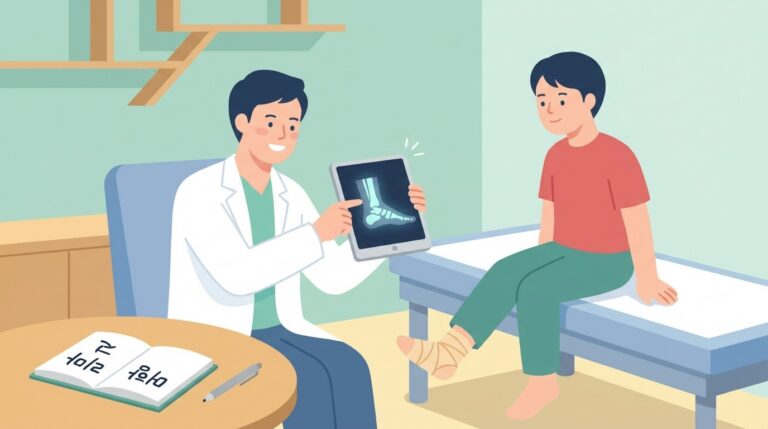
다행히 뼈에는 금이 안 갔고 인대가 조금 늘어났네요: Navigating a Korean Orthopedic Clinic with Confidence
Phase 1: Empathy (Story-Driven Opening)
안녕하세요! 매일한글 에디터입니다. (Hello! This is your Daily Hangul editor.)
Imagine this: You are having the dream day in Seoul. You just explored the bustling vintage alleys of Seongsu-dong, clutching your iced Americano, on your way to an evening K-pop pop-up event. Suddenly, as you step off the curb onto the crosswalk—crunch. Your ankle twists awkward sideways, a sharp jolt shoots up your leg, and your heart sinks. In K-dramas, this is usually the exact moment the handsome lead appears out of nowhere to piggyback you home. But back in reality? You are sitting on a bench with a throbbing, swollen foot, terrified of walking into a local Korean medical clinic with elementary-level Korean.
Don’t panic! Visiting a Korean orthopedic clinic (정형외과 / Jeonghyeong-oegwa) is surprisingly fast, modern, and affordable—provided you understand what the doctor is saying to you. Based on feedback from hundreds of our foreign learners who suffered travel sprains, nothing relieves anxiety faster than understanding that magic diagnostic sentence: “다행히 뼈에는 금이 안 갔고 인대가 조금 늘어났네요 (Thankfully, there is no fracture in the bone, just a slightly stretched ligament).”
Today, I will walk you step-by-step through the orthopedic experience so that an unexpected tumble won’t ruin your Korean journey. Let’s get you back on your feet—literally!
Phase 2: Core Expressions Deep Dive
Here are the top 3 essential expressions you will hear or say at the clinic.
1. 다행히 뼈에는 금이 안 갔어요 (Dahaenghi ppyeoe-neun geumi an gasseoyo)
- Pronunciation: [Da-haeng-hee ppyeo-eh-neun geu-mee an gah-sseo-yo] (Think: “Dah-hang-he” + “p” sound + “yuh” as in yearn + “gum-ee”)
- Meaning: Literal: “Thankfully, a crack did not go into the bone.” / Nuance: “Fortunately, you don’t have a fracture; your bone is completely intact.”
- K-Culture Moment: Seen in almost every medical or sports drama (Hospital Playlist or Weightlifting Fairy Kim Bok-joo) where an athlete or rookie gets an X-ray result, prompting everyone to let out a collective sigh of relief.
- Editor’s Insight: Koreans use the phrase 금이 가다 (geumi gada), which literally means “a crack goes into [an object/bone]”. In casual Korean, hairline fractures are referred to as 금 (geum) rather than the formal medical term 골절 (goljeol).
- Situation Spectrum: Casual: ⚠️ (To close friends: 다행히 뼈엔 금 안 갔대) | Semi-formal: ✅ | Formal: ✅
- 🤔 Think About It: Notice how the doctor starts with 다행히 (Thankfully) before delivering medical news? Korean conversation frequently leads with empathy and shared emotional relief.
2. 인대가 조금 늘어났어요 (Indaega jogeum neureonasseoyo)
- Pronunciation: [In-dae-gah joh-geum neu-reo-nah-sseo-yo] (Sound analogy: “Inn-day-gah” + “joh-goom” + “nuh-raw-nah-ssuh-yo”)
- Meaning: Literal: “The ligament has stretched a little.” / Nuance: “You’ve got a mild sprain / ligament strain.”
- K-Culture Moment: A variety show star returns after an intense physical mission wearing an ankle brace, casually telling the cast, “아, 인대가 좀 늘어났대요~ (Ah, they said my ligament just stretched a bit~).”
- Editor’s Insight: In English, we say “I sprained my ankle.” But in Korean, doctors specifically describe the physical state of the tissue: 인대 (ligament) + 늘어나다 (to stretch). If you hear 늘어났다, know that it’s treatable with rest and a light support brace!
- Situation Spectrum: Casual: ✅ | Semi-formal: ✅ | Formal: ✅
- 🤔 Think About It: Why does Korean medical terminology prefer descriptive physical verbs (늘어나다 – stretched) over Latinate injury terms in patient consultations?
3. 물리치료 받고 가세요 (Mullichiryo batgo gaseyo)
- Pronunciation: [Mool-lee-chee-ryo baht-goh gah-seh-yo] (Sounds like: “Mool-lee-chee-ryo” + “baht-go” + “gah-say-yo”)
- Meaning: Literal: “Receive physical therapy and then go.” / Nuance: “Please stop by the physical therapy room on your way out for treatment.”
- K-Culture Moment: In neighborhood life or family sit-coms, grandmothers and office workers often bond over the cozy heated physical therapy beds in neighborhood clinics on their lunch breaks.
- Editor’s Insight: In Korea, physical therapy isn’t reserved only for severe post-surgery rehab. For simple sprains, a 20-minute combo of ultrasound, hot pack, and electrical stimulation (전기치료) is standard routine before you leave the building.
- Situation Spectrum: Casual: 🚫 | Semi-formal: ✅ | Formal: ✅
- 🤔 Think About It: The construction ~고 가세요 (~and go) reflects how physical therapy in Korean local clinics is designed as a frictionless, in-and-out neighborhood service.
Phase 3: Textbook Korean vs. Real-Life Korean
Let’s compare stiff, classroom Korean with what people actually say at the reception desk.
Situation 1: Explaining how you hurt yourself
- 📖 교과서 한국어 (Textbook): 제가 보행 중에 발목을 삐었습니다. (Je-ga bohaeng jung-e balmok-eul ppieossseumnida. / “I sprained my ankle while pedestrian walking.”)
- 🗣️ 진짜 한국어 (Real-Life): 걸어가다가 발목을 삐끗했어요. (Georeogada-ga balmok-eul ppikkeuthaesseoyo. / “I tripped and twisted my ankle while walking.”)
- 💡 왜 다를까? (Why the difference?): Nobody uses administrative words like 보행 중 (during pedestrian transit) in real life. The onomatopoeic verb 삐끗하다 (ppikkeuthada) vividly conveys that exact sudden twist of the joint.
Situation 2: Asking if your bone is broken
- 📖 교과서 한국어 (Textbook): 저의 뼈가 골절되었습니까? (Jeo-ui ppyeoga goljeoldweeossseumnikka? / “Is my bone fractured?”)
- 🗣️ 진짜 한국어 (Real-Life): 뼈에는 이상 없나요? (Ppyeoe-neun isang eomnayo? / “Is everything okay with the bone?”)
- 💡 왜 다를까? (Why the difference?): Rather than using the heavy clinical noun 골절 (fracture), patients ask if there is any 이상 (abnormality/issue), making the conversation smoother and natural.
Phase 4: K-Culture Deep Dive & Non-Verbal Manners
4-1. 눈치 (Nunchi) & Clinic Etiquette
- Entering the Treatment Bed: When moved into the Physical Therapy Room (물리치료실), you must take off your shoes before lying on the bed. Look for the rubber slippers placed neatly next to the bed edge.
- Answering the Pain Test: When the doctor presses along your foot joint asking “여기가 아파요? (Does it hurt here?)”, don’t just endure the pain silently out of polite shyness! Vocalize clearly with “앗, 네! 거기 아파요! (Ouch, yes! Right there!)” so they can pinpoint ligament strain vs. bone tenderness.
- Phone Etiquette: Physical therapy treatment rooms in Korea are quiet spaces resembling sleeping rooms. Set your smartphone to vibrate (진동) and avoid taking voice calls while lying down.
4-2. Cultural Code: The Cozy “K-Healing” Physical Therapy Room
In many Western countries, a sprained ankle gets you an ice pack, an elastic bandage, and a bill. In Korea, you are guided through a curtain into a cozy clinic room with heated massage beds (온열 매트). You receive cooling therapy, ultrasound waves, and electric pulse stimulation—often wrapped up with red infrared heat lamps. It feels half medical clinic and half Korean sauna (찜질방), reflecting the Korean standard that clinic care should feel immediately comforting and attentive.
Phase 5: Real-Life Roleplay Scenario
Setting: Dr. Park’s consultation room at Seoul Orthopedic Clinic (서울정형외과). Patient Alex sits next to the X-ray monitor with an ice pack resting on their ankle.
- Dr. Park: 엑스레이 보고 말씀드릴게요. 어디 봅시다… (X-ray bogo malsseumdeurilgeyo. Eodi bopsida…)
(🎭 Looking closely at the monitor, pointing at the joint outline with a pen)
“Let’s take a look at the X-ray. Let’s see here…” - Alex: 많이 심한가요, 선생님? (Manhi simhangayo, seonsaengnim?)
(🎭 Clasping hands together nervously with wide eyes)
“Is it very serious, Doctor?” - Dr. Park: 다행히 뼈에는 금이 안 갔고 인대가 조금 늘어났네요. (Dahaenghi ppyeoe-neun geumi an gatgo indaega jogeum neureonatneyo.)
(🎭 Smiling gently to reassure the patient)
“Thankfully, there is no crack in the bone, just a slightly stretched ligament.” - Alex: 휴, 정말 다행이에요! 깁스 해야 하나요? (Hyu, jeongmal dahaeng-ieyo! Gipseu haeya hanayo?)
(🎭 Letting out a long sigh of relief)
“Phew, what a relief! Do I need to wear a cast?” - Dr. Park: 통깁스는 안 해도 되고요, 반깁스랑 보호대 며칠만 하세요. (Tong-gipseu-neun an haedo doegoyo, ban-gipseu-rang bohoda-e myeochilman haseyo.)
(🎭 Demonstrating a removable velcro support splint)
“A full cast is not necessary; just wear a half-cast splint and brace for a few days.” - Alex: 네, 알겠습니다. 약도 먹어야 하나요? (Ne, algetseumnida. Yakdo meogeoya hanayo?)
(🎭 Nodding attentively)
“Yes, understood. Do I need to take medicine too?” - Dr. Park: 소염진통제 3일 치 처방해 드릴게요. (Soyeom-jintongje sam-il chi cheobanghae deurilgeyo.)
(🎭 Typing prescription notes into the medical computer)
“I’ll prescribe anti-inflammatory painkillers for three days.” - Dr. Park: 나가셔서 물리치료 받고 가세요. (Nagasyoseo mullichiryo batgo gaseyo.)
(🎭 Pointing towards the adjacent physical therapy door)
“Please head out and get physical therapy before you leave.”
🔀 Interactive Decision Fork: How would you respond to Dr. Park?
- Choice A: “네, 물리치료실로 가면 되나요?” (Ne, mullichiryosillo gamyeon doenayo? / “Yes, should I go to the physical therapy room?”)
- Outcome (Best): Perfect, natural, polite! The nurse will guide you immediately to a warm bed.
- Choice B: “싫어요, 그냥 갈래요.” (Sireoyo, geunyang gallaeyo. / “I hate it, I just want to leave.”)
- Outcome (Bad): Too blunt and impolite. If you’re in a rush, say: “제가 시간이 없어서 오늘은 약만 받아갈게요 (I’m short on time, so I’ll just pick up the medicine today).”
- Choice C: “물리치료 공짜예요?” (Mullichiryo gongjja-yeyo? / “Is physical therapy free?”)
- Outcome (Risk): Culturally awkward. Better to ask at the reception desk: “비용이 대략 얼마 정도 나오나요? (Approximately how much will the total cost be?)”
Phase 6: 10-Second Emotion Shadowing Drill
Practice these natural rhythm pauses (/) and emotional deliveries!
[😮 With immense relief]
다행히 / 뼈에는 금이 안 갔대요!
(Dahaenghi / ppyeoe-neun geumi an gatdaeyo!)
“Thankfully / they said there’s no crack in the bone!”-
[🤕 Wincing in slight pain]
발목을 삐끗해서 / 걸을 때 욱신거려요.
(Balmok-eul ppikkeuthaeseo / georeul ttae uksingeoryeoyo.)
“I twisted my ankle / and it throbs when I walk.” -
[😊 Inquiring politely]
물리치료는 / 어디서 받으면 되나요?
(Mullichiryo-neun / eodiseo badeumyeon doenayo?)
“Where should I / receive the physical therapy?”
Phase 7: K-Culture Mini Dictionary
- 정형외과 (Jeonghyeong-oegwa) | Orthopedic Clinic
Everyday usage: Look for signs ending in 정형외과 for any joint sprains, muscle aches, neck stiffness, or back issues. - 반깁스 (Ban-gipseu) | Half-Cast / Splint
Everyday usage: Derived from German Gips (plaster) + Korean 반 (half). A lightweight, removable splint held with velcro strips or bandages. - 찜질 (Jjimjil) | Pack / Compress Therapy
Everyday usage: 냉찜질 (naeng-jjimjil) is cold compress for initial swelling; 온찜질 (on-jjimjil) is warm compress for chronic muscle pain. - 파스 (Paseu) | Medicated Relief Patch
Everyday usage: The iconic medicinal pain-relief patch found in convenience stores and pharmacies across Korea. Essential for sore legs!
Phase 8: Survival Kit for Travelers
Top 3 Immediate Phrases
- 발목을 접질렸어요. (Balmok-eul jeopjillyeosseoyo.)
Romanization: [Bahl-mohk-eul jup-jeel-lyuh-ssuh-yo]
Pro Tip: Use this at the front desk when describing how you twisted your foot inwards. - 여기를 누르면 아파요. (Yeogi-reul nureumyeon apayo.)
Romanization: [Yuh-gee-reul noo-reu-myeon ah-pah-yo]
Pro Tip: Point directly to the sore spot when the doctor examines you. - 해외여행자보험 서류 써주실 수 있나요? (Hae-oe yeohaengja boheom seoryu sseojusil su 있nayo?)
Romanization: [Hae-weh yuh-haeng-jah boh-huhm suh-ryoo ssuh-joo-seel soo it-nah-yo]
Pro Tip: Hand this phrase to the reception desk so they provide English diagnostic receipts for your travel insurance claim.
Editor’s Travel Note
- Finding Clinics Fast: Don’t search on international maps. Use the Naver Map app download and search “정형외과”. You will see clinics within 5 minutes of any major subway station.
- Payment & Prescriptions: Korean clinics accept foreign Visa and Mastercard effortlessly. You will pay for the clinic consultation and physical therapy first (usually 15,000 to 40,000 KRW without national insurance), and then take your paper prescription (처방전) to the nearby pharmacy (약국) right next door to pick up pills for 3,000 to 6,000 KRW.
Phase 9: “One Step Deeper” (Reflective Question)
In Korean culture, the word 다행이다 (Dahaeng-ida / It’s a relief; Thankfully) is more than an adverb; it is an emotional cushion. When Koreans witness someone experience bad luck, their immediate instinct is to seek the silver lining—“그래도 뼈는 안 다쳐서 다행이야 (Still, it’s a blessing your bone didn’t break).” This habit of highlighting what was preserved rather than what was lost reveals how communal warmth and reassurance operate in Korean everyday speech.
💬 Your Turn: Have you ever had a medical mishap while traveling abroad? How did people in that country reassure you compared to Korea’s encouraging 다행이다? Share your thoughts below!
Phase 10: FAQ & Avoiding Misunderstandings
Q: Do I need an appointment to visit a Korean orthopedic clinic?
A: No! Korean neighborhood clinics operate on walk-in visits (당일 진료). Simply walk in, show your passport at the desk, write down your name and symptoms, and wait 5 to 15 minutes.
Q: What is the difference between a full cast and a half cast in Korea?
A: A full cast (통깁스 / tong-gipseu) stays on for weeks and cannot be removed. For simple ankle sprains, doctors almost always prescribe a removable splint (반깁스 / ban-gipseu) which you can take off when showering or sleeping.
Q: Can I take the subway with crutches or a sprained ankle in Seoul?
A: Yes, but Seoul subways feature long stairs. Look for station elevators or ask the station agent by using the intercom: “다리를 다쳐서 엘리베이터를 찾고 있어요 (I hurt my leg and I’m looking for the elevator).”
🚨 Common Mistakes Warning Board
- ❌ Mistake 1: Going to an Emergency Room (응급실) for a basic daytime sprain.
Correct Action: ERs in general hospitals are expensive and involve long waits. Head to a local neighborhood 정형외과 (Orthopedics) instead. - ❌ Mistake 2: Asking the doctor for medicine directly.
Correct Action: Korean doctors don’t dispense medicine in the clinic. You must take your paper prescription slip downstairs to the adjacent 약국 (Pharmacy). - ❌ Mistake 3: Forgetting to remove your socks or tights before X-rays.
Correct Action: Wear loose, easily rolled-up pants or shorts when visiting an orthopedic clinic so the doctor can inspect both ankles.
Phase 11: Action Missions
- 🥉 Bronze Mission (Solo Vocal Drill): Say “다행히 뼈에는 금이 안 갔어요” out loud 3 times in front of your mirror with a relieved facial expression.
- 🥈 Silver Mission (Social Audio Check): Record yourself reading the 3 sentences from Phase 6 on your voice memo app and compare your pause markers with the slashes (
/). - 🥇 Gold Mission (Real-World Spotting): When passing through Korean streets or looking on street view, spot three green medical cross signs that say 정형외과!
- 🎮 K-Culture Bonus Mission: In your favorite K-drama, find a scene where someone sprains an ankle or gets a piggyback ride. Did anyone use the word 다행이다 or 업어줄게 (I’ll carry you on my back)?
Phase 12: Interactive Quiz Challenge
Test what you’ve learned today!
1. Situational Judgment: You twisted your ankle on the steps. What is the most natural sentence to say to the receptionist at the clinic?
(A) 제 발목이 골절되어 사망할 것 같습니다.
(B) 계단에서 발목을 삐끗해서 왔어요.
(C) 물리치료실로 바로 침대를 주세요.
2. Fill-in-the-Blank: Complete the doctor’s reassuring sentence:
“다행히 뼈에는 ____이/가 안 갔고 인대가 늘어났어요.”
3. True or False: In Korea, you must buy your prescribed medication inside the clinic room directly from the doctor. (T / F)
👉 Click to view answers and explanations!
- Answer: (B)
Explanation: 계단에서 발목을 삐끗해서 왔어요 (I came because I twisted my ankle on the stairs) is natural and polite. Option (A) is dramatically unnatural (“my ankle fractured and I feel like dying”), and (C) is rude. - Answer: 금 (Geum)
Explanation: The idiom for a hairline bone crack is 금이 가다 (geumi gada). - Answer: False (F)
Explanation: Korea enforces medical division of labor (의약분업). You take the clinic prescription slip to an outside pharmacy (약국) right next door.






