

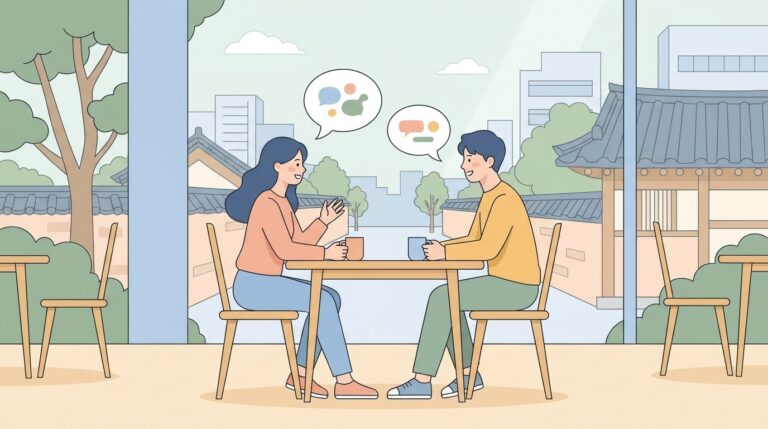
Phase 1: Empathy & Storytelling
안녕하세요! 매일한글 에디터입니다. (Hello! I’m your Daily Hangul editor.)
Imagine this scenario: It’s 11:30 PM on a Friday in Seoul. You glance at your phone. You sent a message on KakaoTalk four hours ago, and the tiny yellow ‘1’ just vanished—read, but no reply. Suddenly, your partner uploads an Instagram story sipping craft beer at a stylish bar in Euljiro with their college “여사친” (yeosachin, female friend). Your stomach tightens. Back home, you might either shrug it off or immediately ask, “Who’s that?” But in Korea, navigating “연락 빈도” (texting frequency) and opposite-sex friendships can feel like walking through an emotional minefield.
Here’s the truth: You aren’t being overly sensitive, and your partner probably isn’t trying to ignore you. In Korea, dating culture places enormous emphasis on constant connection (often texting every few hours just to say what you ate), while boundaries with opposite-sex friends are fiercely debated on trending variety shows every single week. When two people come from different family backgrounds, distinct communication styles, and different cultural expectations, friction is not just possible—it’s inevitable.
In this guide, based on real feedback from dozens of international couples learning Korean with us, you won’t learn robotic textbook demands. Instead, you’ll master empathetic, emotionally intelligent B1-level expressions to negotiate texting styles and set healthy boundaries with opposite-sex friends. By the end of this lesson, you’ll know how to say, “We grew up differently, so let’s build our own unique rules together,” with grace, confidence, and warmth.
Phase 2: Core Expressions Deep Dive
Here are three essential B1-level expressions designed to turn potential arguments into bonding moments.
1. 서로 맞춰가는 중이잖아요 (Seoro matchwoganeun jung-ijanh-ayo)
- Pronunciation: suh-roh maht-chwo-ga-neun joong-ee-jah-nah-yo (Think of “match-wo” like matching a puzzle piece, flowing smoothly into “jung-i-jan-a-yo”).
- Meaning: Literal: “We are in the process of fitting to each other, isn’t it?” / Nuance: “Relationships take time and compromise; we’re figuring this out together as a team.”
- K-Culture Moment: Heard frequently in realistic romance K-Dramas like Our Beloved Summer or Lovestruck in the City when two stubborn protagonists realize love isn’t automatic harmony, but patient negotiation.
- Editor’s Insight: The verb “맞춰가다” (matchwogada) combines “맞추다” (to adjust/fit together) with “-아/어가다” (an ongoing process toward the future). Adding “-잖아요” gently reminds your partner of a mutual truth without being accusatory.
- Situation Spectrum:
- Casual (반말): 서로 맞춰가는 중이잖아. (✅ Used between partners of equal age or close informal status)
- Semi-formal (존댓말): 서로 맞춰가는 중이잖아요. (✅ Perfect for respectful couple talk)
- Formal (격식체): 서로 맞춰가는 과정입니다. (⚠️ Too stiff for a bedroom/cafe heart-to-heart)
- 🤔 Think About It: In English, we often say “we need to compromise,” which sometimes implies giving something up. In Korean, “맞추다” evokes interlocking puzzle pieces. How does viewing disagreement as “adjusting the fit” change how you argue?
2. 미리 말만 해주면 괜찮아요 (Miri malman haejumyeon gwaenchanh-ayo)
- Pronunciation: mee-ree mahl-mahn hay-joo-myeon gwen-chahn-ah-yo (Connect “mal” and “man” softly; pronounce “괜찮아요” as gwen-chahn-ah-yo).
- Meaning: Literal: “If you just tell me in advance, it’s totally okay.” / Nuance: “I trust you, but I appreciate transparency so my imagination doesn’t run wild.”
- K-Culture Moment: A boyfriend is going to have lunch with a long-time female study partner. The girlfriend doesn’t forbid it; she smiles and gently sets the expectation of courtesy.
- Editor’s Insight: The magic particle “-만” (only/just) attached to “말” (words/telling) softens the condition. You are not asking for permission slips or GPS tracking; you are simply asking for the consideration of a quick heads-up.
- Situation Spectrum:
- Casual: 미리 말만 해주면 괜찮아. (✅ Standard for couples speaking informally)
- Semi-formal: 미리 말만 해주면 괜찮아요. (✅ Great when keeping polite emotional distance during a serious talk)
- Formal: 사전에 공유해 주시면 감사하겠습니다. (🚫 Sounds like an office memo between business executives)
- 🤔 Think About It: Why does Korean dating culture prize “사전 공유” (sharing schedules in advance)? Is sharing your whereabouts viewed as a loss of autonomy or an expression of “배려” (consideration) in your native culture?
3. 우리만의 규칙을 만들어 가요 (Uriman-ui gyuchik-eul mandeul-eo gayo)
- Pronunciation: oo-ree-mahn-eh gyoo-cheek-eul mahn-deul-uh gah-yo (Pronounce the possessive “의” comfortably as eh).
- Meaning: Literal: “Let’s make and develop rules that are uniquely ours.” / Nuance: “Forget what other couples do or what social media says; let’s create boundaries that make both of us feel safe.”
- K-Culture Moment: A classic turning point in relationship vlogs on YouTube where a couple sits down with a notepad over coffee to agree on communication habits.
- Editor’s Insight: The suffix “-만의” signifies “exclusive to.” It rejects societal pressure (like the unspoken rule that partners must text every 30 minutes) and empowers the couple to define intimacy on their own terms.
- Situation Spectrum:
- Casual: 우리만의 규칙을 만들어 가자. (✅)
- Semi-formal: 우리만의 규칙을 만들어 가요. (✅)
- Formal: 저희만의 원칙을 정립해 나가시죠. (🚫 Way too academic)
- 🤔 Think About It: Do you prefer unspoken mutual understanding, or do you prefer explicitly talking through “rules” in romance? Why can explicit rule-making feel unromantic to some, yet liberating to others?
Phase 3: Textbook Korean vs. Real Korean
Textbooks often give you stiff, direct translations that sound robotic or defensive. Here is how real Koreans handle these delicate relationship topics:
Situation 1: Expressing that you prefer regular check-ins
- 📖 교과서 한국어 (Textbook): 저는 연락을 자주 하는 것을 원합니다. (Jeoneun yeollag-eul jaju haneun geos-eul wonhamnida. / I desire frequent contact.)
- 🗣️ 진짜 한국어 (Real Korean): 저는 사소한 거라도 연락이 좀 자주 닿는 편이 마음이 편해요. (Jeoneun sasohan georado yeollagi jom jaju danneun pyeoni ma-eumi pyeonhaeyo. / Even with tiny updates, I feel more at ease when we stay in touch frequently.)
- 💡 왜 다를까? (Cultural Nuance): Using “~편이다” (to tend to be) softens personal preferences so they don’t sound like rigid ultimatums, and mentioning “마음이 편해요” (my mind feels at ease) focuses on vulnerability rather than blaming the other person.
Situation 2: Asking comfortably about a friend of the opposite sex
- 📖 교과서 한국어 (Textbook): 당신의 그 이성 친구는 누구입니까? (Dangsin-ui geu iseong chinguneun nugu-imnikka? / Who is that opposite-sex friend of yours?)
- 🗣️ 진짜 한국어 (Real Korean): 혹시 어떤 친구인지 나한테도 편하게 얘기해 줄 수 있어? (Hoksi eotteon chingu-inji nahantedo pyeonhage yaegihae jul su isseo? / Could you comfortably tell me a bit about what kind of friend they are?)
- 💡 왜 다를까? (Cultural Nuance): Using “이성 친구” sounds like a sociology survey. Real Koreans use “어떤 친구인지 얘기해 주다” to show curious interest rather than jealous interrogation.
Phase 4: K-Culture Deep Dive & Non-Verbal Manners
4-1. Nunchi (눈치) & Non-Verbal Nuance
When having this conversation in Korean, your body language carries 70% of the message:
* The Softened Gaze (시선 처리): Never stare unblinkingly into your partner’s eyes while discussing boundaries; it feels aggressive in Korean interpersonal dynamics. Instead, lower your gaze slightly toward their hands or coffee cup, then meet their eyes warmly when delivering key phrases like “서로 맞춰가요” (Let’s adjust together).
* The Open Hand Gesture: Keep your hands visible on the table. Clasping a warm mug with both hands signals vulnerability and warmth, immediately disarming any defensive instinct.
* The Sigh Check: Avoid deep exhales before speaking. In Western contexts, a sigh can simply mean gathering your thoughts, but in Korea, a deep sigh (한숨) is often perceived as an expression of profound disappointment or frustration.
4-2. Cultural Code: The KakaoTalk Pace & The Perilla Leaf Debate
To understand Korean relationship friction, you must understand two cultural phenomena:
1. The “Bap Meogeosseo?” (밥 먹었어? / Did you eat?) Ritual: In Korea, texting isn’t merely for exchanging logistical information; it is the modern pulse of affection. Texting “I’m leaving the office,” “I just had kimchi stew,” or “Getting on the subway” is seen as emotional reassurance, not micromanagement.
2. The Nam-sa-chin / Yeo-sa-chin Boundary: You might have heard of the viral “깻잎 논쟁” (Kkaennip Nonjaeng – The Perilla Leaf Debate): Can your partner hold down a stuck pickled perilla leaf for their opposite-sex friend? Koreans take boundary etiquette seriously. While platonic friendships are common, private one-on-one drinks late at night without giving your partner a heads-up (“귀띔”) often crosses the boundary of relationship “예의” (etiquette).
Phase 5: Real-World Roleplay Scenario
Setting: A dimly lit, quiet cafe in Yeonnam-dong on a rainy Tuesday evening.
Characters:
* Minwoo (민우): A thoughtful 28-year-old Korean office worker who grew up with several close female friends from high school.
* Alex (You): An international professional living in Seoul who values independent personal space but wants closer communication and mutual reassurance.
Turn 1
* Alex: 민우야, 어제 동창 모임에서 늦게까지 있었잖아. (Minwoo-ya, eoje dongchang mo-im-eseo neutgekkaji isseotjanha. / Minwoo, you were out late at the alumni reunion yesterday, right?)
* 🎭 행동 지문: Gently twirling the coffee stirrer, keeping the tone curious rather than critical.
Turn 2
* Minwoo: 응, 오랜만에 고등학교 친구들 만나서 시간 가는 줄 몰랐어. 지은이라는 여사친도 진짜 오랜만에 봤거든. (Eung, oraenmane godeunghakgyo chingudeul mannaseo sigan ganeun jul mollasseo. Jieun-iraneun yeosachindo jinjja oraenmane bwatgeodeun. / Yeah, I met my high school friends after so long that I lost track of time. I also caught up with a female friend named Jieun for the first time in forever.)
* 🎭 행동 지문: Scratching the back of his neck, slightly nervous about how Alex will react.
Turn 3
* Alex: 그랬구나. 사실 연락이 너무 오랫동안 끊겨서 조금 걱정됐어. (Geuraetguna. Sasil yeollagi neomu oraedong-an kkeunkyeoseo jogeum geokjeongdwaesseo. / I see. Honestly, because you didn’t check in for so long, I got a little worried.)
* 🎭 행동 지문: Holding the warm coffee cup with both hands, making soft eye contact.
Turn 4
* Minwoo: 아, 방해될까 봐 일부러 폰을 안 봤는데… 혹시 서운했어? (A, banghaedoelkka bwa ilbureo poneul an bwanneunde… Hoksi seounhaesseo? / Ah, I didn’t check my phone thinking I might disturb you… Did that make you feel hurt or upset?)
* 🎭 행동 지문: Leaning forward with genuine concern on his face.
Turn 5
* Alex: 화난 건 아니야. 다만 서로 자라온 환경이 다르니까 생각하는 게 다를 수 있잖아. (Hwanan geon aniya. Daman seoro jaraon hwan-gyeongi dareunikka saenggakhaneun ge dareul su itjanha. / I’m not angry. It’s just that since we grew up in different environments, we can naturally think differently.)
* 🎭 행동 지문: Smiling reassuringly to disarm the tension.
Turn 6
* Minwoo: 맞아, 나도 알렉스가 불편한 건 싫어. 어떻게 하면 좋을까? (Maja, nado Alex-ga bulpyeonhan geon sileo. Eotteoke hamyeon joeulkka? / Right, I don’t want you to feel uncomfortable either. What would be best?)
* 🎭 행동 지문: Nodding attentively, placing his phone face-down on the table.
Turn 7
* Alex: 남사친이나 여사친 만나는 거 이해해. 대신 미리 말만 해주고, 늦어지면 짧게 카톡 하나만 남겨줘. (Namsachin-ina yeosachin mannaneun geo ihaehae. Daesin miri malman haejugo, neujeojimyeon jjalpge katok hanaman namgyeojwo. / I understand meeting guy or girl friends. Instead, just give me a heads-up beforehand, and if it gets late, just leave a brief KakaoTalk text.)
* 🎭 행동 지문: Speaking slowly with a calm, friendly tone.
Turn 8
* Minwoo: 그건 당연히 할 수 있지! 우리 이렇게 대화하면서 하나씩 맞춰가자. 고마워, 솔직하게 말해줘서. (Geugeon dang-yeonhi hal su itji! Uri ireoke daehwahamyeonseo hanassik matchwogaja. Gomawo, soljik-hage malhaejwoseo. / I can definitely do that! Let’s keep adjusting one by one through talking like this. Thank you for being honest with me.)
* 🎭 행동 지문: Reaching across the table to gently pat Alex’s hand with a bright smile.
🔀 Interactive Decision Point
Suppose Minwoo suddenly says: “그런데 매번 어디 갈 때마다 보고하는 건 조금 답답하지 않아?” (Geureonde maebeon eodi gal ttaemada bogo-haneun geon jogeum dapdaphaji anha? / “But isn’t reporting every single place you go a little suffocating?” How do you respond?
- Option A: “보고하라는 게 아니라 마음 편하게 배려해 달라는 뜻이야. 우리만의 편한 방식을 찾아보자.” (Bogo-haraneun ge anira ma-eum pyeonhage baeryeo-hae dallaneun tteusiya. Uriman-ui pyeonhan bangsik-eul chajaboja.)
👉 Feedback [BEST]: Brilliant! You distinguish between “보고” (formal reporting) and “배려” (caring consideration), and invite mutual collaboration. - Option B: “한국 연인들은 다 이렇게 하던데 왜 너만 그래?” (Hanguk yeonindeureun da ireoke hadeonde wae neoman geurae?)
👉 Feedback [BAD]: Danger zone! Comparing your partner to “all other Koreans” makes them feel defensive and invalidated. - Option C: “알았어, 그럼 앞으로 나도 연락 안 하고 친구들 만날게.” (Arasseo, geureom apeuro nado yeollak an hago chingudeul mannalke.)
👉 Feedback [RISK]: Passive-aggressive! Retaliatory silence breeds resentment and breaks emotional trust.
Phase 6: 10-Second Emotional Shadowing Drill
Practice these lines aloud, following the slash marks (/) for breath breaks and matching the emotional cues:
[🥺 솔직하고 서운한 마음을 담아 - Honestly expressing slight disappointment]
“사실은 / 연락이 너무 안 돼서 / 조금 서운했어.”
(Sasileun / yeollagi neomu an dwaeseo / jogeum seounhaesseo.)
Listen & Pause: Drop pitch slightly on “서운했어” to convey vulnerability rather than anger.-
[🤍 다정하고 조율하려는 톤으로 - Warmly proposing compromise]
“서로 자라온 환경이 다르니까 / 대화하면서 / 우리만의 규칙을 만들어 가요.”
(Seoro jaraon hwan-gyeongi dareunikka / daehwahamyeonseo / uriman-ui gyuchik-eul mandeul-eo gayo.)
Listen & Pause: Gentle rise at “다르니까 / “, soothing cadence on “만들어 가요.” -
[😊 안심시키며 미소 짓는 목소리 - Reassuring with a friendly smile]
“친구 만나는 건 괜찮아! / 미리 말만 해주면 / 걱정 안 할게.”
(Chingu mannaneun geon gwaenchana! / Miri malman haejumyeon / geokjeong an halge.)
Listen & Pause: Upbeat, light emphasis on “미리 말만”.
Phase 7: K-Culture Mini Dictionary
- 연락 빈도 (Yeollak Bindo) – Contact/Texting Frequency
Meaning: How often partners call or text throughout the day. In Korea, a mismatch in yeollak bindo is cited as one of the top three reasons for breakups among young couples. - 남사친 / 여사친 (Namsachin / Yeosachin) – Guy Friend / Girl Friend (Platonic)
Meaning: Portmanteau of 남자 사람 친구 (male human friend) and 여자 사람 친구 (female human friend). Crucially differentiated from 남자친구 (namjachingu = boyfriend) and 여자친구 (yeojachingu = girlfriend). - 맞춰가다 (Matchwogada) – To Adjust / Fit to Each Other Over Time
Meaning: Composed of mat-chuda (to tune, adjust) and gada (to proceed). Conveys an ongoing mutual journey of aligning lifestyle and emotional differences. - 서운하다 (Seounhada) – Hurt / Sad Because Expectations Weren’t Met
Meaning: A unique Korean emotion that lies right between sadness and resentment. It is distinct from “화나다” (to be angry). Saying “서운해” allows you to communicate hurt without initiating a battle.
Phase 8: Dating Survival Kit for Korea Travelers & Expats
Survival Expressions Top 3
- “천천히 답장해도 괜찮아!” (Cheoncheonhi dapjanghaedo gwaenchana!)
Translation: “Take your time replying, it’s totally fine!”
Pro Tip: Perfect to send during busy work hours to relieve texting pressure. - “집에 도착하면 카톡 하나만 줘.” (Jibe dochakhamyeon katok hanaman jwo.)
Translation: “Just send one quick KakaoTalk when you get home safe.”
Pro Tip: The quintessential Korean way to express caring without micro-managing. - “우리 생각할 시간을 조금만 가질까?” (Uri saenggakhal siganeul jogeumman gajilkka?)
Translation: “Shall we take a little time to clear our heads and think?”
Pro Tip: Use this de-escalation phrase if a discussion gets overly emotional.
Editor’s Dating & Tech Note
- Communication Infrastructure: Don’t use standard SMS or WhatsApp in Korea for dating; 99% of couples live on KakaoTalk. Get familiar with cute Kakao emoticons (이모티콘)—they carry half of your emotional tone! If you haven’t installed it yet, check the KakaoTalk official download page.
- Navigation for Date Nights: If you’re setting up a neutral, cozy cafe meetup to talk through things, avoid Google Maps (which has limited transit accuracy in Korea) and plan your quiet cafe route using the Naver Map application.
Phase 9: Going One Step Deeper (Reflective Thought)
In many Western cultures rooted in individual autonomy, love is framed as two complete circles standing side-by-side, maintaining personal space, private friendships, and separate schedules. However, Korean relationship culture is heavily influenced by the concept of “우리” (Uri – We/Our) and “정” (Jeong – Deep Emotional Bonding).
When a Korean partner asks for regular texting or feels uneasy about your late-night outings with a nam-sa-chin, they usually aren’t trying to police your freedom. To them, sharing everyday mundanities and honoring emotional boundaries is how two separate “I”s merge into a cohesive, bonded “We.” Understanding this distinction shifts your perspective from “Why are they trying to control me?” to “How can we bridge our definitions of love?”
💬 Your Turn: How often do you like to text your significant other throughout the day? Have you ever experienced a cultural clash regarding opposite-sex friends? Share your story in the comments below!
Phase 10: FAQ & Common Mistakes
Q: Why do Koreans get so sensitive about male or female friends (남사친/여사친)?
A: Traditional relationship philosophy in Korea emphasizes absolute exclusivity in romantic devotion. While platonic friendships are respected, activities that mimic date behavior—such as intimate one-on-one late-night drinks or regular private calls without clear boundaries—are often viewed as a breach of emotional courtesy toward one’s partner.
Q: What is the difference between “화났어?” and “서운했어?”
A: “화났어?” (Hwanasseo?) means “Are you angry/mad?”, which focuses on hostility and conflict. In contrast, “서운했어?” (Seounhaesseo?) means “Did that hurt your feelings because you felt neglected?” Using “서운하다” leads to intimacy and understanding, whereas focusing on “화” frequently leads to defensiveness.
Q: Is it considered normal to text every hour in Korea?
A: For many young Korean couples (especially in their 20s and 30s), continuous micro-updates throughout the day are standard practice. However, working adults frequently find this exhausting. The key is never to assume; use the phrase “우리만의 규칙을 만들어 가요” to establish a frequency that suits your actual working lives.
🚨 Common Mistakes Alert
- Mistake 1: Accusing them with “너는 왜 그래?” (Why are you like that?)
Correct Action: Frame it with “우리” (We) and your own feelings: “우리가 자라온 방식이 다르니까 서로 맞춰가자.” (Since we grew up differently, let’s adjust together.) - Mistake 2: Leaving messages on “읽씹” (Reading without replying) during an argument
Correct Action: Disappearing after the “1” vanishes creates massive anxiety in Korea. Even if you need space, type one line: “감정이 격해져서 조금 진정하고 다시 연락할게.” (I’m feeling overwhelmed, so I’ll calm down and text you back shortly.) - Mistake 3: Comparing your partner to K-Drama characters
Correct Action: Avoid saying “드라마에서는 안 그러던데…” (That’s not how it is in dramas). Remind yourself that K-Dramas are heightened fiction; real relationships flourish through patient, everyday communication.
Phase 11: Action Missions & Participation
- 🥉 Bronze Mission (Solo Practice): Record yourself saying “서로 맞춰가는 중이잖아요” three times on your smartphone voice memo app. Check if your tone sounds soft and collaborative rather than sharp.
- 🥈 Silver Mission (Community Interaction): Leave a comment below using the structure: “저는 [연락이 잘 되는 편 / 개인 시간이 필요한 편]이에요.” (I tend to [prefer easy contact / need personal time].)
- 🥇 Gold Mission (Real-life Execution): Next time you discuss plans or schedules with your Korean partner or language exchange buddy, use “미리 말만 해주면 괜찮아요” or “우리만의 규칙을 만들어 봐요” in actual conversation.
- 🎮 K-Culture Detective Mission: Watch one episode of a romantic reality dating show like Heart Signal (하트시그널) or Transit Love (환승연애). Spot how many times the cast uses the word “서운하다” or debates texting frequency!
Phase 12: Interactive Quiz Challenge
Test your understanding of Korean dating nuances and expressions with this 3-question challenge!
Q1. Situational Judgment: Your Korean partner feels hurt because you grabbed a quick lunch with your opposite-sex coworker without mentioning it beforehand. Which response best resolves the tension with empathy?
* A) “회사 동료인데 왜 의심해?” (They’re just a coworker, why are you suspicious?)
* B) “서운하게 해서 미안해. 다음부터는 미리 말만 해줄게!” (Sorry for hurting your feelings. From now on, I’ll just give you a heads-up in advance!)
* C) “미국에서는 원래 이래.” (In America, this is totally normal.)
🔍 Click to Reveal Answer & Explanation
Correct Answer: B
Explanation: Option B validates the partner’s feeling of “서운함” without unnecessary defensiveness and offers a proactive, comforting solution using “미리 말만 해줄게.”
Q2. Fill in the Blank: Complete the sentence to say, “Since we grew up differently, let’s build our own rules together.”
* “서로 자라온 환경이 다르니까, 대화하면서 우리만의 규칙을 ________ 가요.”
* A) 버려 (beoryeo)
* B) 만들어 (mandeul-eo)
* C) 숨겨 (sumgyeo)
🔍 Click to Reveal Answer & Explanation
Correct Answer: B (만들어)
Explanation: “만들어 가다” means to build/create gradually over time. “버리다” means to throw away, and “숨기다” means to hide.
Q3. True or False Culture Check: In Korea, expressing “서운하다” carries the exact same aggressive hostility as “화나다”.
* [ ] True
* [ ] False
🔍 Click to Reveal Answer & Explanation
Correct Answer: False
Explanation: “서운하다” expresses disappointment and a desire for greater affection/care from someone you love, whereas “화나다” indicates anger or outrage. Recognizing “서운함” is a superpower for relationship harmony in Korea!







