

Phase 1: Empathy & Story Intro
안녕하세요! 매일한글 에디터입니다. (Hello! I’m your Daily Hangul editor.)
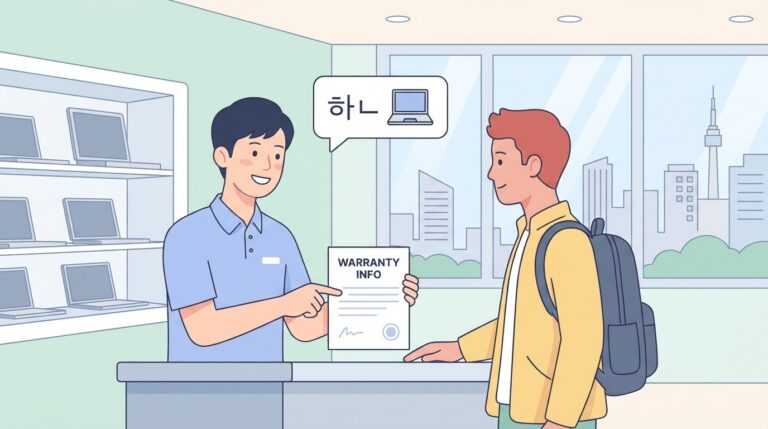
Picture this: You are standing inside a bustling, neon-lit electronics superstore in Seoul—maybe the famous Yongsan Electronics Market or a stylish flagship store in Gangnam. Glass displays shine with the newest foldable smartphones and featherlight laptops. You finally decide to treat yourself to that sleek Korean laptop you have had your eye on. The clerk smiles and begins explaining terms rapidly: “…무상 수리 보증 기간은…”
Suddenly, your mind freezes like a crashed operating system. You know the word 컴퓨터 (keompyuteo – computer), but what about warranty? What if you drop your device next week or the screen starts flickering? Will repair cost a fortune, or is it covered? This is a moment almost every foreign resident and traveler faces in Korea. Trying to decipher consumer electronics policies while nodding nervously can be terrifying.
Don’t worry! This guide is built directly from real student experiences and practical store visits. By the end of this post, you will comfortably understand how Korean warranties work, compare device perks with confidence, and never fear asking about “AS” (after-service) again.
Phase 2: Core Expressions Deep Dive
1. 무상 수리 보증 기간은 구매일로부터 1년이에요.
- Pronunciation: Musang suri bojeung giganeun gumaeillobuteo il-nyeonieyo. (Sounds like: Moo-sahng soo-ree boh-jeung gee-gahn-eun goo-mae-eel-loh-boo-tuh eel-nyun-ee-yeh-yoh)
- Meaning: Literal: “The free-of-charge repair guarantee period is 1 year from the purchase date.” Nuance: “Your free warranty lasts for one year after buying this.”
- K-Culture Moment: In Korean tech review videos on YouTube, unboxers always point their camera at the warranty paper and say this exact line to notify their subscribers.
- Editor’s Insight: 무상 (musang) means “free/no fee” in formal and legal contexts, while 유상 (yusang) means “paid repair.” Learning this distinction protects your wallet!
- Situation Spectrum:
- Casual (반말): ⚠️ (Too informal for clerks)
- Semi-formal (해요체): ✅ Perfect for shopping and asking questions
- Formal (하십시오체): ✅ Used by store staff to you
- 🤔 Think About It: In English, we usually just say “It has a one-year warranty.” Why do you think Korean specifically emphasizes “free repair” (무상 수리) instead of just using the word “warranty”?
2. 영수증 꼭 보관하셔야 해요.
- Pronunciation: Yeongsujeung kkok bogwanhasyeoya haeyo. (Sounds like: Yung-soo-jeung kohk boh-gwahn-hah-syuh-yah hae-yoh)
- Meaning: Literal: “You must certainly keep the receipt.” Nuance: “Make sure you save your receipt (for proof of purchase).”
- K-Culture Moment: Clerks at electronics hubs like Himart or ElectroMart will underline the date on your printed receipt with a red pen and hand it over with two hands.
- Editor’s Insight: In Korea, the warranty start date defaults to the manufacture date if you lose the receipt (영수증). Keeping it guarantees your full 365 days!
- Situation Spectrum:
- Casual: 🚫
- Semi-formal: ✅ Standard customer care
- Formal: ✅
- 🤔 Think About It: Digital receipts are huge via KakaoPay now, yet paper receipts are still prized for electronics warranties. How does proof of purchase work in your home country?
3. 배터리 수명은 얼마나 돼요?
- Pronunciation: Baeteori sumyeongeun eolmana dwaeyo? (Sounds like: Bae-tuh-ree soo-myung-eun uhl-mah-nah dwae-yoh?)
- Meaning: Literal: “How much is the battery lifespan?” Nuance: “How long does the battery last?”
- K-Culture Moment: In K-dramas, when a character is stranded with 1% battery while waiting for a critical call, they lament their phone’s short 배터리 수명!
- Editor’s Insight: 수명 (sumyeong) means “lifespan.” You can use it for appliances, batteries, and even metaphors!
- Situation Spectrum:
- Casual: ⚠️ (Only with close friends: 배터리 얼마나 가?)
- Semi-formal: ✅ Best when asking tech staff
- Formal: ✅
- 🤔 Think About It: Notice how Korean uses 얼마나 돼요? (How much does it become?) rather than “How long is it?”. Korean often views duration and quantity in fluid terms.
Phase 3: Textbook Korean vs. Real-World Korean
Situation 1: Asking about warranty repair service
- 📖 교과서 한국어 (Textbook Korean): 이 기기의 제품 보증 기간을 알려 주십시오. (I gigi-ui jepum bojeung giganeul allyeo jusipsio. – “Please inform me of the product warranty period of this device.”)
- 🗣️ 진짜 한국어 (Real-World Korean): 이거 AS 기간이 어떻게 돼요? (Igeo AS gigani eotteoke dwaeyo? – “How long is the AS period for this?”)
- 💡 Why is it different?: Koreans almost never say “제품 보증” in casual store chats. Instead, everyone says AS (pronounced 에이에스 / Ae-i-seu, standing for “After Service”).
Situation 2: Asking if a repair costs money
- 📖 교과서 한국어 (Textbook Korean): 이것은 무료로 수리할 수 있습니까? (Igeoseun muryoro surihal su itsseumnikka? – “Can this be repaired without charge?”)
- 🗣️ 진짜 한국어 (Real-World Korean): 이거 무상 수리 되나요? (Igeo musang suri doenayo? – “Does this qualify for free repair?”)
- 💡 Why is it different?: While 무료 (muryo) means free (like free snacks), 무상 (musang) is the precise, professional term used for services covered under legal consumer warranties.
Phase 4: K-Culture Deep Dive & Non-Verbal Manners
4-1. Nunchi & Tech Store Gestures
When interacting with Korean retail staff, body language speaks louder than grammar:
* The Two-Handed Handover: When receiving a device, invoice, or receipt from the clerk, accept it with both hands or with your left hand lightly supporting your right forearm. This demonstrates respect.
* Respectful Inquiries: When asking a staff member to explain specs, avoid pointing your index finger directly at the product tag or the clerk. Instead, use an open palm gesturing toward the display.
* The Attentive Nod (끄덕임): Gently nodding while the employee explains technical details signals nunchi—it shows you are actively engaged even if you miss a few complex terms.
4-2. The “AS (After Service)” Phenomenon
South Korea takes customer care to legendary heights. Brands like Samsung and LG operate nationwide multi-story “Service Centers” (서비스센터) equipped with customer lounges, free coffee, high-speed Wi-Fi, and real-time repair status boards. In Korean consumer culture, exceptional After Service is often valued more than initial product price. If a brand offers poor AS, word spreads overnight across online communities (맘카페, 클리앙), making fast, generous one-year free warranties a non-negotiable standard.
Phase 5: Real-World Roleplay Scenario
Setting: A modern electronics megastore in Sinchon, Seoul.
Characters:
* Minho (Store Specialist): Kind, polite, and eager to help international shoppers.
* Alex (You): An expat looking to buy a lightweight laptop for work and travel.
- Minho: 손님, 찾으시는 모델 있으세요? (Sonnim, chajeusineun model isseuseyo? / “Welcome! Is there a specific model you are looking for?”)
🎭 Smiling warmly while standing beside the display table. - Alex: 네, 가볍고 배터리가 오래가는 노트북 보고 있어요. (Ne, gabyeopgo baeteoriga oraeganeun noteubuk bogo isseoyo. / “Yes, I am looking for a laptop that is lightweight with long battery life.”)
🎭 Pointing with an open hand at the sleek silver laptop. - Minho: 이 모델이 요즘 제일 인기 많아요. 무게가 1킬로도 안 돼요. (I modeli yojeum jeil ingi manayo. Mugega il-killodo an dwaeyo. / “This model is the most popular these days. It weighs under one kilogram.”)
🎭 Lifting the laptop gently to demonstrate its featherweight feel. - Alex: 와, 진짜 가볍네요! 그런데 AS는 어떻게 돼요? (Wa, jinjja gabyeomneyo! Geureonde ASeuneun eotteoke dwaeyo? / “Wow, that is really light! By the way, how does AS work?”)
🎭 Leaning in with keen interest. - Minho: 무상 수리 보증 기간은 구매일로부터 1년이에요. (Musang suri bojeung giganeun gumaeillobuteo il-nyeonieyo. / “The free warranty repair period is one year from the purchase date.”)
🎭 Pointing to the warranty clause printed on the official catalog. - Alex: 고객 과실로 깨진 액정도 무상인가요? (Gogaek gwasillo kkaejin aekjeongdo musangingayo? / “Is a cracked screen caused by customer accident also free?”)
🎭 Making a tapping gesture toward the screen with a curious expression. - Minho: 아, 고객님 부주의로 인한 파손은 유상 수리예요. (A, gogaeknim buju-uiro inan paseoneun yusang suriyeyo. / “Ah, damage caused by customer carelessness is a paid repair.”)
🎭 Tilting head slightly with an apologetic, polite smile. - Alex: 알겠습니다. 영수증은 모바일로 받을 수 있나요? (Algetseumnida. Yeongsujeungeun mobaillo badeul su innayo? / “Understood. Can I receive the receipt on my mobile phone?”)
🎭 Taking out phone to get ready for payment.
🔀 Interactive Decision Point
You just bought the laptop! As Minho hands you the box, what do you say to confirm warranty coverage?
- Option A: “영수증 버려 주세요!” (Yeongsujeung beoryeo juseyo! – “Please throw away the receipt!”)
- Feedback (Bad): ❌ Big mistake! Without proof of purchase date, your warranty start date defaults to the device’s factory build date, which might lose you several months of free coverage.
- Option B: “영수증 꼭 챙겨 둘게요. 감사합니다!” (Yeongsujeung kkok chaenggyeo dulgeyo. Gamsahamnida! – “I will make sure to keep the receipt. Thank you!”)
- Feedback (Best): 🎉 Perfect! You show appreciation, confirm you understand store policies, and protect your warranty rights like a local pro.
- Option C: “나중에 망가지면 새 걸로 공짜로 바꿔 줘요?” (Najunge manggajimyeon sae geollo gongjjaro bakkwo jwoyo? – “If it breaks later, will you replace it with a brand new one for free?”)
- Feedback (Risk): ⚠️ Too blunt, slightly informal, and unrealistic. Free warranties cover repairs (수리), not instant automatic replacements with brand-new devices.
Phase 6: 10-Second Emotion Shadowing Drill
Practice these natural rhythm pauses (/) and embody the emotions behind the lines!
[😊 밝고 명확하게 - Bright & clear]
무상 수리 보증 기간은 / 구매일로부터 / 1년이에요.
(Musang suri bojeung giganeun / gumaeillobuteo / il-nyeonieyo.)-
[🧐 꼼꼼하고 진지하게 - Thorough & curious]
이거 / 배터리 수명이 / 얼마나 돼요?
(Igeo / baeteori sumyeongi / eolmana dwaeyo?) -
[🙏 정중하고 확실하게 - Polite & confirmed]
영수증 / 꼭 보관할게요. / 감사합니다!
(Yeongsujeung / kkok bogwanhalgeyo. / Gamsahamnida!)
Phase 7: K-Culture Mini Dictionary
- AS (에이에스 – Ae-i-seu): Short for “After Service.” This konglish term is universally recognized throughout Korea for warranty repairs, maintenance, and technical customer service.
- 무상 수리 (Musang suri): Free repair service covered under manufacturer warranty for defects that arise during normal, intended use.
- 유상 수리 (Yusang suri): Paid repair service. This applies when the warranty period has expired or when damage results from user accidents (고객 과실).
- 영수증 (Yeongsujeung): Receipt or proof of purchase. Essential paper or digital evidence to prove when your one-year warranty officially started.
Phase 8: Survival Kit for Travelers
Top 3 Survival Phrases in Electronics Stores
- 무상 수리 돼요? (Musang suri dwaeyo? / “Is this covered under free repair?”)
- Pro Tip: Use this whenever an electronic item acts up during your warranty period.
- 글로벌 워런티 있어요? (Geullobeol woreonti isseoyo? / “Does it have a global/international warranty?”)
- Pro Tip: Crucial question if you plan to take laptops or cameras back to your home country.
- 택스 리펀 받을 수 있어요? (Taekseu ripeon badeul su isseoyo? / “Can I get a tax refund?”)
- Pro Tip: Save up to 7-8% at certified duty-free retail outlets in Korea by showing your passport!
Editor’s Travel Note
Before heading to an official electronics store or repair center, open your phone and search for nearby repair locations using the official Naver Map mobile application. Simply type “삼성전자 서비스센터” (Samsung Service Center) or “LG전자 서비스센터” (LG Service Center). The app provides real-time operating hours, waiting queue lengths, and parking availability so you never show up to a closed door.
Phase 9: One Step Deeper (Reflection)
In many Western countries, consumer purchases are often treated as cold, one-and-done contracts: “Once you buy it, it’s your responsibility unless you pay extra for extended insurance.” In South Korea, however, a product purchase initiates an enduring social relationship between the customer and company. The rapid and attentive After-Service system is deeply rooted in Korea’s cultural sense of 정 (Jeong – relational warmth) blended with competitive corporate accountability. When a brand guarantees one year of free repair, they are not just fixing microchips—they are actively preserving your trust and safeguarding their public reputation.
💬 Your Turn: Does customer service in your home country prioritize fixing items quickly for free, or is it common to just buy extended protection plans? Share your experience in the comments below!
Phase 10: FAQ & Common Mistakes
Q: Does the one-year free warranty apply to water damage or cracked screens?
A: Typically, no. In Korea, free warranty (무상 수리) only covers internal mechanical defects and manufacturing faults. External drops, water spills, and shattered screens are classified as user fault (고객 과실), requiring paid repair (유상 수리).
Q: What if I lose my physical paper receipt?
A: If you made the purchase via credit card or registered your product serial number on the brand’s official Korean website, the company can often track the purchase date electronically. However, if no record is found, the warranty defaults to the factory manufacturing date stamped on the device.
Q: Can I get my Korean laptop serviced under warranty in my home country?
A: It depends on the brand’s international policy. Brands like Apple offer worldwide warranty on laptops, but many Korean-domestic domestic market models (like certain specialized Samsung Galaxy Book or LG Gram SKUs) only qualify for domestic Korean AS. Always ask: “글로벌 워런티 돼요?” (Geullobeol woreonti dwaeyo?).
🚨 흔한 실수 (Common Mistakes)
- Mistake 1: Saying “공짜 수리 (Gongjja suri)” instead of “무상 수리 (Musang suri)”.
- Why: 공짜 (gongjja) sounds overly childish or demanding in commercial settings. Always stick to 무상 수리 with clerks.
- Mistake 2: Expecting store clerks to repair your device at the retail register.
- Correct Action: Retail stores (like Himart or ElectroMart) only sell devices. For repairs, visit the brand’s dedicated 서비스센터 (Service Center).
- Mistake 3: Forgetting to ask for tax refund receipts on the day of purchase.
- Correct Action: Tax refund slips must be generated at the cash register during the transaction—bring your physical passport!
Phase 11: Action Mission & Engagement
- 🥉 Bronze Mission (Solo Practice): Read the sentence 무상 수리 보증 기간은 구매일로부터 1년이에요 aloud 5 times using the Emotion Shadowing drill from Phase 6.
- 🥈 Silver Mission (Social Challenge): Check your current smartphone or computer. Write a short Korean post on Instagram or Threads: “제 노트북 보증 기간은 끝났어요! (My laptop warranty period is over!)” and tag us @DailyHangul.
- 🥇 Gold Mission (Real Life): Next time you visit a Korean electronics shop or browse a Korean online mall (Coupang, Gmarket), locate the phrase 무상 보증 on the product page and note how many years it guarantees!
- 🎮 K-Culture Mission: Watch a scene from an office K-drama (like Misaeng or Start-Up). Listen for characters mentioning “AS” or “교환/환불 (Exchange/Refund)” during client meetings.
Phase 12: Interactive Quiz Challenge
Test your knowledge with these three practical questions!
- Situational Judgment: You accidentally dropped your new phone on the Seoul subway platform and the screen cracked. You bought it 3 weeks ago. What will the technician likely say?
- A) “구매일로부터 1년 안이라서 완전 무상 수리예요!”
- B) “고객 과실 파손이라서 유상 수리하셔야 해요.”
- C) “새 폰으로 즉시 교환해 드립니다.”
- Fill-in-the-Blank: Fill in the missing words:
“무상 수리 보증 기간은 [________]로부터 1년이에요.” (The free repair warranty period is 1 year from the purchase date.) -
True or False: In everyday conversational Korean at tech shops, people prefer saying “AS 기간” rather than “제품 보증 기간.”
- True / False
👉 Click to view answers and explanations!
- Answer: B
- Explanation: Accidental drops and shattered screens count as customer negligence (고객 과실), which requires paid service (유상 수리).
- Answer: 구매일 (Gumae-il – purchase date)
- Explanation: 구매 (gumae – purchase) + 일 (il – day/date) + 로부터 (robuteo – starting from).
- Answer: True
- Explanation: “AS” is the universal everyday term used across Korea for repair and warranty services!
- Explanation: “AS” is the universal everyday term used across Korea for repair and warranty services!






