

Beyond Kyobo: How to Talk Books in Seoul’s Cozy Neighborhood Bookshops
Phase 1: 공감 (Story Immersion Opening)
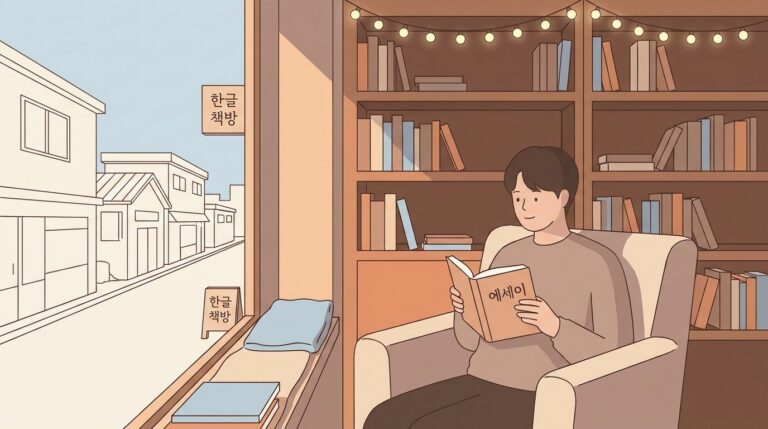
안녕하세요! 매일한글 에디터입니다. (Hello! I’m your Daily Hangul editor.) Have you ever stepped into the massive, fluorescent-lit halls of Kyobo Book Centre at Gwanghwamun? While it is thrilling to see towering bestseller pyramids, something distinctly magical happens when you slip into a quiet alley in Mangwon-dong or Seochon and push open the door of a dongne-chaekbang (동네책방, neighborhood bookstore). The bell softly chimes, the aroma of hand-dripped coffee drifts from the counter, and instead of algorithmic bestsellers, you see handmade zines, raw personal journals, and poetry collections published by solo creators.
Many of our intermediate learners share a specific frustration: “I want to join a local book talk or chat with the bookstore keeper, but my Korean feels either too stiff like a textbook or too casual like K-drama teen slang.” You want to express genuine appreciation for an author’s delicate worldview without sounding like you are submitting a corporate report. This curated guide is crafted precisely from the real experiences of our global readers living in Seoul. Master these nuanced expressions, and you will not just buy a souvenir—you will step right into Korea’s soulful literary subculture with confidence.
Phase 2: 핵심 표현 3선 심층 분석 (Top 3 Key Expressions)
1. 취향이 통하다 (Chwihyangi tonghada)
- Pronunciation: [Chwi-hyang-i tong-ha-da] (Think of Chwi like ‘chewy’ without the heavy ‘w’, and tong sounding like ‘toe’ ending with a soft ‘ng’ as in ‘song’).
- Meaning: Literal: “Tastes pass through/connect” ➔ Real Nuance: “To click culturally / to share artistic taste.”
- K-Culture Moment: In intimate indie bookstore interviews or slice-of-life K-dramas like When the Weather Is Fine, two characters discover they underline the same paragraph in a little-known poetry book and smile, realizing: “우리 취향이 통하네요” (Uri chwihyangi tonghaneyo – “We have identical taste”).
- Editor’s Insight: Unlike simply saying “좋아하는 게 비슷해요” (Our likes are similar), 통하다 implies a direct mental bridge. It suggests mutual alignment in aesthetic sensibilities.
- Situation Spectrum: Casual ✅ | Semi-formal ✅ | Formal ⚠️
- 🤔 Think About It: In English, we say “we’re on the same page,” which originates from books. In Korean, 통하다 (to flow or ventilate freely) is used. Why does Korean culture value uninterrupted flow when describing human connection?
2. 결이 맞다 (Gyeori matda)
- Pronunciation: [Gyeo-ri mat-da] (Pronounce gyeol like the English ‘girl’ without the curling ‘r’, blending into ‘mat-da’).
- Meaning: Literal: “The wood grain/texture matches” ➔ Real Nuance: “To share the same vibe, emotional tempo, or inner philosophy.”
- K-Culture Moment: Used frequently by essayists, podcast hosts, and curators on platforms like Brunch Story when explaining why a particular local bookstore feels like home.
- Editor’s Insight: 결 originally refers to the grain of polished wood or woven fabric. When someone says, “이 책방은 제 감성과 결이 맞아요” (This bookshop matches the grain of my emotional vibe), it is the ultimate B2-level compliment—poetic, subtle, and incredibly organic.
- Situation Spectrum: Casual ✅ | Semi-formal ✅ | Formal ✅
- 🤔 Think About It: What metaphor does your mother tongue use to describe matching vibes? Is it acoustic (like ‘harmony’), visual, or textural like the Korean 결?
3. 진솔한 시선이 담겨 있다 (Jinsolhan siseoni damgyeo itda)
- Pronunciation: [Jin-sol-han si-seo-ni dam-gyeo it-da] (Jin-sol sounds like ‘jean’ + ‘sole’).
- Meaning: Literal: “An honest gaze is contained within” ➔ Real Nuance: “It embodies an unpretentious, raw perspective on life.”
- K-Culture Moment: During Q&A sessions at indie book launches (북토크), audience members praise self-published essays by saying the author’s voice is refreshingly unvarnished.
- Editor’s Insight: Don’t use 정직하다 (morally honest) here. 진솔하다 is reserved for heart-to-heart vulnerability where one lays bare awkward truths, failures, and quiet introspections.
- Situation Spectrum: Casual ⚠️ | Semi-formal ✅ | Formal ✅
- 🤔 Think About It: Why has raw personal vulnerability (진솔함) become the defining currency of contemporary Korean literature over grandiose fiction?
Phase 3: 교과서 한국어 vs 진짜 한국어 (Textbook vs. Real Korean)
Situation 1: Recommending a book you loved
- 📖 교과서 한국어: 이 책은 아주 재미있고 유익합니다. (I chaekeun aju jaemi-itgo yuik-hamnida. – This book is very interesting and beneficial.)
- 🗣️ 진짜 한국어: 문체가 담백해서 술술 읽히고, 작가님 시선이 참 따뜻해요. (Munchega dambaekhaeseo sulsul ilkhigo, jakganim siseoni cham ttatteut-haeyo. – The writing style is clean and reads like a breeze, and the author’s gaze is wonderfully warm.)
- 💡 왜 다를까?: B2 speakers rarely stop at 재미있다 (fun). Expressing how the prose feels (담백하다 – unadorned/clean; 술술 읽히다 – page-turner) reflects genuine literary appreciation.
Situation 2: Empathizing with a personal essay at an indie book talk
- 📖 교과서 한국어: 저도 작가님의 생각에 완전히 동의합니다. (Jeodo jakganim-ui saenggake wanjeonhi dong-uihamnida. – I completely agree with the author’s thought.)
- 🗣️ 진짜 한국어: 읽는 내내 제 일기장을 들킨 것처럼 찡하고 큰 위로가 됐어요. (Ilkneun naenae je ilgijangeul deulkin geotcheoreom jjinghago keun wiroga dwaesseoyo. – The whole time I was reading, it felt like someone peeked at my private diary; it pulled my heartstrings and gave me immense comfort.)
- 💡 왜 다를까?: In Korean essay culture, reading is an act of shared healing (힐링). Stating that a book felt like your own secret diary (일기장을 들키다) demonstrates authentic vulnerability.
Phase 4: K-Culture 딥다이브 & 비언어적 매너 (Deep Dive & Non-Verbal Manners)
4-1. 눈치 (Nunchi) & Physical Decorum in Indie Bookstores
- The Gentle Flip (살포시 넘기기): Indie books are often printed on special uncoated craft paper with vulnerable spine bindings. Never open a book 180 degrees flat unless it is explicitly marked with a “견본 / 샘플책” (Sample Book) sticker. Turn pages from the top corner gently.
- The Muted Shutter: Taking aesthetic photos is welcomed in many Korean shops, but taking photos with a loud digital shutter sound while other patrons are reading will instantly kill the mood (분위기 깨기). Set your phone to silent mode or ask beforehand: “사진 몇 장 조용히 찍어도 괜찮을까요?” (May I take a few photos quietly?)
- The Reciprocal Purchase Rule: If you sit down, browse for over twenty minutes, or order a drip coffee, it is customary courtesy (매너) to purchase at least one zine or postcard set to support the indie keeper (책방지기).
4-2. Cultural Code Analysis: The “Personal Essay Boom” in Korea
In hyper-competitive urban Korea, where societal expectations are relentlessly high, independent publishing (독립출판) arose as an antidote. Instead of success stories written by chaebol CEOs, everyday millennials started printing memoirs about career burnout, choosing not to marry, grieving companion animals, or finding joy in quiet solitude. When attending a 북토크 (Book Talk) in areas like Yeonhui-dong, people gather not for academic lectures, but for emotional solidarity—nodding silently (고개 끄덕임) as the author reads aloud.
Phase 5: 실전 롤플레이 시나리오 (Real-World Roleplay Scenario)
- Setting: 고요서점 (Goyo Bookstore), an atmospheric indie bookstore tucked in a quiet alley of Mangwon-dong on a rainy Saturday afternoon.
- Characters:
- You (민우/Minwoo): An intermediate reader looking for independent essay books.
- 수빈 (Subin): The thoughtful bookstore keeper and self-published essayist.
수빈: 어서 오세요! 비 오는데 찾아오시느라 고생하셨어요. 편하게 둘러보세요.
(Eoseo oseyo! Bi oneunde chajaosinura gosaenghasyeosseoyo. Pyeonhage dulleoboseyo.)
Welcome! You must have had trouble walking through the rain to find us. Please browse comfortably.
(🎭 따뜻한 차 한 잔을 건네며 부드럽게 미소 짓는다 – Handing over a small warm cup of tea with a gentle smile)
민우: 네, 안녕하세요! 인스타그램에서 독립출판 북토크 공지 보고 찾아왔어요.
(Ne, annyeonghaseyo! Inseutageuraem-eseo dongnip-chulpan buk-tokeu gongji bogo chajawasseoyo.)
Hello! I came across your announcement for the indie book talk on Instagram.
수빈: 아, 오늘 저녁 북토크 신청하셨군요! 반갑습니다. 독립출판물 코너는 중앙 테이블에 모여 있어요.
(A, oneul jeonyeok buk-tokeu sincheonghasyeotgunyo! Bangapseumnida. Dongnip-chulpanmul koneoneun jung-ang teibeure moyeo isseoyo.)
Ah, you signed up for this evening’s book talk! Nice to meet you. The independent publications are curated on the central table.
민우: 감사합니다. 대형 서점에서는 만날 수 없는 진솔한 시선의 책을 읽어보고 싶었어요.
(Gamsahamnida. Daehyeong seojeom-eseoneun mannal su eomneun jinsolhan siseon-ui chaegeul ilgeobogo sipeosseoyo.)
Thank you. I really wanted to read books with raw, honest perspectives that you can’t find in big commercial bookstores.
수빈: 잘 찾아오셨네요. 여기 있는 책들은 작가의 내밀한 일상이 날것 그대로 담겨 있어서 결이 남달라요.
(Jal chajawosyeonneyo. Yeogi inneun chaekdeureun jakga-ui naemilhan ilsangi nalgeot geudaero damgyeo isseoseo gyeori namdallayo.)
You came to the right place. These books carry the raw, intimate everyday lives of the writers, so their texture is truly distinctive.
민우: 표지 디자인부터 개성이 넘치네요. 혹시 책방지기님이 요즘 가장 애정하시는 책 하나 추천해 주실 수 있나요?
(Pyo-ji dijainbuteo gaeseongi neomchineyo. Hoksi chaekbangjiginimi yojeum gajang aejeonghasineun chaek hana chucheonhae jusil su innayo?)
Even the cover designs are bursting with character. Could you perhaps recommend a book you are most fond of these days?
(🎭 양손으로 표지를 조심스럽게 어루만지며 – Carefully touching the cover with both hands)
수빈: 이 책 어떠세요? 번아웃이 온 직장인이 1년간 매일 산책하며 쓴 에세이인데, 문체가 참 담백해서 마음에 스며들어요.
(I chaek eotteoseyo? Beon-a-usi on jikjang-ini il-nyeon-gan maeil sanchaekhamyeo sseun ese-i-inde, munchega cham dambaekhaeseo maeume seomyeodeureoyo.)
How about this one? It’s an essay written by an office worker suffering from burnout who took daily walks for a year; the prose is so understated that it quietly seeps into your heart.
민우: 와, 첫 장만 읽었는데도 벌써 깊이 공감돼요. 오늘 북토크 시작 전에 여기서 다 읽고 들어가야겠어요!
(Wa, cheot jangman ilgeonneundedo beolsseo gipi gonggamdwaeyo. Oneul buk-tokeu sijak jeone yeogiseo da ilkgo deureogayagesseoyo!)
Wow, even reading just the first page resonates deeply. I definitely want to finish reading it right here before the book talk begins!
🔀 인터랙티브 분기점 (Interactive Choice Point)
After finding the book you love, you want to ask the bookstore keeper if you can participate in their upcoming weekend essay writing workshop (에세이 글쓰기 모임). How do you ask?
- Option A: “저도 글 쓰는 거 좋아하는데, 주말 모임에 외국인도 껴도 돼요?” (Jeodo geul sseuneun geo joahaneunde, jumal mo-ime oegugindo kkyeodo dwaeyo?)
- Option B: “혹시 주말에 여시는 글쓰기 모임에 저처럼 외국인인 사람도 함께할 수 있는 자리가 있을까요?” (Hoksi jumare yeosineun geulsseugi mo-ime jeocheoreom oeguginin saramdo hamkkehal su inneun jariga isseulkkayo?)
- Option C: “나 다음 주말 글쓰기 클럽 들어갈래요. 신청서 줘요.” (Na daeum jumal geulsseugi keulleop deureogallaeyo. Sincheongseo jwoyo.)
[선택지 피드백]
* Option A [Risk / ⚠️]: Using 껴도 돼요? (Can I squeeze in/butt in?) is too colloquial and slightly coarse for this intimate bookstore setting. It sounds like you are asking to crash an informal party.
* Option B [Best / 🌟]: Polite, considerate, and shows immense respect for the group’s dynamic. Using 자리가 있을까요? (Is there room/a spot available?) is graceful and idiomatic.
* Option C [Bad / 🚫]: Dropping honorifics into Panmal (신청서 줘요) will make you sound shockingly rude to an indie curator you just met.
Phase 6: 10초 감정 섀도잉 드릴 (10-Second Emotional Shadowing Drill)
Pay attention to the slash (/) pauses and immerse yourself fully in the designated mood!
- [잔잔하고 다정하게 – Calmly & Warmly]
이 책, / 작가님의 진솔한 시선이 / 담겨 있어서 / 마음이 참 따뜻해지네요.
(I chaek, / jakganim-ui jinsolhan siseoni / damgyeo isseoseo / maeumi cham ttatteuthaejineyo.)
This book… / because it holds the author’s honest perspective… / my heart feels truly warmed. -
[눈빛을 반짝이며 깊이 공감하듯 – Eyes Sparkling with Deep Empathy]
읽는 내내 / 완전 제 얘기 같아서 / 울컥하기도 하고 / 큰 위로를 받았어요.
(Ilkneun naenae / wanjeon je yaegi gat-aseo / ulkkeokhagido hago / keun wiroreul badasseoyo.)
The whole time reading it… / it felt just like my own story… / that I got choked up… / and received immense comfort. -
[조심스럽고 수줍게 취향을 밝히며 – Shyly & Respectfully Expressing Shared Taste]
책방지기님이랑 / 책 취향이나 / 감성의 결이 / 참 잘 통하는 것 같아요.
(Chaekbangjiginim-irang / chaek chwihyangi-na / gamseong-ui gyeori / cham jal tonghaneun geot gat-ayo.)
With you, the shopkeeper… / our reading taste… / and the grain of our emotional vibes… / seem to click so well.
Phase 7: K-Culture 미니 사전 (Mini Dictionary: 4 Essential Terms)
- 독립출판 (Dongnip-chulpan): Independent Publishing. Unlike commercial books processed through massive publishers, these are books written, edited, designed, and financed by the authors themselves. They represent authentic creative autonomy.
- 동네책방 / 책방지기 (Dongne-chaekbang / Chaekbangjigi): Neighborhood bookstore / Bookstore guardian. Koreans prefer calling small independent bookstore owners 책방지기 (bookstore keeper/guardian) rather than 사장님 (boss/CEO) because it emphasizes stewardship over commercialism.
- 북토크 (Buk-tokeu): Book Talk. An intimate gathering, usually consisting of 5 to 15 people in an indie bookshop, where an indie author reads selections, shares backstories, and converses casually with readers.
- 고즈넉하다 (Gojeuneokhada): Peacefully secluded and quiet. An advanced aesthetic adjective to describe the serene, unhurried atmosphere of an alley bookstore in traditional neighborhoods like Seochon or Bukchon.
Phase 8: 여행자를 위한 생존 키트 (Traveler’s Survival Kit)
서바이벌 표현 TOP 3 (Top 3 Phrases)
- “이 책 샘플 읽어봐도 되나요?”
(I chaek saempeul ilgeobwado doenayo?)
May I read the sample copy of this book?
👉 Pro Tip: If a book is sealed in plastic wrap, never unseal it yourself. Look nearby for a copy with a sticker that says 견본 (Specimen) or 샘플 (Sample). - “책방지기님 추천 스티커 붙은 책은 어디 있나요?”
(Chaekbangjiginim chucheon seutikeo buteun chaegeun eodi innayo?)
Where are the books with the bookstore keeper’s recommendation stickers?
👉 Pro Tip: Many indie booksellers handwrite small sticky notes on book covers detailing personal reviews. These are literary goldmines! - “북토크 현장 접수도 가능한가요?”
(Buk-tokeu hyeonjang jeopsudo ganeunghangayo?)
Can I register for the book talk on-site?
👉 Pro Tip: Most book talks require prior reservations via Instagram DM or Naver Booking due to limited seating, but occasional cancellations create walk-in spots.
Editor’s Travel Note: Finding Hidden Indie Bookshops
Forget standard tourist maps. To track down Seoul’s finest literary spaces, open your 네이버 지도 앱 다운로드 및 동네서점 찾기 (Naver Map app) and search for the specific keyword “독립서점” (independent bookstores) or “동네책방”. Top neighborhoods to wander on foot include Mangwon-dong (Mapo-gu), Yeonhui-dong (Seodaemun-gu), and the quiet maze-like alleys behind Gyeongbokgung Palace in Seochon. Most independent bookshops don’t open until 1:00 PM and are closed on Mondays and Tuesdays, so always double-check operating hours on their official Instagram profiles!
Phase 9: “한 발 더 깊이” (Deep Cultural Reflection)
In many fast-paced societies, reading is seen as utilitarian—a tool for self-improvement, networking, or gaining financial leverage. But in modern Korea, the neighborhood bookshop is a sanctuary from constant performance anxiety. When Koreans buy independent essays about quiet everyday routines or existential doubts, they are engaging in silent solidarity. By picking up an unvarnished indie book, you are agreeing to witness someone’s authentic human condition without judgment.
💬 Your Turn: What kind of stories do you turn to when you feel overwhelmed by the expectations of modern life? Have you ever felt that a book’s “grain” (결) matched yours? Leave a comment below—let’s share our reading tastes!
Phase 10: FAQ & 오해 방지 (FAQ & Common Mistakes)
Q: Can I visit independent bookstores if my Korean reading level is only intermediate?
A: Absolutely! Many indie bookshops feature photo zines, poetry books with minimal text, bilingual picture books, and artistic graphic essays. Even browsing the titles (책 제목) is incredible reading practice because indie titles often employ inventive, poetic Korean phrasing.
Q: Are indie bookstores okay with customers staying for a long time without buying books?
A: Unlike large chains like Kyobo, which operate like public libraries with spacious desks, indie bookstores operate on razor-thin margins. If you enjoy the space for more than 15-20 minutes, it is good etiquette to purchase a book, an indie beverage, or stationery goods.
Q: How do I sign up for an indie essay writing club (글쓰기 모임)?
A: Most bookshops announce their 4-week to 8-week clubs on Instagram. Look for posts containing “글쓰기 클럽 모집” (Recruiting writing club) or “합평 모임” (Peer critique meeting). Send a polite DM introducing yourself and confirming whether non-native Korean speakers can submit short essays.
🚨 흔한 실수 (Common Mistakes) 경고판
- Mistake: Tearing the plastic shrink-wrap (비닐 랩핑) off a book to peek inside.
Correct Action: Only read open books labeled 견본 (Sample). If no sample exists, politely ask: “혹시 이 책 샘플이 따로 있을까요?” - Mistake: Calling the curator 아줌마 (Ajumma) or 사장님 (Sajangnim).
Correct Action: Address them gracefully as 책방지기님 (Chaekbangjiginim – Bookstore Guardian) or 작가님 (Jakganim – Author/Writer). - Mistake: Photographing every single page of an indie book to read later on your phone.
Correct Action: Taking pictures of book contents (무단 도촬) is considered copyright infringement. Only snap the cover or quotes on display bookmarks after purchasing.
Phase 11: 액션 미션 & 참여 유도 (Action Missions)
- 🥉 Bronze Mission (Solo Practice): Look at three books currently on your personal shelf. Describe their vibe in Korean using the sentence frame: “이 책은 제 취향/감성과 결이 참 잘 맞아요.” (I chaekeun je chwihyang/gamseong-gwa gyeori cham jal mat-ayo.)
- 🥈 Silver Mission (Social Share): Snap a photo of a cozy reading corner or your favorite notebook. Post it with the Korean caption: “나만의 소소한 동네책방 감성 ☕📖 #독립출판 #동네책방 #매일한글”
- 🥇 Gold Mission (Real-world Challenge): Walk into an independent bookshop in Korea, locate the keeper, and ask for a personal recommendation using: “대형 서점에서는 보기 힘든 진솔한 에세이 한 권 추천해 주실 수 있나요?”
- 🎮 K-Culture Mission: Watch an episode of a comforting K-drama (like Run On or When the Weather Is Fine) and spot the scene where characters browse books in a cozy local spot. Notice how quietly and gently they speak to each other!
Phase 12: 인터랙티브 퀴즈 챌린지 (Interactive Quiz Challenge)
1. Situation Judgment (상황 판단)
You are attending an intimate indie book talk with eight people. The author reads an emotional passage about feeling lonely in a big city. Which response is the most natural, B2-level way to show empathy?
* A) 아주 웃기네요. (Aju utgineyo.)
* B) 읽는 내내 제 얘기 같아서 큰 위로를 받았어요. (Ilkneun naenae je yaegi gat-aseo keun wiroreul badasseoyo.)
* C) 그 생각은 비논리적인 것 같습니다. (Geu saenggakeun binonrijeogin geot gatseumnida.)
2. Fill-in-the-Blank (빈칸 채우기)
Choose the correct word to complete this warm literary compliment:
“책방지기님이 고르신 책들은 제 감성과 ______이/가 정말 잘 맞아요.”
(The books chosen by the bookkeeper match the very texture/grain of my sensibility.)
* ① 칼 (Kal – knife)
* ② 결 (Gyeol – grain/texture)
* ③ 길 (Gil – road)
3. True / False Cultural Check
- Indie bookstore keepers in Korea prefer being addressed as 책방지기님 rather than commercial business titles like 사장님. (True / False)
클릭하여 정답과 해설 확인하기 (Click to reveal answers)
1. 정답: B
해설: Option B demonstrates heartfelt empathy (위로를 받다) and connection (제 얘기 같아서), which fits the vulnerable spirit of Korean essay clubs. Option A is dismissive, and Option C is overly argumentative for a warm book talk!
2. 정답: ② 결
해설: 결이 맞다 is the idiomatic expression for sharing the same vibe, emotional wavelength, or aesthetic temperament.
3. 정답: True
해설: 책방지기 (guardian of the bookshop) conveys literary respect and emotional warmth, which indie curators deeply appreciate over the transactional term 사장님!







