

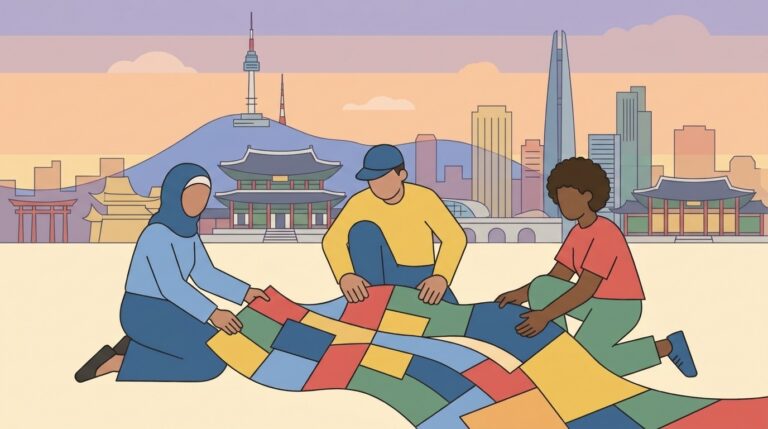
Beyond Assimilation: Weaving Korea’s Vibrant Cultural Mosaic
Phase 1: Empathy & Narrative Opening
안녕하세요! 매일한글 에디터입니다. (Hello! I’m your Daily Hangul editor.)
Picture this: You are sitting in a sleek conference room in Seongsu-dong, or perhaps sharing a late-night cup of tea with Korean colleagues after a collaborative project. The conversation shifts toward Korea’s rapidly transforming demographics. Someone sighs and remarks, “그래도 외국인들이 한국 문화에 빨리 적응해서 한국 사람처럼 되어야 할 텐데요… (Still, foreign residents should quickly adapt and become like Koreans…)”
You feel an immediate knot in your stomach. As an advanced Korean speaker at the C1 level, you understand what they mean, yet you recognize the lingering shadow of assimilationism (동화주의). You want to articulate that the future of Korea does not lie in erasing differences to fit a single mold, but in weaving a multidimensional cultural mosaic (문화 모자이크)—where reciprocal interaction, mutual respect, and interculturalism (상호문화주의) open unprecedented horizons.
Yet, words stall on your tongue. How do you advocate for genuine pluralism without sounding confrontational or resorting to bland textbook clichés? Many of our advanced learners share this exact pain point: they possess deep thoughts about society, but their Korean vocabulary defaults to simple expressions like “다문화가 좋아요 (Multiculturalism is good).”
This guide was forged directly from real workshop debates and feedback from our C1 alumni living and working in Korea. Today, you will master the elevated lexicon and communicative tact required to discuss cultural diversity with nuance, poise, and native-level sophistication.
Phase 2: Core Expressions Deep Dive
Here are three indispensable expressions that will immediately elevate your discourse when discussing societal transformation.
1. 다양성을 포용하다 (Dayangseong-eul poyonghada)
- Pronunciation: [Da-yang-seong-eul po-yong-ha-da] (Sound analogy: pronounce ‘da-yang’ like ‘die-young’ said gently, ‘seong’ like ‘sung’, and ‘po-yong’ like ‘poh-yohng’)
- Meaning: Literally “to embrace diversity.” Nuance: Actively creating space for differences rather than merely tolerating them.
- K-Culture Moment: Frequently heard during panel debates on programs like JTBC’s 비정상회담 (Abnormal Summit) or cultural forums on Arirang TV when discussing social inclusion.
- Editor’s Insight: While
인정하다(to acknowledge) is passive,포용하다carries the image of opening one’s arms to wrap around someone warmly. It connotes mature societal empathy. - Situation Spectrum:
- Casual: ⚠️ (Can sound overly poetic/grandiose with close friends)
- Semi-formal: ✅ (Great for workplace brainstorming and roundtables)
- Formal: ✅ (Essential for academic essays, media interviews, and public speaking)
- 🤔 Think About It: Does your native tongue distinguish between “tolerating” diversity and “embracing” it? How does the emotional warmth of
포용shift the conversation from policy to human connection?
2. 동화되기보다는 공존하다 (Donghwadoegibodaneun gongjonhada)
- Pronunciation: [Dong-hwa-doe-gi-bo-da-neun gong-jon-ha-da] (Sound analogy: ‘Dong-hwa’ rhymes with ‘song-bra’, ‘gong-jon’ sounds like ‘gong-zone’)
- Meaning: Literally “to coexist rather than be assimilated.” Nuance: Rejecting the melting-pot ideology in favor of a salad-bowl or mosaic paradigm where distinct cultural identities remain intact.
- K-Culture Moment: Used by visionary sociologists and independent documentary filmmakers exploring immigrant hubs like Ansan or Daerim-dong.
- Editor’s Insight: The grammar pattern
-기보다는allows you to tactfully challenge the status quo without dismissing the other speaker. It replaces a blunt “no” with a constructive alternative. - Situation Spectrum:
- Casual: ⚠️ (Slightly heavy for casual chit-chat, but natural if discussing current events)
- Semi-formal: ✅ (Perfect for coffee chats about society or company diversity initiatives)
- Formal: ✅ (Standard phrasing in editorial columns and policy critiques)
- 🤔 Think About It: In many Western societies, the term “melting pot” was once praised before being scrutinized. How does Korea’s linguistic contrast between
동화(assimilation) and공존(coexistence) mirror your own home culture’s journey?
3. 문화적 지평을 넓히다 (Munhwajeok jipyeong-eul neolphida)
- Pronunciation: [Mun-hwa-jeok ji-pyeong-eul neol-pi-da] (Sound analogy: ‘Mun-hwa’ like ‘moon-wha’, ‘ji-pyeong’ like ‘jee-pyung’, ‘neol-pi-da’ with an aspirated ‘p’)
- Meaning: Literally “to broaden cultural horizons.” Nuance: Expanding creative, intellectual, and economic possibilities through cross-cultural fusion.
- K-Culture Moment: Prominently featured in arts & culture manifestos, film festival director addresses (such as the Busan International Film Festival), and K-content export strategy debates.
- Editor’s Insight:
지평(horizon) evokes an expansive visual landscape. Pair it with수놓다(to embroider/weave) or넓히다(to broaden) to instantly mark yourself as an eloquent, visionary speaker. - Situation Spectrum:
- Casual: 🚫 (Sounds like a textbook unless said tongue-in-cheek)
- Semi-formal: ✅ (Inspiring during collaborative project pitches and vision meetings)
- Formal: ✅ (Gold-standard rhetoric in academic and public keynote settings)
- 🤔 Think About It: Why is “horizon” such an effective metaphor for the future? How does expanding horizons differ from simply “learning new things”?
Phase 3: Textbook Korean vs. Real Native Korean
Elevate your spoken register from dry textbook grammar to authentic, compelling Korean.
Situation 1: Discussing Foreign Residents Integrating into Society
- 📖 교과서 한국어 (Textbook):
외국인 주민들이 한국 문화를 빨리 배워서 한국 사람처럼 행동해야 합니다.
(Oegukin jumindeuri hanguk munhwareul ppalli baewoseo hanguk saramcheoreom haengdonghaeya hamnida.)
“Foreign residents must quickly learn Korean culture and act like Koreans.” - 🗣️ 진짜 한국어 (Real Native C1):
일방적인 동화만을 요구하기보다, 각자의 고유한 결을 살리면서 자연스럽게 어우러져야죠.
(Ilbangjeogin donghwamaneul yoguhagiboda, gakjaui goyuhan gyeoreul sallimyeonseo jayeonseureopge eoureojyeoyajyo.)
“Rather than demanding unilateral assimilation, we ought to preserve everyone’s unique texture while harmonizing naturally together.” - 💡 왜 다를까? (Why the difference?):
The textbook version defaults to an outdated, coercive framing (-해야 합니다). The native C1 version introduces the poetic word결(innate texture/grain) and soft suggestive ending-어야죠, projecting both intellectual elegance and persuasive warmth.
Situation 2: Defining Korea’s Evolving Identity
- 📖 교과서 한국어 (Textbook):
한국은 단일민족 국가에서 다문화 사회가 되었습니다.
(Hangugeun danilminjok gukgaeseo damunhwa sahoega doe-eossseumnida.)
“Korea has become a multicultural society from a single-ethnic nation.” - 🗣️ 진짜 한국어 (Real Native C1):
단색화 같던 사회에서, 다채로운 조각들이 모여 하나의 모자이크를 이루는 시대로 나아가고 있어요.
(Dansaekhwa gatdeon sahoeeseo, dachaeroun jogakdeuri moyeo hanaui mojaikeureul iruneun sidaero na-agago isseoyo.)
“We are moving away from a monochromatic society toward an era where colorful pieces assemble into a single mosaic.” - 💡 왜 다를까? (Why the difference?):
The textbook phrase sounds like a rote recitation of a middle school civics textbook. The real C1 expression uses evocative cultural metaphors (단색화– monochrome art vs.모자이크– mosaic) to paint an inspiring vision.
Phase 4: K-Culture Deep Dive & Non-Verbal Manners
4-1. 눈치 (Nunchi) & Non-Verbal Manners: Nuanced Inclusivity
When engaging in sensitive conversations around diversity in Korea, non-verbal cues carry as much weight as your grammar:
* The Mindful Nod (경청의 고개 끄덕임): When someone expresses an older or more conservative viewpoint about cultural cohesion, avoid abruptly shaking your head or sighing. Tilt your head slightly forward, nodding slowly twice (끄덕임). This signals: “I understand where your perspective originates historically, but let us explore the next step together.”
* Retiring the “Alienating Compliment”: Native speakers often unconsciously say, “한국 사람 다 됐네요! (You’re basically Korean now!)” intending it as the ultimate compliment. As an advanced speaker advocating for interculturalism, avoid adopting this phrase yourself. Instead, use: “한국 문화를 깊이 이해해주셔서 든든해요 (It is so reassuring to see you understand Korean culture so deeply).” This validates understanding without requiring the erasure of one’s origin.
* Soft Hands Gesture: When gesturing toward an inclusive concept like 모자이크 or 포용, keep both hands open with palms angled slightly upward and inward, circling toward the center chest. It visually manifests communal harmony.
4-2. Cultural Code Analysis: The Evolution of Diversity in K-Media
Korean media has undergone an astonishing shift over the past decade. In the early 2000s, non-Korean characters were framed almost exclusively as exotic outsiders (외국인 손님) who were expected to marvel at kimchi or perform total assimilation.
Today, modern K-content reflects a burgeoning intercultural reality. From the cosmopolitan, barrier-breaking restaurant crew in 이태원 클라쓰 (Itaewon Class) to modern culinary reality shows where international chefs fuse fermentation techniques with global pantry staples, diversity is no longer treated as an oddity. It is recognized as Korea’s creative fuel. Korean viewers are realizing that global soft power cannot survive in an insular echo chamber; it flourishes precisely when distinct artistic threads cross-pollinate.
Phase 5: Real-Life Roleplay Scenario
Setting: A creative think-tank conference room in Mapo-gu, Seoul. You are discussing the core theme of an upcoming city-wide international cultural festival with Team Director Min-jun.
Character: Park Min-jun (박민준 팀장) — A thoughtful, detail-oriented cultural planner who wants the event to succeed but worries about conservative public pushback.
Dialogue
민준 (Min-jun):
🎭 (서류철을 넘기며 살짝 미간을 찌푸린 채)
이번 글로벌 페스티벌 기획안 말인데요, 외국인 참가자들에게 한복 입히고 김치 담그게 하는 전형적인 프로그램은 이제 좀 식상하지 않나요?
(Ibeon geullobeol peseutibeol gihoean marindeyo, oegukin chamgajadeurege hanbok iphigo gimchi damgeuge haneun jeonhyeongjeogin peurogeuraemeun ije jom siksanghaji annayo?)
“Regarding this global festival proposal… don’t you think typical programs like having foreign attendees dress in Hanbok and make Kimchi have become a bit stale?”
You (Alex):
🎭 (고개를 가볍게 끄덕이며 차분한 미소를 짓고)
맞아요, 팀장님. 일방적으로 우리 문화를 체험하게 하는 건 동화주의적인 발상에 머물 수 있죠.
(Maj-ayo, timjangnim. Ilbangjeogeuro uri munhwareul cheheomhage haneun geon donghwaju-uijeogin balsang-e meomul su itjyo.)
“You are spot on, Director. Unilaterally having them experience our culture can remain stuck in an assimilationist mindset.”
민준 (Min-jun):
🎭 (흥미롭다는 듯 안경을 고쳐 쓰며)
동화주의라… 그렇다면 알렉스 씨는 어떤 방향이 더 의미 있다고 봐요?
(Donghwaju-uira… Geureotamyeon Allekkseu ssineun eotteon banghyang-i deo uimi itdago bwayo?)
“Assimilationism… If so, Alex, which direction do you consider more meaningful?”
You (Alex):
🎭 (양손을 부드럽게 모으며 확신에 찬 어조로)
단순한 보여주기식 행사를 넘어서, 서로 다른 문화가 동등하게 교류하는 상호문화주의적 접근이 필요하다고 생각해요.
(Dansunhan boyeojugisik haengsareul neomeoseo, seoro dareun munhwaga dongdeunghage gyoryuhaneun sanghomunhwaju-uijeok jeopgeuni piryohadago saenggakhaeyo.)
“Beyond mere performative showcases, I believe we need an intercultural approach where distinct cultures interact on equal footing.”
민준 (Min-jun):
🎭 (턱을 괴며 깊이 고민하듯)
상호문화주의라… 취지는 참 좋은데, 일반 시민들이 거리감 없이 받아들일 수 있을까요?
(Sanghomunhwaju-uira… Chwijineun cham joeunde, ilban simindeuri georigam eop-si badadeuril su isseulkkayo?)
“Interculturalism… The intent is truly noble, but will everyday citizens be able to embrace it without feeling a sense of distance?”
You (Alex):
🎭 (자료 화면을 가리키며 열정적으로 눈을 맞추고)
차이를 두려워하기보다 다채로운 문화 모자이크를 수놓을 때 도시의 브랜드 가치도 훨씬 풍성해지니까요.
(Chaireul duryeowohagiboda dachaeroun munhwa mojaikeureul sunoheul ttae dosi-ui beuraendeu gachido hwolssin pungseonghaejinikkayo.)
“Because rather than fearing difference, when we weave a vibrant cultural mosaic, our city’s brand value will become infinitely richer.”
민준 (Min-jun):
🎭 (환하게 웃으며 테이블을 가볍게 톡 치며)
‘문화 모자이크’라는 비유가 와닿네요! 기획서 메인 카피로 바로 밀고 나가봅시다.
(‘Munhwa mojaikeu’raneun biyuga wadatneyo! Gihoekseo mein kapiro baro milgo nagabopsida.)
“The ‘cultural mosaic’ metaphor really hits home! Let’s push forward with that as our proposal’s main tagline.”
You (Alex):
🎭 (서류를 정돈하며 밝게 답하며)
감사합니다, 팀장님. 두 문화의 경계를 허무는 세부 워크숍 안도 곧 정리해 올리겠습니다.
(Gamsahamnida, timjangnim. Du munhwaui gyeonggyereul heomuneun sebu wokeusyop ando got jeongrihae olligessseumnida.)
“Thank you, Director. I will soon outline detailed workshop plans that break down the borders between cultures.”
🔀 Interactive Choice Point
At turn 4, if Min-jun had asked: “우리 시민들이 다문화라는 단어에 아직 피로감을 느끼지 않을까요? (Don’t our citizens still feel fatigued by the word ‘multicultural’?)”, how would you respond?
- Option A: “그럼 다문화라는 말 대신 ‘글로벌 상생’ 같은 세련된 단어로 포장해서 홍보만 그럴듯하게 하죠.” (Best / Bad / Risk: Risk – Evades substance; sounds cynical and PR-driven.)
- Option B: “맞습니다. 그래서 ‘도움을 받는 수혜자’로서의 다문화 프레임을 깨고, 동등하게 미래를 함께 만드는 파트너십을 보여줘야 합니다.” (Best / Bad / Risk: BEST – Directly deconstructs paternalism with sharp C1 socio-political awareness.)
- Option C: “시민들의 인식이 아직 부족해서 그런 것이니 공익광고를 더 많이 틀어야 합니다.” (Best / Bad / Risk: Bad – Patronizing, tone-deaf, and alienates everyday citizens.)
Phase 6: 10-Second Emotional Shadowing Drill
Practice breathing through these rhythmically marked sentences to master authentic cadence and rhetorical conviction.
- Sentence 1:
[🤝 확신에 차서 진지하게 - With grounded conviction and sincerity]
일방적인 / 동화만을 요구하기보다 / 각자의 고유한 결을 살리는 것이 / 진정한 상호문화주의입니다.
(Ilbangjeogin / donghwamaneul yoguhagiboda / gakjaui goyuhan gyeoreul sallineun geosi / jinjeonghan sanghomunhwaju-ui-imnida.)
“Rather than demanding / unilateral assimilation / preserving everyone’s inherent texture / is true interculturalism.” -
Sentence 2:
[✨ 희망차고 따뜻하게 - Warmly, filled with visionary optimism]
서로의 다름을 / 두려워하지 않고 포용할 때 / 한국 사회의 문화적 지평도 / 한층 넓어질 것입니다.
(Seoroui dareumeul / duryeowohaji anko poyonghal ttae / hanguk sahoe-ui munhwajeok jipyeongdo / hancheung neolbeojil geosimnida.)
“When we embrace / differences without fear / the cultural horizon of Korean society / will broaden substantially.” -
Sentence 3:
[💡 명쾌하고 통찰력 있게 - Crisp, lucid, and insightful]
다채로운 문화 조각들이 / 유기적으로 어우러질 때 / 비로소 독창적인 모자이크가 / 완성되죠.
(Dachaeroun munhwa jogakdeuri / yugijeogeuro eoureojil ttae / biroso dokchangjeogin mojaikeuga / wanseongdoejyo.)
“Only when diverse cultural pieces / harmonize organically / is an original mosaic / truly complete.”
Phase 7: K-Culture Mini Dictionary
- 상호문화주의 (Sanghomunhwaju-ui) | Interculturalism
- Beyond mere passive multicultural coexistence (다문화주의), this refers to active two-way dialogue, mutual transformation, and reciprocal learning between different cultural groups in civic spaces.
- 다채로움 (Dachaeroum) | Rich variety / Multicolor vibrancy
- Originating from
다채롭다(variegated, colorful), this word denotes aesthetic and intellectual richness stemming from diverse elements flourishing simultaneously.
- Originating from
- 결 (Gyeol) | Innate grain / Texture / Character
- Originally referring to the grain of fine wood or waves of water, in modern sociological parlance it expresses someone’s intrinsic identity, rhythm, or cultural uniqueness that should not be artificially flattened.
- 문화 모자이크 (Munhwa Mojaikeu) | Cultural Mosaic
- A sociological metaphor contrasting the “melting pot” (용광로 모델). It describes a society where distinct immigrant communities preserve their identities while creating an integrated, harmonious collective picture.
Phase 8: Traveler & Resident Survival Kit
TOP 3 Civic Discourse Phrases
- 서로의 다름을 인정하는 태도가 필요해요. (Seoroui dareumeul injeonghaneun taedoga piryohaeyo.)
- Pro Tip: Use this to defuse rigid assumptions gracefully during workplace meetings or neighborhood committee discussions.
- 틀린 게 아니라 서로 다른 것뿐이잖아요. (Teullin ge anira seoro dareun geotppun-ijanhayo.)
- Pro Tip: The ultimate conversational equalizer. It reminds native speakers of the linguistic confusion between
틀리다(to be wrong) and다르다(to be different).
- Pro Tip: The ultimate conversational equalizer. It reminds native speakers of the linguistic confusion between
- 다양성이야말로 조직의 가장 큰 경쟁력입니다. (Dayangseong-iyamallo jojik-ui gajang keun gyeongjaengnyeok-imnida.)
- Pro Tip: The gold-standard line during business presentations or interviews to champion diversity as an operational asset.
Editor’s Travel Note: Discovering Dynamic Mosaic Hubs
To experience Korea’s intercultural reality beyond tourist brochures, take the subway out to Ansan Multicultural Food Street (안산 다문화음식거리) near Wongok-dong. Here, hundreds of authentic community-run eateries from over 20 countries thrive alongside local Korean markets.
- Download the local transport guide via the Naver Map Application to navigate the alleyways of Ansan and Daerim with pinpoint accuracy.
- For deeper civic involvement and language resources, bookmark the Danuri Multicultural Family Portal which offers multi-lingual civic guidelines, legal workshops, and exchange seminars across Korea.
Phase 9: A Step Deeper (“한 발 더 깊이”)
For decades, the myth of the “single-race nation” (단일민족 신화) was wielded as a survival tool—a psychological fortress that united Koreans through colonial devastation, war, and grueling industrialization. Yet, in our interconnected era, clinging to an insular definition of “Koreanness” risks stifling the very dynamic creativity that catapulted Hallyu across the globe. Transitioning toward true interculturalism (상호문화주의) does not dilute Korea’s identity; it enriches it, transforming ancient heritage into a multifaceted global dialogue where belonging is defined not by ancestral bloodlines, but by shared civic commitment.
💬 Your Turn: Have you ever experienced a moment in Korea where your own cultural background was celebrated as a unique contribution rather than an obstacle to assimilate? Share your story in the comments below!
Phase 10: FAQ & Mistake Prevention
Q: Why do many Koreans still use ‘틀리다’ instead of ‘다르다’ when talking about cultural differences?
A: Historically and colloquially, colloquial Korean frequently conflated 다르다 (different) with 틀리다 (incorrect/wrong). While younger Koreans are increasingly diligent about using 다르다, older generations may slip unintentionally. When you hear this, do not assume malice; gently model the correct phrasing by replying with 다르다 in your next sentence: “네, 방식이 서로 확실히 다르네요 (Yes, our methods are certainly different).”
Q: Is the word ‘다문화 (Damunhwa)’ perceived negatively in Korea today?
A: In legal and institutional contexts, 다문화가정 (multicultural family) remains standard. However, in popular culture, the term has occasionally suffered from paternalistic overtones, implying families in need of state welfare or assimilation. Advanced speakers increasingly favor phrasing like 이주민 (migrant residents), 글로벌 시민 (global citizens), or 문화적 다양성 (cultural diversity) to emphasize agency and parity.
Q: How can I respectfully push back if someone says ‘우리나라 문화에 맞춰야지’ (You must adjust to our country’s culture)?
A: Acknowledge their intention first, then widen the scope: “물론 기본 규범은 지켜야겠지만, 서로의 장점이 어우러질 때 사회가 더 건강하게 발전할 수 있지 않을까요? (Of course, baseline norms must be honored, but won’t our society advance much more healthily when our respective strengths harmonize?)”
🚨 Common Mistakes Warning Board
- Mistake 1: Saying “우리는 문화가 틀려요” ❌
- Correct Action: Say “우리는 문화적 배경이 달라요” ✅ (
틀리다implies moral fault; always use다르다for diversity).
- Correct Action: Say “우리는 문화적 배경이 달라요” ✅ (
- Mistake 2: Equating multiculturalism solely with food or clothing (e.g., “이태원 음식 맛있어서 다문화가 좋아요”). ❌
- Correct Action: Ground your rationale in civic and intellectual enrichment (e.g., “다양한 시각이 더해질 때 혁신적인 아이디어가 나오니까요”). ✅
- Mistake 3: Overusing English loanwords like 인터컬처럴리즘 when pure Sino-Korean terminology exists. ❌
- Correct Action: Confidently use
상호문화주의 (Sanghomunhwaju-ui)—it instantly commands academic and professional respect. ✅
- Correct Action: Confidently use
Phase 11: Action Mission & Engagement
- 🥉 Bronze Level: Stand before a mirror and record yourself shadowing the 3 sentences from Phase 6, focusing on natural pauses at every
/mark. - 🥈 Silver Level: Write a short 3-sentence commentary on your social media about a multi-ethnic movie or K-drama, utilizing the expression
다양성을 포용하다and문화적 지평을 넓히다. - 🥇 Gold Level: During your next meeting, language exchange, or coffee chat with a Korean colleague, initiate a gentle conversation on how workplaces can embrace
상호문화주의적 가치 (intercultural values). - 🎮 K-Culture Mission: Watch an episode of a modern Korean documentary or debate program dealing with local communities (e.g., KBS 다큐 인사이트 or 비정상회담 reruns). Transcribe three moments where speakers discuss integration vs. diversity, noting down their non-verbal gestures.
Phase 12: Interactive Quiz Challenge
Test your mastery of advanced intercultural discourse!
1. Situational Judgment
During a strategy session, a team member says: “외국인 인재들이 한국식 수직적 회식 문화에 무조건 적응해야 진정한 팀원이 되는 거죠.” Which of the following responses represents the most articulate C1 intercultural critique?
* (A) “그건 틀린 생각입니다. 회식 문화를 당장 없앱시다.”
* (B) “일방적인 동화보다는, 서로의 업무 스타일을 존중하며 새로운 팀 문화를 함께 수놓는 게 지속 가능하지 않을까요?”
* (C) “한국 문화니까 외국인들이 무조건 참아야 합니다.”
🔍 Click here for the Answer & In-Depth Explanation
Correct Answer: (B)
Explanation: Option (A) is combatively blunt and unproductive. Option (C) accepts rigid assimilation. Option (B) brilliantly employs the soft query -지 않을까요?, introduces 동화 vs. 상호 존중, and elevates the tone using the vivid metaphor 수놓다 (to weave/embroider together).
2. Fill-in-the-Blank
Complete the sentence using the most sophisticated vocabulary learned today:
“우리는 단순히 차이를 참아내는 단계를 넘어, 서로의 고유한 결을 인정하고 ________을(를) 적극적으로 실천해야 합니다.”
🔍 Click here for the Answer & In-Depth Explanation
Correct Answer: 상호문화주의 (Interculturalism) (or 다양성 포용)
Explanation: The sentence establishes a progression beyond passive tolerance (차이를 참아내는 단계) toward active, mutual, dynamic engagement, which is the textbook definition of 상호문화주의.
3. True or False Cultural Quiz
Statement: In modern advanced Korean discourse, comparing society to a 모자이크 (Mosaic) carries a more progressive, pluralistic nuance than describing it as a 용광로 (Melting Pot).
* [ True / False ]
🔍 Click here for the Answer & In-Depth Explanation
Correct Answer: True
Explanation: 용광로 (Melting Pot) symbolizes melting away all individual cultural distinctions into a single dominant identity (동화주의). In contrast, 모자이크 (Mosaic) honors the individual color and edges of each distinct piece while celebrating the collective masterpiece they form together.






