

Phase 1: Empathy (Story-Immersive Opening)
안녕하세요! 매일한글 에디터입니다. (Annyeonghaseyo! Daily Hangul Editor here.)
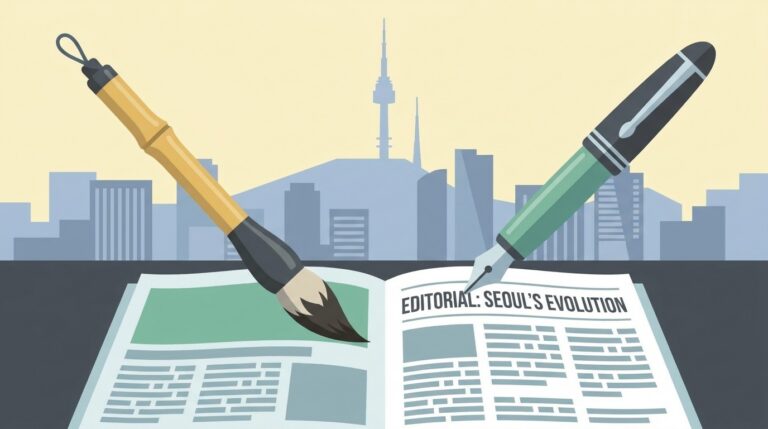
Picture this: You are watching a high-stakes Korean political drama like Argon or The Devil Judge. The scene shifts to the editorial desk of a major Seoul daily at midnight. The chief editor slaps a draft column onto the desk, scowling: “이건 그냥 불평불만이잖아! 그래서 대안이 뭔데?” (Igeon geunyang bulpyeongbulman-ijana! Geuraeseo daeani mwonde? – “This is merely a list of grievances! What is the institutional remedy?”).
If you have ever attempted to draft an opinion column or sit for an advanced C2-level Korean writing examination like TOPIK II Level 6+, you know this exact frustration. You have mastered complex grammar like -을 뿐만 아니라 (-eul ppunman anira) and vocabulary like 사회적 폐해 (sahoejeok pyehae – social evils). You tear into contemporary issues—housing unaffordability, youth burnout, demographic decline—with impassioned rhetoric. Yet, your native Korean readers or mentors pause, sigh, and remark: “진단은 좋은데, 용두사미네요.” (Jindaneun joeunde, yongdusamineyo. – “The diagnosis is sound, but it ends in an anticlimactic whimper.”)
In Korean journalistic culture, an editorial that merely laments a crisis without outlining actionable, policy-level remedies is dismissed as a “비판을 위한 비판” (bipaneul wihan bipan – critique for critique’s sake). True mastery of Korean op-ed architecture (기명 칼럼) requires moving past visceral critique. You must deliver viable institutional blueprints (제도적 대안과 로드맵) and seal your argument with a razor-sharp epigrammatic closing: 촌철살인 (寸鐵殺人, Choncheolsarin)—literally, “a tiny piece of iron that strikes the heart of the matter.”
Based on feedback from senior foreign correspondents and scholars at Seoul’s press forums, mastering this leap transforms your Korean from academically correct to institutionally persuasive. Let us bridge that gap together today.
Phase 2: Core Expressions Deep Dive
Here are three indispensable expressions that separate standard intermediate critique from high-level, policy-shaping editorial writing.
1. 미봉책에 그치지 않고 제도적 기틀을 마련하다
- Pronunciation: [Mibongchaege geuchiji anko jedojeok giteureul maryeonhada] (Sound analogy: mee-bong-check-eh geu-chee-jee ahn-ko jeh-doh-jeok gee-teul-eul mah-ryeon-hah-dah)
- Meaning: Literal: “Not stopping at makeshift patch-up measures, but establishing an institutional framework.” / Nuance: Denounces superficial band-aid solutions while demanding systemic, legislative transformation.
- K-Culture Moment: Heard during fiery televised parliamentary audit hearings (국정감사) when lawmakers confront ministers over repetitive workplace safety accidents.
- Editor’s Insight:
미봉책(Mibongchaek) originated from sewing clothes loosely to temporarily hide a tear. In modern editorials, pair it with근본적 처방(fundamental prescription) or제도적 기틀to instantly elevate your register. - Situation Spectrum: Casual: 🚫 | Semi-formal: ⚠️ | Formal: ✅
- 🤔 Think About It: Does your native language distinguish so sharply between pragmatic executive action and foundational, structural overhaul?
2. 탁상공론을 넘어 실효성 있는 로드맵을 제시하다
- Pronunciation: [Taksanggongroneul neomeo silhyoseong inneun rodeumaebeul jesihada] (Sound analogy: tahk-sahng-gong-rohn-eul neom-eo sheel-hyoh-seong eent-neun roh-deu-maep-eul jeh-shee-hah-dah)
- Meaning: Literal: “Transcending desk-bound empty discussions to propose an effective roadmap.” / Nuance: Calling out bureaucratic ivory-tower theorizing and demanding pragmatic, ground-level policy sequencing.
- K-Culture Moment: Often used in editorial columns in newspapers like the Chosun Ilbo or Hankyoreh when critiquing municipal development or education reform.
- Editor’s Insight:
탁상공론(Taksanggongron – “table-top empty debate”) is the ultimate weapon against policy proposals that ignore real-world market friction. Counterbalancing it with실효성(tangible effectiveness) establishes you as an analytical realist. - Situation Spectrum: Casual: ⚠️ | Semi-formal: ✅ | Formal: ✅
- 🤔 Think About It: How does naming bureaucratic inaction as “desk talk” shift the burden of proof back onto policymakers in your culture?
3. 촌철살인의 필치로 결착을 짓다
- Pronunciation: [Choncheolsarin-ui pilchiro gyeolchageul jitta] (Sound analogy: chohn-cheol-sah-reen-wee peel-chee-roh gyeol-chah-geul jeet-dah)
- Meaning: Literal: “Reaching a final conclusion with the writing style of a heart-piercing weapon.” / Nuance: Delivering a succinct, unforgettable closing line that crystallizes the editorial’s moral and institutional thesis.
- K-Culture Moment: When prominent guest columnists (논설위원) write their final anchor sentence on the back page of Sunday broadsheets.
- Editor’s Insight: This four-character idiom (사자성어) does not mean literal violence. It implies dismantling an opponent’s faulty premise with one singular, piercing truth rather than paragraphs of repetitive moralizing.
- Situation Spectrum: Casual: 🚫 | Semi-formal: ⚠️ | Formal: ✅
- 🤔 Think About It: Why does Korean rhetoric value concise, epigrammatic endings over long summaries in opinion writing?
Phase 3: Textbook Korean vs. Real Korean
Notice the vast difference between textbook-style formal statements and native C2 journalistic authority.
Situation 1: Calling for policy changes regarding low birth rates
- 📖 교과서 한국어 (Textbook): 정부는 저출산 문제를 해결하기 위해 지원금을 더 많이 줘야 하고 좋은 정책을 만들어야 합니다. (Jeongbuneun jeochulsan munjeleul haegyeolhagi wihae jiwongeumeul deo mani jwoya hago joeun jeongchaegeul mandeureoya hamnida. – The government must provide more subsidies and create good policies to solve the low birth rate problem.)
- 🗣️ 진짜 한국어 (Real C2 Editorial): 단순 현금성 살포라는 미봉책을 걷어내고, 양육 인프라 구축과 법제화를 아우르는 중장기 로드맵을 설계해야 한다. (Dansun hyeongeumseong salporeul geodeonaego, yang-yuk impeura guchuk-gwa beopjehwareul aureoneun jungjanggi rodeumaebeul seolgyehayeoya handa. – We must strip away makeshift cash handouts and design a medium-to-long-term roadmap that encompasses childcare infrastructure and statutory codification.)
- 💡 왜 다를까? Textbook Korean relies on subjective evaluative adjectives like
좋은(good) and colloquial auxiliary verbs like-어 주다. Native editorial Korean deploys actionable systemic nouns (인프라 구축,법제화) and assertive literary endings (-해야 한다).
Situation 2: Concluding an editorial on environmental regulations
- 📖 교과서 한국어 (Textbook): 환경 오염이 심각하니 우리 모두 조심해야 하고 기업들도 환경을 생각해야 합니다. (Hwangyeong oyeomi simgakhani uri modu josimhaeya hago gieopdeuldo hwangyeongeul saenggakhaeya hamnida. – Because environmental pollution is severe, we must all be careful and corporations should consider the environment.)
- 🗣️ 진짜 한국어 (Real C2 Editorial): 기후 위기 대응은 선의에 기댄 구호가 아니라, 시장 진입 기준을 재편하는 징벌적 규제와 인센티브의 정교한 줄타기여야 한다. (Gihu wigi dae-eungeun seon-uie gidaen guhoga anira, sijang jinip gijuneul jaepyeonhaneun jingbeoljeok gyujewa insenteibeu-ui jeonggyohan jultagi-yeoya handa. – Climate crisis response must not be a slogan reliant on goodwill, but an exquisite tightrope walk between punitive regulations reshaping market entry and structured incentives.)
- 💡 왜 다를까? C2 discourse replaces sentimental appeals to “goodwill” (
선의) with macroeconomic mechanisms (징벌적 규제,인센티브).
Phase 4: K-Culture Deep Dive & Non-Verbal Manners
4-1. Nunchi & Rhetorical Demeanor in the Seoul Press Club
When presenting an op-ed pitch or debating on a Korean current affairs program (such as MBC 100-Minute Debate), your non-verbal cues carry as much weight as your prose.
* The Steady Micro-Nod: Never shake your head vigorously when an opponent brings up counter-evidence. Instead, maintain a steady gaze, perform a minimal head-nod (목례/고개 끄덕임), and calmly jot down notes on paper. This projects the stance of an intellectual who acknowledges data before dismantling its framework.
* Vocal Modulation: Avoid raising your pitch when critiquing public institutions. In Korean public intellectual circles, emotional escalation is perceived as an absence of empirical evidence. Drop your register into a measured, baritone cadence with distinct sentence terminality (-ㅂ니다, -다).
4-2. Cultural Code Analysis: The Yeouido Policy Echo Chamber
In South Korea’s political heartland, Yeouido (여의도), op-eds published in major morning papers are clipped and delivered to assembly members (국회의원) by 7:00 AM. If an editorial merely scolds the ruling or opposition party, it gets trashed. But if a columnist outlines: “1단계: 공청회 개최, 2단계: 관련 법 개정안 발의” (Stage 1: Public hearing; Stage 2: Introduction of statutory amendments), that column transforms into legislative agenda. Media columns in Korea are an informal branch of governance, creating direct social traction through actionable roadmaps.
Phase 5: Real-World Roleplay Scenario
Setting: The high-rise editorial office of The Hankook Forum. You are meeting with Senior Chief Editorial Writer, Park Min-seok (박민석 논설위원), to finalize your guest column on regulating AI in financial markets.
- Turn 1 (Editor Park): 이번 초고 잘 읽었습니다. 전반부의 알고리즘 폐해 지적은 날카로운데, 후반부 결론이 조금 공허하네요. (I read your first draft carefully. Your critique of algorithmic abuse in the first half is sharp, but the conclusion in the second half feels somewhat hollow.)
🎭 Action:Tapping the printout with his pen, looking over reading glasses.
- Turn 2 (You): 어떤 측면에서 보완이 필요하다고 보십니까? (In what respect do you see a need for supplementation?)
🎭 Action:Leaning forward attentively, open notebook ready.
- Turn 3 (Editor Park): “규제를 강화해야 한다”는 누구나 할 수 있는 말이잖아요. 금융 현장에 먹힐 제도적 대안이 빠져 있어요. (Anyone can say “regulations must be strengthened.” You’ve omitted institutional remedies that will actually take hold in the financial sector.)
🎭 Action:Leaning back in his leather chair, crossing arms thoughtfully.
- Turn 4 (You): 단순히 처벌 조항을 늘리기보다, 알고리즘 감사 권한을 제3자 기구에 위탁하는 구체적 로드맵을 제시하면 어떨까요? (Rather than simply increasing penal clauses, what if I propose a concrete roadmap commissioning algorithm audit authority to a third-party agency?)
🎭 Action:Pointing confidently to section 3 of your notes.
- Turn 5 (Editor Park): 바로 그겁니다! 그 대안을 법안 개정 일정과 맞물려 서술할 수 있겠어요? (That’s precisely it! Can you articulate that remedy in tandem with the legislative amendment schedule?)
🎭 Action:Eyes lighting up, tapping the desk enthusiastically.
- Turn 6 (You): 네, 자본시장법 개정안의 계류 현황을 짚고, 단계적 시행령 개정이라는 실천적 경로를 명시하겠습니다. (Yes, I will highlight the current pending status of the Capital Markets Act amendments and delineate a practical pathway via phased presidential enforcement decrees.)
🎭 Action:Nodding crisply while summarizing the structure.
- Turn 7 (Editor Park): 좋습니다. 그리고 마지막 결구는 도덕적 훈계 대신 칼럼 전체를 관통하는 촌철살인 한 문장으로 마무리해 주세요. (Excellent. And ensure the final conclusion wraps up with a single razor-sharp epigrammatic line penetrating the entire column, instead of moral preaching.)
🎭 Action:Handing you back the edited draft with a firm smile.
- Turn 8 (You): 독자의 뇌리에 각인될 명료한 결구를 준비해 오늘 일몰 전까지 송고하겠습니다. (I will prepare a lucid conclusion that will be etched into readers’ minds and submit the final file before sunset.)
🎭 Action:Standing up, bowing slightly at a 15-degree angle.
🔀 Interactive Choice Branch
At Turn 4, if you had responded differently, how would Editor Park react?
- Option A: “그냥 정부가 적극적으로 나서서 시민 사회와 소통해야 한다는 당위론을 더 힘주어 강조하겠습니다.” (I will just emphasize more forcefully the imperative that the government must actively step up and communicate with civil society.)
- Outcome (Bad): ❌ Editor Park rejects the draft: “그건 신문 칼럼이 아니라 대학교 교양 과제 수준의 공허한 선언입니다.” (That’s not a newspaper column; that’s an empty declaration on the level of an undergraduate assignment.)
- Option B: “처벌 수위를 미국 수준인 징역 20년으로 대폭 상향하자는 급진적 여론을 전면에 내세우겠습니다.” (I will spotlight radical public opinion calling for sentences to be hiked drastically to 20 years like in the US.)
- Outcome (Risk): ⚠️ Editor Park sighs: “통쾌할지는 몰라도, 한국의 현행 형법 체계와 비례성의 원칙상 현실성이 떨어져 역풍을 맞습니다.” (It might feel cathartic, but it lacks feasibility under Korea’s criminal justice system and principle of proportionality, inviting severe backlash.)
- Option C: “단순히 처벌 조항을 늘리기보다, 알고리즘 감사 권한을 제3자 기구에 위탁하는 구체적 로드맵을 제시하면 어떨까요?” (Rather than simply increasing penal clauses, what if I propose a concrete roadmap commissioning algorithm audit authority to a third-party agency?)
- Outcome (Best): ✅ Editor Park approves: Pragmatic, actionable, institutional policy traction achieved.
Phase 6: 10-Second Emotion Shadowing Drill
Read these actual editorial lines aloud, respecting the rhythm markers (/) and emotional tone cues.
- [🔥 결연하고 단호하게 – Resolute & Decisive]
미봉책으로 / 위기를 모면하려는 시도는 / [pause] 더 큰 사회적 비용을 / 부를 뿐이다.
(Mibongchaeg-euro / wigireul momyeonharyeoneun sidoneun / deo keun sahoejeok biyong-eul / bureul ppunida.)
Attempting to evade crisis through stopgap measures / will only invite / greater social cost. -
[🧐 냉철하고 설득력 있게 – Cool-headed & Persuasive]
탁상공론에 머무는 구호는 / 공허하다. / [pause] 현장의 목소리를 담아낸 / 입법 로드맵만이 / [pause] 실효성을 담보한다.
(Taksanggongron-e meomuneun guhoneun / gongheohada. / Hyeonjang-ui moksorireul damanaen / ipbeop rodeumaepmani / silhyoseong-eul dambohanda.)
Slogans idling in desk-bound theorizing / are empty. / Only a legislative roadmap / reflecting on-site voices / guarantees real-world efficacy. -
[⚡ 촌철살인의 무게감으로 – Piercing & Weighty Epigram]
개혁의 성패는 / 비판의 목청이 아니라, / [pause] 디테일한 제도의 설계도에서 / 판가름 난다.
(Gaehyeok-ui seongpaeneun / bipan-ui mokcheong-i anira, / dite-ilhan jedoui seolgyedo-eseo / pangareum nanda.)
The success or failure of reform / hinges not on the volume of one’s critique, / but on the detailed architectural blueprints of the institution.
Phase 7: K-Culture Mini Dictionary
-
촌철살인 (Choncheolsarin / 寸鐵殺人)
- Translation: A razor-sharp epigram; striking the vital point with a single succinct phrase.
- Usage: Used to describe an extraordinary final sentence in an essay, column, or debate rebuttal that completely reframes the entire discourse.
- 탁상공론 (Taksanggongron / 卓上空論)
- Translation: Desk-bound, ivory-tower armchair theorizing.
- Usage: Indispensable when pointing out policies devised by central bureaucrats who have never visited factories, small businesses, or local schools.
- 미봉책 (Mibongchaek / 彌縫策)
- Translation: Stopgap band-aid measure; superficial plastering.
- Usage: Applied to short-term emergency subsidies or public relations campaigns that dodge fundamental structural reform.
- 법제화 (Beopjehwa / 法制化)
- Translation: Statutory codification / Legislative institutionalization.
- Usage: Crucial for editorial conclusions. Changing social behavior in Korea sustainably requires turning agreements into formal statutes through the National Assembly.
Phase 8: Traveler and Researcher Survival Kit
If you are visiting Seoul to conduct policy research, engage with academic think tanks, or tour the National Assembly Press Center (국회 소통관), keep these survival phrases at your fingertips:
- TOP 1 Survival Line: 정책의 실효성을 담보할 구체적인 로드맵이 있습니까? (Jeongchaeg-ui silhyoseong-eul dambohal guchejeogin rodeumaebeul isseumnikka? – Is there a concrete roadmap to ensure the practical effectiveness of this policy?)
- Pro Tip: Use this during Q&A sessions at academic conferences; you will instantly command respect.
- TOP 2 Survival Line: 단순한 일회성 예산 지원 외에 법제화 추진 계획은 무엇인가요? (Dansunhan ilhoeseong yesan jiwon oe-e beopjehwa chujin gyehoegeun mueosingayo? – Beyond one-off budgetary grants, what are the plans to pursue legislative codification?)
- Pro Tip: Cuts straight to the sustainability of NGO or municipal projects.
- TOP 3 Survival Line: 이번 사안의 본질을 짚는 결저 문안을 다듬고 있습니다. (Ibeon saan-ui bonjireul jinneun gyeoljeo mun-aneul dadeumgo isseumnida. – I am refining the concluding draft sentences that grasp the essence of this matter.)
- Pro Tip: Perfect when collaborating with Korean co-authors on policy papers.
Editor’s Travel & Research Note:
If you are heading to Yeouido for legislative research, make sure you access the official National Assembly Bill Information System to track pending bills referenced in your writings. When riding the Seoul Subway Line 9 to the National Assembly Station (국회의사당역), keep quiet during peak rush hour—professionals around you are reading those very morning editorials on their tablets!
Phase 9: Deep Reflection (“한 발 더 깊이”)
In traditional Korean rhetoric, rooted deeply in Confucian communicative ethics (유교적 담론 규범), writing was never viewed as a detached intellectual sport. Critique carried direct karmic and civic responsibility. To criticize the state without providing a remedy was historically termed “망언” (mangeon – reckless talk). Today’s high-level Korean op-ed culture preserves this exact ethos: authority does not come from how brutally you tear down an opponent, but from the dignity, institutional viability, and communal restoration presented in your final lines.
💬 Your Turn: In your home country, what holds more social influence in media op-eds: impassioned ideological rhetoric or technical policy solutions? Let me know in the comments below!
Phase 10: FAQ & Avoiding Misunderstandings
Q: Can I use the phrase “촌철살인” to describe someone’s speech in everyday casual situations?
A: Be careful! If a friend makes a funny, sharp joke at dinner, calling it 촌철살인 sounds excessively dramatic and pedantic. In casual settings, use 팩트 폭격 (paekteu pokgyeok – “fact bomb”) or 사이다 발언 (saida bareon – “refreshing, straight-shooting remark”). Reserve 촌철살인 for formal debates, critical essays, and journalism.
Q: How long should the policy roadmap section be in an 800-word Korean editorial?
A: Follow the classic Ki-Seung-Jeon-Gyeol (기승전결) structure. Spend 40% on framing and analyzing the systemic failure, but dedicate at least 35-40% to concrete institutional proposals. The final 10-15% must be your epigrammatic closure.
Q: Is ending an op-ed with “~을 기대해 본다” (I look forward to…) acceptable at C2 level?
A: It is grammatically correct, but stylistically weak for an influential column. Native columnists often call -을 기대해 본다 an evasive, passive cop-out. Instead, use definitive declarations: ~을 마련해야 할 시점이다 (It is high time to establish…) or ~에 성패가 달려 있다 (Success hinges upon…).
🚨 Common Mistakes Checklist
- ❌ Mistake 1: Ending with broad moralizing like
모두가 양심을 지켜야 한다(Everyone must protect their conscience).- 👉 Correct Action: Anchor it to institutional frameworks:
제도적 감시망을 촘촘히 엮어야 한다(We must weave a tight institutional oversight net).
- 👉 Correct Action: Anchor it to institutional frameworks:
- ❌ Mistake 2: Overusing emotional adverbs like
너무나,진짜로,엄청.- 👉 Correct Action: Replace with academic/journalistic amplifiers like
극히,심대하게,현저히.
- 👉 Correct Action: Replace with academic/journalistic amplifiers like
- ❌ Mistake 3: Failing to mention counter-arguments before presenting your roadmap.
- 👉 Correct Action: Concede the friction using
물론 ~라는 우려가 상존하나, ~(Of course, concerns that… remain, nevertheless…).
- 👉 Correct Action: Concede the friction using
Phase 11: Action Missions
- 🥉 Bronze Mission (Solo Mastery): Take a complaint you have about your neighborhood (e.g., trash recycling, public transport delays) and write a single 3-sentence paragraph using
미봉책,제도적 기틀, and실효성 있는 로드맵. - 🥈 Silver Mission (Social/Media Hunt): Open the editorial section of a Korean news portal today. Find one concluding sentence that fits the description of
촌철살인. Screenshot it and analyze its grammatical ending. - 🥇 Gold Mission (Real-World Op-Ed Pitch): Draft a complete 500-word Korean column arguing for a specific cultural or educational reform, featuring a 2-stage policy roadmap and zero vague moralizations.
- 🎮 K-Culture Mission: Watch an episode of a political drama like The Whirlwind (돌풍) or Stranger (비밀의 숲). Listen for the moment a character uses the word
대안(remedy) or제도(institution) in a press conference scene!
Phase 12: Interactive Quiz Challenge
Test your grasp of C2 editorial rhetoric!
1. Situational Judgment:
You are wrapping up a major op-ed regarding real estate speculation. Which concluding sentence delivers the strongest institutional authority and policy traction?
(A) 시민들이 욕심을 버리고 착하게 살아야 집값이 안정될 것이다.
(B) 단순 대출 규제라는 미봉책을 넘어, 공급과 세제 개혁을 포괄하는 중장기 로드맵만이 시장의 신뢰를 회복할 수 있다.
(C) 집값이 너무 올라서 젊은이들이 힘드니 정부는 반성해야 한다.
2. Fill in the Blank:
현실과 동떨어진 ( ________ )에 매몰된 정책은 국민의 혈세만 낭비할 뿐이다. (Policies mired in armchair, desk-bound theorizing divorced from reality will merely squander citizens’ hard-earned tax dollars.)
3. True or False:
In modern Korean op-ed architecture, concluding your article with a famous ancient Chinese proverb without connecting it to contemporary statutory laws is considered the golden standard of modern editorial writing. (True / False)
👉 Click here to reveal the answers and explanations!
Answers:
1. (B) — Option (A) is naive moralism; Option (C) is emotional critique without remedy. (B) outlines concrete institutional mechanisms.
2. 탁상공론 (Taksanggongron) — The ultimate term for ivory-tower, impractical policy debate.
3. False — While classical aphorisms demonstrate erudition, relying solely on them without concrete statutory or institutional linkage is criticized as decorative writing lacking policy traction!






