

Phase 1: Empathy
안녕하세요! 매일한글 에디터입니다. (Hello! I’m your Daily Hangul editor.)
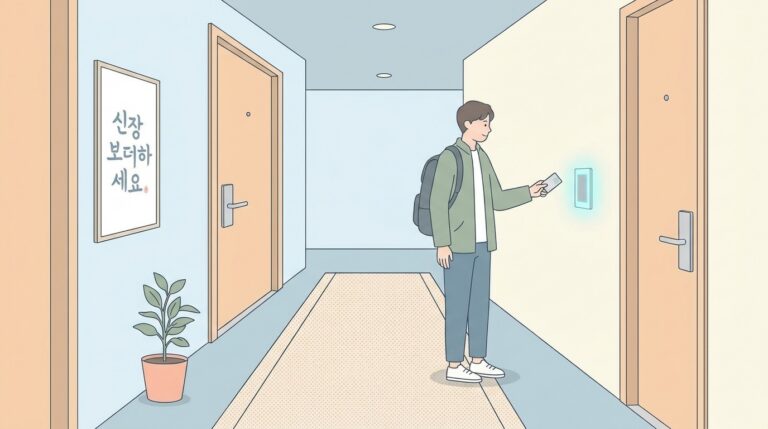
Picture this classic K-Drama scene: You step into the quiet hallway of your sleek Seoul hotel just to grab a warm canned coffee from the vending machine down the hall. You are wearing cozy socks and room slippers. The heavy hotel door gently swings shut behind you with a cheerful digital chime: Bbi-ri-rik, click! Suddenly, your heart drops. Your plastic key card is resting peacefully on the bedside table inside.
You are trapped outside your room, without your phone or your wallet, wondering how on earth to explain this at the front desk without dying of embarrassment. Don’t panic! This is the #1 most common traveler mishap our community members report every travel season. Today, you will master crystal-clear, beginner-friendly Korean phrases to resolve this in under 30 seconds with total confidence.
Phase 2: Core Expressions Deep Dive
1. 방에 카드키를 두고 나왔어요. (Bange kadeukireul dugo nawasseoyo.)
- Pronunciation: [Bange kadeukireul dugo nawasseoyo] (Sounds like: Bahn-geh kah-deu-kee-reul doo-go nah-wah-ssuh-yo)
- Meaning: “I left my card key in the room and came out.” (Nuance: An honest, slightly sheepish confession that you locked yourself out)
- K-Culture Moment: Just like the hilarious scene in romantic comedies where the main lead gets stranded outside their hotel room in matching oversized pajamas!
- Editor’s Insight: In Korean, there is no direct equivalent for “I locked myself out.” Because digital doors lock automatically, Koreans simply state the sequence of events: you placed it down (
두고) and stepped out (나왔어요). - Situation Spectrum: Casual ⚠️ | Semi-formal ✅ | Formal ✅
- 🤔 Think About It: Notice how Korean connects two sequential actions into one smooth flow (
두다+나오다). How does this differ from the passive construction “I am locked out” in English?
2. 문 좀 열어 주실 수 있나요? (Mun jom yeoreo jusil su innayo?)
- Pronunciation: [Mun jom yeoreo jusil su innayo] (Sounds like: Moon johm yuh-ruh joo-sheel soo een-nah-yo)
- Meaning: “Could you please open the door for me?” (Nuance: A polite, considerate request asking hotel staff to assist you)
- K-Culture Moment: Think of a helpful concierge in a luxury Seoul hotel arriving with a master key to save the day.
- Editor’s Insight: The tiny syllable
좀(jom) is your best friend in Korea! It literally means “a little,” but functionally acts like a magic “please” that softens your entire request. - Situation Spectrum: Casual 🚫 | Semi-formal ✅ | Formal ✅
- 🤔 Think About It: In English, asking “Can you open the door?” can sometimes sound like an order. Why does Korean add the auxiliary verb
-어 주다(to do as a favor) when requesting help?
3. 새 카드키 하나 더 주실 수 있나요? (Sae kadeuki hana deo jusil su innayo?)
- Pronunciation: [Sae kadeuki hana deo jusil su innayo] (Sounds like: Seh kah-deu-kee hah-nah duh joo-sheel soo een-nah-yo)
- Meaning: “Could you give me one more new card key?” (Nuance: Requesting a duplicate or spare card key without fuss)
- K-Culture Moment: Busy travelers checking in or requesting spare keys at modern automated hotel kiosks in Gangnam.
- Editor’s Insight: If front desk staff are busy and cannot walk up to your floor right away, they will often quickly print a temporary spare key. Saying
하나 더(hana deo = one more) keeps your sentence natural. - Situation Spectrum: Casual 🚫 | Semi-formal ✅ | Formal ✅
- 🤔 Think About It: Korean uses the native counting number
하나(hana) here. Keeping track of basic counters makes shopping and hotel stays effortless!
Phase 3: Textbook Korean vs. Real Korean
Situation 1: Explaining you left the key inside
- 📖 교과서 한국어: “저는 제 열쇠를 객실 내부에 분실하였습니다.” (Jeoneun je yeolsoereul gaeksil naebue bunsilhayeotseumnida. – I lost my key inside the guest room.)
- 🗣️ 진짜 한국어: “방에 카드키를 두고 나왔어요.” (Bange kadeukireul dugo nawasseoyo. – I left my card key in the room.)
- 💡 왜 다를까?: Textbook Korean relies heavily on formal Sino-Korean terms like
객실 내부(interior of room) and분실(loss), making you sound like a police report! Real Koreans use the everyday loanword카드키(card key) and active conversational verbs.
Situation 2: Asking for help unlocking the door
- 📖 교과서 한국어: “도어 개방을 요청합니다.” (Doeo gaebangeul yocheonghamnida. – I request door opening.)
- 🗣️ 진짜 한국어: “문 좀 열어 주실 수 있나요?” (Mun jom yeoreo jusil su innayo? – Could you open the door for me?)
- 💡 왜 다를까?: Real-world service interactions in Korea favor soft question endings (
-ㄹ 수 있나요?) rather than stiff declarations of demand (-을 요청합니다).
Phase 4: K-Culture Deep Dive & Non-Verbal Manners
4-1. Nunchi & Gestures
When approaching the front desk without your card key, show polite modesty. Keep both hands lightly resting together near your navel (the respectful 배꼽손 posture) and offer a slight 15-degree head bow. Flash a gentle, slightly embarrassed smile (머쓱한 미소). When the desk agent hands you the replacement card key, always receive it using both hands (or rest your left hand gently under your right forearm). This tiny visual gesture instantly conveys deep respect in Korean society.
4-2. Cultural Code: The Land of Digital Doorlocks
South Korea is virtually keyless! Whether it is a luxury hotel in Busan, an Airbnb in Hongdae, or a local studio apartment (원룸), physical brass keys belong to history museums. Almost every door is equipped with a smart electronic lock (디지털 도어락). Because these locks engage automatically the second the door closes, getting locked out is an experience shared by literally every single Korean at least once. Don’t feel guilty or clumsy—hotel staff handle this dozens of times every week!
Phase 5: Real-Life Roleplay Scenario
- Setting: The midnight front desk of Hotel Naru in Mapo, Seoul. Soft jazz plays in the background.
- Character: Min-woo (민우), a polite hotel receptionist in a crisp navy blazer.
- Guest (You): 저기요, 죄송한데요… (Jeogiyo, joesonghandeyo… / Excuse me, I’m sorry to bother you…)
🎭 Rubbing the back of your neck with a sheepish smile - Min-woo: 네, 고객님! 무엇을 도와드릴까요? (Ne, gogaeknim! Mueoseul dowadeurilkkayo? / Yes, guest! How can I help you?)
🎭 Leaning forward attentively with a welcoming smile - Guest (You): 방에 카드키를 두고 나왔어요. (Bange kadeukireul dugo nawasseoyo. / I left my card key inside the room.)
🎭 Pointing shyly toward the elevator bank - Min-woo: 아, 그러셨군요! 몇 호실이신가요? (A, geureosyeotgunyo! Myeot hosirishin-gayo? / Ah, I see! What room number are you in?)
🎭 Nodding understandingly and touching the computer keyboard - Guest (You): 704호예요. (Chil-baek-sa-hoye-yo. / It is Room 704.)
🎭 Speaking clearly and holding up fingers for clarity - Min-woo: 성함 확인 부탁드립니다. (Seongham hwagin butakdeurimnida. / May I confirm your name, please?)
🎭 Looking up from the monitor pleasantly - Guest (You): 제 이름은 Alex예요. (Je ireumeun Alex-ye-yo. / My name is Alex.)
🎭 Stating your reservation name with a clear voice - Min-woo: 확인되셨습니다. 새 카드키 여기 있습니다! (Hwagindwoesyeotseumnida. Sae kadeuki yeogi itseumnida! / Confirmed. Here is your new card key!)
🎭 Handing the card over with both hands
🔀 Interactive Choice Point: How do you conclude the conversation?
- Option A: “정말 감사합니다! 수고하세요!” (Jeongmal gamsahamnida! Sugohaseyo!)
Feedback: Best! Perfect etiquette. You express warm gratitude and wish the staff smooth work on their shift. - Option B: “빨리 주세요.” (Ppalli juseyo!)
Feedback: Bad. Meaning “Give it to me quickly,” this sounds demanding and impatient. - Option C: “고마워!” (Gomawo!)
Feedback: Risk. This is informal banmal. Using it with hotel staff sounds impolite unless you are speaking with an intimate personal friend.
Phase 6: 10-Second Emotion Shadowing Drill
Practice these lines out loud, pausing at the / marks to match natural Korean speech cadences:
[🥺 Embarrassed and apologetic]
저기요, / 방에 카드키를 / 두고 나왔어요.
(Jeogiyo, / bange kadeukireul / dugo nawasseoyo.)-
[🙏 Polite and hopeful]
문 좀 / 열어 주실 수 / 있나요?
(Mun jom / yeoreo jusil su / innayo?) -
[😊 Bright and relieved]
새 카드키 / 정말 감사합니다!
(Sae kadeuki / jeongmal gamsahamnida!)
Phase 7: K-Culture Mini Dictionary
- 카드키 (Kadeu-ki) | Card key | Refers specifically to plastic RFID room cards used for modern hotel doors and elevator sensor pads.
- 프런트 (Peureonteu) | Front Desk | The standard loanword used everywhere in Korea for hotel reception.
- 도어락 (Doeo-rak) | Digital Door Lock | The automatic electronic lock installed on almost every modern Korean residential and hotel door.
- 호실 (Hosil) | Room Number | The counter unit attached to room digits (e.g., 502호 = Room 502).
Phase 8: Traveler’s Survival Kit
Top 3 Survival Phrases for Hotel Stays
- 방 번호를 잊어버렸어요. (Bang beonhoreul ijeobeoryeosseoyo. – I forgot my room number.)
Pro Tip: Always snap a quick smartphone photo of your paper key card sleeve right when checking in. - 카드키가 안 먹혀요. (Kadeukiga an meokhyeoyo. – The card key is not working/scanning.)
Pro Tip: “안 먹혀요” is natural native slang for tech devices or cards failing to register. - 와이파이 비밀번호가 뭐예요? (Wa-i-pa-i bimilbeonhoga mwoyeyo? – What is the Wi-Fi password?)
Pro Tip: The network name and password are almost always printed on the card key holder or desk lamp stand.
Editor’s Travel Note
Before heading out, consult our [네이버 지도 앱 다운로드 및 필수 기능 가이드] to ensure you can find your way back to your accommodation late at night! Always keep a digital photo of your passport on your phone, as front desks must confirm identity before handing out a duplicate room key.
Phase 9: One Step Deeper (Reflective Insight)
In Korean, asking for assistance is rarely framed as a direct demand like “Open the door.” Instead, it relies on the auxiliary grammar pattern -어 주다 (to do something as a benevolent gift). When you say “열어 주실 수 있나요?”, you are acknowledging that the other person is performing a generous act of care for you. This linguistic habit reflects Korea’s deep-rooted value of mutual social consideration (정 and 배려).
💬 Your Turn: Have you ever locked yourself out of your room while traveling? What was the funniest or most awkward outfit you were caught wearing in the corridor? Share your story in the comments below!
Phase 10: FAQ & Common Mistakes
Q: Will the hotel charge me a fee if I leave my card key inside the room?
A: No! If you simply locked your key inside, the front desk will happily open your door or issue a replacement card for free. Replacement fees (around 5,000 to 10,000 KRW) only apply if you permanently lose the card and cannot return it at checkout.
Q: Can I ask the cleaning staff in the corridor to unlock my door?
A: Usually not. For guest safety and theft prevention, housekeeping staff are strictly instructed not to unlock doors without authorization. Always head down to the front desk (프런트).
Q: What if I do not remember my room number?
A: Simply go to the desk and say: “제 이름을 확인해 주실 수 있나요?” (Je ireumeul hwaginhae jusil su innayo? – Could you check my name?). Provide your passport or reservation app, and they will look up your room immediately.
🚨 Common Mistakes Alert
- Mistake 1: Saying “키를 잃어버렸어요” (I lost my key).
Correct Action: Say “두고 나왔어요” (I left it inside) so the front desk knows the key is still safe inside the room. - Mistake 2: Grabbing the replacement card with only one hand.
Correct Action: Receive the key with both hands and make a brief polite bow. - Mistake 3: Forgetting to state your room number with Sino-Korean numbers.
Correct Action: Practice room numbers using Sino-Korean digits (일, 이, 삼, 사…). Room 301 is삼-공-일-호or삼-백-일-호.
Phase 11: Action Mission & Engagement
- Bronze Mission: Stand in front of your mirror and practice saying “방에 카드키를 두고 나왔어요” 3 times with an apologetic smile.
- Silver Mission: Record a 10-second voice note practicing the shadowing rhythm from Phase 6 and share it with your language exchange partner.
- Gold Mission: On your next trip to Korea, greet your accommodation host or front desk team in full Korean without switching to English!
- 🎮 K-Culture Mission: Watch any hotel scene in a Korean drama (such as King the Land) and count how many times staff use two hands when handing items to guests.
Phase 12: Interactive Quiz Challenge
Test your knowledge below:
- Situational Judgment: You locked your card key inside your room at 11 PM. What is the most natural sentence to say to the receptionist?
- A) 문 열어! (Mun yeoreo!)
- B) 방에 카드키를 두고 나왔어요. (Bange kadeukireul dugo nawasseoyo.)
- C) 카드키를 버렸어요. (Kadeukireul beoryeosseoyo.)
- Fill in the Blank: “문 [____] 열어 주실 수 있나요?” (Which polite softening word belongs in the blank?)
-
True or False: In Korea, you should receive a replacement key card with one hand while waving with the other.
Click to reveal answers & explanations!
- Answer: B – Explains clearly that you left the card inside the room without being impolite.
- Answer: 좀 (jom) – The magic softening word that transforms requests into polite, warm inquiries.
- Answer: False – Always receive the card using two hands as a sign of respect and good manners!







