

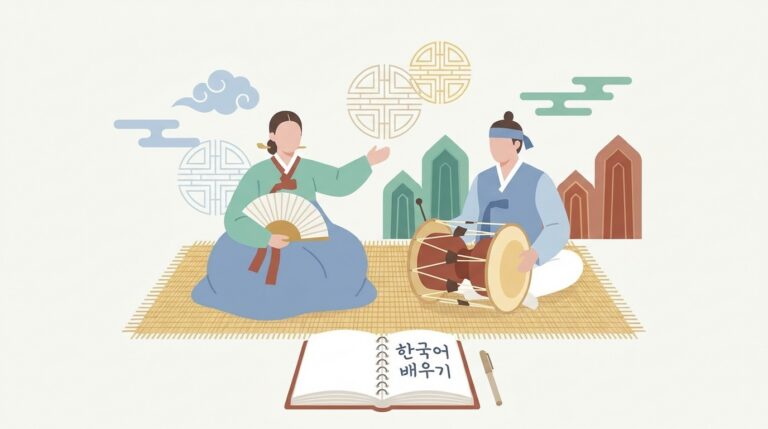
The Linguistic Democracy of Pansori: Where Courtly Elegance Meets Marketplace Slang
Phase 1: Empathy & Storytelling Opening
안녕하세요! 매일한글 에디터입니다. (Annyeonghaseyo! It’s your Daily Hangul editor.)
Picture this: You are seated in a hushed theater—perhaps the National Theater of Korea or an intimate hanok courtyard in Bukchon. The master singer (sorikkun) steps onto the straw mat, clad in pristine white hanbok, gripping a traditional folding fan. In a voice as sonorous as thunder, they unfurl an exquisitely woven narrative. At first, you hear elaborate, antique Sino-Korean couplets evoking Chinese classics that would make a Chosun scholar nod in solemn approval. Then, without missing a single beat of the drum (buk), the singer abruptly switches registers into bawdy, marketplace slang, mocking that very same aristocrat with gut-busting vernacular, local Jeolla dialect, and razor-sharp satire.
If you have reached the C2 proficiency level in Korean, you probably already understand formal honorifics and standard literary prose. Yet, when confronted with classical performing arts like Pansori (판소리) or Mask Dance (탈춤, Talchum), many advanced learners experience linguistic whiplash. How can such high-register tragedy (bijangmi, 비장미) and ribald, earthy comedy (golgyemi, 골계미) coexist within the exact same breath? This phenomenon is what scholars call “linguistic democracy” (언어의 민주주의). In this guide, grounded in real sociolinguistic fieldwork and feedback from learners who conquered classical K-dramas and historical theater, you will discover how decoding this clash of registers transforms you from an advanced speaker into a genuine connoisseur of Korean cultural nuance.
Phase 2: Three Core Expressions in Depth
1. 뼈를 때리는 풍자 (Bpyeoreul ddaerineun pungja)
- Pronunciation: [Ppyeo-reul ddae-ri-neun pung-ja] (Think of ppyeo like ‘pure’ without the ‘u’, tapping your tongue firmly, followed by a crisp dae and poong-ja)
- Meaning: Literal: “Satire that strikes the bone.” / Nuance: Piercing, unfiltered social commentary that cuts straight through hypocrisy and strikes an uncomfortable, undeniable truth.
- K-Culture Moment: In historical films like The King and the Clown (왕의 남자) or modern dramas like Jeongnyeon: The Star is Born (정년이), performers use street theatre to mock the decadent elite right to their faces under the guise of foolish humor.
- Editor’s Insight: While standard Korean uses 풍자하다 (to satirize), adding 뼈를 때리다 captures the physical sting of truth. In Pansori, this represents the transition from tragedy to comic satire: commoners laughing at the powerful because crying won’t change their reality.
- Situation Spectrum: Casual: ✅ | Semi-formal: ✅ | Formal/Academic: ⚠️
- 🤔 Think About It: Does your native culture use humor to speak truth to power, or is political critique typically kept solemn and institutional?
2. 양반을 쥐락펴락하다 (Yangbaneul jwirakpyeorakhada)
- Pronunciation: [Yang-ba-neul jwi-rak-pyeo-rak-ha-da] (Pronounce jwi-rak crisply like ‘jwee-rock’ and pyeo-rak like ‘pyuh-rock’)
- Meaning: Literal: “To clasp and unfold an aristocrat in one’s hand.” / Nuance: To hold someone of superior social standing completely under your control, playing with them through sheer wit and verbal gymnastics.
- K-Culture Moment: In traditional Bongsan Talchum (봉산탈춤), the lowly servant Malttugi (말뚝이) repeatedly tricks the pompous Yangban brothers, insulting their lineage using clever puns, then playing innocent when challenged.
- Editor’s Insight: This compound verb comes from opening and closing the fist (쥐다 and 펴다). When applied to class relations in Joseon dynasty literature, it emphasizes intellectual dominance achieved solely through linguistic agility.
- Situation Spectrum: Casual: ✅ | Semi-formal: ✅ | Formal: ⚠️
- 🤔 Think About It: In English, we say “to twist someone around your little finger.” Notice how the Korean expression focuses on the rhythmic movement of opening and closing (jwirak-pyeorak), evoking theatrical puppetry.
3. 비장미와 골계미가 어우러지다 (Bijangmiwa golgyemiga eoureojida)
- Pronunciation: [Bi-jang-mi-wa gol-gye-mi-ga eo-u-reo-ji-da] (Flowing rhythm: bee-jang-mee and gol-gyeh-mee, joined by uh-oo-ruh-jee-da)
- Meaning: Literal: “Tragic grandeur and comic satire blend harmoniously together.” / Nuance: The unique aesthetic synthesis wherein sublime grief does not drown out hearty laughter, but rather deepens through irony.
- K-Culture Moment: Found in critical reviews of masterpieces like Simcheongga (심청가), where the heart-wrenching scene of a daughter sacrificing herself for her blind father is swiftly offset by the absurd, slapstick antics of Blind Man Sim (Sim Bongsa).
- Editor’s Insight: This is the pinnacle of C2 academic discourse in Korean humanities. Understanding this binary allows you to dissect why modern Korean cinema—from Bong Joon-ho’s Parasite to historical epics—oscillates so naturally between devastating sorrow and grotesque absurdity.
- Situation Spectrum: Casual: 🚫 | Semi-formal: ⚠️ | Formal/Literary: ✅
- 🤔 Think About It: Western classical theatre often separated tragedy and comedy into distinct genres. What does the fusion of bijangmi and golgyemi reveal about the Korean collective consciousness (Han and Heung)?
Phase 3: Textbook Korean vs. Real Native Korean
Situation 1: Describing a biting social critique in a creative work
- 📖 교과서 한국어 (Textbook Korean):
“이 작품은 당대 지배층의 모순을 날카롭게 풍자하고 있습니다.”
(I jakpumeun dangdae jibaecheung-ui mosuneul nalkaropge pungjahago itseumnida. / “This work sharply satirizes the contradictions of the ruling class of the era.”) - 🗣️ 진짜 한국어 (Real Native Korean):
“양반들 위선을 뼈 때리게 까발리는데, 진짜 속이 다 후련하더라고요.”
(Yangbandeul wiseoneul ppyeo ddaerige kkaballineunde, jinjja sogi da huryeonhadeoragoyo. / “It strips away the aristocrats’ hypocrisy with such bone-chilling sharpness that it felt profoundly liberating.”) - 💡 왜 다를까? (Why the difference?): Textbook phrasing relies on objective Hanja-derivatives (지배층, 모순), whereas real native Korean uses dynamic visceral verbs (까발리다 – to uncover rawly) and cathartic emotional states (속이 후련하다 – feeling relieved inside).
Situation 2: Explaining a complex theatrical balance between sadness and comedy
- 📖 교과서 한국어 (Textbook Korean):
“이 공연은 슬픔과 유머를 동시에 보여줍니다.”
(I gong-yeoneun seulpeumgwa yumeoreul dongsie boyeojumnida. / “This performance shows sadness and humor at the same time.”) - 🗣️ 진짜 한국어 (Real Native Korean):
“눈물 콧물 쏙 빼다가도 배꼽 잡게 만드는 게, 완전 비장미랑 골계미의 줄타기예요.”
(Nunmul konmul ssok ppaedagado baekkop japge mandeuneun ge, wanjeon bijangmirang golgyemi-ui jultagi-yeyo. / “It drains your tears and snot one second and makes you clutch your belly laughing the next—it’s a pure tightrope walk between tragic beauty and satirical comedy.”) - 💡 왜 다를까? (Why the difference?): Advanced native speakers employ sensory-loaded idioms (눈물 콧물 쏙 빼다, 배꼽을 잡다) paired with artistic metaphors like tightrope walking (줄타기) to depict dramatic tension.
Phase 4: K-Culture Deep Dive & Non-Verbal Nuance
4-1. 눈치 (Nunchi) & Gestural Mastery: The Sorikkun’s Folding Fan (Hapjukseon)
In the performance of Pansori, language is only half the code; bodily punctuation delivers the democratic punch. When the performer articulates high Sino-Korean verses, notice how their posture erects: the fan rests vertically against the chest, eyes gaze serenely toward an abstract horizon, embodying Confucian decorum.
However, the instant the narrative plunges into marketplace reality, watch the nunchi of the stage shift: the singer’s posture stoops slightly, their eyebrows arch asynchronously, and the fan snaps shut with a crisp crack (딱!). The fan instantly transforms into a club, a smoking pipe, or a measuring stick. To mirror this nuance in sophisticated dialogue, when you transition from discussing solemn academic theory to lively everyday commentary, a deliberate soft chuckle and an open hand gesture acknowledge the intentional register contrast to your conversation partner.
4-2. Cultural Code Analysis: The Carnivalesque in Joseon Society
Pansori librettos (saseol) and Mask Dance narratives served as historical safe zones for ideological subversion. In standard historical records (Sillok), the language of commoners is practically sanitized or erased. But in the oral transmission of Pansori, both registers are preserved in equal weight. Mikhail Bakhtin’s concept of the “carnivalesque” manifests completely in Joseon: during the performance, social hierarchies dissolve. The marketplace becomes an open arena where high culture is brought down to earth through bodily humor, and low culture is elevated into magnificent vocal art.
Phase 5: Real-World Roleplay Scenario
Setting: A seminar lounge at the National Gugak Center in Seoul. You are conversing with Master Park (박 명창), a veteran Pansori master who has spent four decades researching the authentic text of Heungbuga (흥보가).
- 박 명창 (Master Park): “외국인 연구자로서 우리 판소리 사설을 읽을 때 가장 당혹스러운 지점이 어디였습니까?”
(Oegugin yeonguja-roseo uri pansori saseoreul ilgeul ddae gajang danghokseureoun jijeomi eodieotseumnikka?)
“As a foreign scholar, where did you find yourself most perplexed when reading our Pansori librettos?” - You: “🎭 (안경을 살짝 고쳐 쓰며 진지한 눈빛으로) 양반들의 고사성어와 장터의 거친 육담이 한 대목에서 바로 맞부딪치는 순간이었습니다.”
(Yangbandeul-ui gosaseong-eowa jangteo-ui geochin yukdami han daemog-eseo baro matbuditchineun sunganieotseumnida.)
“🎭 (Adjusting glasses with a focused gaze) It was the exact moment where aristocratic classical idioms clashed head-on with raw marketplace bawdiness within a single passage.” - 박 명창 (Master Park): “허허, 그걸 짚어내다니 대단하구려! 그렇다면 그 충돌이 단순한 말장난으로 보였소?”
(Heoheo, geugeol jipeonaedani daedan-haguryeo! Geureotamyeon geu chungdori dansunhan maljangnan-euro boyeotsso?)
“Haha, remarkable that you caught that! Did that collision strike you as mere frivolous wordplay?” - You: “🎭 (고개를 가로저으며 손바닥을 펴 보이며) 아닙니다. 억압받던 민중들이 자신들의 삶의 언어로 지배 질서를 전복하는 ‘언어의 민주주의’로 느껴졌습니다.”
(Animnida. Eog-apbatdeon minjungdeuri jasindeul-ui salm-ui eoneo-ro jibae jilseoreul jeonbokhaneun ‘eoneo-ui minjujuui’-ro neukkyeojyeotseumnida.)
“🎭 (Shaking head gently, opening palm) Far from it. It felt like a ‘linguistic democracy’ wherein the oppressed populace subverted dominant hierarchies using the authentic language of lived experience.” - 박 명창 (Master Park): “정확한 통찰이오. 그렇다면 그 속에서 비장미와 골계미는 어떻게 작동하던가요?”
(Jeonghwakhan tongchario. Geureotamyeon geu sog-eseo bijangmiwa golgyemineun eotteoke jakdonghadeon-gayo?)
“An exacting insight. How then did tragic grandeur and satirical comedy operate together within it?” - You: “🎭 (숨을 고르고 나직하면서도 울림 있는 목소리로) 굶주린 흥보의 처절한 한을 골계적 웃음으로 승화시켜, 비극에 매몰되지 않는 생명력을 만들어내더군요.”
(Gumjurin heungbo-ui cheojeolhan haneul golgyejeok useum-euro seunghwasikyeo, bigeug-e maemoltoeji anneun saengmyeongnyeogeul mandeul-a-naedeogun-yo.)
“🎭 (Catching your breath, speaking in a low, resonant voice) By sublimating the starving Heungbu’s desperate sorrow through satirical laughter, it generated a resilient vitality that refused to be consumed by tragedy.” - 박 명창 (Master Park): “얼씨구! 자네는 사설의 껍데기가 아니라 그 깊은 골수를 꿰뚫어 보고 있네 그려!”
(Eolssigu! Janeneun saseor-ui kkeopdegiga anira geu gipeun golssureul kkweituleo bogo inne geuryeo!)
“Eolssigu! Bravo! You are looking right past the surface of the text straight into the very marrow of its soul!” - You: “🎭 (두 손을 단정히 모으고 미소를 지으며) 선생님의 가르침과 소리판의 현장감 덕분에 비로소 귀가 열린 것 같습니다.”
(Seonsaengnim-ui gareuchimgwa soripan-ui hyeonjanggam deokbune biroso gwiga yeollin geot gateumnida.)
“🎭 (Folding hands respectfully, smiling) It is thanks to your guidance and the electric atmosphere of the performance ground that my ears have finally opened.”
🔀 Interactive Decision Point
How would you frame the contrast between court poetry and street slang if Master Park asks you to summarize it in one sentence?
- Option A: “어려운 한자는 양반을 조롱하기 위한 장식일 뿐이며, 장터 욕설이야말로 진짜 민중의 언어입니다.” (Difficult Hanja is merely decoration to mock nobles; marketplace cursing is the true voice of the people.)
- Option B: “양반의 품격과 서민의 활력이 사설 안에서 대등하게 길항하며, 지배층의 위선과 민중의 고단함을 한 바구니에 담아낸 문학적 용광로입니다.” (The dignity of the aristocracy and the vigor of commoners dialectically balance each other, serving as a literary melting pot holding both elite hypocrisy and peasant hardship.)
- Option C: “솔직히 두 언어 체계가 너무 이질적이어서 작품의 통일성을 해치는 측면도 있습니다.” (Honestly, the two language systems are so heterogeneous that they undermine the structural unity of the work.)
Detailed Feedback:
* Option A (Risk): While appealingly provocative, reducing classical idioms merely to “decoration” misses the aesthetic brilliance: Joseon commoners appreciated the poetic beauty of Sino-Korean verses just as deeply as nobles did.
* Option B (Best): Perfect C2 eloquence! Using terms like 길항하다 (to act dialectically against each other) and 문학적 용광로 (literary melting pot) captures the sophisticated polyphonic reality without sounding overly aggressive.
* Option C (Bad): Viewing stylistic register clashes as “flaws in unity” projects modern Western structuralist assumptions onto traditional Korean oral literature, demonstrating an incomplete grasp of golgyemi.
Phase 6: 10-Second Emotional Shadowing Drill
- Sentence 1:
[🎭 풍자하듯 능청스럽고 익살맞게]
“양반이 행차하신다니 / 뼈대 있는 가문인 줄 알았더니 / 입만 열면 제 무덤 파는 소리뿐이로구나!”
(Yangbani haengchahasindani / ppyedae inneun gamunin jul aratdeoni / imman yeolmyeon je mudeom paneun sorippun-iroguna!)
(Translation: “They announced a nobleman’s procession, so I expected a distinguished house / But every time he opens his mouth, he merely digs his own grave!”) -
Sentence 2:
[😭 비장미 넘치게 가슴을 쥐어짜듯]
“천지가 무너져 / 갈 곳 없는 이 내 신세 / 눈물로 한을 삼켜도 / 피할 길 없는 절벽이로다.”
(Cheonjiga muneojyeo / gal got eomneun i nae sinse / nunmullo haneul samkyeodo / pihal gil eomneun jeolbyeog-iroda.)
(Translation: “The heavens and earth crumble, leaving me stranded with nowhere to turn / Though I swallow my sorrow in tears, an inescapable abyss looms before me.”) -
Sentence 3:
[🎉 흥겹고 당당하게 반전시키며]
“슬프다고 주저앉을쏘냐! / 북소리 장단 맞춰 / 한바탕 신명 나게 놀아나 보자꾸나!”
(Seulpeudago jujeo-anjeolssonya! / buksori jangdan matchwo / hanbatang sinmyeong nage norana bojakkkuna!)
(Translation: “Shall we sit and sulk simply because life is bitter? / Match the cadence of the drum / Let’s bring forth ecstatically radiant merrymaking!”)
Phase 7: K-Culture Mini Dictionary
- 사설 (Saseol) | Libretto / Narrative Text
- Usage: Refers to the comprehensive, lyrical and narrative text of Pansori. In modern business and everyday Korean, calling someone’s explanation “사설이 길다” implies their introductory excuses or backstory are unnecessarily verbose.
- 추임새 (Chuimsae) | Audience Interjection / Encouraging Call-and-Response
- Usage: Shouts like 얼씨구! (Eolssigu!), 좋다! (Jota!), or 잘한다! (Jalhanda!) given by the drummer or the audience. In everyday life, providing good chuimsae means actively nodding, reacting, and validating a colleague’s presentation.
- 아니리 (Aniri) | Spoken Monologue / Descriptive Prose
- Usage: The spoken prose sections connecting dramatic sung arias (chang, 창). It is where context, humor, and marketplace commentary shine most brightly, bridging songs with down-to-earth realism.
- 너름새 (Neoreumsae) | Theatrical Stage Presence and Expressive Action
- Usage: The complete composite of mime, facial acting, and fan manipulation (ballim). In modern artistic critiques, an actor with outstanding neoreumsae possesses compelling charisma and physical stage presence.
Phase 8: Traveler’s Survival Kit for Cultural Connoisseurs
TOP 3 Survival Expressions for the Traditional Stage
- “얼씨구! 추임새는 언제 넣어야 자연스러워요?”
(Eolssigu! Chuimsaeneun eonje neoeoya jayeonseureowoyo?)
Pro Tip: Ask the theater staff or neighboring audience members before a show. Inserting chuimsae precisely when a singer concludes a complex melodic phrase establishes an instant bond with local patrons. - “이 대목 사설 자막이나 해설집이 따로 준비되어 있나요?”
(I daemok saseol jamagina haeseoljibi ttaro junbidi-eo innayo?)
Pro Tip: Classical librettos feature archaic Jeolla dialect and obscure Sino-Korean poetry. Major venues offer English and modern Korean booklets or digital sub-screens. - “판소리 완창 공연은 중간 인터미션이 몇 번인가요?”
(Pansori wanchang gong-yeoneun junggan inteomisyeoni myeot beon-in-gayo?)
Pro Tip: Full wanchang (complete narrative) performances can last anywhere from 3 to 8 hours! Always verify the intermission schedule before committing your afternoon.
Editor’s Travel Note
- Getting Your Tickets: Do not wait in line at the venue box office hoping for remnant tickets for marquee productions. Open your browser and check the National Gugak Center ticket reservation platform or National Theater of Korea portal weeks in advance.
- Navigation: When visiting regional performance centers like the Andong Hahoe Mask Dance Drama preservation grounds or the Namwon National Gugak Center, download Naver Map app for real-time bus transfers and rural express schedules, as international map platforms often lack provincial cultural shuttle details.
Phase 9: “One Step Deeper” (Sociolinguistic Essay)
In classical Western linguistics, the mixing of low sociolects and elevated poetic diction was long viewed as a degradation of stylistic purity. In Chosun Pansori, however, this hybridity served as an indispensable democratic pressure valve. The commoner class (minjung) possessed no formal legislative venue to indict corrupt magistrates or lament landlord exploitation; the performance circle (soripan) became their temporary parliament. By juxtaposing pristine classical Chinese idioms against visceral peasant slang within the same narrative breath, the commoners stripped the ruling class of their greatest weapon: exclusive control over elevated meaning. When an illiterate buffoon delivers profound philosophical truths while an ostentatious nobleman stumbles over childish desires, the moral authority of the Joseon caste system collapses through collective laughter.
💬 Your Turn: Have you ever encountered a modern movie, song, or theatre piece where the author intentionally switches between academic formal vocabulary and raw street slang to expose hypocrisy? Share your favorite examples in the comments below!
Phase 10: FAQ & Avoiding Misconceptions
Q: Isn’t marketplace slang in Pansori considered historically vulgar or offensive?
A: Not in the context of traditional performance aesthetics. What might appear as 비속어 (vulgar slang) in isolation functions within Pansori as 육담 (earthy, vital bawdiness) and 해학 (benevolent humor). It is an artistic medium reflecting genuine living realities rather than gratuitous profanity.
Q: Can I use Pansori-style satire expressions like “양반을 쥐락펴락하다” in modern corporate settings?
A: Use with extreme caution. While using it to analyze a third party (e.g., “우리 마케팅 팀이 경쟁사를 쥐락펴락했죠”) showcases high-level command of idiom, using it in direct reference to your superiors or clients can sound irreverent and conspiratorial.
Q: How do I know when the singer transitions from tragedy (bijangmi) to comedy (golgyemi)?
A: Listen to the drum (buk). When tragic themes dominate, the tempo slows to a heavy, grieving rhythm known as Jinyangjo (진양조). The moment satire and marketplace wit erupt, the rhythm accelerates into lively syncopated meters like Jungmori (중모리) or Jajinmori (자진모리).
🚨 Common Mistakes Warning Board
- Mistake: Shouting chuimsae in the middle of a singer’s intense, tearful vocal line.
- Correct Action: Only interject during momentary vocal breaks or immediately following a breathtaking vocal climax.
- Mistake: Assuming that saseol written with Chinese characters indicates that the text was composed exclusively by the Yangban.
- Correct Action: Recognize that sorikkun commoners strategically learned classical references to enchant elite patrons while embedding subversive satire for their common audiences.
- Mistake: Translating Han (한) purely as despairing sorrow without recognizing its dynamic twin, Heung (흥).
- Correct Action: Always analyze the text as a cyclical engine where sorrow inevitably drives exuberant, defiant celebration.
Phase 11: Action Missions & Cultural Challenge
- Bronze Level (Solo Practice): Record yourself reading Shadowing Sentence 1 from Phase 6. Focus on snapping your rhythm from pretentious nobility to streetwise satire.
- Silver Level (Social Sharing): Find an excerpt of Pansori on YouTube (such as an aria from Chunhyangga or Sugungga). Post an insightful comment in Korean identifying one moment where 비장미 shifts into 골계미.
- Gold Level (Real-World Application): Attend a live Gugak performance or write a Korean critique of a historical K-Drama using the phrase: “비장미와 골계미가 어우러져 지배층의 위선을 뼈 때리게 풍자했다.”
- 🎮 K-Culture Scavenger Mission: Watch the drama Jeongnyeon: The Star is Born or the film The King and the Clown. Spot three instances where a performer wields their folding fan to mimic a physical object or demarcate a shift in social status.
Phase 12: Interactive Quiz Challenge
Question 1: Situational Judgment
During a lecture on classical Korean literature, you want to praise how a 19th-century folk novel balanced gut-wrenching scenes of poverty with hilarious servant dialogue. Which sentence demonstrates C2-level proficiency?
* (A) 양반들이 욕을 많이 써서 공연이 너무 재미있고 시끄러웠습니다.
* (B) 비장미와 골계미가 절묘하게 교차하며 민중의 고단한 현실을 해학적으로 승화시켰습니다.
* (C) 슬픈 이야기와 웃긴 이야기가 섞여 있어서 작품의 원래 의미를 알기 어려웠습니다.
Click here to reveal the answer and explanation
Correct Answer: (B)
Explanation: Choice (B) precisely deploys advanced humanities vocabulary (비장미, 골계미, 교차하다, 승화시키다) to articulate the dual aesthetic without falling into vulgar phrasing (A) or misinterpreting the synthesis as confusion (C).
Question 2: Fill in the Blanks
판소리 무대에서 청중과 고수가 소리꾼의 호흡에 맞춰 외치는 “얼씨구!”, “좋다!”와 같은 추임새는, 무대와 객석의 경계를 허물며 판소리 특유의 ( )를 실현하는 핵심적인 장치이다.
Click here to reveal the answer and explanation
Correct Answer: 언어의 민주주의 (or 민주성 / 소통성)
Explanation: The participatory call-and-response (chuimsae) democratizes the performance space, dissolving the boundary between performer and spectator.
Question 3: True or False Cultural Concept
True or False: In Pansori, the tragic emotion (Han) and comic satire (Golgyemi) were strictly segregated into separate chapters because Joseon etiquette prohibited laughing during sorrowful themes.
Click here to reveal the answer and explanation
Correct Answer: False
Explanation: Pansori’s distinct genius lies precisely in its fluid interplay: tragic pathos and uproarious comedy continually cross and reinforce each other within the same chapter.






