

When April Arrives: Your Friendly Korean Guide to Cherry Blossom Festivals
Phase 1: Empathy & Story Opening
안녕하세요! I’m your Daily Hangul editor and your personal Korean cultural navigator!
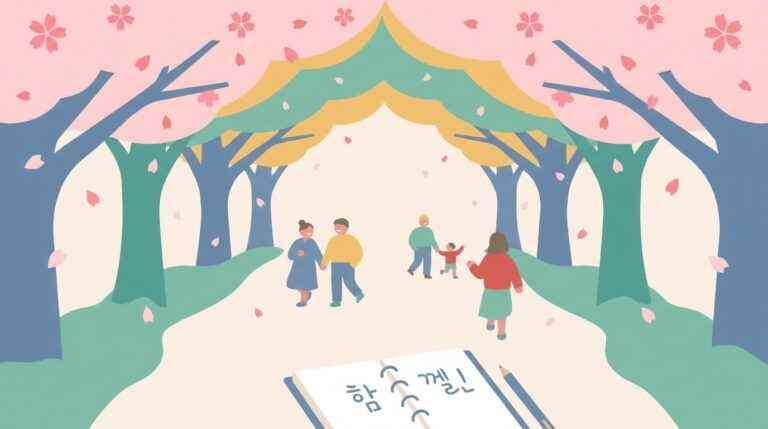
Picture this: It is early April, the crisp winter chill has melted away, and you have just stepped out of Yeouinaru Station onto the banks of the Han River in Seoul. Or perhaps you took an early morning KTX train down to Jinhae for the legendary Gunhangje Festival. Looking up, you are surrounded by an endless, whispering canopy of pale pink and white cherry blossom petals drifting like warm snow over the sidewalks.
Everyone around you is snapping photos, unwrapping picnic snacks on colorful mats, and laughing. You want to ask a friendly passerby to take a photo of you under the floral tunnel. You want to compliment how gorgeous the trees look, or ask where everyone got those cute strawberry-blossom pastries. But suddenly, your mind freezes. Textbook phrases like “이곳은 벚꽃이 아름답습니다” feel uncomfortably robotic. Don’t worry! Every foreign traveler in Korea encounters this exact hesitation. Drawing directly from real classroom feedback and festival field trips, this guide gives you real, natural, A2-level Korean so you can stroll confidently beneath the blossoms like a local.
Phase 2: 3 Key Expressions Deep-Dive
1. 사진 한 장만 찍어 주실 수 있나요? (Sajin han jangman jjigeo jusil su innayo?)
- Pronunciation: sah-jeen hahn jahng-mahn jee-guh joo-sheel soo een-nah-yo? (Think of “sajin” like sargent without the ‘r’, and “jjigeo” sounding like a firm click of a camera shutter).
- Meaning: “Could you take just one photo for me?” (Literal: Photo one sheet only take give can you?)
- K-Culture Moment: Picture standing in front of the famous Gyeonghwa Station railway tracks or the Yeojwacheon Romance Bridge in Jinhae, where couples and families queue up for that picture-perfect angle.
- Editor’s Insight: The magic phrase here is 한 장만 (han jangman – just one sheet/shot). Even though Koreans will almost certainly snap five or ten shots with various angles for you, asking for “just one” shows polite consideration for their time.
- Situation Spectrum: Casual ⚠️ | Semi-formal ✅ | Formal ✅
- 🤔 Think About It: Why do you think Korean etiquette emphasizes asking for “just one” photo even when everyone knows the photographer will take several bursts?
2. 벚꽃이 만개했어요! (Beotkkochi man-gae-haesseoyo!)
- Pronunciation: but-kko-chee mahn-gae-hae-ssuh-yo! (Sounds like “boat” with a short ‘o’, “kkochi” like coach-ee, and “man-gae” like mahn-geh).
- Meaning: “The cherry blossoms are in full bloom!”
- K-Culture Moment: Walking into Yeouido Park and typing your first Instagram caption of the day using the hashtag #벚꽃만개.
- Editor’s Insight: While “꽃이 피었어요” (The flowers bloomed) is basic, the Sino-Korean term 만개 (man-gae, 滿開 – full bloom) immediately elevates your speech to sound expressive, poetic, and delightfully natural.
- Situation Spectrum: Casual ✅ | Semi-formal ✅ | Formal ✅
- 🤔 Think About It: In English, we often say “in peak bloom.” Notice how Korean compresses this whole seasonal concept into a neat two-syllable word, “만개”.
3. 사람이 진짜 많네요. (Sarami jinjja manneeyo.)
- Pronunciation: sah-rahm-ee jeen-jjah mahn-neh-yo. (Sounds like “sah-rahm”, “jean-jah”, and “mahn-neh-yo”).
- Meaning: “There are really so many people here!”
- K-Culture Moment: Stepping into the river of visitors on Yeouido Yunjung-ro on a warm Saturday afternoon.
- Editor’s Insight: The ending -네요 (-neyo) indicates spontaneous realization or shared observation. Saying this to someone sitting beside you on a bench is an instant bonding phrase.
- Situation Spectrum: Casual ⚠️ | Semi-formal ✅ | Formal ⚠️
- 🤔 Think About It: Rather than complaining, Koreans often use this phrase as a friendly exclamation to acknowledge the lively festival buzz (인파).
Phase 3: Textbook Korean vs. Real Korean
Situation 1: Remarking on the huge crowd
* 📖 교과서 한국어: 축제 장소에 군중이 많습니까? (Chukje jangssoe gunjung-i manseumnikka?) — Are there many crowds at the festival venue?
* 🗣️ 진짜 한국어: 와, 사람 완전 많아요! (Wa, saram wanjeon manayo!) — Wow, there are so many people!
* 💡 왜 다를까? Nobody uses the formal noun “군중” (throng/masses) in spoken Korean. Everyday speakers use 완전 (wanjeon – totally/completely) as a casual intensifier.
Situation 2: Asking someone nearby to take your photo
* 📖 교과서 한국어: 저의 기념사진을 촬영해 주십시오. (Jeoui ginyeomsajineul chwaryeonghae jusipsio.) — Please film my commemorative photograph.
* 🗣️ 진짜 한국어: 저, 사진 한 번만 찍어주세요! (Jeo, sajin han beonman jjigeojuseyo!) — Excuse me, could you take a picture for me once?
* 💡 왜 다를까? “촬영” sounds like an official broadcast recording. Real locals say “사진 찍다” paired with the friendly softener 한 번만 (han beonman – just once).
Phase 4: K-Culture Deep Dive & Non-Verbal Manners
4-1. Nunchi (눈치) & Body Language at Cherry Blossom Hotspots
- The Two-Hand Phone Handover: When handing your smartphone to a stranger to take a photo, always hand it over with both hands and a polite slight head bow. When they finish, accept it back with both hands while offering a bright “감사합니다!” (Gamsahamnida!).
- Photo Line Etiquette: When popular photo spots form an informal queue (like under an arching blossom branch), do not linger for more than two minutes. Have your camera app already open and framing checked before your turn!
4-2. Cultural Codes: The Spring Zombie & Picnic Culture
- The Cherry Blossom Zombie: Every spring, the iconic 2012 indie track Cherry Blossom Ending (벚꽃 엔딩) by Busker Busker climbs right back up the Melon music charts. Koreans jokingly nickname this song the “Spring Zombie” (봄 좀비) or “Cherry Blossom Pension” because it never dies and brings the singer yearly royalties whenever flowers bloom.
- Hangang Picnic Mats (돗자리): In Korea, spring festivals mean renting a 돗자리 (dotjari – picnic mat), buying instant ramen cooked from automated machines at the Han River convenience store, and ordering seasoned fried chicken delivered straight to your picnic zone.
Phase 5: Real-Life Roleplay Scenario
- Setting: Yunjung-ro Cherry Blossom Tunnel, Yeouido. Petals are fluttering down in the afternoon sun.
- Characters: You (an excited festival visitor) and Minji (a Korean college student carrying a pastel film camera).
Dialogue:
1. You: 저기요, 실례지만 사진 한 장만 찍어 주실 수 있나요? (Jeogiyo, sillyejiman sajin han jangman jjigeo jusil su innayo?) — Excuse me, but could you take just one photo for me?
🎭 Hands phone forward with both hands and a friendly smile.
2. Minji: 네, 좋아요! 어디서 찍어 드릴까요? (Ne, joayo! Eodiseo jjigeo deurilkkayo?) — Sure, sounds great! Where would you like me to take it?
🎭 Points gently toward the blooming branches.
3. You: 저 벚꽃 나무 아래에서 서 볼게요. (Jeo beotkkot namu arae-eseo seo bolgeyo.) — I will stand under that cherry blossom tree over there.
🎭 Walks toward the tree and turns around.
4. Minji: 자, 찍을게요! 하나, 둘, 셋, 김치~! (Ja, jjigeulgeyo! Hana, dul, set, gimchi~!) — Alright, taking it now! One, two, three, kimchi~!
🎭 Crouches slightly to catch the best angle of you and the blossom canopy.
5. Minji: 가로로도 찍고 세로로도 찍었어요. 한번 확인해 보세요! (Garorodo jjikgo serorodo jjigeosseoyo. Hanbeon hwaginhae boseyo!) — I took both landscape and portrait shots. Please take a look!
🎭 Hands phone back with two hands.
6. You: 와, 인생샷 나왔네요! 벚꽃이 진짜 예뻐요. (Wa, insaengsyat nawanne-yo! Beotkkochi jinjja yeppeoyo.) — Wow, this is a legendary life-shot! The blossoms are really pretty.
🎭 Checks the screen with wide eyes and nods enthusiastically.
7. Minji: 마음에 드셔서 다행이에요! 축제 재밌게 즐기세요. (Maeume deuseyeoseo dahaeng-ieyo! Chukje jaemitge jeulgiseyo.) — I’m relieved you like them! Enjoy the festival.
🎭 Smiles warmly with a soft bow.
8. You: 친절하게 찍어 주셔서 정말 감사합니다! (Chinjeolhage jjigeo jusyeoseo jeongmal gamsahamnida!) — Thank you so much for taking them so kindly!
🎭 Returns the bow with hands folded in front.
🔀 Interactive Branch Point:
Minji looks like she is visiting the festival alone with her camera. What do you say next?
* Option A: “저도 사진 한 장 찍어 드릴까요?” (Jeodo sajin han jang jjigeo deurilkkayo? – Shall I take a photo for you too?)
* Option B: “전화번호 뭐예요?” (Jeonhwabeonho mwoyeyo? – What is your phone number?)
* Option C: “이제 가세요.” (Ije gaseyo. – Now go away.)
Feedback:
* Option A (Best): Fantastic! Offering to return the favor is customary festival courtesy in Korea. It builds instant goodwill.
* Option B (Risk): Too abrupt! Jumping straight to asking for contact info from a stranger taking your photo can feel intrusive and make them uncomfortable.
* Option C (Bad): Rude! Dismissing someone who just did you a favor will leave a sour impression.
Phase 6: 10-Second Emotion Shadowing Drill
Practice saying these lines with the indicated emotional tempo and pauses (/):
[😊 감탄하며 신나게 - Joyful & Amazed]
“와! / 벚꽃이 / 완전 만개했어요!”
(Wa! / Beotkkochi / wanjeon man-gae-haesseoyo!)-
[📸 조심스럽고 예의 바르게 - Polite & Respectful]
“저기요, / 사진 한 장만 / 찍어 주실 수 있나요?”
(Jeogiyo, / sajin han jangman / jjigeo jusil su innayo?) -
[🤩 감동받아서 벅차오르게 - Thrilled & Grateful]
“대박! / 사진이 / 진짜 인생샷이에요!”
(Daebak! / Sajini / jinjja insaengsyat-ieyo!)
Phase 7: K-Culture Mini Dictionary
- 벚꽃 터널 (Beotkkot teoneol) | Cherry blossom tunnel
Describes long tree-lined streets where fully grown trees on both sides curve over the road to create a continuous roof of petals (e.g., Yeouido Yunjung-ro, Jinhae Yeojwacheon Stream). - 돗자리 (Dotjari) | Picnic ground mat
The essential Korean spring gear. Sold outside every festival subway exit for 3,000 to 5,000 KRW so you can sit anywhere under the trees. - 인생샷 (Insaeng-syat) | Once-in-a-lifetime photo
A blend of “인생” (life) and “shot”. Refers to an extraordinarily flattering picture worthy of being your profile photo for months. - 벚꽃엔딩 (Beotkkot-ending) | Cherry Blossom Ending
Both the famous Busker Busker spring song and a slang term for the final days when petals rain down onto the ground before the green leaves sprout.
Phase 8: Traveler’s Survival Kit
Top 3 Survival Phrases
- 화장실이 어디예요? (Hwajangsiri eodiyeyo?)
Where is the restroom?
Pro Tip: Festival portable restrooms often have long queues; spot public subway station restrooms in advance! - 돗자리 얼마예요? (Dotjari eolmayeyo?)
How much is the picnic mat?
Pro Tip: Keep small 1,000 KRW and 5,000 KRW cash notes ready for street vendors. - 여기 앉아도 돼요? (Yeogi anjado dwaeyo?)
May I sit here?
Pro Tip: Perfect when finding a picnic patch near a crowded lawn at Yeouido Hangang Park.
Editor’s Travel Note
- Navigation: Google Maps has limited pedestrian routing in Korea. Always download the [Naver Map app navigation guide] before heading out.
- Timing Tip: To experience the blossom tunnel without massive human gridlock, arrive before 10:30 AM on weekdays. For Jinhae, take the high-speed KTX to Changwon Jungang Station, then transfer to a local bus.
Phase 9: “One Step Deeper” (Reflective Question)
In Korea, cherry blossoms remain in full bloom for barely seven to ten days before spring showers bring them down. Rather than mourning this brevity, Korean culture celebrates it with intense communal energy. Young couples, multi-generational families, and solo strollers all come out to share the brief beauty together under the trees, sharing food and taking photos for one another. It reflects the Korean value of 정 (Jeong)—a warm, invisible bond shared through collective human moments.
💬 Your Turn: How does your home country celebrate the coming of spring? Share your favorite festival memory in the comments below!
Phase 10: FAQ & Common Mistakes (FAQ Schema)
Q: When is the peak cherry blossom blooming window in Korea?
A: Blooming begins in late March in Jeju and the southern coastal regions like Jinhae, reaching Seoul and Yeouido around the first to second week of April. The exact peak changes every year depending on spring temperatures.
Q: Is it considered rude to ask someone to retake a photo if it looks blurry?
A: It is not rude if you phrase it kindly! You can say: “죄송하지만, 한 번만 더 찍어 주실 수 있나요?” (Joesonghajiman, han beonman deo jjigeo jusil su innayo? – I am sorry, but could you take it just once more?). Most Koreans are happy to help you get your best shot!
Q: Can I drink beer or eat snacks while walking under the cherry blossoms?
A: Yes, drinking beer and eating snacks during outdoor spring festivals is very common. However, always carry your trash with you until you find an official festival waste disposal sorting station (분리수거함).
🚨 Common Mistakes Warning Board
- Saying “찰칵해 주세요” (Chalkak-hae juseyo): While “찰칵” is the onomatopoeia for a camera shutter, using it as a verb sounds like toddler speech. Always use 사진 찍어 주세요 (Sajin jjigeo juseyo).
- Handing your phone with one hand: Handing electronics to an adult with one outstretched hand can appear dismissive. Anchor your elbow or wrist with your second hand to show polite body language.
- Dropping honorifics in crowds: When asking someone to move aside, avoid saying “비켜” (bikyeo – move). Instead, say politely: 잠시만 지나갈게요 (Jamsiman jinagalgeyo – Just passing through for a moment).
Phase 11: Action Missions
- 🥉 Bronze Mission (Solo Shadowing): Stand in front of your mirror with your phone. Pretend you are handing it over and recite: “저기요, 사진 한 장만 찍어 주실 수 있나요?” smoothly three times without looking at notes.
- 🥈 Silver Mission (Social Media): Post a spring photo on Instagram or X with the caption: “벚꽃이 만개했어요! 🌸 #DailyHangul #벚꽃축제”
- 🥇 Gold Mission (Real-world Challenge): Next time you see someone taking a selfie at a park or festival, approach them with a warm smile and say: “사진 찍어 드릴까요?” (Shall I take your picture?).
- 🎮 K-Culture Mission: Search for Busker Busker – Cherry Blossom Ending (벚꽃 엔딩) on YouTube or Spotify. Listen carefully and count how many times you hear the word “벚꽃”!
Phase 12: Interactive Quiz Challenge
1. Situation Judgment: You want a great photo at the festival. What is the most natural way to ask a passerby?
* A) 사진을 촬영하라! (Sajineul chwaryeonghara!)
* B) 저, 사진 한 장만 찍어 주실 수 있나요? (Jeo, sajin han jangman jjigeo jusil su innayo?)
* C) 카메라 봐봐. (Kamera bwabwa.)
2. Fill in the Blank: Complete the expression meaning “The flowers are in full bloom”:
* 벚꽃이 ________ 했어요! (Hint: Sino-Korean word for full bloom)
3. True or False: In Korea, saying “사람이 진짜 많네요” is considered an insulting complaint to the festival hosts.
* [True / False]
👉 Click here for Answers & Explanations
- Answer: B. Option A sounds like a military command from a historical drama, and Option C is informal banmal. Option B is polite, natural, and friendly.
- Answer: 만개 (man-gae). The full sentence is “벚꽃이 만개했어요!”
- Answer: False. Saying “사람이 진짜 많네요” is a natural, conversational observation about the lively, bustling energy of the festival!
“







