

Phase 1: Empathy (Story-Immersive Opening)
안녕하세요! 매일한글 에디터입니다. (Hello! This is your Daily Hangul editor.)
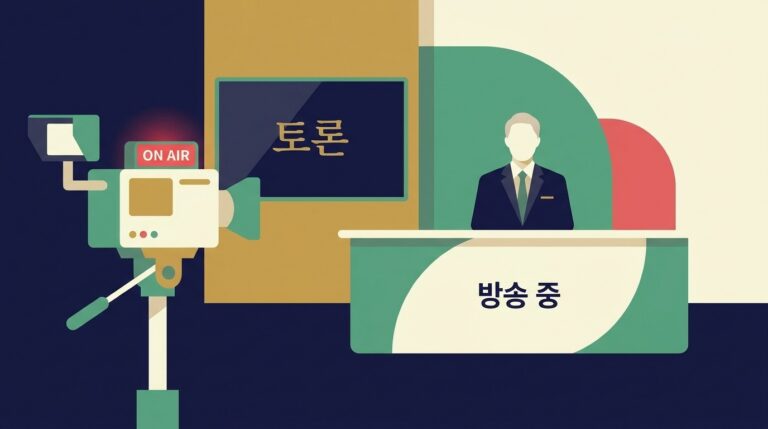
Picture this: You are seated under the sweltering tungsten lights of a major broadcast studio in Sangam-dong, Seoul. The iconic digital clock of a live current-affairs show—reminiscent of MBC’s legendary 100-Minute Debate (100분 토론)—is ticking down in red LEDs. Across the curved acrylic table sits your debate adversary, a seasoned veteran who has just delivered a venomous, rhetorically charged barb aimed directly at your credibility. Your natural instinct, honed perhaps by competitive Western-style parliamentary debate, is to lock eyes with him, lean aggressively over the desk, and systematically eviscerate his factual discrepancies piece by piece.
Stop right there. Take a breath. If you do that on Korean television, you have already lost the debate.
In Korean televised rhetoric—a high-stakes art dramatized with chilling precision in political thrillers like Queenmaker (퀸메이커) and Chief of Staff (보좌관)—the person sitting across from you is merely a sparring prop. The real judge, jury, and audience is the silent, discerning majority watching from their living rooms: the 중도층 (jung-do-cheung, undecided moderate voters). When debaters get dragged into an eye-to-eye mudslinging brawl, the Korean viewing public turns away in disgust, diagnosing both parties as petty political brawlers (정쟁에 눈이 먼 사람들). To conquer live Korean current affairs debates at a C2 Mastery Level, you must master the art of the triangular gaze: absorbing the blow with aristocratic serenity, pivoting the frame, and addressing the camera lens with impeccable civic dignity.
This masterclass isn’t theoretical jargon; it is synthesized from over a decade of analyzing prime-time Korean political broadcasts and coaching international spokespersons who needed to survive the fiercest media gauntlets in Seoul. By the end of this guide, you will wield the linguistic armor necessary to transform hostile cross-examinations into golden opportunities to win the hearts of millions.
Phase 2: Core Expressions Deep Dive (핵심 표현 3선)
1. 시청자 여러분께서 엄중히 지켜보고 계십니다
- Pronunciation: [Sicheongja yeoreobunkkeseo eomjunghi jikyeobogo gyesimnida] (Phonetic flow: “Shee-chong-jah yaw-raw-boon-kkay-saw ohm-joong-hee jee-kyo-boh-goh gay-sheem-nee-dah”)
- Meaning:
- Literal: “The esteemed viewers are watching with solemn gravity.”
- Actual Nuance: “Stop this circus immediately; the public sees right through your cheap political theatrics.”
- K-Culture Moment: Ubiquitous in prime-time political debates right before an assembly member refuses to take the bait of a personal smear, turning squarely to Camera 1.
- Editor’s Insight: Notice the double layer of deference here. You use the highest honorific subject marker
께서(kkeseo) paired with the humble yet grave adverb엄중히(eomjunghi). By invoking the sovereign gaze of the audience, you disarm your opponent’s petty attack and cast yourself as the only adult in the room who respects civic intellect. - Situation Spectrum: Casual 🚫 | Semi-formal ⚠️ | Formal/Broadcast ✅
- 🤔 Think About It: In your native culture, do public debaters appeal directly to the public’s moral gaze to silence an adversary, or is direct confrontation preferred?
2. 상대 패널의 지적은 본질을 흐리는 프레임에 불과합니다
- Pronunciation: [Sangdae paeneorui jijeogeun bonjireul heurineun peureime bulgwahamnida] (Phonetic flow: “Sahng-day peh-nawl-oo-ee jee-jaw-goon bohn-jee-reul hoo-ree-noon poo-ray-eem-ay bool-gwah-hahm-nee-dah”)
- Meaning:
- Literal: “The opposing panelist’s critique is nothing more than a frame that blurs the essence.”
- Actual Nuance: “Nice try moving the goalposts, but you’re evading the critical point because you have no real answer.”
- K-Culture Moment: A hallmark defense tactic used in televised confirmation hearings (인사청문회) when dodging partisan entrapment.
- Editor’s Insight: The phrase
본질을 흐리다(to muddy the core essence) is lethal in high-level Korean debate. Combined with~에 불과하다(is merely / is nothing more than), it minimizes the opponent’s entire diatribe down to an artificial gimmick (프레임) while positioning your argument as objective reality. - Situation Spectrum: Casual 🚫 | Semi-formal ⚠️ | Formal/Broadcast ✅
- 🤔 Think About It: How does the English debate concept of “strawman” differ from the Korean public discourse concept of “muddying the essence” (본질을 흐리다)?
3. 표심과 민생 앞에서는 정쟁보다 대안이 우선되어야 합니다
- Pronunciation: [Pyosim-gwa minsaeng apeseoneun jeongjaengboda dae-ani useondoeeoya hamnida] (Phonetic flow: “Pyoh-sheem-gwah meen-seng ah-pay-saw-noon jawng-jeng-boh-dah day-ahn-ee oo-sawn-dway-aw-yah hahm-nee-dah”)
- Meaning:
- Literal: “In the face of the public mandate and popular livelihoods, alternatives must take precedence over political strife.”
- Actual Nuance: “You are playing self-serving factional games while real citizens are suffering; here is my actual policy solution.”
- K-Culture Moment: Delivered during closing arguments by seasoned strategists in high-stakes mayoral or presidential candidate debates to court undecided moderate voters.
- Editor’s Insight: In Korean culture, invoking
민생(minsaeng, the everyday livelihood and bread-and-butter survival of ordinary people) is the ultimate trump card. Any debate that looks like abstract ideological squabbling (정쟁) loses public favor; the panelist who ties their rhetoric to tangible citizen welfare instantly claims the moral high ground. - Situation Spectrum: Casual 🚫 | Semi-formal ⚠️ | Formal/Broadcast ✅
- 🤔 Think About It: Why does the rhetorical pivot toward “livelihood” (민생) carry such immense emotional weight in a nation with Korea’s rapid post-war developmental history?
Phase 3: Textbook Korean vs. Real Korean (교과서 한국어 vs 진짜 한국어)
Scenario 1: Rebuffing a Distracting, Out-of-Scope Accusation
- 📖 교과서 한국어 (Textbook Korean):
“그것은 오늘의 토론 주제와 상관이 없으니 다른 이야기를 합시다.”
(Geugeoseun oneurui toron jujewa sang-gwani eopseuni dareun iyagireul hapsida.)
“That has nothing to do with today’s debate topic, so let’s talk about something else.” - 🗣️ 진짜 한국어 (Real C2 Debate Korean):
“말씀하신 쟁점의 취지는 이해합니다만, 지금 화면 너머 시청자들께서 가장 절박하게 묻고 계신 본질은 그것이 아닙니다.”
(Malsseumhasin jaengjeomui chwijineun ihaehamnidaman, jigeum hwamyeon neomeo sicheongjadeulkkeseo gajang jeolbakhage mutgo gyesin bonjireun geugeosi animnida.)
“I grasp the underlying intent of the panelist’s point; however, that is hardly the essential question our viewers across the screen are desperately asking right now.” - 💡 Why is it different?: The textbook version sounds petulant, robotic, and defensive, signaling that the opponent rattled you. The C2 real-world phrase uses tactical validation (취지는 이해합니다만 – “I understand your intent”) before decisively reorienting the moral compass toward the viewer’s urgent interests.
Scenario 2: Responding to a Blatantly Biased, Emotional Invective
- 📖 교과서 한국어 (Textbook Korean):
“패널님의 말씀이 너무 지나치십니다. 사실과 다르니 사과하세요.”
(Paeneolnimui malsseumi neomu jinachisimnida. Sasilgwa dareuni sagwahaseyo.)
“Your words go too far, panelist. That is contrary to fact, so apologize.” - 🗣️ 진짜 한국어 (Real C2 Debate Korean):
“격정 어린 고언으로 받아들이겠습니다만, 검증되지 않은 정치적 공세로 중도층의 눈과 귀를 가릴 수는 없습니다.”
(Gyeokjeong eorin go-eoneuro badadeurigessumnidaman, geomjeungdoeji aneun jeongchijeok gongséro jungdocheung-ui nungwa gwireul garil suneun eopseumnida.)
“I shall receive your impassioned words as fervent counsel; nonetheless, unverified political offensives cannot blind the eyes and ears of our discerning moderates.” - 💡 Why is it different?: Demanding an apology on live TV looks insecure and defensive. Re-framing their furious insult as 격정 어린 고언 (impassioned, bitter counsel) demonstrates superior emotional equilibrium (품격) and exposes their hostility as a futile attempt to deceive undecided voters.
Phase 4: K-Culture Deep Dive & Non-Verbal Manners (비언어적 매너)
4-1. The Art of Nunchi & Camera Micro-Manners
In a Western debate, split-screen displays often show the waiting debater shaking their head vigorously, smirking, or scribbling notes aggressively to project defiance. On Korean television, this is disastrous. Korean viewers prize 품격 (pum-gyeok, moral dignity and gravitas) above all.
* The Triangulated Sightline: When your opponent launches an attack, do not glare directly into their eyes like an enraged gladiator. Maintain a 45-degree respectful profile, resting your eyes calmly on your notepad or on the floor midway between you. When it is your turn to speak, acknowledge the opponent for two seconds with a respectful nod, and then shift your gaze squarely into the Red Tally Lamp of Camera 1.
* The Fountain Pen Restraint: Keep both hands resting on the desk, holding a quality ballpoint pen horizontally between both palms. Never point a pen, finger, or index knuckle (삿대질) at the opponent. Pointing in Korean public forums denotes an absolute loss of self-control and an overt violation of basic decorum.
* The Stoic Micro-Expression: During hostile accusations, avoid cynical smiles (실소). Instead, adopt a focused, slightly pensive gaze that signals, “I am listening attentively to my fellow citizen, even if his stance is flawed.”
4-2. The Cultural Battleground: Jungdocheung (중도층) and Minshim (민심)
Why this obsessive focus on the audience rather than the opponent? Korean civic society is deeply conscious of 민심 (min-sim, the sovereign will of the people). In high-stakes broadcast programs like JTBC’s 썰전 (War of Words) or general election debates, polarized partisans have already made up their minds. The real victory lies in persuading the 중도층 (undecided swing voters)—frequently comprising 30% or more of the electorate. These voters judge a panelist not merely on spreadsheet data, but on emotional maturity (그릇의 크기, the size of one’s vessel/character). The moment you scream back at your opponent, undecided voters conclude that your party lacks the emotional maturity to govern the nation.
Phase 5: Real-World Roleplay Scenario (실전 롤플레이 시나리오)
- Setting: Live studio of KBS’s flagship debate show 시사포커스 K (Current Affairs Focus K). Studio floor, 11:15 PM.
- Characters:
- Anchor Min (진행자 민정): Crisp, razor-sharp broadcast journalist who ruthlessly cuts off rambling debaters.
- Assemblyman Park (박 의원): Combative, five-term politician known for trapping opponents in emotional cross-examinations.
- You (Dr. Kang / 강 박사): Independent civic policy analyst brought in to represent balanced economic reform.
Turn 1 (Anchor Min):
🎭 Looking down at the tablet cue sheet, then glancing sharply at the panel.
“시간이 촉박합니다. 박 의원님, 주도권 토론 2분 드리겠습니다.”
(Sigani chokbakamnida. Bak uiwonnim, judogwon toron 2-bun deurigessumnida.)
“Time is running short. Assemblyman Park, you have a two-minute lead-cross examination.”
Turn 2 (Assemblyman Park):
🎭 Leaning over the desk, raising his voice, cutting right toward you with a pointed gaze.
“강 박사님! 학계에만 계셔서 현장 물정을 전혀 모르시나 본데, 이번 개혁안이 통과되면 자영업자들 다 길거리에 나앉습니다. 책임지실 겁니까?”
(Kang baksanim! Hakgye-eman gyesyeoseo hyeonjang muljeong-eul jeonhyeo moreusina bonde, ibeon gaehyeogani tonggwadoemyeon jayeongeopjadeul da gilgeorie naan-sseumnida. Chaegimjisil geomnikka?)
“Dr. Kang! Since you’ve spent your entire life in ivory-tower academia, you seem utterly oblivious to real-world business realities. If this reform passes, small shop owners will all be thrown out on the street. Will you take personal responsibility for that?!”
Turn 3 (You – The Master Debater):
🎭 Calmly writing down one keyword on your notepad, giving a composed nod toward Assemblyman Park, then shifting your gaze smoothly to the center broadcast camera.
“박 의원님께서 소상공인의 절박함을 대변해 주신 점, 정책 설계자로서 무겁게 새기겠습니다.”
(Bak uiwonnimkkeseo sosang-gong-inui jeolbakhameul daebyeonhae jusin jeom, jeongchaek seolgyejaroseo mugeopge saegigessumnida.)
“I will solemnly engrave upon my heart the weight of Assemblyman Park’s point, as he champions the desperate reality of our self-employed citizens.”
Turn 4 (Assemblyman Park):
🎭 Interrupting, waving a stack of printed handouts.
“동문서답하지 마시고! 그래서 자영업자 망하면 책임질 거냐고요! 예, 아니오로만 답하세요!”
(Dongmunseodaphaji masigo! Geuraeseo jayeongeopja manghamyeon chaegimjil geonyagoyo! Ye, anio-roman daphaseyo!)
“Don’t evade the question with political platitudes! I asked if you would take responsibility if they go bankrupt! Answer with a simple Yes or No!”
Turn 5 (You – The Master Debater):
🎭 Gently lowering the pen to the blotter, keeping an unruffled, empathetic tone while looking right into the lens.
“시청자 여러분, 저들이 던지는 ‘예 혹은 아니오’라는 양극단의 프레임 속에는 정작 국민들의 내일을 구할 실천적 해법이 없습니다.”
(Sicheongja yeoreobun, jeodeuri deonjineun ‘ye hogeun anio’raneun yanggeukdanui peureim sogeneun jeongjak gungmindeurui naeireul guhal silcheonjeok haebeobi eopseumnida.)
“Dear viewers, within the extreme, binary frame of ‘Yes or No’ being forced upon us, there lies no actionable solution whatsoever to safeguard the livelihoods of our citizens tomorrow.”
Turn 6 (Anchor Min):
🎭 Nodding slightly in appreciation of the professional composure, tapping the desk timer.
“박 의원님, 발언 시간 30초 남았습니다. 상대 패널의 답변을 보장해 주십시오.”
(Bak uiwonnim, bareon sigan 30-cho namasseumnida. Sangdae paeneorui dapbyeoneul bojanghae jusipsio.)
“Assemblyman Park, you have 30 seconds left. Please grant the opposing panelist the space to conclude their answer.”
Turn 7 (You – The Master Debater):
🎭 Speaking with measured cadence, opening the palm slightly toward the public viewing audience.
“정쟁으로 소비되는 30분보다, 한 분의 자영업자에게 실질적 보상이 돌아갈 수 있는 사회적 완충 지대를 만드는 대안을 논의해야 합니다.”
(Jeongjaeng-euro sobidoeneun 30-bunboda, han bunui jayeongeopja-ege siljiljeok bosang-i doragal su inneun sahoejeok wanchung jidaereul mandeuneun dae-aneul nonuihaeya hamnida.)
“Rather than burning thirty precious minutes on partisan mudslinging, we must deliberate the pragmatic alternatives: building an economic safety buffer where substantial compensation directly reaches our self-employed citizens.”
Turn 8 (Assemblyman Park):
🎭 Shuffling papers awkwardly, clearing his throat, unable to continue the personal smear.
“어… 물론 구체적인 보상 체계는 저 역시 동의합니다만…”
(Eo… mullon guchejeogin bosang chegyeneun jeo yeoksi dong-uihamnidaman…)
“Uh… well, of course, I too agree that concrete compensation mechanisms are necessary, but…”
🔀 Interactive Branching Moment
Right at Turn 3, when Assemblyman Park accuses you of being an ivory-tower academic who doesn’t understand the real world, how do you respond?
- Option A: Lock eyes with him and retort: “제가 현장을 모른다니요? 지난 10년간 소상공인 실태 조사를 이끈 책임자입니다. 근거 없는 흑색선전 삼가세요!” (Me not know the field? I have led small-business field research for a decade. Refrain from groundless black propaganda!)
- Option B: Look into Camera 1 with serene composure: “의원님께서 소상공인의 절박함을 대변해 주신 점은 공감합니다만, 현장 위기를 정쟁의 도구로 삼아 공포를 조장하는 것은 시청자에 대한 도리가 아닙니다.” (I empathize with the Assemblyman’s sentiment for small business owners; however, exploiting their crisis as a partisan weapon to stoke fear is a disservice to the viewers.)
- Option C: Turn to the Anchor with an exasperated shrug: “진행자님, 저 패널분이 계속 인신공격성 발언을 하시는데 마이크 꺼 주셔야 하는 것 아닙니까?” (Anchor, this panelist keeps making ad hominem attacks; shouldn’t you turn off his microphone?)
💡 Branching Feedback:
- Option A (Risk / C-): You swallowed the bait. By defending your personal credentials, you transformed a systemic policy debate into a petty ego-defense. Undecided viewers register your reaction as thin-skinned and arrogant.
- Option B (Best / A+): Flawless C2 statecraft! You validated his concern for citizens (공감), redirected the blame to his fear-mongering tactics, and championed the viewers’ dignity—all while remaining impeccably polite.
- Option C (Bad / F): Fatal move. Whining to the anchor makes you look helpless, fragile, and incapable of enduring political pressure. The public wants a leader who commands the stage, not one who begs the moderator for protection.
Phase 6: 10-Second Emotion Shadowing Drill (감정 섀도잉 드릴)
Master the rhythm, deliberate pauses, and gravitas of prime-time televised rhetoric. Practice these three distinct deliveries out loud:
- [⚖️ Cold, Immovable Stoicism – Deflecting an Invective]
“말씀의 격정은 / 충분히 이해합니다만, / 본질을 왜곡하는 프레임에는 / 동의할 수 없습니다.”
(Malsseumui gyeokjeong-eun / chungbunhi ihaehamnidaman, / bonjireul waegokhaneun peureimeneun / dong-uihal su eopseumnida.)
“While I fully understand the fervor of your words / I cannot assent / to a deliberate framing / that distorts the core essence.” -
[🎯 Warm, Direct Appeal – Looking Straight at Undecided Viewers]
“지금 이 순간 / 브라운관 너머에서 / 한숨짓고 계실 국민 여러분을 / 먼저 생각해야 합니다.”
(Jigeum i sungan / beura-un-gwan neomeo-eseo / hansumjitgo gyesil gungmin yeoreobuneul / meonjeo saeng-gak-haeya hamnida.)
“At this very juncture, / our highest obligation / is to consider first the citizens / sighing in anxiety on the other side of that broadcast screen.” -
[🏛️ Resolute Authority – Seizing the Agenda]
“정쟁은 여기서 멈추고, / 이제 / 내일을 위한 대안의 시간으로 / 나아갑시다.”
(Jeongjaeng-eun yeogiseo meomchugo, / ije / naeireul wihan dae-anui sigan-euro / na-agapsida.)
“Let the political squabbling halt right here, / and let us now advance / into the hour of pragmatic solutions / for our shared tomorrow.”
Phase 7: K-Culture Mini Dictionary (핵심 키워드 미니 사전)
- 중도층 (Jung-do-cheung) [Noun]: Moderate / Undecided Swing Voters.
- Usage: In Korean elections and live public debates, candidates spend minimal effort wooing solid partisans (집토끼, home rabbits) and deploy 90% of their rhetorical finesse to court the critical swing cohort (산토끼, mountain rabbits / 중도층).
- 프레임 전환 (Peu-re-im Jeon-hwan) [Noun]: Framing Pivot / Agenda Reframing.
- Usage: The sophisticated debate art of acknowledging an adversary’s trap and pivoting the battlefield onto terrain where your moral or empirical authority is unquestionable.
- 품격 (Pum-gyeok) [Noun]: Class, Grace, Moral Gravitas.
- Usage: In Korean public discourse, pum-gyeok is more valuable than winning on technicalities. A debater who is technically correct but condescending loses moral legitimacy in the public eye.
- 민심 (Min-sim) [Noun]: The Collective Heart / Sovereign Sentiment of the People.
- Usage: The invisible, irresistible undercurrent of public sentiment. In Korean political mythology, politicians who fail to read the min-sim face swift democratic reckoning.
Phase 8: Traveler’s Survival Kit for Civic Spaces (여행자를 위한 생존 키트)
Even if you aren’t running for the National Assembly, high-level civic visits—such as touring government centers, attending open academic seminars at Seoul National University, or visiting the National Assembly—require sophisticated communicative manners:
- Top 3 High-Register Expressions:
- “원활한 소통을 위해 잠시 논점을 정리해 주시겠습니까?”
(Wonhwalhan sotong-eul wie jamsi nonjeomeul jeongnihae jusigessumnikka?)
Pro Tip: Use this in heated corporate or institutional meetings instead of “What are you talking about?” It instantly brings professional order to chaotic discussions. - “다양한 시각이 존재하는 만큼, 공통의 대안을 모색하고 싶습니다.”
(Dayanghan sigagi jonjaehaneun mankeum, gongtong-ui dae-aneul mosaekhago sipseumnida.)
Pro Tip: An ironclad phrase for navigating politically sensitive topics with Korean colleagues without picking a partisan side. - “국민적 눈높이에서 납득할 수 있는 설명이 필요해 보입니다.”
(Gungminjeok nunnopieseo naptukhalsu inneun seolmyeong-i piryohae boimnida.)
Pro Tip: Invoking the public’s perspective (국민적 눈높이) softens hard critiques and gives your stance objective authority.
- “원활한 소통을 위해 잠시 논점을 정리해 주시겠습니까?”
- Editor’s Civic Travel Note: If you wish to witness real Korean debate culture firsthand, book a public tour through the National Assembly of the Republic of Korea Visitor Reservation Portal. Afterward, take Line 9 to National Assembly Station and walk over to Yeouido Park; you will frequently encounter lively, passionate public forums and citizen rallies that define contemporary Korean democracy.
Phase 9: “One Step Deeper” (한 발 더 깊이)
In traditional Western debating traditions tracing back to Aristotle and the Roman Forum, rhetoric is inherently agonistic—two combatants duel directly, clash over logic, and the victor takes the spoils. In Korea, however, public discourse is governed by the Confucian ethics of third-party harmony and 체면 (che-myeon, face/dignity).
When you publicly embarrass an opponent or scream over their microphone, you do not demonstrate strength; you reveal an unrefined inner spirit (수양의 부족). The television audience does not view themselves as detached spectators watching a bloodsport in the Colosseum; they view themselves as the senior elders of the nation adjudicating a family squabble. The debater who honors the collective gaze of the people, refuses to wallow in factional malice, and maintains unbreakable civic composure is the one granted the authority to lead.
💬 Your Turn: Have you ever watched a live broadcast debate in Korea or your home country where a speaker won the crowd solely through emotional restraint rather than aggressive retorts? Share your observations in the comments below!
Phase 10: FAQ & Avoiding Misunderstandings (자주 묻는 질문 & 주의사항)
Q: Why shouldn’t I maintain direct eye contact with my opponent while debunking their argument?
A: In televised Korean debates, prolonged, piercing eye contact combined with refutation can appear combative and personally vindictive to older viewers. Glancing briefly at your opponent to acknowledge their presence, and then addressing the camera lens directly, reinforces the psychological reality that the audience—not your opponent—is the supreme arbiter of truth.
Q: Is it considered a weakness if I say “I agree with your intent” (취지는 공감합니다만)?
A: Quite the contrary! In Korean high-level rhetoric, this is known as 포용적 반박 (inclusive refutation). By demonstrating that you have the magnanimity to acknowledge your opponent’s underlying premise, you neutralize their aggressive hostility and make their ongoing attacks look unreasonably narrow-minded to undecided moderates.
Q: Can I use everyday conversational contractions like “근데요” (Geundeyo) or “제 말은요” (Je mareun-yo)?
A: Absolutely not in a formal broadcast or high-level panel setting. At the C2 level, you must consistently utilize the formal high-deference style (하십시오체, hasipsioche), incorporating polished discourse markers such as 그 점에 관하여는 (In regard to that aspect) or 첨언하여 말씀드리자면 (If I may add a supplementary point).
🚨 Common Mistakes Alert:
- Dropping Honorific Suffixes under Duress: In intense exchanges, non-native speakers often slip into informal speech (
반말) or omit the honorific infix-시-. This is broadcast suicide. Address your opponent strictly as의원님(Assemblyman),교수님(Professor), or상대 패널님(Esteemed Fellow Panelist). - Looking Constantly at the Anchor for Help: Avoid looking desperately toward the moderator when attacked. It signals weakness and lack of leadership endurance.
- Interrupting with Loud Over-talking: Unlike some Western networks where talking over each other is standard theatrical fare, interrupting on Korean airwaves alienates older viewers. Wait for the moderator’s nod, or interject with a polite, razor-sharp prefix: “발언 기회를 주시면 짧게 팩트를 바로잡겠습니다” (If granted the floor, I will briefly correct the factual record).
Phase 11: Action Mission & Engagement (액션 미션)
- 🥉 Bronze Mission (Self Practice): Record a 60-second video of yourself on your smartphone. Look straight into the camera lens (representing Camera 1) and deliver Expression #1 (
시청자 여러분께서 엄중히 지켜보고 계십니다) with a stoic, commanding, yet empathetic facial expression. Check your posture: no pen pointing! - 🥈 Silver Mission (Social Media Reflection): Watch a 5-minute clip of a Korean parliamentary debate or the drama Queenmaker on YouTube. Identify one instance where a speaker successfully pivots the discussion using the term
본질(essence) or민생(livelihood). Share your favorite line on X (Twitter) or Instagram tagging#DailyHangulC2Debate. - 🥇 Gold Mission (Real-World Application): In your next high-level professional meeting or presentation conducted in Korean, when confronted with a difficult or stray question, deliberately use: “지적해 주신 취지는 충분히 이해합니다만, 현 시점에서 우리가 집중해야 할 본질은…” and observe how gracefully you command the room.
🎮 K-Culture Mission: Watch Episode 4 of Netflix’s Queenmaker. Pay close attention to how Hwang Do-hee (played by Kim Hee-ae) choreographs her candidate’s body language, breathing pauses, and camera angles during the live televised debate. Spot the exact moment when the candidate stops fighting her rival and speaks directly to the working-class citizens!
Phase 12: Interactive Quiz Challenge (인터랙티브 퀴즈)
Test your high-stakes debate acumen! Answer these three strategic challenges, then expand the toggle below to verify your mastery.
Q1. [Situational Judgement]
During a live broadcast, the opposing panelist makes a wild, ungrounded accusation regarding your personal finances. Which of the following responses reflects the highest level of C2 debate mastery?
* A) “거짓말하지 마세요! 당장 고소하겠습니다!”
* B) “진행자님, 저 사람 마이크 좀 꺼주세요. 사실이 아닙니다.”
* C) “격정 어린 의혹 제기 속에서도 시민들께서 진정으로 궁금해하시는 정책 검증의 본질로 돌아가 답변드리겠습니다.”
* D) “제 통장 내역을 다 공개할 테니, 패널님도 똑같이 전 재산 까시겠습니까?”
Q2. [Fill in the Blank]
Complete the classic C2 agenda-pivot phrase designed to appeal directly to the public interest:
“선거철마다 반복되는 소모적인 ( A )을/를 멈추고, 우리 국민의 실질적인 삶을 보듬는 ( B )에 집중해야 합니다.”
* 1) A: 정쟁 (Political squabbling) / B: 민생 (People’s livelihood)
* 2) A: 연설 (Speeches) / B: 광고 (Advertisements)
* 3) A: 언론 (Press) / B: 여론 (Public opinion)
Q3. [True or False: Cultural Code]
In televised Korean debates, looking directly into the camera lens instead of maintaining eye contact with your counter-panelist during a rebuttal is considered extremely rude and evasive.
* True / False
👉 Click here for Answers & Strategic Explanations
Answers & Detailed Feedback:
- Q1 Answer: C
- Why?: Option C exemplifies consummate rhetorical poise. It absorbs the accusation as an “impassioned raising of suspicions” (격정 어린 의혹 제기) without accepting liability, and immediately shifts the debate back to systemic policy vetting (정책 검증의 본질) for the citizens. Options A, B, and D are disastrously emotional, juvenile, and petty.
- Q2 Answer: 1 (A: 정쟁 / B: 민생)
- Why?: The quintessential dialectic in Korean public statecraft is contrasting petty partisan warfare (
정쟁) with the tangible, everyday bread-and-butter struggles of the citizenry (민생). Using this pair instantly positions you as an enlightened statesman.
- Why?: The quintessential dialectic in Korean public statecraft is contrasting petty partisan warfare (
- Q3 Answer: False
- Why?: Absolutely False! On television, addressing the camera lens acknowledges that the true audience is the citizen watching at home. Looking exclusively at the counter-panelist creates an insular, aggressive dynamic that alienates undecided voters.
- Why?: Absolutely False! On television, addressing the camera lens acknowledges that the true audience is the citizen watching at home. Looking exclusively at the counter-panelist creates an insular, aggressive dynamic that alienates undecided voters.
Written with dedication by your fellow cultural navigator at Daily Hangul. Keep your composure, keep your dignity, and lead the conversation!







