

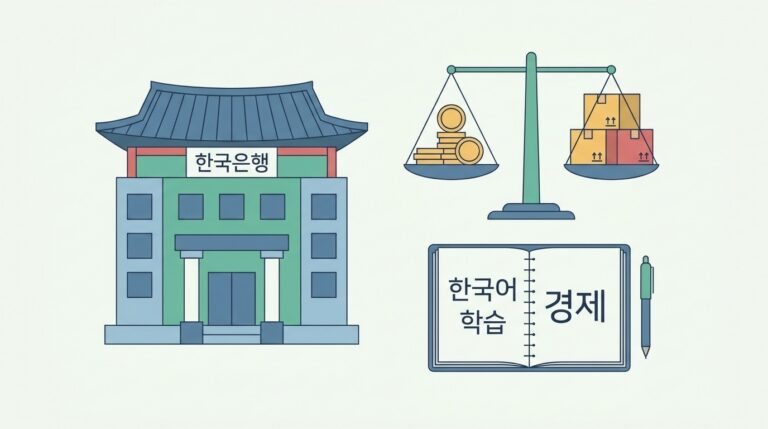
Phase 1: Empathy & Story-Driven Opening
안녕하세요! 매일한글 에디터입니다.
Imagine sitting in a high-stakes morning briefing in a sleek glass high-rise in Yeouido, Seoul’s Wall Street. The room is dead quiet except for the rustle of macroeconomic reports. On the monitor, the Bank of Korea’s Monetary Policy Committee press conference is streaming live. Your director, Min-woo, turns to you and asks: “이번 금리 인상으로 배추값이나 반도체 부품 단가 같은 공급망 이슈를 과연 잡을 수 있을까요?” (Ibeon geumri insang-euro baechugap-ina bandoche bupeum danga gateun gonggeupmang issyu-reul gwayeon jabeul su isseulkkayo? / Do you really think this rate hike can curb supply chain issues like cabbage prices or semiconductor component costs?).
You know textbook economic terminology, yet your mind freezes. You want to articulate that central bank rate hikes dampen aggregate demand, but cannot untie physical transport bottlenecks or geopolitical trade snarls—meaning targeted micro-level market measures and coordinated fiscal support are essential. Yet, all you can manage is: “금리가 높아서 어려워요” (Geumriga nop-aseo eoryeowoyo / It is difficult because rates are high). It feels frustratingly simplistic for a seasoned professional.
At the C1 level, discussing Korean monetary policy requires more than memorized vocabulary; it demands understanding how Korean policymakers articulate the delicate friction between curb-stomping inflation and averting economic stagnation. Drawing from years of tutoring expatriate analysts, diplomats, and business strategists in Seoul, this guide will equip you with sophisticated, natural phrasing to dissect policy dilemmas, challenge monolithic views, and debate high-level policy combinations with native nuance.
Phase 2: Core Expressions Deep Dive
1. 통화량 조절만으로는 공급 병목 현상을 해소하기 어렵습니다
- Pronunciation: Tong-hwa-ryang jo-jeol-man-eu-ro-neun gong-geup byeong-mok hyeon-sang-eul hae-so-ha-gi eo-ryeop-seum-ni-da. (Phonetic rhythm: Think of ‘Tong-hwa’ like the crisp snap in “tongue”, ‘byeong-mok’ sliding from “bottle” to “neck” with a clipped ‘k’ stop).
- Meaning: Literal: “Only by adjusting the money supply, it is difficult to resolve the supply bottleneck phenomenon.” / Nuance: Pure monetary tightening is a blunt tool that fails to fix structural, supply-side logjams.
- K-Culture Moment: Seen in boardroom dramas like Reborn Rich (재벌집 막내아들) or Midas (마이더스), where a sharp-witted strategist stands up against conservative board members insisting solely on raising interest rates.
- Editor’s Insight: “공급 병목” (supply bottleneck) borrows from the literal image of a bottle’s narrow neck (병목). When paired with “해소하기 어렵다” (hard to alleviate), it signals to Korean peers that you recognize the limits of macroeconomic broad-brushing.
- Situation Spectrum: Casual: 🚫 | Semi-formal: ⚠️ | Formal: ✅
- 🤔 Think About It: Does your native language view inflation primarily as a monetary failure, or do you readily separate monetary policy from physical logistics in daily workplace debates?
2. 미시적 물가 대책과 정교한 정책 조합(Policy Mix)이 절실해요
- Pronunciation: Mi-si-jeok mul-ga dae-chaek-gwa jeong-gyo-han jeong-chaek jo-ha-bi jeol-sil-hae-yo. (Tip: Blend ‘jo-hap’ and ‘i’ smoothly into ‘jo-ha-bi’, evoking the sound of assembling delicate puzzle pieces).
- Meaning: Literal: “Micro-level price countermeasures and an exquisite policy combination are desperate.” / Nuance: We urgently need surgical, sector-specific market policies working in lockstep with fiscal maneuvers.
- K-Culture Moment: A staple line on KBS or SBS evening business talk shows when seasoned economic panels critique government initiatives that lean solely on rate levers while daily grocery prices skyrocket.
- Editor’s Insight: “절실하다” conveys pressing, urgent necessity without emotional desperation. Adding “정교한” (elaborate, sophisticated) elevates your discourse from basic administrative complaint to executive strategic advisory.
- Situation Spectrum: Casual: ⚠️ | Semi-formal: ✅ | Formal: ✅
- 🤔 Think About It: In Korean policy discussions, “조합” (combination) often implies collective harmony between ministries. How does this compare to how institutional friction is described in your country?
3. 금리 인상만 고집하다가는 경기 침체의 늪에 빠질 수 있습니다
- Pronunciation: Geum-ri in-sang-man go-jip-ha-da-ga-neun gyeong-gi chim-che-ui neu-pe ppa-jil su it-seum-ni-da. (Analogous flow: “Geum-ri” rhymes smoothly with “dreamy”, followed by the guttural tension of ‘늪’ [neup] like stepping into deep mud).
- Meaning: Literal: “If one insists only on interest rate hikes, one may fall into the swamp of economic recession.” / Nuance: Dogmatically hiking rates without complementary safety nets risks tipping our economy into a devastating, prolonged slump.
- K-Culture Moment: Often delivered by an embattled Prime Minister or Bank Governor character in financial thrillers like Default (국가부도의 날), underscoring moral weight and systemic dread.
- Editor’s Insight: The metaphor “침체의 늪” (swamp of stagnation) is powerful rhetoric. The grammar pattern “-다가(는)” warns of a disastrous inevitable outcome if the present action persists.
- Situation Spectrum: Casual: ⚠️ | Semi-formal: ✅ | Formal: ✅
- 🤔 Think About It: Metaphors of nature (swamps, tsunamis, cold waves) appear frequently in Korean economics. What environmental metaphors does your culture lean on when describing fiscal crises?
Phase 3: Textbook Korean vs. Real Korean
Scenario 1: Proposing targeted food subsidies and logistics support instead of just hiking the base rate
- 📖 교과서 한국어: 정부는 중앙은행의 기준금리 인상 외에도 공급망에 대한 재정 지출을 늘려야 합니다. (Jeongbuneun jung-ang-eunhaeng-ui gijungeumri insang oedo gonggeupmange daehan jaejeong jichureul neullyeoya hamnida.)
- 🗣️ 진짜 한국어: 금리 올려서 수요만 누른다고 될 게 아니라, 물류비 보조 같은 미시 대책으로 급한 불부터 꺼야죠. (Geumri ollyeoseo suyoman nureundago doel ge anira, mullyubi bojo gateun misi daechaeg-euro geuphan bulbuteo kkeoyajyo.)
- 💡 왜 다를까? Textbook Korean sounds like a written whitepaper clause. Real native analysts use dynamic expressions like “급한 불을 끄다” (put out immediate fires) and conversational contrast markers (“-ㄴ다고 될 게 아니라”) to emphasize pragmatic action.
Scenario 2: Debating whether fiscal and monetary policies are colliding
- 📖 교과서 한국어: 현재 통화정책과 재정정책의 방향성이 불일치하여 혼란스럽습니다. (Hyeonjae tonghwajeongchaekgwa jaejeongjeongchaeg-ui banghyangseong-i burilchihayeo hollanseureopseumnida.)
- 🗣️ 진짜 한국어: 통화 긴축이랑 재정 부양이 엇박자를 내면 시장에 잘못된 시그널을 줄 수밖에 없어요. (Tonghwa ginchug-irang jaejeong buyang-i eotbakjareul naemyeon sijange jalmotdoen sigeuneoreul jul subakke eopseoyo.)
- 💡 왜 다를까? Educated professionals frequently utilize “엇박자를 내다” (to fall out of step / create syncopated discord) to intuitively illustrate uncoordinated policy execution rather than stiff words like “방향성 불일치”.
Phase 4: K-Culture Deep Dive & Non-Verbal Etiquette
4-1. Nunchi & Executive Body Language
When delivering macroeconomic critiques in Korea, direct contradiction can instantly chill the room. Senior officials and executives heavily identify with institutional policy continuity.
* The Softened Gaze & Half-Nod: When about to express that a base rate hike is insufficient, start by nodding slowly while taking notes. Begin with “충분히 공감합니다만…” (I completely empathize, however…) while keeping your gaze tilted down toward your briefing paper before looking up to meet the Director’s eyes.
* The Open Hand Presentation: Avoid pointing with pens or fingers when presenting conflicting economic charts. Gesture with an open palm turned upward toward the data screen to denote shared objective scrutiny rather than personal confrontation.
4-2. The “Daepa (Green Onion) Syndrome” in Korean Micro-Policy
In Western media, central banking debates often center around housing indices or broad tech stocks. In Korea, however, public anxiety around inflation frequently detonates over kitchen staples: Daepa (대파 / green onions), Baechu (배추 / napa cabbage), and eggs.
This phenomenon gives rise to intense discussions about “미시적 물가 안정” (micro price stabilization). If international crude oil jumps or drought hits domestic agricultural heartlands, tightening credit lines simply strains small merchants without lowering the cost of kimchi making. This explains why Korean TV news devotes entire prime-time segments to government release of national rice reserves alongside Bank of Korea monetary bulletins. To sound like an authentic insider, frame economic debates around how micro-interventions protect everyday consumer sentiment (장바구니 물가).
Phase 5: Real-World Roleplay Scenario
Setting: A modern conference room in Gwanghwamun. Director Min (민 부장), a veteran macroeconomic strategist, is reviewing the upcoming quarterly policy outlook with Junior Partner Chris.
[Turn 1] 민 부장: 크리스 씨, 물가 상승률이 아직도 3%대인데, 이번 금통위에서 기준금리를 최소 25bp는 더 올려야 하지 않겠어요?
(Keuriseu ssi, mulga sangseungnyuri ajikdo samposeenteu daeinde, ibeon geumtongwieseo gijungeumrireul choeso isibiobipineun deo ollyeoya haji ankkesseoyo? / Chris, inflation is still in the 3% range; shouldn’t the Monetary Policy Committee hike the base rate by at least 25 basis points this time?)
🎭 [서류를 툭툭 치며 안경 너머로 날카롭게 응시한다 / Tapping his papers and peering sharply over his glasses]
[Turn 2] 크리스: 부장님 말씀대로 수요 둔화도 필요하지만, 이번 인플레이션은 공급 병목에서 기인한 측면이 더 큽니다.
(Bujangnim malsseumdaero suyo dunhwado piryohajiman, ibeon inpeulleisyeoneun gonggeup byeongmog-eseo giinhan cheukmyeon-i deo keumnida. / As you mentioned, director, cooling demand is necessary, but this inflation stems more heavily from supply bottlenecks.)
🎭 [침착하게 태블릿 화면의 글로벌 공급망 지표를 띄우며 / Calmly bringing up global supply chain indices on his tablet]
[Turn 3] 민 부장: 그렇다고 금리를 묶어두면 기대인플레이션을 어떻게 잡겠다는 건가요? 시장에 안이한 신호를 줄 텐데.
(Geureotdago geumrireul mukkeodumyeon gidae-inpeulleisyeoneul eotteoke japgetdaneun geongayo? Sijange anihan sinhoreul jul tende. / Even so, if we keep rates frozen, how do we anchor inflation expectations? It would send a complacent signal to the market.)
🎭 [팔짱을 끼며 고개를 살짝 갸웃거린다 / Folding his arms with a slight head tilt]
[Turn 4] 크리스: 물론 기대심리를 꺾는 것도 중요합니다. 다만 통화량 조절만으로는 원자재 수입단가 상승을 직접 해소할 수 없습니다.
(Mollon gidaesimnireul kkeongneun geotdo jung-yohamnida. Daman tonghwaryang jojeolmaneuro-neun wonjajae su-ipdanga sangseung-eul jikjeop haesohal su eopseumnida. / Of course breaking psychological expectations is critical. However, monetary control alone cannot directly resolve rising raw material import costs.)
🎭 [두 손을 가볍게 모아 경청하는 태도를 유지하며 / Keeping hands loosely clasped in an attentive, respectful posture]
[Turn 5] 민 부장: 흠, 결국 금리 하나로 다 틀어막을 수는 없다는 뜻이군요. 그럼 우리가 제시할 대안은 뭐죠?
(Heum, gyeolguk geumri hanaro da teureomageul suneun eopdaneun tteus-igunyo. Geureom uriga jesihal daeaneun mwojyo? / Hmm, you mean we cannot block everything with just the interest rate. Then what alternative should we present?)
🎭 [표정이 부드러워지며 펜을 들고 메모할 준비를 한다 / Expression softening as he picks up his pen, ready to take notes]
[Turn 6] 크리스: 통화 긴축의 완급을 조절하는 동시에, 정부 차원의 관세 인하나 유류세 감면 같은 미시 대책이 병행되어야 합니다.
(Tonghwa ginchuk-ui wangeubeul jojeolhaneun dongsie, jeongbu chaweon-ui gwanse inhahana yuryuse gammyeon gateun misi daechaeg-i byeonghaengdoeeoya hamnida. / While pacing monetary tightening, micro-measures like government tariff cuts or fuel tax reductions must be executed concurrently.)
🎭 [차분하고 설득력 있는 어조로 방안을 가리키며 / Pointing to the proposals with a calm, persuasive tone]
[Turn 7] 민 부장: 즉, 통화정책과 재정정책의 정교한 정책 조합(Policy Mix)을 권고안의 핵심으로 삼자는 말이군요.
(Jeuk, tonghwajeongchaekgwa jaejeongjeongchaeg-ui jeonggyohan jeongchaek johabeul gwon-goan-ui haeksim-euro samjaneun marigunyo. / In other words, you are proposing an elaborate policy mix of monetary and fiscal policy as the core of our advisory.)
🎭 [고개를 끄덕이며 흡족한 미소를 짓는다 / Nodding thoughtfully with a satisfied smile]
[Turn 8] 크리스: 네, 맞습니다. 그래야만 경기 침체의 늪을 피하면서 실질적인 물가 안정을 꾀할 수 있습니다.
(Ne, matseumnida. Geuraeyaman gyeonggi chimche-ui neupeul pihamyeonseo siljiljeogin mulga anjeong-eul kkoehal su itseumnida. / Yes, precisely. Only then can we avoid the swamp of economic recession while engineering real price stability.)
🎭 [자신감 있는 눈빛으로 정중하게 목례한다 / Bowing slightly with confident eye contact]
🔀 Interactive Decision Point
Suppose Director Min challenges your policy combination during Turn 5 by saying: “하지만 정부 재정이 이미 빠듯한데 보조금이나 세제 혜택이 가능할까요?” (hajiman jeongbu jaejeong-i imi ppadeuthande bojogeumina seje hye-taeg-i ganeunghalkkayo? / But government fiscal space is already tight; are subsidies or tax incentives even viable?) How do you respond?
- Option A: “돈이 없으면 금리라도 계속 올려서 소비를 바닥까지 죽이는 수밖에 없습니다.” (Don-i eopseumyeon geumrirado gyesok ollyeoseo sobireul badakkkaji jugineun subakke eopseumnida. / If there is no money, all we can do is keep jacking up rates to crush consumption to the floor.)
- ❌ Feedback (Bad): Too fatalistic and reckless. In a Korean strategic context, advocating total consumption collapse destroys your credibility as a balanced advisor.
- Option B: “보편적 지원 대신 병목이 극심한 수입 공급망 품목에 한해 핀셋 지원을 펼쳐야 재정 부담을 최소화할 수 있습니다.” (Bopyeonjeok jiwon daesin byeongmog-i geuksimhan su-ip gonggeupmang pummoge hanhae pinset jiwoneul pyeolchyeoya jaejeong budameul choesohwahal su itseumnida. / Instead of universal welfare, pinpointing precision support specifically to severe supply bottleneck import items will minimize fiscal burden.)
- ✅ Feedback (Best): Flawless C1 articulation! Using “핀셋 지원” (pinpoint/tweezer targeted relief) and contrasting it with “보편적 지원” (universal assistance) proves you understand contemporary Korean technocratic vernacular.
- Option C: “그건 재정 당국이 알아서 할 문제니까 한국은행은 금리만 생각하면 됩니다.” (Geugeon jaejeong danggug-i araseo hal munjeneikka hangugeunhaeng-eun geumriman saenggakhamyeon doemnida. / That is a matter for fiscal authorities to handle; the Bank of Korea only needs to care about rates.)
- ⚠️ Feedback (Risk): While theoretically highlighting central bank independence, dismissing fiscal synergy sounds uncooperative and bureaucratic in an inter-ministerial strategy session.
Phase 6: 10-Second Emotional Shadowing Drill
Mastering executive cadences requires pausing at logical junctions (/) to build intellectual gravitas. Shadow each turn following the emotional prompt.
- Drill 1:
[🧐 단호하고 학구적으로 / Firm & Academic]
“통화량 조절만으로는 / 공급망에서 발생한 병목 현상을 / 근본적으로 해결할 수 없습니다.”
(Tonghwaryang jojeolmaneuro-neun / gonggeupmang-eseo balsaenghan byeongmok hyeonsang-eul / geunbonjeog-euro haegyeolhal su eopseumnida.) -
Drill 2:
[🤔 신중하고 균형 잡힌 태도로 / Prudent & Balanced]
“물가 안정도 시급하지만, / 과도한 긴축으로 / 경기 침체의 늪에 빠지지 않도록 / 속도 조절이 필요합니다.”
(Mulga anjeongdo sigeuphajiman, / gwadohan ginchug-euro / gyeonggi chimche-ui neupe ppajiji antorok / sokdo jojeor-i piryohamnida.) -
Drill 3:
[💡 영민하고 설득력 있게 / Sharp & Persuasive]
“금리 정책과 더불어 / 취약 부문을 겨냥한 / 미시적 대책과의 정교한 정책 조합이 / 절실한 시점입니다.”
(Geumri jeongchaekgwa deobureo / chwi-yak bumuneul gyeonanghan / misijeok daechaekgwa-ui jeonggyohan jeongchaek johabi / jeolsilhan sijeom-imnida.)
Phase 7: K-Culture Mini Dictionary
- 정책 조합 (Jeong-chaek Jo-hap) | Noun: Policy Mix
Usage: Refers directly to the delicate synchronization between Bank of Korea’s interest rate levers and the Ministry of Economy and Finance’s fiscal spending. - 공급 병목 (Gong-geup Byeong-mok) | Noun: Supply Bottleneck
Usage: Widely used across Korean logistics, trade analyses, and financial news reports describing chip shortages, marine freight disruptions, or agricultural shocks. - 미시 대책 (Mi-si Dae-chaek) | Noun: Micro/Targeted Measures
Usage: Contrasted with macroeconomic rate tools. Covers targeted tariff eliminations, emergency fuel subsidies, and reserve stock releases for sensitive domestic goods. - 급한 불 끄기 (Geup-han Bul Kkeu-gi) | Idiom: Extinguishing the Immediate Fire
Usage: Highly common in executive meetings to describe urgent, temporary measures implemented to suppress immediate market panic before structural reforms take root.
Phase 8: Corporate Traveler’s Survival Kit
Top 3 Survival Phrases for Korean Business Encounters
- “양측 입장의 균형점을 찾을 필요가 있습니다.” (Yangcheuk ipjang-ui gyunhyeongjeomeul chajeul piryoga itseumnida.)
Translation: “We need to locate an equilibrium point between both positions.”
Pro Tip: Use this when financial discussions stall between hawks advocating heavy rate hikes and doves fearing domestic credit freezes. - “거시적 지표와 체감 경기 사이에 괴리가 큽니다.” (Geosijeok jipyowa chegam gyeonggi sa-ie goeriga keumnida.)
Translation: “There is a substantial gap between macroeconomic indices and felt market realities.”
Pro Tip: Drops directly into lunch meetings with Korean banking colleagues when official stats look stable but foot traffic in local shopping districts is declining. - “속도 조절론에 무게가 실리고 있습니다.” (Sokdo jojeollone mugega silligo itseumnida.)
Translation: “Weight is shifting toward the argument for pacing the adjustments.”
Pro Tip: Ideal for summarizing the latest market consensus regarding central bank meetings without committing to an aggressive personal prediction.
Editor’s Travel Note: Financial & Logistics Commuter Tips
- When heading to high-level briefings in Seoul’s financial hubs like Yeouido (여의도) or Gwanghwamun (광화문), avoid taking standard taxis during peak market opening hours (8:00 AM – 9:30 AM). Instead, check real-time routing on the 네이버 지도 대중교통 길찾기 앱 and ride Seoul Metro Line 5 or 9, which run with surgical punctuality.
- For continuous market surveillance during your business trip, download and track domestic indices via the 한국은행 경제통계시스템 (ECOS) 포털 to reference real-time base rate decisions and foreign exchange reserves on your commute.
Phase 9: 한 발 더 깊이 (Reflective Essay)
In contemporary Western macroeconomic theory, the separation between central banks and administrative cabinets is treated as an almost inviolable pillar of market integrity. Yet in Korea, the boundaries between the central bank (한국은행) and the fiscal authority (기획재정부) inhabit a nuanced cultural landscape shaped by collective crisis recovery. From the 1997 Asian Financial Crisis gold-collecting campaign (금모으기 운동) to today’s emergency pandemic responses, Koreans maintain an ingrained social expectation that all institutional arms must ultimately paddle the boat in harmony when the economic ship hits rough seas.
When foreign analysts loudly demand pure, unadulterated monetary independence without acknowledging the necessity for “정책 공조” (policy coordination) and “미시적 물가 대책” (targeted micro-stabilization), native professionals can perceive it as detached theoretical idealism. To thrive in Korean policy discussions is to grasp that technocratic rigor is always filtered through a deep-seated cultural mandate: never let theoretical orthodoxy derail practical social equilibrium.
💬 Your Turn: How are trade-offs between central bank decisions and government fiscal policies handled in your home country? Are they fiercely combative, or do they pursue collective synchronization like Korea? Share your reflections below!
Phase 10: FAQ & Common Pitfalls
Q: Can I use the word “스프레드” (spread) or “병목” (bottleneck) in regular daily Korean conversations?
A: Words like “공급 병목” (supply bottleneck) are common in professional environments, news programs, and intellectual discussions, but using them while haggling over prices at a local traditional market (시장) will sound overly stiff. In daily shopping contexts, simply use “물량이 부족하다” (supplies are short) or “수급이 꼬였다” (supply and demand got tangled).
Q: What is the exact nuance difference between “물가 대책” and “통화 정책”?
A: “통화 정책” (monetary policy) strictly refers to actions by the central bank concerning the money supply, reserve requirements, and the base interest rate (기준금리). “물가 대책” (price countermeasures) is a broader umbrella term typically enacted by the executive government, covering import tariffs, temporary price caps, inventory releases, and consumer tax subsidies.
Q: Why do Koreans say “정책 조합” instead of just “폴리시 믹스” (Policy Mix)?
A: While loanwords are popular in Korean finance, “정책 조합” (Policy Mix) and “정책 공조” (Policy Coordination) are the established standard terminology in official whitepapers and national news. Knowing “정책 조합” immediately establishes you as an advanced speaker with formal mastery of academic Sino-Korean roots.
🚨 흔한 실수 (Common Mistakes) Warning Board
- Mistake: Translating “supply bottleneck” literally as “공급 병의 목” (Gonggeup byeong-ui mok).
Correct Action: Always use the compound noun 공급 병목 (Gonggeup byeongmok) or 공급망 병목 현상 (Gonggeupmang byeongmok hyeonsang). - Mistake: Using “돈을 덜 찍다” (printing less money) during executive presentations.
Correct Action: Upgrade your register to 통화량 긴축 (monetary tightening) or 유동성 흡수 (liquidity absorption). - Mistake: Saying “금리를 내리면 물가가 잡힌다” (Lowering rates controls inflation).
Correct Action: Avoid accidental causal reversals under pressure! Remember: 금리 인상 (Rate hike) cools demand, while 금리 인하 (Rate cut) stimulates liquidity.
Phase 11: Action Missions & Cultural Challenge
- 🥉 Bronze Mission (Solo Mastery): Stand in front of your mirror and practice Shadowing Drill 2 three times without pausing, ensuring you articulate the tricky vowel in “늪” (swamp) accurately.
- 🥈 Silver Mission (Social Engagement): Record a 15-second audio snippet analyzing a recent interest rate dilemma using the phrase “정책 조합이 절실합니다” and post it on your study social media or language exchange group.
- 🥇 Gold Mission (Real-World Application): Read a current economic article on Naver Finance concerning the Bank of Korea’s base rate decision, locate one sentence mentioning “미시 대책” or “공급망”, and write a two-sentence comment in professional Korean debating the issue.
- 🎮 K-Culture Media Mission: Watch an episode of a Korean business-themed drama (like Midas or Search: WWW) or a Yonhap News economic debate segment. Jot down how often panelists use the suffix “-적” (e.g., 거시적, 미시적, 구조적) when diagnosing national problems.
Phase 12: Interactive Quiz Challenge
Test your mastery of Korean macroeconomic debates! Select your answers, then expand the toggle below to verify.
1. Situation Judgment: You are presenting to a board of directors who are solely planning to cut operational spending because of rate hikes. You want to suggest that broader logistics bottlenecks are the real culprit. Which sentence is most professional?
* (A) 금리 때문에 망했으니 그냥 물건 수입을 끊어버립시다.
* (B) 단순한 긴축보다는 공급망 병목을 해소할 수 있는 맞춤형 대책이 선행되어야 합니다.
* (C) 한국은행 총재님한테 직접 가서 금리를 도로 내리라고 따집시다.
2. Fill-in-the-Blank: Complete the following C1 policy statement:
“통화 긴축만으로는 원자재발 인플레이션을 잡기 어려우므로 재정 당국과의 정교한 ( )이 필수적입니다.”
* (A) 가격 파괴
* (B) 정책 조합
* (C) 단순 노무
3. True or False Cultural Quiz: In Korean macroeconomic media, “미시적 물가 대책” (micro-measures) can include government actions like releasing stockpiled agricultural goods or cutting tariffs on cooking essentials. (True / False)
🔍 클릭하여 정답 및 해설 확인하기 (Click to reveal answers & explanations)
정답 및 해설 (Answers & Explanations)
-
정답: (B)
해설: (B) uses sophisticated C1 vocabulary (“단순한 긴축”, “공급망 병목 해소”, “맞춤형 대책 선행”). Options (A) and (C) use unprofessional, emotional slang totally inappropriate for a strategic boardroom. -
정답: (B) 정책 조합
해설: The integration of fiscal policy with monetary strategy is termed “정책 조합” (Policy Mix). (A) means price slashing, and (C) means manual labor. -
정답: True
해설: Because daily items like napa cabbage, garlic, and oil strongly dictate public inflation sentiment in Korea, targeted governmental supply intervention is an integral component of national micro-policy.







