

Surviving a Korean Summer: How to Talk About Muggy and Humid Weather Like a Local
Phase 1: Empathy (Story-Driven Opening)
안녕하세요! 매일한글 에디터입니다. (Hello! I am your Daily Hangul editor.)
Picture this: You step out of the chilled, pristine arrival hall of Incheon Airport or emerge from the underground stairs of a Seoul subway station in mid-July. Within three seconds, a thick, invisible thermal blanket wraps tightly around your shoulders. Your freshly washed hair begins to curl, your cotton shirt immediately clings to your back, and your forehead glazes over with moisture. You check your phone: it says 30°C (86°F), but your body swears you just walked into an operating kitchen steamer.
If the only phrase you packed in your mental luggage was 교과서 (textbook) “날씨가 더워요” (The weather is hot), you will immediately feel lost. Why? Because locals walking past you are not merely saying it is hot. They are waving mini handheld fans, puffing their cheeks, and venting about the crushing moisture in the air. That sticky, sauna-like atmosphere is where real Korean summer conversation starts!
As a Korean culture navigator who has guided hundreds of international students through their first Seoul monsoons, I have heard every frustration: “Editor, why does everyone keep saying a long word that sounds like ‘who-dup-jee-geun’?” Today, we are breaking down the exact phrases real Koreans use to describe humid and muggy weather. By the end of this guide, you will not just endure the humidity—you will bond with locals over it.
Phase 2: Core Expressions Deep Dive
Here are the 3 essential expressions you need when the air feels like warm soup.
1. 습도가 높아요 (Seupdoga nop-ayo)
- Pronunciation: [Seup-do-ga nop-a-yo] (Sounds like: soup-dough-gah noh-pah-yo)
- Meaning: Literal: “The humidity is high.” | Real Nuance: “It is so humid today!”
- K-Culture Moment: The standard phrase spoken by TV meteorologists on morning news programs right as the annual summer monsoon (장마 / Jangma) sweeps up the peninsula.
- Editor’s Insight: 습도 (seupdo) means humidity, and 높아요 (nop-ayo) comes from 높다 (to be high). This is your clean, dependable, factual foundation. It works in any setting without sounding childish or overly dramatic.
- Situation Spectrum: Casual: ✅ | Semi-formal: ✅ | Formal: ✅
- 🤔 Think About It: In English, we naturally say “It’s humid,” turning humidity into an adjective describing the environment. Korean often treats the moisture itself as the subject: “The humidity is high.” How does your native language personify or quantify humidity?
2. 후덥지근해요 (Hudeopjigeunhaeyo)
- Pronunciation: [Hu-deop-ji-geun-hae-yo] (Sounds like: who-dup-jee-geun-heh-yo)
- Meaning: Literal: Sultry/muggy | Real Nuance: “Ugh, the air is suffocatingly hot and thick!”
- K-Culture Moment: You will see this in every slice-of-life K-drama: two office workers duck into a convenience store, shake their collars, and sigh this word while standing right in front of the open beverage cooler.
- Editor’s Insight: This is a sensory powerhouse word. It captures the uncomfortable combo of high temperature and dense airborne moisture pressing against your skin. If you want to sound 100% like a native speaker who feels the heat, use this instead of basic 더워요 (deowoyo).
- Situation Spectrum: Casual: ✅ | Semi-formal: ✅ | Formal: ⚠️ (Slightly too sensory for a stiff corporate board meeting)
- 🤔 Think About It: Notice the rhythmic roll of “Hudeopjigeun.” Korean possesses an astonishing variety of onomatopoeic and mimetic sensory adjectives for physical discomfort. Does your language have a unique sound for sticky air?
3. 끈적끈적해요 (Kkeunjeok-kkeunjeokhaeyo)
- Pronunciation: [Kkeun-jeok-kkeun-jeok-hae-yo] (Pronounce the doubled ‘kk’ with firm tension at the back of your throat, like the ‘k’ in skate)
- Meaning: Literal: Sticky-sticky | Real Nuance: “My skin feels so clammy and glued to everything.”
- K-Culture Moment: K-pop idols behind the scenes of an outdoor summer music festival, fanning their arms while laughing because their stage outfits are sticking to their ribs.
- Editor’s Insight: Repeating words in Korean (끈적 + 끈적) emphasizes physical tactile sensations. You can use it for spilled soda on a desk, but during July and August, it almost always refers to skin covered in a sheen of summer sweat.
- Situation Spectrum: Casual: ✅ | Semi-formal: ✅ | Formal: 🚫
- 🤔 Think About It: Repetition creates emphasis in Korean. Why do you think repeating sensory syllables makes complaints feel more sympathetic among friends?
Phase 3: Textbook Korean vs. Real Korean
Let us bridge the gap between classroom theory and real Seoul streets.
Situation 1: Walking into a room where the air feels heavy
- 📖 교과서 한국어 (Textbook Korean): 방의 습도가 매우 높습니다. (Bang-ui seupdoga maeu nopseumnida. – The humidity of the room is very high.)
- 🗣️ 진짜 한국어 (Real Korean): 방이 너무 꿉꿉해요! (Bangi neomu kkupkkuphaeyo! – The room feels so damp and clammy!)
- 💡 왜 다를까? (Why is it different?): Textbook phrasing sounds like a robotic environmental readout. Real people use sensory adjectives like 꿉꿉하다 (kkupkkuphada) to describe damp bedsheets, moist laundry, and stuffy corners.
Situation 2: Asking someone to turn on the air conditioning
- 📖 교과서 한국어 (Textbook Korean): 냉방기를 가동해 주십시오. (Naengbanggireul gadonghae jusipsio. – Please operate the cooling machinery.)
- 🗣️ 진짜 한국어 (Real Korean): 에어컨 좀 틀어주실 수 있나요? (E-eo-keon jom teureojusil su innayo? – Could you turn on the air conditioner, please?)
- 💡 왜 다를까? (Why is it different?): Nobody says 냉방기 in casual life unless reading an appliance instruction manual. Everyday Koreans say 에어컨 (e-eo-keon from ‘air-con’) and insert the magic softener 좀 (jom, “a little”) to maintain politeness without sounding stiff.
Phase 4: K-Culture Deep Dive & Non-Verbal Manners
4-1. 눈치 (Nunchi) & Summer Body Language
When expressing discomfort in Korea, tone and body language matter just as much as your words. You should never sigh aggressively (한숨 쉬기) directly in the face of retail staff or servers—that is perceived as blunt dissatisfaction with their service.
Instead, practice 공감의 눈치 (Empathetic Nunchi): gently fan your neck with your hand, look slightly upward, exhale softly, and say, “와, 오늘 진짜 후덥지근하네요!” (Wa, oneul jinjja hudeopjigeunhaneyo!). This frames the complaint against the universal enemy—the weather—rather than the establishment.
Pro-tip for the subway: During peak humidity, practice subway etiquette (지하철 매너). Carry your backpack in front of your chest to avoid brushing your moist arms or clothing against seated passengers. Personal space consideration during muggy months earns huge respect!
4-2. The Korean Summer Survival Code: Fans & Iced Americanos
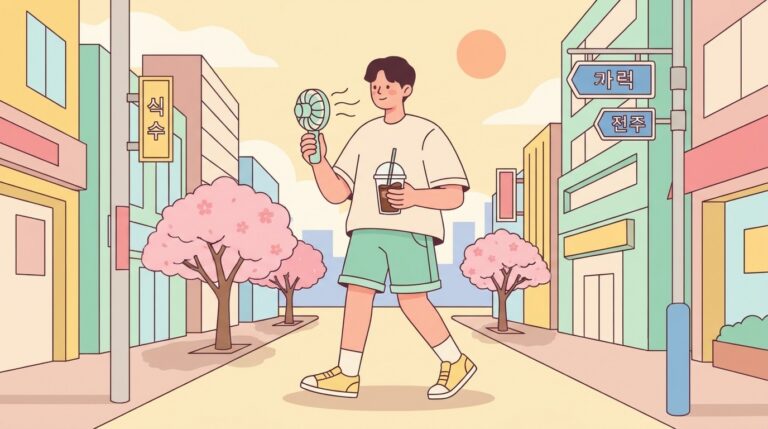
Walk through Gangnam or Hongdae at 2:00 PM in July, and you will notice two ubiquitous accessories: a pastel-colored 손선풍기 (son-seonpunggi / handheld electric mini-fan) and a plastic cup filled with an iced Americano (아아 / A-A).
In Korea, an iced Americano on a muggy afternoon is not just a caffeinated beverage; it is treated as a physiological reset button. Koreans press the icy plastic cup against their cheeks and temples to cool down their pulse points before taking a deep sip. Joining this ritual is your fastest ticket to living like a local.
Phase 5: Real-World Roleplay Scenario
Setting: You are meeting your Korean friend Min-jun at a bustling cafe in Yeonnam-dong on an overcast, 88% humidity Saturday afternoon.
- Turn 1 (Min-jun): 🎭 (Wiping his brow with a tissue as you take a seat) 어서 와! 밖이 진짜 덥지? (Eoseo wa! Bakki jinjja deopji? / Welcome! Isn’t it crazy hot outside?)
- Turn 2 (You): 🎭 (Catching your breath and fanning your shirt collar) 네, 오늘 습도가 진짜 높아요! (Ne, oneul seupdoga jinjja nop-ayo! / Yes, the humidity is really high today!)
- Turn 3 (Min-jun): 🎭 (Sighing in agreement while looking out the window) 맞아, 비 올 것 같아서 완전 후덥지근해. (Maja, bi ol geot gat-aseo wanjeon hudeopjigeunhae. / Exactly, looks like rain, so it’s totally muggy.)
- Turn 4 (You): 🎭 (Lightly shaking your hands) 맞아요, 피부가 끈적끈적해요. (Majayo, pibuga kkeunjeok-kkeunjeokhaeyo. / Right, my skin feels so sticky.)
- Turn 5 (Min-jun): 🎭 (Laughing, sliding the cafe menu towards you) 얼른 시원한 거 마시자. 너 뭐 마실래? (Eolleun siwonhan geo masija. Neo mwo masillae? / Let’s quickly drink something cold. What do you want?)
- Turn 6 (You): 🎭 (Pointing eagerly at the iced drinks) 저는 시원한 아이스 아메리카노요! (Jeoneun siwonhan a-i-seu a-me-ri-ka-no-yo! / I’ll have a refreshing iced Americano!)
- Turn 7 (Min-jun): 🎭 (Smiles and gets up) 역시 여름엔 아아지! 내가 주문할게. (Yeoksi yeoreumen a-a-ji! Naega jumunhalge. / Of course, summer means Iced Americano! I’ll order.)
- Turn 8 (You): 🎭 (Bowing your head slightly with a bright smile) 고마워요, 민준 씨! (Gomawoyo, Minjun ssi! / Thank you, Minjun!)
🔀 Interactive Decision Point
Suppose the cafe’s air conditioning feels a bit weak, and Min-jun fans himself. What is the best way to politely ask the cafe counter staff to adjust the cooling?
- Option A: “저기요, 에어컨 좀 더 시원하게 해주실 수 있나요?” (Jeogiyo, e-eo-keon jom deo siwonhage hae-jusil su innayo?)
- Feedback: [BEST] Perfect! Uses the gentle attention-getter 저기요, includes the softening particle 좀, and frames the request politely with -해 주실 수 있나요.
- Option B: “여기 너무 더우니까 당장 에어컨 켜!” (Yeogi neomu deounikka dangjang e-eo-keon kyeo!)
- Feedback: [BAD] Rude and confrontational! Uses informal 반말 (kyeo) and the aggressive demand word 당장 (immediately). Avoid this at all costs.
- Option C: “실내 습도가 80퍼센트입니다.” (Silnae seupdoga palsip-peosenteu-imnida.)
- Feedback: [RISK] Grammatically accurate, but socially awkward! It sounds like a lab report rather than an everyday request for comfort.
Phase 6: 10-Second Emotion Shadowing Drill
Read these sentences aloud! Follow the / pause markers and adopt the emotional stage cue.
[🥵 Exhausted and overheated]
오늘 / 습도가 높아서 / 너무 후덥지근해요!
(Oneul / seupdoga nop-aseo / neomu hudeopjigeunhaeyo!
“Today / because humidity is high / it’s so muggy!”)-
[😫 Shuddering at clammy skin]
온몸이 / 끈적끈적해서 / 샤워하고 싶어요.
(Onmomi / kkeunjeok-kkeunjeokhaeseo / syawohago sipeoyo.
“My whole body / feels sticky / so I want to take a shower.”) -
[❄️ Blissful relief upon entering an air-conditioned room]
와, / 에어컨 바람 / 진짜 시원하다!
(Wa, / e-eo-keon baram / jinjja siwonhada!
“Wow, / this air conditioner breeze / is truly refreshing!”)
Phase 7: K-Culture Mini Dictionary
Expand your summer vocabulary with these four colorful cultural terms:
- 찜통더위 (Jjimtong-deowi) | Steamer-pot swelter
Combines 찜통 (a bamboo or metal dumpling steamer) and 더위 (heat). It describes those dreadful August days where the air is so hot and saturated that you feel like a mandu (dumpling) being cooked alive. -
손선풍기 (Son-seonpunggi) | Handheld mini fan
A portable, rechargeable fan. In modern Korea, this is not a novelty toy; it is an absolute summer utility carried by everyone from elementary students to CEOs in sharp suits. -
꿉꿉하다 (Kkupkkuphada) | Damp, musty, and clammy
A vivid tactile descriptor used when laundry fails to dry completely during rainy season, or when indoor air feels like a wet sponge. -
얼죽아 (Eol-juk-ah) | Ice-coffee devotee identity
A trendy portmanteau for “얼어 죽어도 아이스 아메리카노” (Even if I freeze to death, Iced Americano). While born as a winter meme, in the summer it is the national motto for beat-the-heat survival.
Phase 8: Traveler’s Survival Kit
Top 3 Survival Phrases for Tourists
- 시원한 물 좀 주세요. (Siwonhan mul jom juseyo. / Please give me some cold water.)
- Pro Tip: In most casual Korean restaurants, water is self-serve (물은 셀프 / Mul-eun self-eu). Look for a stainless steel water dispenser with stacked cups nearby before asking!
- 실내가 좀 덥네요. (Silnaega jom deomneyo. / It’s a bit warm in here.)
- Pro Tip: A polite, indirect way to hint to shop owners or taxi drivers that you would appreciate the cooling turned up.
- 얼음 많이 넣어주세요. (Eoreum mani neo-eo-juseyo. / Please put lots of ice in it.)
- Pro Tip: Standard cafe ordering line when you need maximum chill in your cup.
Editor’s Travel Note: Subway Hacks
When riding the Seoul Metropolitan Subway during peak summer, keep your eyes on the platform doors and overhead digital screens. Subway cars typically have two 약냉방차 (Yang-naeng-bang-cha / Mild Cooling Cars), usually located in cars 4 and 7 (or cars 3 and 4 depending on the line). The temperature in these cars is set 1–2°C higher for seniors or passengers sensitive to cold drafts. If you are overheating and need powerful air conditioning, avoid the 약냉방차 and step into the standard carriages!
For real-time weather alerts and precipitation radar, keep an eye on the official 기상청 날씨누리 공식 웹사이트 for up-to-the-minute localized updates.
Phase 9: A Step Deeper (Reflective Essay)
In many Western cultures, complaining about the weather can sometimes be seen as negative small talk or conversational filler. In Korea, however, shared complaints about muggy weather serve as a warm social adhesive known as 공감 (Gonggam / Mutual Empathy).
When two relative strangers step into an elevator, fan their faces, and sigh, “오늘 정말 후덥지근하죠?” (It’s really muggy today, right?), an instant sense of solidarity (정 / Jeong) is created. Physical discomfort is universal; by voicing it together, the strict hierarchies and reserved social barriers of Korean society temporarily soften into shared human experience.
💬 Your Turn: How does small talk about oppressive weather work in your native culture? Do you bond over sweat and rain, or do you prefer to keep comments positive? Share your thoughts with me in the comments below!
Phase 10: FAQ & Common Mistakes
Q: Can I just say “더워요” (Deowoyo) when it is humid?
A: Absolutely! 더워요 simply means “It is hot.” However, if the humidity is through the roof, pairing it with 습해요 (seuphaeyo / it’s humid) or swapping it for 후덥지근해요 (hudeopjigeunhaeyo) immediately signals that you understand the nuanced physical reality of Korean climate.
Q: What is the difference between 후덥지근해요 and 후텁지근해요?
A: Both words are standard Korean and virtually interchangeable! Phonetically, 후텁지근해요 (with a aspirated ‘t’) sounds slightly sharper and stuffier, whereas 후덥지근해요 (with a soft ‘d’) is far more common in everyday spoken Korean.
Q: How do I say “sticky” when talking about sticky food versus sticky skin?
A: Great question! For chewy or glutinous food like rice cakes (떡), use 쫄깃해요 (jjolgit-haeyo). For sweet, syrupy stickiness, use 끈적여요 (kkeunjeog-yeoyo). For muggy weather and sweaty skin, the best natural fit is 끈적끈적해요 (kkeunjeok-kkeunjeokhaeyo).
🚨 Common Mistakes Alert
- Mistake 1: Saying “나는 습해요” (Naneun seuphaeyo).
- Why it’s wrong: This literally means “I am humid” (as if your biological body is made of moisture vapor!).
- Correct Action: Always assign humidity to the atmosphere: 날씨가 습해요 (The weather is humid) or 습도가 높아요 (The humidity is high).
- Mistake 2: Confusing 덥다 (Deopda) with 뜨겁다 (Tteugeopda).
- Why it’s wrong: 뜨겁다 is for physical objects hot to the touch (like hot soup or boiling water). Saying 날씨가 뜨거워요 sounds strange unless you are poetically emphasizing burning direct sunlight.
- Correct Action: Use 날씨가 더워요 or 후덥지근해요 for ambient atmospheric temperature.
- Mistake 3: Dropping politeness markers with service workers.
- Why it’s wrong: Heat makes everyone irritable, but saying 에어컨 켜 (Turn on AC) without honorifics sounds aggressive.
- Correct Action: Always end your request with -주세요 (juseyo) or -주실 수 있나요? (jusil su innayo?).
Phase 11: Action Mission & Engagement
Ready to put your learning into practice? Take on our 3-tier challenge:
- 🥉 Bronze Mission (Solo Shadowing): Stand in front of your mirror, mimic an exhausted expression, and say aloud: “오늘 습도가 높아서 너무 후덥지근해요!” three times with authentic pacing.
- 🥈 Silver Mission (Social Media): Post a photo of an iced beverage or summer sky on Instagram or Threads with the caption: #DailyHangul 오늘 날씨 완전 후덥지근해요 ☕🧊.
- 🥇 Gold Mission (Real World): Next time you walk into a Korean grocery mart or cafe, smile politely and use “에어컨 진짜 시원하네요!” (The AC is really refreshing!) or order with “얼음 많이 넣어주세요!”.
🎮 K-Culture Mission: Watch any summer episode of a popular Korean variety show (such as Running Man or I Live Alone). Keep a tally of how many times the cast mentions 에어컨 (e-eo-keon) or fans themselves with a 손선풍기!
Phase 12: Interactive Quiz Challenge
Test your summer Korean fluency! Try answering these questions before checking your score.
- Situational Judgment: You enter your Korean friend’s apartment during a monsoon downpour. The air inside feels clammy and heavy. Which expression will sound most natural?
- (A) 오늘 방이 매우 차가워요.
- (B) 방이 좀 꿉꿉하네요, 에어컨 틀까요?
- (C) 날씨가 뜨거워서 밥을 먹어요.
- Fill in the Blank: Fill in the missing word describing sticky skin:
“날씨 때문에 피부가 ________해요.” (Hint: Reduplicated sensory adjective starting with 끈…) -
True or False Cultural Fact: In the Seoul subway, carriages marked as 약냉방차 are kept colder than standard cars for passengers who overheat easily.
- (True / False)
👉 Click here to reveal answers and explanations!
- Answer: (B) 방이 좀 꿉꿉하네요, 에어컨 틀까요? (The room feels a bit damp, shall we turn on the AC?). Option A means cold, and Option C is an illogical sentence about eating food because weather is hot to the touch.
- Answer: 끈적끈적 (끈적끈적해요 / kkeunjeok-kkeunjeokhaeyo). It perfectly describes the clammy, sticky tactile sensation caused by summer moisture.
- Answer: False! 약냉방차 (Mild Cooling Cars) are kept 1–2°C warmer for people sensitive to icy air. If you want maximum cold air conditioning, avoid cars 4 and 7!







