

Never Ruin Your Korean Perm Again: Essential Salon Advice Decoded
Phase 1: 공감 (Story-driven Opening)
안녕하세요! 매일한글 에디터입니다. (Hello! This is your Daily Hangul editor.)
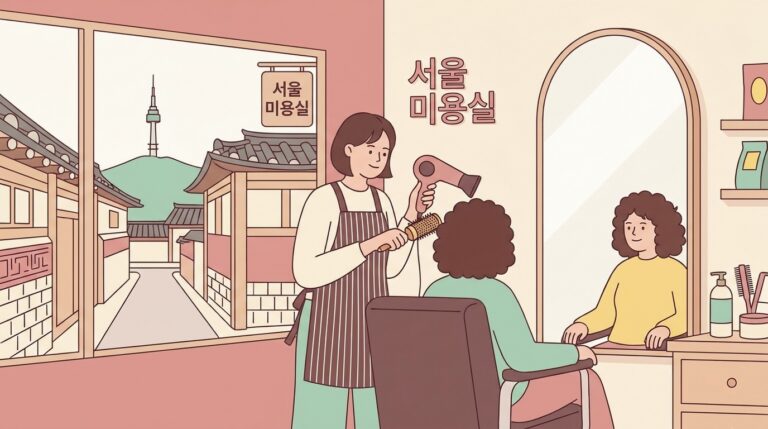
Picture this: You are sitting in a sleek, minimalist hair salon in Yeonnam-dong. For the past two and a half hours, your stylist has washed, rolled, heated, and neutralized your hair while treating you to iced corn silk tea and mini biscuits. Finally, the big reveal arrives. You look in the mirror, and for a second, you swear you look like the main lead of a trending K-drama. The waves are bouncy, soft, and impeccably layered.
Then, as your stylist begins the final dry, they lean in with a gentle smile and say: “집에서 머리 말릴 때 컬링 에센스를 발라 주시면 좋아요.”
You catch familiar words like jib (home) and e-sen-seu (essence), but the rest zooms past. You nod politely, pay at the counter, and head out. The next morning, you wash your hair, blow-dry it haphazardly, and freeze in horror: where did your chic idol curls go? Why does your hair suddenly resemble a fluffy dandelion?
If you have ever felt overwhelmed when Korean hair designers give post-styling advice, you are not alone! Over 80% of our beginner learners tell us that while booking appointments feels manageable, understanding the final styling instructions is where communication breaks down. In this guide, you will master the exact phrases Korean stylists use to keep your hair looking fresh from the salon, grounded in real salon interactions. Let’s turn that post-salon panic into effortless confidence!
Phase 2: 핵심 표현 3선 심층 분석 (3 Core Expressions In-Depth)
1. 집에서 머리 말릴 때 컬링 에센스를 발라 주시면 좋아요 (Jib-eseo meori mallil ttae keol-ling e-sen-seu-reul bal-la ju-si-myeon jo-a-yo)
- Pronunciation: [Jib-eh-seo meo-ri mal-lil ddae curl-ling eh-sen-seu-reul bal-la joo-she-myeon joh-ah-yo] (Think of ‘ttae’ like the punchy start of ‘tamales’, and ‘bal-la’ like the singer ‘ballad’)
- Meaning:
- Literal: “When drying hair at home, if you apply curling essence, it is good.”
- Real Nuance: “For best results, make sure to apply curling essence when you blow-dry your hair at home!”
- K-Culture Moment: You will hear this in almost every makeover scene in Korean lifestyle shows or vlogs when the stylist hands the client a pump bottle of cream essence right before showing them the mirror.
- Editor’s Insight: Notice the ending ~시면 좋아요 (-si-myeon jo-a-yo). Koreans rarely say “You must put on essence!” (발라야 해요). Instead, they gently suggest: “It would be great if you do this.” It softens the instruction into caring advice.
- Situation Spectrum: Casual: ⚠️ | Semi-formal: ✅ | Formal: ✅
- 🤔 Think About It: In English, we often say “Apply this product before blow-drying.” Why do you think Korean stylists prefer phrase structures like “It would be nice if you…” rather than direct commands?
2. 드라이기로 말릴 때 돌려가면서 말려 주세요 (Deu-ra-i-gi-ro mallil ttae dol-lyeo-ga-myeon-seo mal-lyeo ju-se-yo)
- Pronunciation: [Deu-rah-ee-gee-roh mal-lil ddae dohl-lyeo-gah-myeon-seo mal-lyeo joo-seh-yoh] (Say ‘dol-lyeo’ smoothly like ‘dolphin’ + ‘yawn’)
- Meaning:
- Literal: “When drying with a hairdryer, please dry while twirling.”
- Real Nuance: “Twist sections of your hair outward with your fingers while blow-drying to hold the curl!”
- K-Culture Moment: A signature visual in Korean hair styling: the stylist grabs a section of hair, winds it around their index finger like a ribbon, and blasts warm air onto it. That twirling technique is called 돌리기 (dol-li-gi).
- Editor’s Insight: The pattern ~면서 (-myeon-seo) means “while doing [action].” Here, 돌려가면서 (dol-lyeo-ga-myeon-seo) means doing the rotating motion continuously as you blow-dry.
- Situation Spectrum: Casual: ⚠️ | Semi-formal: ✅ | Formal: ✅
- 🤔 Think About It: How does breaking down multi-tasking actions with grammar like ~면서 make instructions feel more visual and dynamic?
3. 샴푸는 내일 저녁에 하세요 (Syam-pu-neun nae-il jeo-nyeog-e ha-se-yo)
- Pronunciation: [Sham-poo-neun neh-il jeo-nyuk-eh ha-seh-yoh] (Think of ‘jeo-nyeok’ like ‘journey’ with a crisp ending sound)
- Meaning:
- Literal: “As for shampoo, please do it tomorrow evening.”
- Real Nuance: “Do not wash your hair until tomorrow evening so the perm chemical fully sets.”
- K-Culture Moment: The iconic final instruction heard at the checkout counter before the stylist bows and hands you your jacket.
- Editor’s Insight: In Korean, you do not usually say “머리를 씻다” (wash hair); you say 샴푸하다 (syam-pu-ha-da) or 머리를 감다 (meo-ri-reul gam-da). When stylists want to be specific about using soap/cleanser, they often borrow the loanword 샴푸 as a verb.
- Situation Spectrum: Casual: ⚠️ | Semi-formal: ✅ | Formal: ✅
- 🤔 Think About It: Notice how the designer specifies the exact time of day (내일 저녁). What does this detail show about the precision of Korean beauty services?
Phase 3: 교과서 한국어 vs 진짜 한국어 (Textbook vs. Real Korean)
Situation 1: Stylist recommending daily styling product
- 📖 교과서 한국어: “에센스를 모발에 바르십시오.” (Apply essence to your hair follicles.)
- 🗣️ 진짜 한국어: “집에서 머리 말릴 때 컬링 에센스 발라 주시면 좋아요!” (It is really great if you put on some curling essence when drying at home!)
- 💡 왜 다를까? Standard textbooks use rigid imperative forms like -십시오, which sounds like a military manual or a legal disclaimer. Real Korean salons prioritize hospitality (친절), using soft suggestion endings (-시면 좋아요) that sound like a warm beauty tip from an older sister or brother.
Situation 2: Asking the client to wait before washing hair
- 📖 교과서 한국어: “24시간 동안 머리를 감지 마십시오.” (Do not wash hair for 24 hours.)
- 🗣️ 진짜 한국어: “샴푸는 내일 저녁쯤에 해 주세요!” (Please shampoo your hair around tomorrow evening!)
- 💡 왜 다를까? Rather than giving a restrictive negative warning (“Do not do X”), Korean professionals prefer phrasing actions positively by telling you when you are clear to proceed (내일 저녁쯤에 해 주세요).
Phase 4: K-Culture 딥다이브 & 비언어적 매너 (K-Culture Deep Dive)
4-1. 눈치 (Nunchi) & Salon Etiquette
- The Head Tilt & Mirror Check: When your designer holds a handheld mirror behind your head to show you the back layers, do not just stay frozen! Slightly tilt your chin downward, look into the main mirror, and nod gently. Saying “와, 마음에 들어요!” (Wa, maeume deureoyo! / Wow, I love it!) gives the designer immense satisfaction.
- Receiving Product Samples: Designers often tuck 1-2 small foil packets of treatment or curling cream into your payment receipt bag. Accept the bag with both hands (두 손) and give a slight bow of acknowledgment. It acknowledges their personalized consideration.
4-2. The Culture Behind the “Curling Essence”
In Western styling routines, heavy sea-salt sprays, firm hairsprays, or rigid mousses are common for texturizing. In Korea, however, the hallmark aesthetic is 꾸안꾸 (Ggu-an-ggu: Effortless, decorated-yet-undecorated look). Korean perms (like the C-curl, S-curl, or build perm) depend on soft hydration. This is why 컬링 에센스 (curling essence)—a hybrid between a moisturizing lotion and a light curl-defining gel—is considered an absolute holy grail in every Korean household bathroom.
Phase 5: 실전 롤플레이 시나리오 (Real-Life Roleplay Scenario)
- Setting: A bright, aesthetic hair salon in Yeonnam-dong with indie-pop playing softly. Designer Min-ji is finishing up drying your new soft wave perm.
- Characters:
- 디자이너 민지 (Designer Min-ji): Trend-conscious, warm, and attentive.
- 알렉스 (Alex): A beginner Korean learner rocking fresh waves.
Frequently Asked Questions (FAQ)
Q: What does "샴푸는 내일 저녁에 하세요 (Syam-pu-neun nae-il jeo-nyeog-e ha-se-yo)" mean in Korean and how do you pronounce it?
A: In Korean, "샴푸는 내일 저녁에 하세요 (Syam-pu-neun nae-il jeo-nyeog-e ha-se-yo)" is pronounced [Sham-poo-neun neh-il jeo-nyuk-eh ha-seh-yoh] and means: Literal: "As for shampoo, please do it tomorrow evening."







