

Phase 1: 공감 (Story Immersion Opening)
안녕하세요! 매일한글 에디터입니다. (Hello! This is your Daily Hangul editor.)
Picture this: You just stepped off Line 2 at the bustling Hongdae subway station after an afternoon of hunting for cute stationery and K-pop albums. You rush up the stairs to catch the green local bus waiting at the curb. You pull out your cute Kakao Friends T-Money card, hold your breath, and press it against the black sensor pad. BEEP! The screen flashes with numbers, and your balance says: 0원 (0 won). For a split second, your heart drops. Wait, did my payment fail? Is the driver going to scold me in rapid-fire Korean in front of everyone?
Take a deep, relaxed breath! You didn’t break anything, and your card isn’t declining. In fact, you just experienced one of Seoul’s greatest daily superpowers: 환승 할인 (Hwanseung Harin – Transfer Discount)! Navigating public transit in Korea can feel high-stakes, especially when fast-walking commuters are bustling right behind you in true bbali-bbali (hurry, hurry) fashion. Based on real questions from hundreds of our beginner students, this guide breaks down exactly what you see and hear at the gates so you can glide through Seoul like a seasoned local.
Phase 2: 핵심 표현 3선 심층 분석 (Top 3 Core Expressions)
1. 환승이에요 (Hwanseung-ieyo)
- Pronunciation: [Hwan-seung-i-ye-yo] (Sound analogy: Think of ‘Hwan’ rhyming with ‘wand’, ‘seung’ like ‘sung’, and ‘ieyo’ like ‘ee-yeh-yo’!)
- Meaning: Literal: “It is a transfer.” / Real Nuance: “The transfer discount is applied, so this ride is free or discounted!”
- K-Culture Moment: Seen in relatable workplace K-dramas like Misaeng or My Liberation Notes, where characters sprint between subway turnstiles and bus stops to make that magic 30-minute transfer window.
- Editor’s Insight: Whenever you see
0원or a tiny amount like100원on the turnstile screen, this phrase is the secret answer. It is a polite, natural sentence you can use if a bus driver ever glances at your card reading. - Situation Spectrum: Casual: ⚠️ (Say 환승이야 to friends) | Semi-formal: ✅ (Perfect) | Formal: ✅ (환승입니다)
- 🤔 Think About It: In many Western subway systems, subways and buses have completely separate fare systems. Why do you think Korea integrated both into a single seamless discount network?
2. 얼마 남았어요? (Eolma namasseoyo?)
- Pronunciation: [Eol-ma na-ma-sseo-yo?] (Sound analogy: ‘Uhl-mah’ + ‘nah-mah-ssuh-yo’)
- Meaning: Literal: “How much remained?” / Real Nuance: “How much balance is left on my card?”
- K-Culture Moment: Standing at a convenience store counter near the station, handing your card to the clerk alongside a banana milk, wondering if you have enough balance left for the bus.
- Editor’s Insight: This phrase is an essential survival question. At A1 level, whenever you are unsure about money or remaining amounts,
얼마 남았어요?works like magic at stations and stores alike. - Situation Spectrum: Casual: ⚠️ (얼마 남았어?) | Semi-formal: ✅ (Standard) | Formal: ✅ (얼마 남았습니까?)
- 🤔 Think About It: Korean often drops the subject (‘T-money balance’) when the context is obvious from the physical object you are holding.
3. 찍어 주세요 (Jjigeo juseyo)
- Pronunciation: [Jji-geo ju-se-yo] (Sound analogy: A sharp, crisp ‘Jjee-guh’ like cheese + ‘joo-seh-yo’)
- Meaning: Literal: “Please stamp/tag it.” / Real Nuance: “Please tap your card on the reader.”
- K-Culture Moment: In reality variety shows like Running Man, cast members tap their transit cards while sprinting through subway turnstiles to complete timed transit missions.
- Editor’s Insight: The verb
찍다(jjikda) literally means to stamp or imprint, but colloquially it means ‘to tap an RFID/transit card’ because of the physical stamping motion and the satisfying beep sound. - Situation Spectrum: Casual: ⚠️ (찍어) | Semi-formal: ✅ (Standard) | Formal: ✅ (찍어 주십시오)
- 🤔 Think About It: How did the sound and physical action of tapping transform into an everyday slang verb in modern Korean?
Phase 3: 교과서 한국어 vs 진짜 한국어 (Textbook vs. Real Korean)
Situation 1: Explaining that your transit transfer discount worked
- 📖 교과서 한국어 (Textbook): 환승 할인이 적용되었습니다. (Hwanseung harini jeokyongdoe-eotsseumnida.) — Transfer discount has been applied.
- 🗣️ 진짜 한국어 (Real Life): 환승이에요! 0원 나왔어요! (Hwanseung-ieyo! Yeong-won nawasseoyo!) — It’s a transfer! It showed 0 won!
- 💡 왜 다를까? (Why the difference?): The textbook version is an automated robotic broadcast announcement. Real humans simply state “환승이에요” (It’s a transfer) with a bright smile.
Situation 2: Asking someone where to tap the card
- 📖 교과서 한국어 (Textbook): 교통카드를 단말기에 접촉하십시오. (Gyotongkadeureul danmalgie jeopchokhasipsio.) — Please contact the transit card to the terminal device.
- 🗣️ 진짜 한국어 (Real Life): 여기에 띡 찍으세요. (Yeogie ttik jjigeuseyo.) — Just tap it right here.
- 💡 왜 다를까? (Why the difference?): Words like ‘단말기’ (terminal) and ‘접촉’ (contact) are formal administrative terms. Everyday Koreans use the onomatopoeia ‘띡’ (ttik – beep sound) and the verb ‘찍다’ (jjikda – to tap).
Phase 4: K-Culture 딥다이브 & 비언어적 매너 (Deep Dive & Transit Etiquette)
4-1. 눈치 (Nunchi) & Turnstile Etiquette
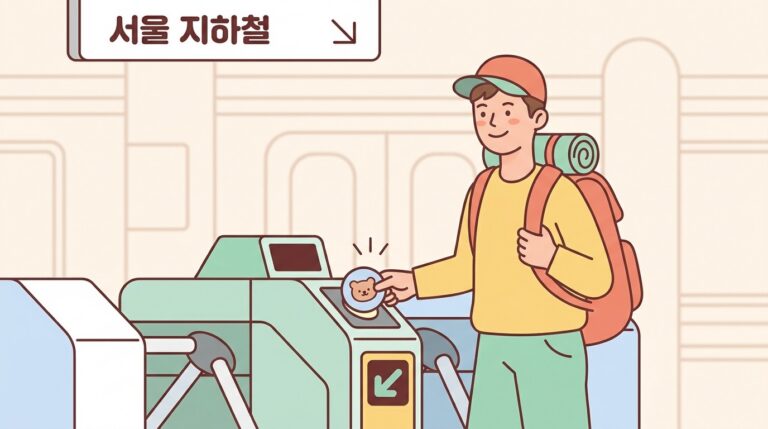
- Ready in Hand: Never halt in front of the gate to dig through your backpack. Seoulites have their card or phone in hand before reaching the yellow line. Having your card ready is the ultimate display of public consideration (배려, baeryeo).
- The Exit Tap is Mandatory: If you don’t tap your card when getting off the bus, you will lose your transfer discount and get charged a penalty fare on your next ride! Always tap upon boarding AND exiting.
4-2. The 30-Minute Transit Miracle
Korea’s Metropolitan Transfer Discount System links subways and buses across Seoul, Gyeonggi, and Incheon. You get up to 4 transfers (5 total rides) within 30 minutes of tapping out (extended to 60 minutes between 9 PM and 7 AM). That is why you will see Korean college students briskly power-walking from the subway station to the bus stop—they are beating the 30-minute clock to save the price of a delicious street food snack!
Phase 5: 실전 롤플레이 시나리오 (Real-World Roleplay)
Setting: Gangnam Station Exit 11 bus stop. Evening rush hour. Neon signs glowing.
Characters: Alex (A1 beginner traveler) & Minji (Korean local friend).
- Alex: 민지 씨, 지하철 나와서 버스 타요? (Minji ssi, jihacheol nawaseo beoseu tayo?)
Minji, we just left the subway and now we take the bus?
🎭 Alex checks his phone transit map nervously. - Minji: 네! 빨리 환승해야 할인돼요. (Ne! Ppalli hwanseunghaeya harindwaeyo.)
Yes! We need to transfer quickly to get the discount.
🎭 Minji points toward incoming green bus #3412. - Alex: 카드를 어디에 찍어요? (Kadeureul eodie jjigeoyo?)
Where do I tap the card?
🎭 Alex holds up his T-Money card near the bus door. - Minji: 여기 단말기에 띡 찍으세요! (Yeogi danmalgie ttik jjigeuseyo!)
Tap it right here on this sensor pad!
🎭 Minji taps her card first with a swift beep. - Card Machine: 삐빅! (Bbi-bik!)
🎭 The machine screen displays: '0원 (환승)' - Alex: 어? 0원 나왔어요. 고장이에요? (Eo? Yeong-won nawasseoyo. Gojang-ieyo?)
Huh? It says 0 won. Is it broken?
🎭 Alex steps aside with wide, startled eyes. - Minji: 아니에요! 환승 할인이 적용되었어요! (Anieyo! Hwanseung harini jeokyongdoe-eotsseoyo!)
No, it’s not! The transfer discount has been applied!
🎭 Minji laughs warmly and gestures toward an open seat. - Alex: 와, 대박! 진짜 신기해요! (Wa, daebak! Jinjja singihaeyo!)
Wow, amazing! That’s really cool!
🎭 Alex sits down, relieved and proud.
🔀 Interactive Choice Point
The bus is arriving at your destination stop, but people are crowded near the rear exit door. What do you do?
- Option A: Silently push through the crowd and jump off without tapping the sensor pad.
👉 [Risk – Failed Transfer]: You missed the exit tap! You will be charged an extra penalty fare next time you board, and no transfer discount will apply. - Option B: Say “잠시만요!” (Jamsimanyo! – Excuse me!) politely, step up, and tap your card until it beeps before stepping out.
👉 [Best Choice – Smooth Commuter]: Perfect manners! You locked in your 30-minute transfer window and paid zero penalty. - Option C: Wave your card at the bus driver from the back door and shout “환승이에요!”.
👉 [Bad Choice – Awkward Moment]: The driver cannot manually validate your card from the front seat; the automated exit reader must scan it!
Phase 6: 10초 감정 섀도잉 드릴 (10-Second Emotion Shadowing Drill)
Practice these lines out loud with the emotional rhythm markers (/ = brief pause):
[😊 Relieved and excited]
카드 찍었어요! / 환승이에요!
(Kadeu jjigeosseoyo! / Hwanseung-ieyo!)
“I tapped the card! / It’s a transfer!”-
[🤔 Curious and polite]
잔액이 / 얼마 남았어요?
(Janaegi / eolma namasseoyo?)
“Balance-wise / how much is left?” -
[🏃♂️ Hurried but cheerful]
빨리 찍고 / 타요!
(Ppalli jjikgo / tayo!)
“Let’s tap quickly / and get on!”
Phase 7: K-Culture 미니 사전 (Mini Dictionary)
- 환승 (Hwanseung) | Transfer (Transit)
Used when switching between bus lines, subway lines, or between bus and subway. (Slang bonus: Dating someone right after a breakup is jokingly called ‘환승연애’ – transfer dating!) - 충전 (Chungjeon) | Recharge / Top-up
Used at convenience stores or subway automated kiosks when adding cash balance to your T-money card. - 잔액 (Janaek) | Remaining Balance
The numerical amount left on your card, visible for 1.5 seconds on the screen right after tapping. - 개찰구 (Gaechalgu) | Turnstile / Ticket Gate
The physical gates at subway stations that open when your card successfully taps.
Phase 8: 여행자를 위한 생존 키트 (Traveler’s Survival Kit)
🚨 Survival Phrases TOP 3
- 환승 돼요? (Hwanseung dwaeyo?) — Does this transfer apply?
Pro Tip: Use this when asking an attendant if taking a particular airport or regional bus allows regular transfer discounts. - T머니 충전해 주세요. (T-meoni chungjeonhae juseyo.) — Please recharge my T-money card.
Pro Tip: Hand your card and cash together to any 7-Eleven, CU, or GS25 cashier. - 카드가 안 찍혀요. (Kadeuga an jjikhyeoyo.) — My card isn’t scanning/tapping.
Pro Tip: Press the red ‘Help’ button near the subway wheelchair gate to summon an attendant if your card gets stuck.
Editor’s Travel Note
- Cash is Still King for Cards: While Korea is virtually cashless everywhere else, T-Money top-up machines at subway stations and small convenience stores only accept physical Korean Won bills for charging transit cards. Keep a 10,000 KRW bill in your phone case!
- Transit Navigation: Download the Naver Map public transit navigation app before departing. It tells you the exact subway car door number to exit for the fastest transfer!
Phase 9: “한 발 더 깊이” (Cultural Reflection)
Korea’s transit transfer system reflects the core societal value of 상부상조 (Sangbusangjo – mutual communal benefit). By removing financial friction when combining subway and bus routes, the city ensures everyone—from students to elderly vendors—can traverse the giant metropolis affordably. Saving that 1,400 won isn’t just about spare change; it’s a shared communal courtesy that keeps the entire city connected and flowing smoothly.
💬 Your Turn: What is public transit fare like in your hometown? Do you get free transfers between buses and subways, or do you have to pay twice? Tell us in the comments below!
Phase 10: FAQ & 오해 방지 (FAQ & Common Mistakes)
Q: Why did the bus screen say “0원” when I tapped my card?
A: That means your transfer discount was successfully applied! Because you transferred within the 30-minute window from the subway, your base bus fare was 100% free.
Q: Can two people share one T-money card and still get the transfer discount?
A: No. Multi-person card taps (다인승) only work on buses when you tell the driver first, but they cannot transfer into the subway turnstiles simultaneously. Each traveler must have their own card for transfer discounts to work.
Q: How long do I have before the transfer discount expires?
A: You must tap into your next transit vehicle within 30 minutes after tapping out of the previous one (extended to 60 minutes between 9 PM and 7 AM).
🚨 Common Mistakes (흔한 실수 TOP 3)
- Forgetting to tap when exiting the bus: If you don’t tap off, the system assumes you rode to the end of the line and hits you with maximum extra fares.
- Tapping the exact same bus route twice: You cannot get a transfer discount if you get off Bus 100 and get back onto another Bus 100 within 30 minutes.
- Holding your entire wallet against the reader: If you have multiple RFID credit cards together, the reader will say “카드를 한 장만 대주세요” (Please tap only one card). Keep your T-money card separate!
Phase 11: 액션 미션 & 참여 유도 (Action Missions)
- 🥉 Bronze Mission (Solo): Look into your mirror with a transit card in hand, smile, and say: “환승이에요! (Hwanseung-ieyo!)” three times.
- 🥈 Silver Mission (Social): Screenshot your favorite K-drama transit scene and post it on your Instagram story with the caption: “Next stop: 환승 (Hwanseung)! #DailyHangul”
- 🥇 Gold Mission (Real Life): On your next trip to Korea, complete a subway-to-bus transfer within 30 minutes and capture the victorious 0-won reading on the screen!
- 🎮 K-Culture Mission: Watch an episode of a commuting K-drama (like My Liberation Notes). Count how many times you hear the iconic subway gate ding or bus beep!
Phase 12: 인터랙티브 퀴즈 챌린지 (Interactive Quiz)
Question 1: Situational Judgment
You tapped your card onto the bus reader after leaving the subway, and the screen flashed 0원. What happened?
* A) The card ran out of balance.
* B) The bus sensor broke.
* C) The transfer discount successfully applied!
👉 Click to reveal the answer and explanation!
Correct Answer: C
Explanation: When transferring within 30 minutes, Korea’s transit system waives the base fare, showing 0원 on the reader! You rode for free!
Question 2: Fill in the Blank
Complete the sentence for when you want to ask a cashier how much money is left on your card:
“잔액이 _____ 남았어요?” (How much balance is left?)
👉 Click to reveal the answer and explanation!
Correct Answer: 얼마 (Eolma)
Explanation: 얼마 means ‘how much’. “잔액이 얼마 남았어요?” (Janaegi eolma namasseoyo?) is the ideal polite phrase to check your balance!
Question 3: True or False Cultural Quiz
True or False: You do not need to tap your T-money card when getting off a Korean bus if you are not planning to transfer to another bus.
👉 Click to reveal the answer and explanation!
Correct Answer: False!
Explanation: Even if you are not transferring right away, failing to tap out on a bus will trigger a distance penalty fare on your subsequent trip. Always tap off!






