

Phase 1: Empathy & Story Immersion
안녕하세요! 매일한글 에디터입니다. Have you ever watched a high-stakes historical K-drama like The Red Sleeve or Mr. Sunshine, or listened to an intense political debate on Korean news, and felt completely alienated when the dialogue shifted from everyday vocabulary into profound philosophical critiques?
A common pain point for advanced learners approaching C2 proficiency is navigating the vast conceptual ocean of late Joseon intellectual history. Picture this: You are watching a Joseon period drama where court ministers spend months bitterly disputing the exact mourning attire an empress dowager should wear for a deceased king—the infamous Yesong controversy. Meanwhile, in the provinces, ordinary farmers face starvation and exorbitant taxation. Enter Silhak (실학 – Practical Learning), the revolutionary intellectual current pioneered by polymaths like Dasan Jeong Yak-yong (정약용), who dared to say: Stop the empty metaphysical dogma, and let us build practical tools, reform corrupt governance, and feed the people.
One of our advanced students, Marcus from Berlin, recently shared: “I thought my Korean was near-native until I sat in a graduate seminar at Seoul National University discussing public policy. When the professor critiqued a proposal as ‘mere gongnigongdam lacking silsagusi,’ I froze. I realized that to truly speak executive-level Korean, I had to master these Silhak paradigms.” That is precisely why we crafted this masterclass. By internalizing these foundational Silhak concepts, you will not only dissect elite-tier historical dramas with ease, but also master high-level Korean used in editorials, corporate strategic meetings, and academic discourse.
Phase 2: In-Depth Breakdown of 3 Core Expressions
1. 실사구시 (實事求是)
- Pronunciation: [Sil-sa-gu-si] (Think: Seal + Sah + Goo + See)
- Meaning: Literal: “Seek truth from facts.” | Nuance: A relentless commitment to empirical evidence and factual verification over baseless, abstract theorizing.
- K-Culture Moment: In modern corporate dramas like Misaeng or political thrillers like Chief of Staff, a senior executive slaps a spreadsheet onto the table and dismisses wishful projections with this four-character idiom to demand concrete, field-tested metrics.
- Editor’s Insight: Originating from Han Dynasty texts but reinvented by Joseon scholars like Jeong Yak-yong and Kim Jeong-hui, this phrase is today’s gold standard among Korean intellectual elites when advocating for data-driven decisions.
- Situation Spectrum: Casual ⚠️ | Semi-formal ✅ | Formal ✅
- 🤔 Think About It: Does your native culture elevate abstract idealist logic above empiricism, or does it demand proof before policy? How does language reflect that preference?
2. 이용후생 (利用厚生)
- Pronunciation: [I-yong-hu-saeng] (Think: Ee + Yong + Who + Saeng)
- Meaning: Literal: “Promote practical utility to enrich the people’s livelihoods.” | Nuance: Championing technology, infrastructure, and commerce specifically to alleviate human suffering and raise living standards.
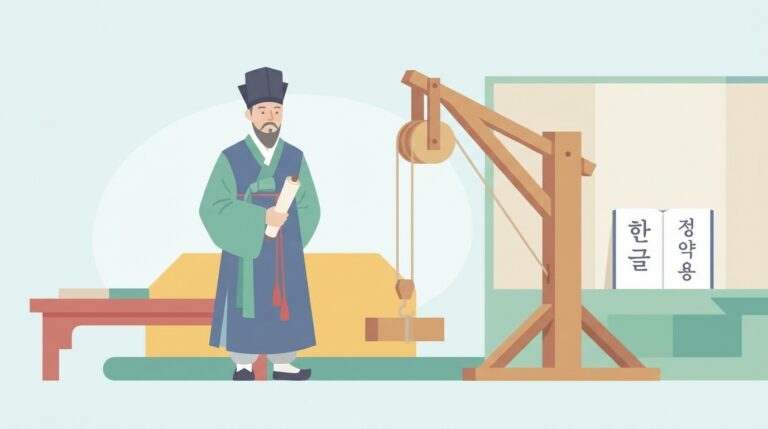
- K-Culture Moment: Seen in historical films like The King’s Letters or documentaries on Dasan’s invention of the Geojunggi (거중기, crane pulley system) used to construct Suwon Hwaseong Fortress, highlighting innovation anchored in human welfare.
- Editor’s Insight: Jeong Yak-yong argued that governance is void if it fails to improve real material conditions. In modern Korean policy editorials, this idiom surfaces whenever green energy or technological subsidies are debated.
- Situation Spectrum: Casual 🚫 | Semi-formal ✅ | Formal ✅
- 🤔 Think About It: Is technological advancement in your society primarily viewed through the lens of corporate profit, or public welfare (후생, husaeng)?
3. 공리공담 (空理空談)
- Pronunciation: [Gong-ni-gong-dam] (Think: Gong + Knee + Gong + Dahm)
- Meaning: Literal: “Empty principles and vain words.” | Nuance: Pointless metaphysical bickering, ungrounded boardroom rhetoric, or bureaucratic hair-splitting that accomplishes nothing in the real world.
- K-Culture Moment: Often barked by frustrated protagonists in courtroom dramas or parliamentary debates when opposing factions stonewall a bill with pedantic ideological technicalities.
- Editor’s Insight: Silhak scholars specifically coined this weapon of a word to eviscerate the scholastic Neo-Confucian elite (Seongnihak) who debated abstract cosmic order while the peasants starved.
- Situation Spectrum: Casual ⚠️ | Semi-formal ✅ | Formal ✅
- 🤔 Think About It: Why does modern Korean culture have so many specific idiomatic expressions to condemn inaction and pedantic debates?
Phase 3: Textbook Korean vs. Native C2 Korean
Situation 1: Calling out an unproductive meeting that fixates on theory
- 📖 교과서 한국어 (Textbook): 이론적인 이야기만 하지 말고, 현실적인 방법을 찾아봅시다. (Let us not only speak of theoretical things, but find realistic methods.)
- 🗣️ 진짜 한국어 (Authentic C2): 탁상공론에 불과한 공리공담은 접어두고, 실사구시의 관점에서 당장 현장에 적용 가능한 대안부터 도출합시다. (Let us shelve this sterile armchair theorizing and, from a strictly empirical standpoint, derive immediate field-applicable alternatives.)
- 💡 왜 다를까? (Why the difference?): At the C2 level, substituting generic words like 이론 (theory) and 현실적 (realistic) with four-character idioms like 공리공담 and 실사구시 elevates your discourse into elite, authoritative Korean.
Situation 2: Emphasizing that innovation must serve the end user
- 📖 교과서 한국어 (Textbook): 새로운 기술은 사람들의 삶을 더 편하게 만들어 주어야 합니다. (New technology should make people’s lives more comfortable.)
- 🗣️ 진짜 한국어 (Authentic C2): 진정한 혁신은 허울 좋은 구호가 아니라, 백성의 삶을 윤택하게 하는 이용후생의 정신에서 출발해야 합니다. (Genuine innovation does not stem from hollow rhetoric; it must be anchored in the spirit of practical utility dedicated to enriching everyday lives.)
- 💡 왜 다를까? (Why the difference?): Using 이용후생의 정신 (the spirit of pragmatic welfare) positions your argument within Korea’s profound intellectual heritage, conveying deep cultural literacy.
Phase 4: K-Culture Deep Dive & Non-Verbal Manners
4-1. Nunchi & Scholarly Physicality (비언어적 태도)
In Korean historical debates, posture was ideological. Conservative Neo-Confucian scholars (Seongnihakja) adopted an upright, unyielding posture, holding ceremonial tablets with solemn, fixed expressions to project moral purity (Gyoeng).
Conversely, Silhak thinkers like Dasan Jeong Yak-yong embodied 실천적 당당함 (practical assertiveness): an open, leaning-forward posture, direct eye contact, and hands holding diagrams, measuring instruments, or architectural blueprints. When delivering advanced critiques in professional Korean settings today, mirror this Silhak ethos: lean in slightly, maintain steady yet respectful eye contact, and anchor your points with tangible reports rather than waving hands in abstract gestures.
4-2. Cultural Code: The Tragedy and Triumph of Dasan in Media
Korean media has an enduring obsession with Jeong Yak-yong. In historical representations, Dasan is depicted as the ultimate tragic genius: exiled for 18 years to remote Gangjin due to vicious factional purges (Sinyu Persecution), he channeled his isolation into penning over 500 monumental volumes, notably Gyeongseyupyo (경세유표 – Design for Reorganizing State Governance) and Mongminshimseo (목민심서 – Admonitions on Governing the People).
When modern Koreans praise a leader for being “다산과 같은 인물 (a Dasan-like figure),” they are paying the highest compliment possible: an intellect who possesses profound scholastic depth paired with unyielding empathy for the common person.
Phase 5: Real-Life Roleplay Scenario
Setting: A high-level policy think tank seminar in Jongno, Seoul. You are debating Professor Kang, an uncompromising conservative policy theorist.
Character Profile: Professor Kang (강 교수)
Age 58, prestigious academic background, prone to theoretical pedantry, values classical propriety.
- Turn 1 (강 교수): 이번 정책 과제는 국가의 본원적 기강과 도덕적 명분을 바로 세우는 데 방점을 두어야 마땅합니다. (Ibeon jeongchaek gwajeneun gukgaui bonwoneok giganggwa dodeokjeok myeongbuneul baro seuneun de bangjeomeul dueoya mattanghapnida.)
🎭 (Folds his hands rigidly and tilts his chin up with solemn conviction.)
“This policy initiative must naturally prioritize re-establishing the fundamental discipline and moral pretext of the state.” -
Turn 2 (You): 교수님의 고견에 일리가 있으나, 자칫 현장을 도외시한 공리공담으로 흐를까 염려됩니다. (Gyosunimui gogyeone illiga isseuna, jachit hyeonjangeul doewesihan gongnigongdameuro heureulkka yeomryeodoepnida.)
🎭 (Nods politely once to acknowledge his stature, then opens a binder filled with field statistics.)
“Your esteemed perspective holds merit; however, I am concerned that it may easily degenerate into empty theorizing detached from field realities.” -
Turn 3 (강 교수): 도덕적 명분이 결여된 정책은 사상누각에 불과하거늘, 어찌 이를 헛된 담론이라 치부하십니까? (Dodeokjeok myeongbuni gyeolyeodwoen jeongchaegeun sasangnugage bulgwahageoneul, eojji ireul heotdoen damronira chibuhasipnikka?)
🎭 (Furrows his brows and adjusts his glasses sharply.)
“A policy lacking moral justification is nothing more than a castle built on sand. How can you dismiss this as mere empty rhetoric?” -
Turn 4 (You): 다산 정약용 선생께서도 실사구시에 근거하지 않은 치세는 백성을 도탄에 빠뜨린다 경계하셨습니다. (Dasan Jeong Yak-yong seonsaengkkesodo silsagusie geungeohaji aneun chiseneun baekseongeul dotane ppatteurinda gyeonggyehasyeossseupnida.)
🎭 (Speaks in a measured, calm baritone, pointing directly to economic distress indicators.)
“Even Dasan Jeong Yak-yong cautioned that governance not rooted in seeking truth from facts casts the people into utter misery.” -
Turn 5 (강 교수): 그렇다면 실무진에서 제시하는 구체적인 대안은 대체 무엇입니까? (Geureotdamyeon silmujin-eseo jesihaneun guchejeogin dae-aneun daeche mueosipnikka?)
🎭 (Taps the table impatiently with his pen.)
“Then what, pray tell, is the concrete alternative proposed by the working team?” -
Turn 6 (You): 목민심서의 취지를 계승하여, 관료의 탁상행정을 근절하고 이용후생의 원칙으로 민생 예산을 재배정해야 합니다. (Mongminsimseoui chwijireul gyeseunghayeo, gwanryoui taksanghaengjeongeul geunjeolhago iyonghusaengui wonchigeuro minsaeng yesaneul jaebaejeonghaeya hapnida.)
🎭 (Maintains steady, resolute eye contact, passing the revised fiscal blueprint.)
“Inheriting the ethos of Mongminshimseo, we must eradicate bureaucratic desk-bound administration and reallocate the civic budget on the principle of practical welfare.” -
Turn 7 (강 교수): 허허, 다산의 경세유표와 목민심서를 시의적절하게 결합하셨군요. 반박의 여지가 없습니다. (Heoheo, Dasan-ui Gyeongseyupyowa Mongminsimseoreul siuijeokjeolhage gyeolhophasyeotgunyo. Banbagui yeojiga eopseupnida.)
🎭 (Lets out a slow, conceding breath and leans back with an appreciative smile.)
“Haha, you have tied Dasan’s Gyeongseyupyo and Mongminshimseo to the present situation with remarkable acumen. I have no room left to rebut.” -
Turn 8 (You): 경청해 주셔서 감사합니다. 과거의 실학을 오늘의 활력으로 되살려 내겠습니다. (Gyeongcheonghae jusyeoseo gamsahapnida. Gwageoui silhageul oneurui hwallyeogeuro doesallyeo naegesseupnida.)
🎭 (Bows moderately from the torso in humble acknowledgment.)
“Thank you for listening so generously. We will resurrect the Practical Learning of the past into the vitality of today.”
🔀 Interactive Decision Point
How would you conclude your closing remarks during the press briefing that follows?
- Choice A (Pragmatic & Visionary – Best): “형식적 명분론에 얽매이지 않고 오직 국민의 삶을 보살피는 실사구시의 행정을 펼치겠습니다.” (We will not be bound by formalistic dogma, but deliver empirical administration solely devoted to the people’s lives.)
Feedback: Best! Demonstrates decisive leadership while honoring Silhak philosophy. - Choice B (Too blunt & Aggressive – Risk): “성리학적인 낡은 꼰대 사상은 싹 다 치워버리고 일이나 똑바로 합시다.” (Let’s throw out all this old-fart Confucian rubbish and just do our jobs properly.)
Feedback: Risk. Highly offensive register. Degrades scholarly critique into vulgar workplace slang. - Choice C (Excessively Passive – Bad): “교수님 말씀도 맞으니 그냥 적당히 타협해서 조용히 넘어가지요.” (The professor is also right, so let’s just make a mediocre compromise and move on quietly.)
Feedback: Bad. Displays zero ideological backbone and abandons the critical purpose of the Silhak discourse.
Phase 6: 10-Second Emotional Shadowing Drill
Sharpen your delivery with these cadence-marked sentences. Pause at the / marks!
[🧐 날카롭고 비판적으로 / Sharply and critically]
탁상공론에 불과한 / 공리공담은 / 이제 그만 접어두어야 합니다.
(Taksanggongrone bulgwahan / gongnigongdameun / ije geuman jeobeodueoya hapnida.)
“Empty theorizing / that amounts to armchair chatter / must now be put to rest.”-
[🏛️ 단호하고 학구적으로 / Resolutely and scholastically]
문헌의 허울을 벗겨내고, / 실사구시의 정신으로 / 본질을 규명하겠습니다.
(Munheonui heoureul beotgyeonaego, / silsagusiui jeongsineuro / bonjireul gyumyeonghagesseupnida.)
“Stripping away the hollow veneer of literature, / in the spirit of seeking truth from facts, / I shall illuminate the essence.” -
[🤝 따뜻하고 사려 깊게 / Warmly and thoughtfully]
진정한 기술 혁신은 / 백성의 일상을 지탱하는 / 이용후생에서 피어납니다.
(Jinjeonghan gisul hyeoksineun / baekseongui ilsangeul jitaenghaneun / iyonghusaeng-eseo pieonapnida.)
“True technological innovation / blossoms from practical utility / that sustains the daily lives of the people.”
Phase 7: K-Culture Mini Dictionary
-
경세유표 (Gyeongseyupyo – 經世遺表)
Meaning: Design for Reorganizing State Governance (Jeong Yak-yong’s institutional reform magnum opus).
Modern Usage: Invoked when calling for comprehensive, radical systemic overhauls of government agencies or public institutions rather than superficial cosmetic fixes. -
목민심서 (Mongminshimseo – 牧民心書)
Meaning: Admonitions on Governing the People (The quintessential ethical manual for local governors).
Modern Usage: Required metaphorical reading for mayors, district heads, and public civil servants. To possess “목민관의 자세 (the posture of a shepherd-governor)” means to serve with incorruptible integrity and deep public compassion. -
거중기 (Geojunggi – 擧重機)
Meaning: Crane pulley invented by Jeong Yak-yong combining Western mechanics and Eastern craft.
Modern Usage: A cultural symbol of native Korean technological ingenuity that reduced labor burdens. Used in tech journalism to represent indigenous innovation (한국형 독자 기술). -
애민정신 (Aeminjeongsin – 愛民精神)
Meaning: Genuine love and empathy for the common people.
Modern Usage: The cornerstone of humane leadership in Korea. Evaluates whether politicians and CEOs view constituents and employees as human souls rather than tax revenue or production units.
Phase 8: Traveler’s Survival Kit (Intellectual Pilgrimage)
Heading to Gangjin (Dasan Chodang) or Suwon Hwaseong Fortress? Arm yourself with these sophisticated cultural phrases:
- Top 1: “이곳이 다산 정약용 선생께서 목민심서를 저술하신 유서 깊은 산실이군요.”
(Igosi Dasan Jeong Yak-yong seonsaengkkeso Mongminsimseoreul jeosulhasin yuseo gipeun sansiligunyo.)
Pro Tip: Use this at Dasan Chodang in Gangjin. The docents will be visibly stunned by your historical vocabulary. - Top 2: “수원 화성 축조에 거중기가 실제로 어떻게 활용되었는지 해설을 들을 수 있을까요?”
(Suwon Hwaseong chukjoe geojunggiga siljero eotteoke hwalyongdoeeotneunji haeseoreul deureul su isseulkkayo?)
Pro Tip: Perfect when booking an official cultural interpreter at the Suwon Hwaseong Visitor Center. - Top 3: “당시 실학자들의 개혁 사상이 성벽 건축 구조에도 투영되어 있나요?”
(Dangsi silhakjadeurui gaehyeok sasangi seongbyeok geonchuk gujoedo tuyeongdoe-eo itnayo?)
Pro Tip: Shows a university-level curiosity that connects intangible philosophy with physical architecture.
🧭 Editor’s Travel Note:
When exploring historic Joseon heritage sites, avoid outdated paper maps. Check out the Smart Tour Guide Odii App for curated museum audio tours. For navigation through historic provincial towns like Gangjin, make sure you perform a quick Naver Map Navigation Download to easily locate rural bus schedules and secluded historic huts.
Phase 9: A Step Deeper (한 발 더 깊이)
Have you ever wondered why modern South Korea has an almost obsessive drive for rapid technological adoption, ultra-efficient logistics, and hyper-practical digital administrative services (like government certificates issued in seconds via smartphone apps)?
Many historians argue this is the direct spiritual resurrection of late Joseon Silhak thought. After enduring the traumatic devastations of the Japanese invasions (Imjin War) and Manchu invasions (Byeongja Horan), Joseon thinkers realized that empty theoretical squabbles could not defend a nation nor fill an empty rice bowl. While orthodox Confucianism dictated propriety and hierarchy, the undercurrent of Silhak demanded tangible results: utilize machines, foster commerce, and ease people’s labor. Today’s South Korea—where high technology serves everyday convenience—is in many ways the physical manifestation of Dasan’s Iyonghusaeng dream.
💬 Your Turn: Does your home country prioritize theoretical perfection or pragmatic expediency when crafting public policies? Share your thoughts below using today’s expression, 실사구시!
Phase 10: FAQ & Common Mistakes
Q: Can I use ‘실사구시’ (Silsagusi) when choosing a practical laptop or car?
A: While grammatically possible, native speakers will find it comically pedantic for private consumer decisions. Save 실사구시 for business decisions, research methodologies, political initiatives, or corporate restructuring. In casual consumer situations, simply say 실용적이다 (it is practical) or 가성비가 좋다 (it has great cost-performance).
Q: Did Silhak completely reject Neo-Confucianism?
A: Not at all! This is a common historical misconception. Figures like Jeong Yak-yong were deeply steeped in the Confucian classics. Rather than destroying Confucianism, they sought to purge the corrupt scholastic layers of speculation that had accumulated over centuries, returning to the primal Confucian command: to love the people and rule with practical righteousness.
Q: What is the antonym of ‘이용후생’ (Iyonghusaeng)?
A: The conceptual opposite is 명분론 (Myeongbullon – justification-first dogmatism) or 탁상공론 (Taksanggongron – armchair theorizing), where ideological correctness is prized even if it actively impoverishes or harms the general populace.
🚨 Common Mistakes Warning Board
- Mistake: Pronouncing 공리공담 as [Gong-ri-gong-dam].
Correct Action: Follow the Korean liquid assimilation rule: [ㄹ] after [ㅇ] nasalizes into [ㄴ]. It must be pronounced as [공니공담 / Gong-ni-gong-dam]. - Mistake: Using 목민심서 as an adjective.
Correct Action: Mongminshimseo is the proper title of a book. To express its values adjectivally, use 목민관의 자세 (the demeanor of a shepherd-official) or 애민의 정신 (the spirit of loving the people). - Mistake: Calling any random practical tip “실학 (Silhak).”
Correct Action: Silhak is a specific historical paradigm. For general modern life-hacks, use 생활의 지혜 (life wisdom) or 실용 꿀팁 (practical pro-tips).
Phase 11: Action Missions
- 🥉 Bronze Mission (Solo Shadowing): Stand in front of your mirror and deliver Phase 6 Shadowing Drill sentence #2 with the gravitas of a reformist scholar confronting a royal court. Check your breath control.
- 🥈 Silver Mission (SNS Micro-Essay): Write a 2-sentence post on Threads or X analyzing a current technological trend (such as AI or green energy) using the phrase 이용후생의 관점에서 (from the perspective of practical utility). Tag us
@DailyHangul! - 🥇 Gold Mission (Real-World Execution): In your next Korean language exchange, advanced seminar, or business debate, deliberately replace a generic phrase like “데이터를 봅시다 (let’s look at the data)” with “실사구시의 관점에서 접근해 봅시다 (Let’s approach this from an empirical standpoint of seeking truth from facts)” and observe your partner’s reaction.
- 🎮 K-Culture Mission: Watch an episode of a Joseon-era historical political drama (such as Secret Royal Inspector and Joy or The King’s Affection). Listen intently and see if you can spot court ministers arguing over 명분 (myeongbun) versus reformists defending the people’s livelihood (민생, minsaeng).
Phase 12: Interactive Quiz Challenge
1. Situational Judgment
A junior software developer suggests spending three months rewriting backend documentation in theoretical pure code, while the live app is crashing and losing thousands of active users every hour. As the project manager, what is the most philosophically cutting yet refined critique you can deliver?
* A) 목민심서나 다시 읽고 오세요.
* B) 지금 그건 백성을 버리고 공리공담을 일삼는 격입니다. 당장 실사구시로 버그부터 잡으세요.
* C) 참으로 이용후생의 표본이라 할 만합니다.
🔍 Click to reveal answer and commentary
Correct Answer: B
Explanation: Criticizing the proposal as 공리공담 (empty theorizing) and commanding an empirical focus (실사구시) to fix the immediate breakdown matches the C2 context perfectly. Choice A is nonsensical because the dev is not a local governor; Choice C is the opposite of reality.
2. Fill-in-the-Blank
다산 정약용 선생은 수원 화성을 축조할 때 ( )를 발명하여 인부들의 노고를 덜고 공사 기간을 획기적으로 단축시켰다.
(Hint: The mechanical crane pulley system that embodies practical engineering).
🔍 Click to reveal answer and commentary
Correct Answer: 거중기 (Geojunggi)
Explanation: The Geojunggi is Jeong Yak-yong’s most famous mechanical invention, combining traditional physics with Western pulley theories imported via Jesuit treaties.
3. True or False Cultural Check
“Silhak arose in late Joseon purely as an academic hobby among wealthy aristocrats who were completely satisfied with the existing social and economic order.”
* [ ] True
* [ ] False
🔍 Click to reveal answer and commentary
Correct Answer: False
Explanation: Silhak was born out of profound crisis, national trauma, and intense moral indignation against aristocratic complacency. Many of its greatest proponents, including Dasan Jeong Yak-yong, suffered brutal factional banishment and political marginalization because their radical reformist ideas threatened the conservative status quo.







