

안녕하세요! 매일한글 에디터입니다.
Have you ever walked into a stunning aesthetic cafe in Seongsu-dong or Yeonnam-dong, picked out a gorgeous, crusty sourdough or a gigantic flaky pastry, and sat down excitedly—only to realize your only weapon is a flimsy miniature plastic knife? You try slicing into it, the crust resists, and suddenly BAM! Flaky pastry crumbs erupt across the table like delicious confetti. You glance around nervously, hoping the chic locals at the next table didn’t witness your pastry explosion.
I’ve lost count of how many of our international students have shared this exact bittersweet moment! In Korea, bakeries and dessert cafes produce world-class pastries, but many of them—like campagne, baguettes, and thick stuffed brioches—are virtually impossible to eat neatly without proper slicing. Fortunately, Korean cafe baristas are more than happy to slice your baked goods for you before serving them; you just need to know the polite, natural way to ask before they finish ringing up your order. By the end of this guide, you’ll command three essential bakery survival phrases, dodge awkward counter moments with spot-on nunchi, and order like a true Seoulite!
1. 반으로 잘라 주시겠어요? (Ban-euro jalla jusigess-eoyo?)
- Pronunciation: Ban-oo-ro jal-la joo-she-gess-oh-yo? (Think of “ban” like the English word bun, and “jalla” sounds like a snappy jal-la).
- Meaning: Literal: “Could you cut it in half for me?” | Nuance: Extremely polite, considerate request asking the staff to divide a pastry into two equal pieces.
- K-Culture Moment: Picture a sweet scene in a romantic K-Drama where the two leads share a giant strawberry pastry. Rather than biting from opposite ends, one character steps to the counter and charmingly asks: “반으로 잘라 주시겠어요?” (Ban-euro jalla jusigess-eoyo?)
- Editor’s Insight: The particle -으로 (-euro) denotes “into” or “in the direction of”, and -아/어 주시겠어요? (-a/eo jusigess-eoyo?) is the gold-standard A2 polite request form. It sounds infinitely warmer than simply saying “잘라요” (cut it).
- Situation Spectrum:
- Casual (Friends): 🚫 반으로 잘라 줘! (Ban-euro jalla jwo!)
- Semi-formal (Cafes/Everyday service): ✅ 반으로 잘라 주시겠어요? (Ban-euro jalla jusigess-eoyo?)
- Formal (Official/Business): ⚠️ 반으로 분할해 주시겠습니까? (Ban-euro bunhalhae jusigessseumnikka? – Too robotic!)
- 🤔 Think About It: In your home country, do bakeries customarily slice pastries, or are you expected to tackle them yourself? Why do you think Korean service culture embraces preparing food ready-to-eat?
2. 먹기 좋게 잘라 주세요 (Meokgi joke jalla juseyo)
- Pronunciation: Meok-gi joh-ke jal-la joo-seh-yo (“Meok-gi” rhymes with puck-key; “joke” sounds like the English word joke but with an open “eh” at the end).
- Meaning: Literal: “Please cut it nicely so it’s easy to eat.” | Nuance: A friendly catch-all phrase that lets the barista decide the optimal bite-sized portions for that specific bread.
- K-Culture Moment: You’ll hear this constantly on food variety shows like Amazing Saturday or mukbang vlogs when guests receive large, crusty treats.
- Editor’s Insight: -기 좋게 (-gi joke) means “in a manner good/convenient for [verb]”. When you say this, the staff knows whether that specific bread does better sliced into thin wheels (like baguettes) or quarters (like scones).
- Situation Spectrum:
- Casual: 🚫 먹기 좋게 잘라 줘. (Meokgi joke jalla jwo.)
- Semi-formal (Counter request): ✅ 먹기 좋게 잘라 주세요. (Meokgi joke jalla juseyo.)
- Formal: ⚠️ 편히 취식할 수 있도록 절단 바랍니다. (Way too bureaucratic!)
- 🤔 Think About It: Notice how Korean prioritizes the convenience of the person eating (먹기 좋게). How does language reflect a culture’s hospitality mindset?
3. 데워 주실 수 있나요? (Dewe-o jusil su innayo?)
- Pronunciation: Deh-wo joo-shil soo ean-nah-yo? (“Deh” like dead without the d; “innayo” sounds like in-nah-yo).
- Meaning: Literal: “Can you warm this up for me?” | Nuance: A gentle, non-demanding inquiry to check if a pastry (like an egg tart, salt bread, or garlic bun) can be heated in an oven or microwave.
- K-Culture Moment: In travel vlogs visiting Jeju or Gangneung bakeries, hosts always ask this when buying sogeum-ppang (salt bread) to ensure the butter inside melts perfectly.
- Editor’s Insight: In Korean bakeries, some items taste heavenly warmed up, while cream-filled items will melt! Asking -ㄹ 수 있나요? (-l su innayo? – “Is it possible to…?”) is softer and more deferential than demanding it straight out.
- Situation Spectrum:
- Casual: 🚫 데워 줘! (Dewe-o jwo!)
- Semi-formal (Standard cafe etiquette): ✅ 데워 주실 수 있나요? (Dewe-o jusil su innayo?)
- Formal: ⚠️ 가열 처리가 가능합니까? (Unnaturally technical!)
- 🤔 Think About It: Why does phrasing a request as a gentle possibility (“Can you…?” vs “Do this”) make baristas in Seoul smile and provide even better service?
Situation 1: Asking to slice hard bread
- 📖 교과서 한국어 (Textbook Korean): 이 빵을 칼로 절단해 주십시오. (I ppang-eul kal-lo jeoldanhae jusipsio. – “Please sever this bread with a knife.”)
- 🗣️ 진짜 한국어 (Real-World Korean): 이거 먹기 편하게 잘라 주시겠어요? (Igeo meokgi pyeonhage jalla jusigess-eoyo? – “Could you cut this so it’s easy to eat?”)
- 💡 왜 다를까?: Words like “절단” (amputation/severing) are industrial terms! Native speakers use the soft verb “자르다” (to cut) coupled with polite petition endings.
Situation 2: Asking if a pastry can be warmed up
- 📖 교과서 한국어 (Textbook Korean): 빵을 전자레인지에 가열할 수 있습니까? (Ppang-eul jeonjareinjie gayeolhal su issseumnikka? – “Can the bread be thermally heated in a microwave oven?”)
- 🗣️ 진짜 한국어 (Real-World Korean): 이거 살짝 데워 주실 수 있나요? (Igeo saljjak dewe-o jusil su innayo? – “Could you warm this up just a little bit?”)
- 💡 왜 다를까?: Koreans frequently add mitigating adverbs like 살짝 (saljjak – slightly/a little bit) to soften inquiries and avoid sounding demanding.
4-1. 눈치 (Nunchi) & Non-Verbal Manners at the Bakery Counter
Timing is everything in Korean cafes!
* The Golden Moment: Always ask for your bread to be cut or heated at the exact moment you place your tray on the counter to pay. If you wait until after the cashier has wrapped your bread or handed you the buzzer, they will have to reopen packaging, rewash scissors, or put on a new pair of sanitary gloves—triggering a subtle barista sigh.
* The Two-Handed Handover: When handing over your payment card or tray, hold it with both hands or support your right wrist/forearm with your left hand. Pair this with a polite, slight head bow.
4-2. The Soul of Korean Cafe Culture: ‘빵지순례’ (Ppangjisullye)
Korea is currently obsessed with Ppangjisullye—a portmanteau of Ppang (bread) and Seongjisullye (pilgrimage). People travel across provinces just to try famous salt breads or specialty sourdoughs! In Korean food culture, eating bread is rarely a solo, hurried experience; it is a shared ritual (나눔 문화). Because Koreans almost always share desserts with friends, bakeries naturally offer cutting services so everyone around the table can taste a neat portion without tearing the bread apart by hand.
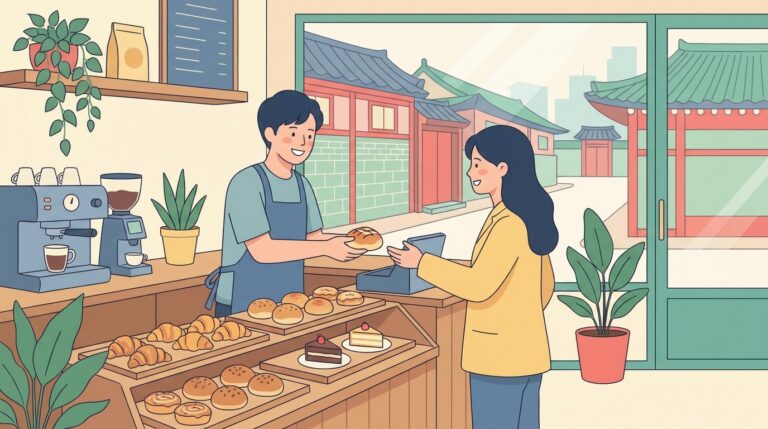
Setting: Cafe Butter & Loaf, a trendy European-style bakery in Yeonnam-dong. Freshly baked olive bread and flaky croissants line the wooden racks.
Characters:
* Minji (민지): A swift, friendly barista wearing an apron and clear service mask.
* Alex (알렉스): An international student ready to enjoy an afternoon treat with a friend.
- Turn 1 (Minji): 안녕하세요! 주문 도와드릴게요. (Annyeonghaseyo! Jumun dowadeurilgeyo.)
- 🎭 Greeting with a bright smile while preparing the POS register.
- “Hello! I can help you with your order.”
- Turn 2 (Alex): 안녕하세요! 이 깜빠뉴랑 소금빵 계산해 주세요. (Annyeonghaseyo! I kkamppanyurang sogeum-ppang gyesanhae juseyo.)
- 🎭 Placing the heavy wooden tray carefully on the counter.
- “Hello! Please ring up this campagne and salt bread.”
- Turn 3 (Minji): 네! 매장에서 드시고 가시나요, 아니면 포장이세요? (Ne! Maejang-eseo deusigo gasinayo, animyeon pojang-iseyo?)
- 🎭 Tapping the screen, looking up at Alex.
- “Sure! Will you be having this in-store, or is it to-go?”
- Turn 4 (Alex): 먹고 갈게요. 그런데 깜빠뉴를 먹기 좋게 반으로 잘라 주시겠어요? (Meokgo galgeyo. Geureonde kkamppanyureul meokgi joke ban-euro jalla jusigess-eoyo?)
- 🎭 Pointing politely with an open hand at the crusty campagne.
- “I’ll eat here. But could you cut the campagne in half so it’s easy to eat?”
- Turn 5 (Minji): 물론이죠! 깜빠뉴가 딱딱하니까 4등분으로 썰어 드릴게요. 소금빵도 잘라 드릴까요? (Mollon-ijyo! Kkamppanyuga ttakttakhani-kka ne-deungbun-euro sseoreo deurilgeyo. Sogeum-ppangdo jalla deurilkkayo?)
- 🎭 Nodding thoughtfully while picking up the bread tongs.
- “Of course! The campagne is crusty, so I’ll slice it into four pieces for you. Would you like the salt bread sliced too?”
- Turn 6 (Alex): 아니요, 소금빵은 그냥 주셔도 돼요. 혹시 살짝 데워 주실 수 있나요? (Aniyo, sogeum-ppang-eun geunyang jusyeodo dwaeyo. Hoksi saljjak dewe-o jusil su innayo?)
- 🎭 Shaking head gently, then asking politely with hands clasped.
- “No, you can leave the salt bread as it is. By any chance, could you warm it up slightly?”
- Turn 7 (Minji): 네, 소금빵은 따뜻하게 데워서 진동벨로 알려드릴게요. 14,000원 결제 도와드리겠습니다. (Ne, sogeum-ppang-eun ttatteuthage deweoseo jindongbel-lo allyeodeurilgeyo. Man-sa-cheon-won gyeolje dowadeurigessseumnida.)
- 🎭 Gesturing toward the card terminal with two hands.
- “Yes, I’ll warm up the salt bread and notify you with a buzzer. That will be 14,000 won.”
- Turn 8 (Alex): 감사합니다! 여기 카드 있어요. (Gamsahamnida! Yeogi kadeu isseoyo.)
- 🎭 Handing over the payment card using both hands.
- “Thank you! Here is my card.”
🔀 Interactive Choice Point
At Turn 5, Minji asked: “소금빵도 잘라 드릴까요?” (Would you like the salt bread sliced too?). What should Alex reply if he wants to experience the best taste?
- Option A: “네! 가루 날리니까 산산조각 내주세요!” (Yes! It makes crumbs, so smash it into tiny pieces!)
- 👉 Feedback [Risk]: Not only is this unnatural phrasing, but slicing a soft, butter-cored pastry like salt bread into tiny pieces will cause all the melted butter to bleed out onto the plate!
- Option B: “아니요, 소금빵은 그냥 손으로 뜯어먹고 싶어서 데워만 주세요.” (No, I want to tear the salt bread with my hands, so please just warm it up.)
- 👉 Feedback [Best]: Perfect cultural choice! Salt bread is traditionally eaten by pulling it apart with your fingers to savor the airy texture and melted butter cave.
- Option C: “아무거나요.” (Whatever.)
- 👉 Feedback [Bad]: Too blunt and dismissive! Staff won’t know whether to slice it or not, leading to an awkward silence.
Repeat each phrase aloud three times! Pay attention to the rhythm pauses marked by / and channel the emotional cues.
[😊 Polite & Warm]
저기요, / 이 빵 / 반으로 잘라 주시겠어요? ↗
(Jeogiyo, / i ppang / ban-euro jalla jusigess-eoyo?)-
[🥖 Natural & Confident]
매장에서 먹을 건데, / 먹기 좋게 썰어 주세요! ↘
(Maejang-eseo meogeul geonde, / meokgi joke sseoreo juseyo!) -
[🥺 Gentle & Inquiring]
혹시 / 이 빵 / 따뜻하게 데워 주실 수 있나요? ↗
(Hoksi / i ppang / ttatteuthage dewe-o jusil su innayo?)
| # | Term (Hangul + Romanization) | Meaning | Real-Life Application & Insight |
|---|---|---|---|
| 1 | 빵지순례 (Ppangjisullye) | Bakery Pilgrimage | Used on Instagram hashtags (#빵지순례) when touring renowned bakeries in trending Seoul neighborhoods. |
| 2 | 겉바속촉 (Geot-ba-sok-chok) | Crispy outside, moist inside | An acronym for 겉은 바삭하고 속은 촉촉하다. Used to describe ideal baguettes, canelés, and salt bread. |
| 3 | 소금빵 (Sogeum-ppang) | Salt Bread / Shio Pan | Korea’s favorite butter pastry with coarse sea salt on top. Must be eaten warm! |
| 4 | 진동벨 (Jindongbel) | Vibrating Pager / Buzzer | The coaster-like buzzer cafes hand you so you can collect your sliced and heated bread when ready. |
Survival Phrases TOP 3
- 포장해 갈게요. (Pojanghae galgeyo. – “I’ll take it to go.”)
- Pro Tip: Use this right away if you want uncut bread wrapped securely in paper bags.
- 나이프랑 포크 챙겨 주시겠어요? (Naipeurang pokeu chaeng-gyeo jusigess-eoyo? – “Could you give me a knife and fork?”)
- Pro Tip: If the cafe has a policy against slicing soft/cream pastries, ask for cutlery to tackle it at your table.
- 셀프 바가 어디에 있어요? (Selpeu baga eodie isseoyo? – “Where is the self-service station?”)
- Pro Tip: In most Korean dessert bakeries, water, napkins, wet wipes (물티슈), and extra paper cups are located at a small side table called the Self Bar.
Editor’s Travel Note
- Navigation Tip: When searching for top-rated artisanal bakeries in Seoul, Google Maps often lacks recent cafe reviews. Make sure you use the Naver Map App for exploring trending bakeries and search for the keyword “베이커리 카페” (Bakery Cafe).
- Payment Tip: 99% of Seoul bakeries are completely cashless. Keep your international credit card, T-Money travel card, or mobile payment ready before reaching the register!
In many Western cultures, asking service workers to modify, slice, or pre-cut baked goods can sometimes feel demanding or high-maintenance. But in Korea, food is fundamentally communal. Sharing meals and desserts has built social bonds for centuries—from dividing holiday rice cakes (tteok) among neighbors to splitting a single dessert at a cafe with friends. When you say “반으로 잘라 주세요”, you aren’t being difficult; you are participating in a cherished cultural practice of sharing food harmoniously without making a mess. Language is simply the bridge that makes this hospitality effortless.
💬 Your Turn: What is your absolute favorite bakery item to order at a cafe, and do you prefer cutting it into bite-sized pieces or biting right into it? Drop your thoughts in the comments below!
Q: Can I ask the staff to cut ANY kind of cake or bread?
A: Not always! Bakeries will gladly slice hard loaves (sourdough, baguettes, ciabatta) and large dry pastries (plain croissants, pies). However, delicate cream-filled buns (like choux cream or whipped strawberry croissants) and soft mousse cakes will collapse into a gooey mess if sliced behind the counter. For those, staff will politely provide a small serrated knife on your tray instead.
Q: When is the best time to ask for bread slicing?
A: Always ask at the register before paying. In Korea’s fast-paced cafe workflow, the cashier is also the one who places your tray into the prep queue. If you wait until your order is served at the pick-up counter, you disrupt the barista’s workflow.
Q: What should I say if the staff asks “포장이세요, 드시고 가세요?”?
A: If you want to eat in the cafe, answer: “먹고 갈게요” (Meokgo galgeyo – Eating here). If you want takeout, answer: “포장해 주세요” (Pojanghae juseyo – Please pack it to-go).
🚨 흔한 실수 (Common Mistakes) Notice Board
- Mistake: Saying “잘라!” (Jalla!) to the barista.
- Why it’s wrong: This is informal banmal (반말). It sounds like you are bossing a child around!
- Correct Action: Always add the polite honorific request: “잘라 주세요” (Jalla juseyo) or “잘라 주시겠어요?” (Jalla jusigess-eoyo?).
- Mistake: Asking for bread to be cut after it’s already bagged in plastic.
- Why it’s wrong: The staff has already sealed and stickered the packaging; reopening it causes delays.
- Correct Action: State your slicing preference during the card payment step.
- Mistake: Handing the tray across the tall counter with one hand.
- Why it’s wrong: One-handed handoffs can be viewed as dismissive or impolite in Korea.
- Correct Action: Hold the tray with both hands, make eye contact, and give a brief affirmative nod.
- 🥉 Bronze Mission (Solo Practice): Stand in front of your mirror and practice saying: “먹기 좋게 반으로 잘라 주시겠어요?” smoothly three times without hesitating.
- 🥈 Silver Mission (Voice Memo): Record your voice using our Shadowing Drill from Phase 6, listen for the melody rise at the end of the question, and share it with your Korean study buddy.
- 🥇 Gold Mission (Real-Life Cafe Visit): Visit a local Korean bakery (like Paris Baguette or a local artisan shop) and order by asking the staff to warm up or slice your pastry in Korean!
- 🎮 K-Culture Mission: Watch an episode of a cafe-themed K-Drama or a Korean vlog featuring Cafe Layered or Artist Bakery. Listen closely—can you spot customers asking for their bread to be warmed (데워 주세요) or packaged (포장해 주세요)?
Question 1 (Situational Judgement)
You just ordered a large, crusty garlic baguette at a cafe in Hongdae. You want to share it with your friend without sauce getting all over your hands. What is the most natural thing to say to the cashier?
* A) 가위 줘! (Gawi jwo!)
* B) 먹기 좋게 썰어 주시겠어요? (Meokgi joke sseoreo jusigess-eoyo?)
* C) 빵을 분해해 주십시오. (Ppang-eul bunhaehae jusipsio.)
Question 2 (Fill-in-the-Blank)
Complete the sentence to politely ask the barista to cut the pastry in half:
“이 빵, _______ 으로 잘라 주시겠어요?”
* A) 하나 (Hana)
* B) 반 (Ban)
* C) 둘 (Dul)
Question 3 (True or False Cultural Quiz)
Statement: In Korea, it is considered rude to ask the cafe staff to warm up cold bread.
* True or False?
👉 Click to reveal answers & explanations!
- Answer: B
- Explanation: “먹기 좋게 썰어 주시겠어요?” is natural, polite, and directly communicates that you’d like bite-sized slices.
- Answer: B (반 – Ban)
- Explanation: “반” means “half”. “반으로” means “into halves”. (Sentence: 이 빵, 반으로 잘라 주시겠어요?)
- Answer: False
- Explanation: Bakeries in Korea frequently have small toaster ovens or microwaves ready. Asking politely with “살짝 데워 주실 수 있나요?” is completely normal and welcomed!
- Explanation: Bakeries in Korea frequently have small toaster ovens or microwaves ready. Asking politely with “살짝 데워 주실 수 있나요?” is completely normal and welcomed!







