

Phase 1: Empathy (Story-Driven Opening)
안녕하세요! 매일한글 에디터입니다. (Hello! This is your Daily Hangul editor.)
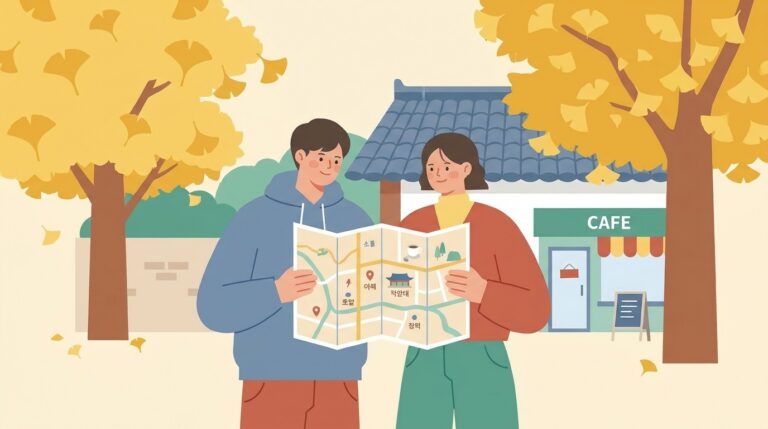
Picture this: You and your best friend have finally landed at Incheon Airport, bursting with excitement for your dream Seoul getaway. But by day three, the dream feels a bit strained. One of you is an extreme ‘J’ (planner) who woke up at 7:00 AM, determined to visit Gyeongbokgung Palace, hike Bukchon Hanok Village, and hit three trendy pop-up stores in Seongsu before sunset. The other is a relaxed ‘P’ (spontaneous traveler) who just wants to sleep in, sip iced Americano at a cozy cafe, and wander aimlessly.
Suddenly, your feet are throbbing, hunger is kicking in, and a small comment like “Are we really walking another twenty minutes?” triggers an icy silence. Traveling together tests even the deepest bonds. In Korean culture, keeping harmony while asserting your needs without offending someone is an art form. Over the years, our Daily Hangul learners have shared that learning gentle compromise phrasing completely transformed their trips with Korean friends and travel partners. Today, we will equip you with natural, native-tested B1 Korean phrases to diffuse tension, negotiate travel styles smoothly, and keep your friendship solid!
Phase 2: Core Expressions Deep Dive
1. 우리 잠깐 쉬었다 갈까? (Uri jamkkan swieotta galkka?)
- Pronunciation: Oo-ree jahm-kkahn shwee-eot-dah gahl-kkah? (Think of the “swi” as a quick whistle-like “shwee” sound, pausing softly at “jamkkan”).
- Meaning: Literal: “Shall we rest for a bit before going?” / Actual Nuance: “Hey, let’s take a quick breather—I’m getting exhausted, and I bet you are too.”
- K-Culture Moment: In K-dramas, when two leads are walking endlessly through a picturesque park or bustling night market, the considerate lead will gently ask this while offering a cool bottled tea.
- Editor’s Insight: Using “우리 (we)” instead of “나 (I)” shifts the focus from your personal complaint to a collective well-being. It feels deeply caring rather than demanding.
- Situation Spectrum:
- Casual (Friends/Peers): ✅
- Semi-formal (Older acquaintances/Coworkers): ⚠️ (Use “우리 잠깐 쉬었다 갈까요?” – Uri jamkkan swieotta galkkayo?)
- Formal (Strict business settings): 🚫
- 🤔 Think About It: In English, we often say “I need a break.” Why does Korean naturally default to “Shall we take a break?” How does framing rest as a joint activity preserve harmony?
2. 네 생각은 어때? 내 생각엔… (Ne saenggageun eottae? Nae saen-ggagen…)
- Pronunciation: Neh seng-gahg-eun uh-tteh? Neh seng-gahg-en… (“Ne” sounds like “neh”, while “saeng-gak” rhymes with “pack”).
- Meaning: Literal: “How is your thought? In my thought…” / Actual Nuance: “What do you think? Personally, I was wondering if…”
- K-Culture Moment: Frequently heard on Korean travel variety shows like Earth Arcade when cast members debate between ordering spicy tteokbokki or savory dumplings.
- Editor’s Insight: Putting “네 생각은 어때?” first shows that you respect their point of view before presenting your own counter-proposal.
- Situation Spectrum:
- Casual: ✅
- Semi-formal: ⚠️ (Change to “어떻게 생각하세요? 제 생각에는…” – Eotteoke saenggakhaseyo? Je saenggageneun…)
- Formal: 🚫
- 🤔 Think About It: How does asking the other person’s opinion before stating yours alter the emotional temperature of a disagreement?
3. 각자 보고 올까? (Gakja bogo olkka?)
- Pronunciation: Gahk-jah boh-goh ohl-kkah? (“Gak” sounds like “gock” in clock, sharp and quick).
- Meaning: Literal: “Shall we each look and come back?” / Actual Nuance: “Why don’t we split up for an hour, do our own thing, and meet back here?”
- K-Culture Moment: On travel vlogs, friends visiting COEX Mall or Dongdaemun Design Plaza casually say this when one wants fashion retail and the other wants indie books.
- Editor’s Insight: Splitting up isn’t seen as abandonment in modern Korean travel; it is an intelligent, mature act of Baeryeo (consideration) so neither person builds resentment.
- Situation Spectrum:
- Casual: ✅
- Semi-formal: ⚠️ (Use “각자 보고 올까요?” – Gakja bogo olkkayo?)
- Formal: 🚫
- 🤔 Think About It: In your home culture, does splitting up during a shared trip feel awkward or freeing? How does modern urban Korean lifestyle embrace this balance?
Phase 3: Textbook Korean vs. Real Korean
Situation 1: Expressing Extreme Physical Fatigue
- 📖 교과서 한국어 (Textbook): 저는 지금 너무 피곤해서 더 이상 걸을 수 없습니다. (Jeoneun jigeum neomu pigonhaeseo deo isang georeul su eopseumnida. – I am currently very tired and cannot walk anymore.)
- 🗣️ 진짜 한국어 (Real Native): 나 진짜 다리 터질 것 같아. 카페 가서 카페인 충전하자! (Na jinjja dari teojil geot gata. Kape gaseo kape-in chungjeonhaja! – My legs are seriously about to burst. Let’s go to a cafe and recharge our caffeine!)
- 💡 왜 다를까? (Why the difference?): Real Koreans rarely use formal declarative fatigue statements with close friends. Using vivid, humorous exaggerations like “다리 터질 것 같아 (my legs are going to explode)” breaks tension through comic relief and leads straight into a fun solution (coffee!).
Situation 2: Suggesting a Compromise on the Itinerary
- 📖 교과서 한국어 (Textbook): 우리의 여행 일정을 서로 타협하는 것이 좋겠습니다. (Uriui yeohaeng iljeongeul seoro tahyeophaneun geosi jokkessseumnida. – It would be good for us to negotiate our travel itinerary.)
- 🗣️ 진짜 한국어 (Real Native): 오늘은 네가 가고 싶은 데 가고, 내일은 내가 고른 데 가자! (Oneureun nega gago sipeun de gago, naeireun naega goreun de gaja! – Let’s go where you want today, and tomorrow let’s go where I picked!)
- 💡 왜 다를까? (Why the difference?): The textbook term “타협 (compromise/negotiation)” sounds like a tense bilateral political treaty. Close Korean friends use fair, reciprocal turn-taking phrasing instead.
Phase 4: K-Culture Deep Dive & Non-Verbal Manners
4-1. Nunchi (눈치) & Body Language
When tensions rise in Korea, what you don’t say matters just as much as what you say. Direct confrontation or crossed arms can signal hostility. Instead, master these cues:
* The Soft Tilt: When expressing reluctance or fatigue, tilt your head slightly and gently rub your neck or feet. It visibly demonstrates your physical limits without sounding accusatory.
* The Beverage Buffer: Never initiate an itinerary debate while walking briskly on an empty stomach. Buy a warm can of tea or an iced drink first, hand it over with both hands, take a sip together, and then begin the conversation.
* Eye Softening: Avoid staring directly with wide eyes when disagreeing; soften your gaze and look down at your map or phone together as co-problem solvers.
4-2. The Cultural Code: MBTI ‘J vs. P’ and 배려 (Baeryeo)
In South Korea today, MBTI is practically an official social metric. Travel disputes are almost universally framed through “J (Judger/Planner)” vs. “P (Perceiver/Spontaneous)”. Koreans joke about “J-style hell marches” vs. “P-style laying in bed until noon.” By framing a dispute as an MBTI personality quirk (“역시 넌 파워 J야!” – You are definitely a power J!), it depersonalizes blame. Behind this lies 배려 (Baeryeo – thoughtful consideration): actively anticipating the other person’s discomfort before they have to complain aloud.
Phase 5: Real-World Roleplay Scenario
Setting: A narrow, crowded alley in Ikseon-dong on a humid afternoon. Minji (your hyper-organized Korean friend who planned a 10-stop day) is looking intently at her navigation app while you can barely feel your toes.
- Turn 1 (Minji): 자, 여기서 15분만 더 걸어가면 사진 진짜 잘 나오는 유명한 카페 있거든? 바로 갈까? (Ja, yeogiseo sibo-bunman deo georeogamyeon sajin jinjja jal naoneun yumyeonghan kape itgeodeun? Baro galkka?)
🎭 Looking at her phone screen with excited eyes, pointing down an incline. - Turn 2 (You): 저기, 민지야… 혹시 발 안 아파? (Jeogi, Minji-ya… hoksi bal an apa?)
🎭 Smiling wryly, lightly shaking your ankle. - Turn 3 (Minji): 응? 난 아직 괜찮은데! 왜, 많이 힘들어? (Eung? Nan ajik gwaenchaneunde! Wae, mani himdeureo?)
🎭 Pausing and looking surprised. - Turn 4 (You): 나 진짜 다리 터질 것 같아. 우리 잠깐 쉬었다 갈까? (Na jinjja dari teojil geot gata. Uri jamkkan swieotta galkka?)
🎭 Gesturing toward a bench under a nearby persimmon tree. - Turn 5 (Minji): 아, 그렇구나! 내가 너무 내 욕심대로 끌고 다녔지? 미안해! (A, geureokguna! Naega neomu nae yoksimdaero kkeulgo danyeotji? Mianhae!)
🎭 Lowering her phone, looking apologetic. - Turn 6 (You): 아니야, 다 좋았어! 근데 우리 여기서 시원한 거 한잔 마시고 가면 어때? (Aniya, da joasseo! Geunde uri yeogiseo siwonhan geo hanjan masigo gamyeon eottae?)
🎭 Reassuring her with a warm smile, pointing to a nearby quiet tea shop. - Turn 7 (Minji): 좋아! 그럼 30분 동안 쉬면서 당 충전하자. (Joa! Geureom samsip-bun dongan swimyeonseo dang chungjeonhaja.)
🎭 Nodding relieved, walking toward the cafe entrance. - Turn 8 (You): 고마워. 네 생각 물어봐 줘서 진짜 든든하다! (Gomawo. Ne saenggak mureobwa jwoseo jinjja deundeunhada!)
🎭 Laughing together as you step inside the air-conditioned shop.
🔀 Interactive Decision Branch
What would you say if Minji says: “여기까지 왔는데 다음 스팟 안 보면 너무 아깝잖아!” (We came all the way here, it’d be such a waste not to see the next spot!)
- Option A: “싫어, 나 절대 못 가. 너 혼자 가.” (Sireo, na jeoldae mot ga. Neo honja ga. – No, I can never go. Go by yourself.)
Feedback: Bad. This blunt refusal shuts down communication and guarantees hurt feelings. - Option B: “아쉽지만, 각자 보고 올까? 넌 사진 찍고 오고 난 여기서 커피 마실게!” (Aswipjiman, gakja bogo olkka? Neon sajin jjikgo ogo nan yeogiseo keopi masilge! – It’s a bummer, but shall we look separately? You take photos, and I’ll sip coffee here!)
Feedback: Best! Validates her desire to see the spot while preserving your need to rest, setting a clear, win-win boundary. - Option C: “…알겠어, 그냥 갈게.” (…Algesseo, geunyang galge. – …Alright, I’ll just go.)
Feedback: Risk! Passive compliance builds silent resentment, which will likely erupt into a major fight later.
Phase 6: 10-Second Emotion Shadowing Drill
Master your intonation by repeating these core lines aloud. Watch the pauses (/) and embody the emotion tags!
[🥺 지치고 솔직하게]나 / 진짜 / 다리 터질 것 같아… / 잠깐만 쉬자!
(Na / jinjja / dari teojil geot gata… / jamkkanman swija!)[🤝 다정하고 제안하듯이]네 생각은 어때? / 내 생각엔 / 천천히 둘러보는 게 좋을 것 같아.
(Ne saenggageun eottae? / Nae saen-ggagen / cheoncheonhi dulleoboneun ge joeul geot gata.)[😊 쿨하고 상쾌하게]무리하지 말고, / 우리 1시간만 / 각자 보고 올까?
(Murihaji malgo, / uri han-siganman / gakja bogo olkka?)
Phase 7: K-Culture Mini Dictionary
- 여행 스타일 (Yeohaeng seutail) | Travel style. Commonly broken down into ‘J vs. P’ (planners vs. freelancing wanderers) or ‘관광파 (sightseeing fans)’ vs. ‘호캉스파 (hotel staycation relaxers)’.
- 당 충전 (Dang chungjeon) | Literally “sugar recharge.” Essential Korean slang used when fatigue makes people irritable; grabbing a dessert or sweet drink to restore happiness.
- 배려 (Baeryeo) | Active consideration and empathy. In Korean travel, proactively checking your companion’s physical and emotional comfort before making decisions.
- 핫플 (Hat-peul) | Short for “Hot Place.” Trendy viral locations that usually require waiting in lines (웨이팅) and can be a major source of travel stress if companions dislike crowds.
Phase 8: Traveler’s Survival Kit
Top 3 Survival Phrases
- 천천히 가자 (Cheoncheonhi gaja)
Let’s go slowly / No rush.
Pro Tip: Use this as soon as you notice your companion walking several paces ahead. - 배고프니까 우리 둘 다 예민해진 것 같아 (Baegopeunikka uri dul da yeminhaejin geot gata)
I think both of us got a bit cranky because we’re hungry.
Pro Tip: Blaming low blood sugar instead of each other’s personality instantly diffuses anger! - 양보해 줘서 고마워 (Yangbohae jwoseo gomawo)
Thank you for yielding / compromising.
Pro Tip: Acknowledge their flexibility immediately after they agree to your suggestion.
Editor’s Travel Note
- Install the 네이버 지도 앱 다운로드 before your journey. It provides accurate walking times, elevation warnings, and crowd levels, helping you prevent exhaustion-driven disputes.
- Download the 카카오 T 앱 다운로드 to call a taxi when walking becomes unbearable. Splitting a 6,000 KRW taxi fare is much cheaper than buying forgiveness after an argument!
Phase 9: One Step Deeper (Reflection)
Traditional Korean culture centers around ‘우리 (We)’, prioritizing group unity and collective experience. Historically, traveling together meant doing everything together from dawn to dusk. However, modern Koreans now blend this collective warmth with respect for individual boundaries—creating a hybrid travel culture where splitting up for an afternoon is seen as peak mutual respect rather than distance. True friendship isn’t about enduring the same itinerary; it’s about making sure both people cherish the memories.
💬 Your Turn: Have you ever experienced a travel style clash with a companion? How did you resolve it, and which phrase above would have helped you the most? Share your stories below!
Phase 10: FAQ & Avoiding Misunderstandings
Q: Does asking “각자 보고 올까?” sound like I am mad at my Korean friend?
A: Not if your delivery is warm and cheerful! If you say it with a smile and suggest a specific reunion time (e.g., “우리 4시에 이 카페 앞에서 다시 만날까?” – Shall we meet back in front of this cafe at 4?), it sounds modern, thoughtful, and pragmatic.
Q: What if my travel buddy ignores my subtle hints about being tired?
A: Shift from hints to affectionate, direct vulnerability. Instead of sighing, say: “나 체력이 바닥났어! 30분만 앉아있자.” (Na cheryeogi badangnasseo! Samsip-bunman anjaitja. – My stamina hit rock bottom! Let’s sit for just 30 minutes).
Q: Is it rude to reject a restaurant my friend queued 40 minutes for?
A: If you truly cannot eat the food, express sincere appreciation first: “기다려 줘서 진짜 고마운데, 내가 이걸 잘 못 먹어서 미안해.” (Thank you so much for waiting, but I’m so sorry I really can’t eat this). Offer to grab a quick takeout nearby and sit together, or buy the dessert afterward.
🚨 Common Mistakes Board
- Mistake 1: Sighing silently and dragging your feet without speaking.
Correct Action: Speak up before your battery hits zero. Use: “우리 잠깐 쉬었다 갈까?” - Mistake 2: Accusing them of bad planning (“너 때문에 너무 많이 걸었잖아” – We walked too much because of you).
Correct Action: Use ‘우리’ and blame physical factors: “오늘 우리 만 보 넘게 걸었나 봐! 발목 쉬어주자.” (We must have walked over 10,000 steps today! Let’s rest our ankles). - Mistake 3: Insisting on sticking strictly to the schedule when your friend is pale and exhausted.
Correct Action: Practice Baeryeo by proactively cutting one destination from the list.
Phase 11: Action Missions & Community
- 🥉 Bronze Mission (Solo Practice): Say “우리 잠깐 쉬었다 갈까?” out loud 5 times in the mirror, varying your tone from pleading to playful.
- 🥈 Silver Mission (Social Share): Post an Instagram story or note with your favorite phrase from this lesson and tag your favorite travel partner with “Next trip, let’s remember this!”.
- 🥇 Gold Mission (Live Action): On your next outing in Korea, initiate a compromise using “네 생각은 어때? 내 생각엔…” when choosing where to eat or visit.
- 🎮 K-Culture Mission: Watch an episode of a Korean travel variety show (like Youth Over Flowers or Europe Outside Your Tent) and spot the exact moment the cast members take a break to ‘recharge their sugar’ (당 충전).
Phase 12: Interactive Quiz Challenge
Test your situational instincts with these three quick questions!
- Situational Judgment: Your friend wants to visit another vintage shop, but your feet are in agony. What is the most polite yet effective compromise?
- (A) “나 발 아프니까 너 혼자 다녀와, 호텔 갈래.”
- (B) “좋아! 근데 나 다리가 좀 아파서, 너 구경하는 동안 난 건너편 카페에 가 있을까?”
- (C) “쇼핑은 어제도 했잖아. 오늘은 그만 가자.”
- Fill-in-the-Blank: Complete the phrase used to ask your companion’s opinion gently:
- “네 (________)은 어때? 내 생각엔 좀 쉬는 게 좋을 것 같아.”
- True or False: Suggesting to split up for an hour (“각자 보고 올까?”) during a trip with a close Korean friend is considered an insult to the friendship.
- (True / False)
👉 Click to reveal answers & explanations!
- Answer: (B)
Explanation: Option B validates their interest while setting a clear physical boundary without whining. Option A is cold, and Option C is critical. - Answer: 생각 (saenggak)
Explanation: “생각” means “thought/opinion.” “네 생각은 어때?” is the golden phrase for respectful consultation. - Answer: False
Explanation: In contemporary Korean travel culture, flexible independence is celebrated as mature mutual consideration (Baeryeo), ensuring both travelers enjoy their trip without resentment!







