

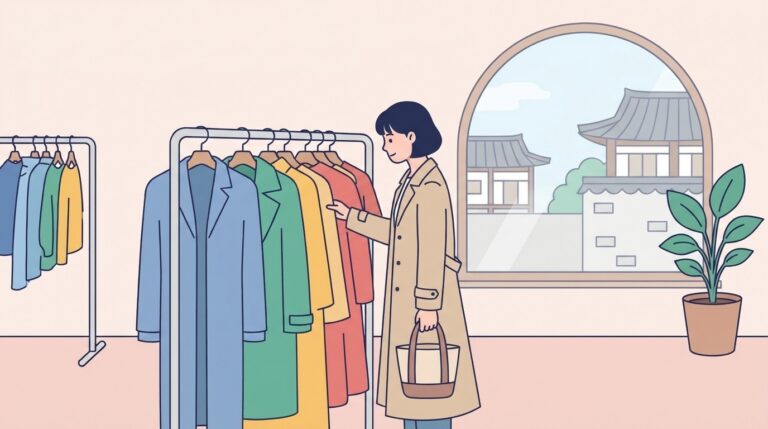
Sound Like a Seoul Stylist: Korean Fashion Haul Buzzwords You Must Know
Phase 1: Empathy (Story Opening)
안녕하세요! (Annyeonghaseyo!) I’m your Daily Hangul editor and your personal cultural navigator. Have you ever watched a Korean fashion haul video on YouTube, only to get stuck when the creator touches a stylish coat and shouts, “이거 완전 가성비 갑이에요!” (Igeo wanjeon gaseongbi gabieyo!)? Traditional textbooks teach stiff, formal phrases like “저렴합니다” (jeoryeomhamnida / it is inexpensive), leaving you puzzled when native speakers celebrate finding department-store quality pieces on a street-market budget. Many of our learners tell us they feel nervous shopping in Hongdae or discussing finds with Korean friends because they worry about sounding like a robotic phrasebook. This guide is built directly from real student experiences to help you bridge that gap. Master these natural buzzwords, and you will shop, chat, and comment on K-style hauls with total confidence!
Phase 2: Core 3 Expressions Deep-dive
1. 가성비 갑 (Gaseongbi gap)
- Pronunciation: Gaseongbi gap (Think of “Ga-sung-bee” + “Gop” with a crisp, closed-lip ‘p’ sound)
- Meaning: Literal: “Cost-performance ratio (가성비) + First/King (甲)” | Real Nuance: “Absolute best bang for your buck / God-tier value”
- K-Culture Moment: A beauty creator testing a 5,000 KRW Daiso lip tint that looks and lasts just like a 45,000 KRW luxury department store brand.
- Editor’s Insight: In legal contracts, “갑” (gap) refers to party A (the party with dominant influence). Internet slang adopted this character to describe anything that reigns supreme in its category.
- Situation Spectrum: Casual ✅ | Semi-formal ⚠️ | Formal 🚫
- 🤔 Think About It: In English, you might say “a steal” or “great value.” Why do you think Korean society created a term comparing everyday products to a “supreme king”?
2. 득템 (Deuktem)
- Pronunciation: Deuk-tem (Sounds like “Dook” rhyming with book + “Tem” from the English word item)
- Meaning: Literal: “Obtain (得) + Item (아이템)” | Real Nuance: “Scoring an incredible find / A shopping victory”
- K-Culture Moment: Digging through vintage racks at Dongmyo Flea Market and pulling out a mint-condition leather jacket for only 15,000 KRW.
- Editor’s Insight: Originally an online gaming term for looting rare gear from raid bosses, shoppers quickly claimed it to celebrate scoring gorgeous clothes at unbelievable prices.
- Situation Spectrum: Casual ✅ | Semi-formal ⚠️ | Formal 🚫
- 🤔 Think About It: Video game culture strongly influences Korean colloquial speech. Are there gaming terms in your language that people use while shopping?
3. 꿀템 (Kkultem)
- Pronunciation: Kkul-tem (A tense “Cool” starting with a sharp ‘kk’ sound + “tem”)
- Meaning: Literal: “Honey (꿀) + Item” | Real Nuance: “A holy-grail product / Sweet, lifesaver find”
- K-Culture Moment: Showing off a non-greasy sunscreen in an Olive Young haul that completely cleared your acne before summer vacation.
- Editor’s Insight: The Korean word for honey (꿀 / kkul) is widely used as a prefix meaning “sweet, highly beneficial, or effortless” (e.g., 꿀팁 / kkultip = great tip; 꿀잠 / kkuljam = deep, restful sleep).
- Situation Spectrum: Casual ✅ | Semi-formal ⚠️ | Formal 🚫
- 🤔 Think About It: Korean links sweetness with practical usefulness. Does your native language compare good products to food?
Phase 3: Textbook Korean vs Real Korean
Situation 1: Describing a high-quality, budget-friendly sweater
* 📖 교과서 한국어: 이 옷은 가격이 싸고 품질이 아주 우수합니다. (I oseun gagyeogi ssago pumjiri aju useuhamnida. / This clothing has a low price and its quality is very excellent.)
* 🗣️ 진짜 한국어: 가격은 착한데 퀄리티가 백화점 브랜드 못지않아요! (Gagyeogeun chakhande kwollitiga baekhwajeom beuraendeu motjianayo! / The price is so kind, yet the quality rivals department store brands!)
* 💡 왜 다를까?: Native speakers frequently personify prices by calling them “착하다” (chak-hada / kind, gentle) and prefer the conversational loanword “퀄리티” (kwolliti) over the formal noun “품질” (pumjil).
Situation 2: Showing off a great purchase from an online sale
* 📖 교과서 한국어: 저는 어제 좋은 물건을 싸게 구매했습니다. (Jeoneun eoje joeun mulgeoneul ssage gumaehaesseumnida. / Yesterday I purchased a good product cheaply.)
* 🗣️ 진짜 한국어: 이번 세일 때 완전 꿀템 득템했어요! (Ibeon se-il ttae wanjeon kkultem deuktemhaesseoyo! / During this sale, I scored a total holy-grail item!)
* 💡 왜 다를까?: Real conversations highlight emotional satisfaction. Combining “꿀템” and “득템” communicates pure excitement that standard textbook verbs cannot match.
Phase 4: K-Culture Deep Dive & Non-verbal Manners
4-1. Nunchi & Gestures: Checking Quality Without Being Rude
When shopping in indie boutiques or underground malls in Express Bus Terminal (Goto Mall), shoppers gently pinch the fabric between their thumb and index finger, give a slight three-beat nod, and quietly murmur: “와, 재질 진짜 좋다…” (Wa, jaejil jinjja jota… / Wow, the fabric is really nice…). Aggressively pulling, stretching, or leaving hanger marks displays poor nunchi (social etiquette). A delicate touch combined with a polite appreciative smile signals that you appreciate fine curation.
4-2. Cultural Code: The Pride of Smart Consumerism
In Seoul, true fashion cred does not come from merely head-to-toe designer labels. The ultimate cultural badge of honor is showing off a stunning outfit and revealing you bought it for 15,000 KRW from an underground station boutique. Koreans admire “스마트한 소비” (smart spending). Bragging about an item being “가성비 갑” is a beloved social flex that celebrates taste over wealth.
Phase 5: Real-Life Roleplay Scenario
- Setting: A chic indie boutique in Hongdae with soft jazz and wooden hangers.
- Characters: Minji (the warm, trendy store clerk) and You (a stylish visitor looking for autumn wear).
- Minji: 손님, 찾으시는 스타일 있으세요? (Sonnim, chajeusineun seutair-isseuseyo? / Welcome! Is there a particular style you are looking for?) 🎭 Smiling warmly while smoothing out a coat on display.
- You: 네! 편하게 입을 가을 아우터 보고 있어요. (Ne! Pyeonhage ibeul gaeul auteo bogo isseoyo. / Yes! I’m looking for an autumn jacket to wear comfortably.) 🎭 Browsing the rack with a friendly look.
- Minji: 이 재킷 어떠세요? 요즘 저희 매장 인기 1등이에요. (I jaekit eotteoseyo? Yojeum jeohui maejang ingi ildeung-ieyo. / How about this jacket? It’s our shop’s number one favorite these days.) 🎭 Holding up an oversized wool-blend blazer with both hands.
- You: 와, 만져보니까 원단이 백화점 브랜드 못지않네요! (Wa, manjyeobonikka wondani baekhwajeom beuraendeu motjianneyo! / Wow, feeling the fabric, it totally rivals department store brands!) 🎭 Gently feeling the sleeve hem between fingers.
- Minji: 맞아요! 4만 원대라서 손님들 사이에서 완전 가성비 갑으로 유명해요. (Majayo! Saman-wondaeraseo sonnimdeul saieseo wanjeon gaseongbi gabeuro yumyeonghaeyo. / Exactly! It’s in the 40,000 won range, so it’s famous among our customers as total value king.) 🎭 Nodding approvingly and pointing to the tag.
- You: 4만 원대요? 대박, 이거 진짜 꿀템이네요! (Saman-wondaeyo? Daebak, igeo jinjja kkultemineyo! / In the 40,000s? Amazing, this is a real holy-grail item!) 🎭 Widening eyes in pleasant surprise.
- Minji: 오늘 마지막 한 장 남아서 바로 득템하시는 거예요. (Oneul majimak han jang namaseo baro deuktemhasineun geoyeyo. / It’s the very last piece today, so you’re scoring a real win.) 🎭 Taking the hanger down gently to wrap it up.
- You: 좋아요! 이걸로 계산해 주세요. (Joayo! Igeollo gyesanhae juseyo. / Great! Please ring this up for me.) 🎭 Presenting your credit card politely with both hands.
🔀 Interactive Decision Point
How would you reply to Minji at Step 6 to sound like a natural shopper?
* Option A: “이거 완전 가성비 갑이라 안 살 수가 없네요!” (Igeo wanjeon gaseongbi gabira an sal suga eomneyo! / This is such a value king that I simply can’t leave without it!)
* Option B: “너무 싸서 솔직히 좀 의심스러워요.” (Neomu ssaseo soljiki jom uisimseureowoyo. / It’s so cheap that honestly, I feel a bit suspicious.)
* Option C: “사장님, 2만 원으로 깎아주시면 살게요.” (Sajangnim, iman-woneuro kkakka-jusimyeon salgeyo. / Owner, I’ll buy it if you slash it down to 20,000 won.)
Feedback:
* Option A (Best): Perfect! It acknowledges the great price enthusiastically. The staff will feel proud of their curation and may even gift you free styling socks.
* Option B (Bad): Calling a curated item suspicious damages the atmosphere and insults the boutique’s standards.
* Option C (Risk): Demanding an aggressive 50% discount in modern fixed-price Korean indie boutiques creates serious awkwardness (tanghwang).
Phase 6: 10-Second Emotion Shadowing Drill
[😲 Amazed & Shocked]와 / 가격은 착한데 / 퀄리티 대박이다! (Wa / gagyeogeun chakhande / kwolliti daebagida! / Wow / the price is gentle / but the quality is epic!)[🔥 Excited & Proud]이거 완전 / 가성비 갑 / 득템이야! (Igeo wanjeon / gaseongbi gap / deuktemiya! / This is totally / the value king / what a score!)[✨ Friendly & Warm]너도 이거 써봐, / 완전 인생 꿀템이야! (Neodo igeo sseobwa, / wanjeon insaeng kkultemiya! / You try this too, / it’s an absolute life holy-grail!)
Phase 7: K-Culture Mini Dictionary
- 내돈내산 (Nae-don-nae-san) | My own money, my own purchase | Abbreviation for “내 돈 주고 내가 산 것”. Content creators use this tag to prove their review is 100% authentic and not paid sponsorship.
- 착붙 (Chak-but) | Sticks like a charm / Perfectly tailored | Short for “착 달라붙다”. Used when a lipstick shade matches your skin undertone seamlessly or when pants fit your waist without any gaps.
- 갓성비 (Gat-seong-bi) | God-tier value | Replaces the “가” (price) in 가성비 with the English word “God” (갓) to praise products with mind-blowing cost performance.
- 품절대란 (Pum-jeol-dae-ran) | Sold-out sensation | Describes viral shopping sensations where everyone rushes to buy an item, causing it to sell out nationwide.
Phase 8: Traveler’s Survival Kit
Top 3 Survival Expressions
- 이거 입어봐도 돼요? (Igeo ibeobwado dwaeyo? / May I try this on?)
- Pro Tip: In many subway station boutiques, white garments and light knit tops cannot be tried on to prevent cosmetic marks. Always ask first!
- 다른 색상도 있어요? (Dareun saeksangdo isseoyo? / Do you have other colors?)
- Pro Tip: Boutique racks often display only one sample color. Fresh variations are stored under counters or in the stockroom.
- 카드 결제 되나요? (Kadeu gyeolje dwenayo? / Can I pay by card?)
- Pro Tip: While Korea is nearly cashless, small flea-market stalls may offer a 1,000 to 2,000 KRW cash discount (hyeongeum harin).
Editor’s Travel Note
- Use the [Naver Map app download for route navigation] to pin hidden indie vintage shops throughout Seongsu and Euljiro.
- Keep your physical passport ready at Olive Young or department stores; purchases over 15,000 KRW qualify for immediate tax refunds right at the cash register!
Phase 9: “One Step Deeper”
Korean shopping habits reflect an intriguing social dynamic known as Mix-and-Match. Instead of using luxury brand logos as blunt status symbols, stylish young Koreans pride themselves on pairing an affordable 12,000 KRW flea-market top with a classic designer accessory. This cultural trait values resourcefulness, aesthetic eye, and smart bargain-hunting over careless spending.
💬 Your Turn: What is your best bargain find from your home country? Share your favorite shopping score in the comments below using the word 득템 (Deuktem)!
Phase 10: FAQ & Avoiding Misunderstandings
Q: Can I use “가성비 갑” when talking to my boss or an elder?
A: Stick to casual contexts. “가성비 갑” is modern slang. In formal business presentations or when speaking with elders, use standard polite Korean: “가격 대비 만족도가 높습니다” (Gagyeok daebi manjokdoga nopeumnida / The satisfaction relative to the price is high).
Q: What is the difference between “가성비” and “갓성비”?
A: “가성비” is the standard term (Price-to-performance ratio). “갓성비” replaces the first syllable with “갓” (God) to describe supernatural, almost unbelievable value.
Q: Is “꿀템” only used for clothes and cosmetics?
A: Not at all! A handy travel adapter, a delicious 1,000 KRW convenience store dessert, or even a helpful language app can all be praised as a “꿀템”.
🚨 Common Mistakes Alert
- Using “가성비 갑” for poor quality products: If something is just dirt cheap but breaks in two days, do not call it “가성비 갑”. Native speakers will say: “그냥 싸구려예요” (Geunyang ssaguryeoyo / It’s just cheap junk).
- Haggling in chain stores or department stores: Never ask for discounts in Olive Young or shopping malls. Fixed pricing is universal except in open-air flea markets.
- Thinking “득템” is only for purchases: If a friend hands down a lovely jacket they no longer wear, you can happily exclaim: “오늘 득템했다!” (I scored a treasure today!).
Phase 11: Action Missions & Participation
- 🥉 Bronze Mission (Solo Practice): Look at your favorite affordable sweater in the mirror and say: “이거 완전 가성비 갑 꿀템이에요!” out loud three times.
- 🥈 Silver Mission (Social Share): Take a photo of an item you love, share it on your social media, and add the caption: My favorite daily #꿀템! 완전 #가성비갑 ✨.
- 🥇 Gold Mission (Real Interaction): Visit a Korean beauty creator’s haul video on YouTube and leave a supportive comment: “완전 꿀템 득템하셨네요! 저도 사고 싶어요!” (You scored a total holy-grail item! I want to buy one too!).
- 🎮 K-Culture Mission: Watch an episode of a K-pop idol vlog or a Korean shopping haul video. Count how many times the words “꿀템”, “착붙”, or “가성비” pop up in the subtitles!
Phase 12: Interactive Quiz Challenge
1. Situation Quiz
You find a wonderful coat in a Dongdaeum market that looks just like a 300,000 KRW luxury brand, but costs only 35,000 KRW. What is the most natural comment?
* A) 이거 품질이 법적으로 최고입니다.
* B) 가격은 착한데 퀄리티가 백화점 브랜드 못지않네요!
* C) 너무 싸서 버리고 싶어요.
2. Fill-in-the-Blank
“I found this amazing lipstick during the sale, it’s a true holy-grail!”
-> “이번 세일에 산 립스틱인데, 완전 인생 [ ]이에요!”
3. True or False
“내돈내산” means the product was sponsored by a brand.
* [True / False]
Click to reveal answers & explanations!
- Answer: B – Expressing that the price is gentle (착하다) while the quality rivals luxury brands (백화점 브랜드 못지않다) is natural and idiomatic.
- Answer: 꿀템 (Kkultem) – “인생 꿀템” translates to “the holy-grail product of my life.”
- Answer: False – “내돈내산” stands for “내 돈 주고 내가 산 것” (I bought it with my own money), meaning it is completely non-sponsored!







