

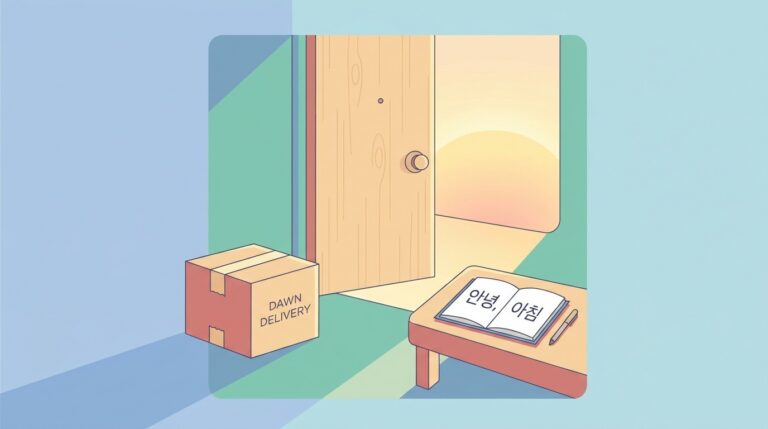
The Magic of Korean Speed: Midnight Deliveries, Instant Setup, and Finding Daily Calm
Phase 1: Empathy (Story Immersion Opening)
안녕하세요! 매일한글 에디터입니다.
Imagine this scenario: it is 11:20 PM on a rainy Tuesday in Seoul. You are snuggled in bed watching your favorite K-Drama, and you realize you have no fresh milk, fruit, or eggs for breakfast tomorrow. In most countries, you would sigh, accept your fate, and plan to grab something on your morning commute. But here in Korea? You open an app, tap a few buttons, and fall asleep. At 6:45 AM, a soft chime on your phone confirms: your groceries are neatly packed and waiting right outside your front door.
Whether it is fresh dawn delivery (새벽배송), getting high-speed gigabit internet connected within three hours of a phone call, or walking out of a district office (주민센터) with an official sealed document in four minutes flat, South Korea’s Ppalli-Ppalli (빨리빨리, ‘hurry-hurry’) culture powers an everyday convenience that feels like genuine magic. Yet, many international learners tell us: “Everyone moves so fast! What should I actually say to service workers so I don’t slow them down or sound rude? And how do Koreans ever relax?”
Take a deep breath! As your local culture navigator with over a decade of teaching experience, I will show you how to navigate this lightning-fast world with confidence, respect, and natural Korean phrasing that makes native speakers smile. Let us dive in!
Phase 2: Core Expressions (핵심 표현 3선)
1. 바로 처리해 드릴게요 (Baro cheorihae deurilgeyo)
- Pronunciation: [Bah-roh chuh-ree-hae deu-ril-geh-yoh] (Think of ‘baro’ sounding like ‘bar-o’ with a quick rolled r)
- Meaning: Literal: “I will process it right away.” / Nuance: “I’m on it immediately; consider it done!”
- K-Culture Moment: You will hear this phrase constantly from customer service representatives, bank tellers, and administrative officers right before their fingers fly across the mechanical keyboard at 120 words per minute.
- Editor’s Insight: The adverb 바로 (baro) is Korea’s ultimate magic word. It promises zero downtime. When someone says this to you, it signals exceptional professional dedication.
- Situation Spectrum: Casual ⚠️ | Semi-formal ✅ | Formal ✅
- 🤔 Think About It: In your home country, does customer service promise immediate resolution, or an estimated waiting window of several business days? How does this alter your daily stress levels?
2. 벌써 도착했어요? (Beolsseo dochakhaesseoyo?)
- Pronunciation: [Buhl-ssuh doh-chak-hae-ssuh-yoh?] (The double ‘ss’ in ‘beolsseo’ has a crisp, punchy pop like ‘sun’)
- Meaning: Literal: “Has it arrived already?” / Nuance: “Wow, that was unbelievably fast!”
- K-Culture Moment: Used by K-Drama characters whenever a delivery driver or courier arrives seemingly seconds after the order screen confirms payment.
- Editor’s Insight: 벌써 expresses pleasant surprise and admiration for speed. It is far more conversational and natural than simply saying 빨라요 (ppallayo, “It’s fast”).
- Situation Spectrum: Casual ✅ | Semi-formal ✅ | Formal ⚠️
- 🤔 Think About It: Why does Korean culture turn punctuality and ultra-speed into an expression of hospitality and care for others?
3. 여유 좀 가져요 (Yeoyu jom gajyeoyo)
- Pronunciation: [Yuh-yoo jom gah-jyeh-yoh] (‘Yeoyu’ flows softly like ‘yo-you’ without sharp stops)
- Meaning: Literal: “Have a little room/leisure.” / Nuance: “Take a breather; don’t rush yourself so much.”
- K-Culture Moment: In healing variety shows like Three Meals a Day or calm slice-of-life dramas, friends say this when someone is frantically multi-tasking.
- Editor’s Insight: 여유 (yeoyu) is the counterweight to 빨리빨리. It represents mental margin, tranquility, and intentional slowness in a hyper-connected society.
- Situation Spectrum: Casual ✅ | Semi-formal ✅ | Formal 🚫
- 🤔 Think About It: When everything around you is engineered for speed, how do you personally protect your own 여유 (mental breathing room)?
Phase 3: 교과서 한국어 vs 진짜 한국어 (Textbook vs. Real Korean)
Situation 1: Asking if same-day delivery or service is possible
- 📖 교과서 한국어: 신속한 배송이 가능합니까? (Sinsokhan baesongi ganeunghamnikka? – “Is prompt delivery feasible?”)
- 🗣️ 진짜 한국어: 오늘 바로 받아볼 수 있을까요? (Oneul baro badabol su isseulkkayo? – “Could I receive it today right away?”)
- 💡 왜 다를까?: Traditional textbooks rely heavily on Sino-Korean bureaucratic vocabulary (신속, promptness). Real Koreans opt for vivid native verbs like 받아보다 (to receive and see) paired with 바로 to keep the conversation warm and collaborative.
Situation 2: Complimenting a technician or clerk’s remarkable speed
- 📖 교과서 한국어: 업무 처리 속도가 매우 빠릅니다. (Eommu cheori sokdoga maeu ppareumnida. – “The work processing speed is exceedingly swift.”)
- 🗣️ 진짜 한국어: 손이 진짜 빠르시네요! (Soni jinjja ppareusineyo! – “Your hands are so fast! / You work with lightning speed!”)
- 💡 왜 다를까?: Instead of sounding like an objective corporate performance audit, native speakers use the idiomatic body phrase 손이 빠르다 (“fast hands”) to deliver a heartfelt, admiring compliment.
Phase 4: K-Culture Deep Dive & Non-verbal Manners
4-1. 눈치 (Nunchi) & Gestures in Fast Transactions
When an internet technician (기사님, gisa-nim) visits your home or a delivery courier hands you an item:
1. The Double-Hand Handover: Even during a 5-second doorstep interaction, always receive a digital tablet, pen, or package using both hands, or support your right forearm with your left hand. It shows respect despite the hurry.
2. The Polite Bow-and-Step: Couriers in Korea move rapidly down stairwells. Do not attempt long small talk. A brisk 30-degree bow combined with: “감사합니다! 수고하세요!” (Gamsahamnida! Sugohaseyo! – “Thank you! Keep up the great work!”) is the highest form of Korean social grace (눈치).
4-2. The Yin and Yang of Ppalli-Ppalli
Korea’s modern infrastructure—such as Coupang’s Rocket Delivery and same-day municipal paper issuance via Government 24—was forged during rapid postwar economic modernization (한강의 기적). Speed became a civic virtue. However, modern Koreans have created rich cultural spaces to balance this velocity: serene Hanok cafes nestled in Bukchon, slow-drip coffee brewing rituals, silent reading rooms (북카페), and weekend temple stays designed specifically to switch off the internal stopwatch.
Phase 5: Real Roleplay Scenario (실전 롤플레이)
Setting: Alex just moved into an officetel in Mapo-gu, Seoul. Min-woo, a telecom technician (기사님), arrives at 2:00 PM on the dot to set up high-speed Wi-Fi.
- Min-woo: 안녕하세요! 인터넷 설치하러 왔습니다. (Annyeonghaseyo! Inteonet seolchihareo watseumnida.)
🎭 [Smiling briskly with a tool pouch around his waist]
“Hello! I’m here for your internet installation.” - Alex: 어서 오세요, 기사님! 이쪽으로 들어오세요. (Eoseo oseyo, gisa-nim! Ijjogeuro deureo-oseyo.)
🎭 [Stepping aside and pointing courteously toward the living room]
“Welcome, technician! Please come right this way.” - Min-woo: 네, 단자함 확인하고 바로 작업 들어갈게요. 15분이면 끝납니다. (Ne, danjaham hwaginhago baro jageop deureogalgeyo. Sib-obun-imyeon kkeutnamnida.)
🎭 [Opening the wall console and quickly running cables]
“Okay, I’ll inspect the terminal box and get to work right away. It will be done in 15 minutes.” - Alex: 벌써 다 되나요? 정말 빠르시네요! (Beolsseo da doenayo? Jeongmal ppareusineyo!)
🎭 [Eyes wide in genuine pleasant astonishment]
“It’s finished already? You are remarkably fast!” - Min-woo: 하하, 한국 속도 아시잖아요! 모뎀 연결 끝났습니다. 와이파이 잡히는지 확인해 보세요. (Haha, hanguk sokdo asijanhayo! Modem yeongyeol kkeutnatseumnida. Waipai japhineunji hwaginhae boseyo.)
🎭 [Placing the blinking router neatly onto the shelf]
“Haha, you know the Korean speed! The modem connection is complete. Please check if your Wi-Fi connects.” - Alex: 와, 바로 잡히네요! 속도도 완전 빨라요. (Wa, baro japhineyo! Sokdodo wanjeon ppallayo.)
🎭 [Looking at the smartphone screen with a delighted nod]
“Wow, it connected instantly! The speed is totally fast.” - Min-woo: 잘 되네요. 서명 여기에 한 번만 부탁드립니다. (Jal doeneyo. Seomyeong yeogie han beonman butakdeurimnida.)
🎭 [Handing over a smartphone signature screen]
“Looks great. Could you please sign right here just once?” - Alex: 네! 날씨 더운데 수고 많으셨습니다. (Ne! Nalssi deounde sugo maneusyeotseumnida.)
🎭 [Signing with two hands holding the phone, handing it back with a small bow]
“Sure! Thank you so much for your hard work in this hot weather.”
🔀 Interactive Decision Point
How would you thank Min-woo as he packs up his gear to head to his next appointment?
- Option A: “기사님, 천천히 커피 한잔 마시면서 쉬었다 가세요!” (Gisa-nim, cheoncheonhi keopi hanjan masimyeonseo swieotta gaseyo! – “Technician, sit down slowly, drink a cup of coffee, and rest before leaving!”)
- Option B: “시원한 캔커피 하나 챙겨가세요! 오늘 정말 감사했습니다.” (Siwonhan kaenkeopi hana chaenggyeogaseyo! Oneul jeongmal gamsahaesseumnida. – “Please take this cold canned coffee with you! Thank you so much today.”)
- Option C: “빨리 가셔야 하니까 인사 안 할게요.” (Ppalli gasyeoya hanikka insa an halgeyo. – “Since you must hurry, I won’t say goodbye.”)
Feedback & Cultural Evaluation:
* Option A (Risk): While well-intentioned, field technicians have strictly timed schedules (often 4 to 6 appointments a day). Forcing them to sit down for conversation causes subtle inner panic (멘붕)!
* Option B (BEST ⭐): Thoughtful, polite, and culturally flawless. Handing them an on-the-go drink honors their speed while demonstrating heartfelt warmth (정, Jeong).
* Option C (Bad 🚫): Blunt and cold. Even in a hurry, courteous closing remarks are vital in Korean social etiquette.
Phase 6: 10-Second Emotional Shadowing Drill
Practice matching the native rhythm and emotional cadence. Slash marks (/) indicate natural breath pauses.
[⚡ 다급하고 빠릿하게 - Energetic & Responsive]
제가 / 지금 바로 확인하고 / 연락드릴게요!
(Je-ga / ji-geum ba-ro hwa-gin-ha-go / yeol-lak-deu-ril-ge-yo!)
“I will check it / right this second / and contact you!”-
[😲 유쾌한 감탄과 놀라움 - Pleasant Amazement]
벌써 도착했어요? / 손이 / 진짜 빠르시네요!
(Beol-sseo do-cha-khae-sseo-yo? / So-ni / jin-jja ppa-reu-si-ne-yo!)
“Did it arrive already? / Your hands / are truly lightning-fast!” -
[😌 편안하고 다정한 위로 - Gentle & Calming]
너무 서두르지 말고 / 여유 좀 / 가져요.
(Neo-mu seo-du-reu-ji mal-go / yeo-yu jom / ga-jyeo-yo.)
“Don’t rush yourself too much; / let’s take / a little breather.”
Phase 7: K-Culture Mini Dictionary
- 새벽배송 (Saebyeok-baesong) | Dawn Delivery
Ordering fresh produce or items up until 11:00 PM or midnight, with guaranteed arrival at your front doorstep before 7:00 AM the following morning. - 당일 설치 (Dang-il seolchi) | Same-Day Installation
A customer service standard where home appliances (air conditioners, washers) or internet connections are mounted and fully operational on the very day of request. - 초스피드 (Cho-seupideu) | Ultra-Speed / Lightning-Fast
A combination of the Chinese prefix 초 (super/ultra) and the English loanword 스피드. Widely used in news headlines and advertisements to describe swift administrative workflows or ultra-fast train networks. - 소확행 (Sohwakhaeng) | Small but Certain Happiness
An acronym for 소소하지만 확실한 행복. It reflects the contemporary Korean antidote to high-speed corporate life—finding deep peace in a quiet slice of cake, a warm cup of barley tea, or a stroll along the Han River.
Phase 8: Traveler’s Survival Kit
Top 3 Survival Phrases for Fast Situations
- 당일 수령 가능한가요? (Dang-il suryeong ganeunghangayo?)
Pro Tip: Use this at photo studios, eye clinics (glasses made in 20 minutes!), or luggage storage services to confirm same-day pick-up. - 조금만 천천히 말씀해 주세요. (Jogeumman cheoncheonhi malsseumhae juseyo.)
Pro Tip: When clerks speak with machine-gun rapid Korean, this polite phrase gently regulates the conversation speed without awkwardness. - 문 앞에 두고 가주세요. (Mun ape dugo gajuseyo.)
Pro Tip: The quintessential Korean delivery note. Couriers will leave your package quietly by your apartment door and send a confirmation photo.
Editor’s Travel Note: Essential Local Tools
- Skip overseas map services that lag in Korea; check train timings and fast walking shortcuts via the 네이버 지도 길찾기 앱.
- Need to order midnight snacks like fried chicken to your hotel lobby? Navigate menus quickly with the 배달의민족 공식 앱 다운로드.
- For foreigners handling residency cards or certificates, access the streamlined digital portal at the 정부24 민원 포털 사이트.
Phase 9: “한 발 더 깊이” (Going One Step Deeper)
Foreign observers frequently interpret 빨리빨리 as mere impatience or restlessness. However, viewed through a deeper cultural lens, Korean speed stems from an intense mutual consideration (배려, baeryeo). Finishing a task quickly for another person is viewed as an act of saving their precious time. In a closely connected society, efficiency is love, respect, and reliability rolled into one. When you observe this dedication—while remembering to nurture your personal inner 여유—you begin to see Korea’s dynamic heartbeat in a whole new light.
💬 Your Turn: What is one task in your home country that takes days or weeks, but you wish could be completed in Korean 초스피드? Share your story in the comments below!
Phase 10: FAQ & Common Misconceptions
Q: Will delivery workers ring my doorbell at 6:00 AM for 새벽배송?
A: No! Korean dawn delivery platforms have strict silent delivery policies. Couriers do not ring bells or knock before 7:00 AM. They quietly place your parcel, take a verification photo, and send a silent app notification or text message.
Q: Is saying “빨리해 주세요” (Please do it fast) considered impolite?
A: Yes, in service situations it often sounds demanding or bossy. Instead of saying 빨리해 주세요, soften your request into an inquiry: “혹시 오늘 중으로 가능할까요?” (Hoksi oneul jung-euro ganeunghalkkayo? – “Could it perhaps be possible by today?”).
Q: How can an internet technician finish an entire home setup in 15 minutes?
A: Korean residential apartment buildings (아파트) are engineered with centralized fiber-optic junction hubs on each floor. Technicians only need to activate the port, attach the pre-configured terminal, and run a fast signal test.
🚨 Common Mistakes Warning Board
| Mistake | Why It Feels Awkward | Correct Action |
|---|---|---|
| Handing a credit card or clipboard with one hand | Interpreted as dismissive or cold during fast handoffs | Support your right elbow/forearm with your left hand (두 손 쓰기) |
| Saying “천천히 일하세요” to working staff | Can sound patronizing or sarcastic to busy professionals | Say “수고 많으십니다!” (Sugoh-maneusimnida! – “Thank you for your hard work!”) |
| Waiting for hours for internet/document appointments | System workflows are digitized; delays mean something is wrong | Inquire politely: “진행 상황 알 수 있을까요?” (May I know the progress?) |
Phase 11: Action Mission & Engagement
- 🥉 Bronze Mission (Solo Shadowing): Stand before your mirror and say “손이 진짜 빠르시네요! 바로 처리해 주셔서 감사합니다!” three times with an upbeat, grateful smile.
- 🥈 Silver Mission (Social Share): Share a photo of your quickest transaction experience (a coffee, a package, or an appointment) on Instagram using the hashtag
#DailyHangulSpeed. - 🥇 Gold Mission (Real-World Application): Next time you order at a Korean store or receive a fast response from a Korean speaker, reply with: “벌써 다 됐어요? 감사합니다!”
- 🎮 K-Culture Media Mission: Watch Episode 1 of any contemporary Seoul-based K-Drama. Spot how many times delivery motorcycles (배달 오토바이) or fast document exchanges appear in the background within the first 20 minutes!
Phase 12: Interactive Quiz Challenge
Test your understanding of Korean speed culture and phrasing!
- Situational Judgment: An administrative worker prints your certificate in 45 seconds. Which response is the most natural and appreciative?
- (A) 왜 이렇게 서둘러요? (Why do you rush like this?)
- (B) 손이 진짜 빠르시네요! 감사합니다. (Your hands are so fast! Thank you.)
- (C) 천천히 다시 뽑아주세요. (Please print it again slowly.)
- Fill in the Blank: When you want to tell a stressed friend to find some mental breathing room and not rush, you say:
“너무 무리하지 말고, _______ 좀 가져요.”- (A) 여유 (Yeoyu)
- (B) 택배 (Taekbae)
- (C) 설치 (Seolchi)
- True or False Cultural Fact: In Korea, asking a delivery driver to sit down for a long chat and tea during work hours is considered thoughtful manners.
- (A) True
- (B) False
👉 Click to view answers and explanations
- Answer: (B) – Complimenting their efficiency with 손이 진짜 빠르시네요! shows genuine admiration and native-level fluency.
- Answer: (A) 여유 – 여유 좀 가져요 is the natural expression for “take a breather / maintain peace of mind.”
- Answer: (B) False – Service professionals have tight, high-speed schedules. The best etiquette is a quick, refreshing drink to go (캔커피) and a warm “수고하세요!”







