

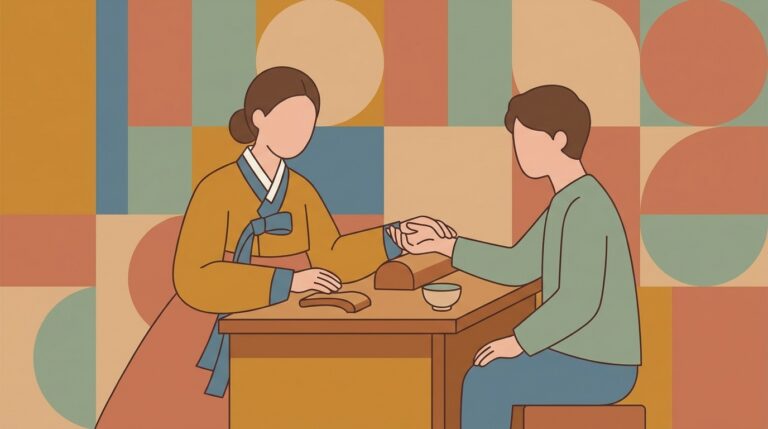
Master the Insightful Idiom: 맥(脈)을 짚다
Phase 1: 공감 (Empathetic Story-Driven Opening)
안녕하세요! 매일한글 에디터입니다. (Hello! It’s your Daily Hangul editor.)
Have you ever watched an intense boardroom scene in a high-stakes K-Drama like Misaeng (미생) or Reborn Rich (재벌집 막내아들)? Everyone is shouting, pointing fingers at plunging sales figures, blaming marketing, or complaining about external logistics. Then, the seasoned executive or sharp strategist leans back, taps their pen, and calmly states: “자, 다들 진정하시고… 사건의 맥을 먼저 짚어봅시다.” (Now, everyone calm down… let’s take the pulse of this issue first.) Instantly, the room falls silent.
For advanced Korean learners aiming for C1 fluency, moving past rigid textbook phrases like “원인을 분석하다” (to analyze the cause) or “문제를 파악하다” (to grasp the problem) is your biggest milestone. When you use vivid metaphors grounded in traditional Korean worldview, your Korean transforms from “grammatically correct foreigner speak” into natural, persuasive insight. Today’s guide stems from dozens of C1 coaching sessions where learners struggled to sound authoritative without sounding aggressive. Let’s explore how taking the pulse of a situation—’맥(脈)을 짚다’—will elevate your executive presence in Korean.
Phase 2: 핵심 표현 3선 심층 분석 (Top 3 Idiomatic Expressions)
1. 맥을 짚다 (Maegeul jipda)
- Pronunciation: [Mae-geul jip-da] (Sounds like: May-gool jeap-dah)
- Meaning: Literal: To feel/take someone’s pulse (as done in Traditional Korean Medicine, 한의학) | Actual Nuance: To accurately identify the underlying root cause, rhythm, or core dynamic of a complicated situation.
- K-Culture Moment: Seen frequently in investigative dramas like Stranger (비밀의 숲), when an astute prosecutor cuts through superficial evidence to expose the structural corruption behind a case.
- Editor’s Insight: ‘맥’ (脈) refers to the pulse, blood vessel, or energetic meridian. When you “take the pulse” of an issue, you aren’t merely debugging a machine; you are treating the problem as a living, breathing ecosystem.
- Situation Spectrum: Casual ⚠️ | Semi-formal ✅ | Formal ✅
- 🤔 Think About It: In English, we often say “hit the nail on the head” (a mechanical, forceful metaphor). Why does Korean culture turn to an organic, medical metaphor like feeling a pulse?
2. 정곡을 찌르다 (Jeonggogeul jjireuda)
- Pronunciation: [Jeong-go-geul jji-reu-da] (Sounds like: Jung-goh-gool jjee-roo-dah)
- Meaning: Literal: To pierce the bullseye (in archery) | Actual Nuance: To hit the nail on the head; to strike directly at a sensitive or undeniable truth with sharp words.
- K-Culture Moment: Common in entertainment talk shows (Radio Star) when an MC reveals a guest’s secret vulnerability with witty precision.
- Editor’s Insight: While ‘맥을 짚다’ is diagnostic and analytical, ‘정곡을 찌르다’ is direct, piercing, and sometimes leaves the other party speechless.
- Situation Spectrum: Casual ✅ | Semi-formal ✅ | Formal ✅
- 🤔 Think About It: Notice the martial focus on archery here versus holistic medicine. Which idiom feels more collaborative to you?
3. 판세를 읽다 (Pansereul ikda)
- Pronunciation: [Pan-se-reul ik-da] (Sounds like: Pahn-seh-rool eek-dah)
- Meaning: Literal: To read the board position in Baduk (Go) | Actual Nuance: To assess the macro political, economic, or situational landscape before making a move.
- K-Culture Moment: In historical Sageuk dramas, the King’s chief advisor quietly assesses factional rivalries before recommending an appointment.
- Editor’s Insight: Use this when discussing market trends, multi-party negotiations, or social dynamics.
- Situation Spectrum: Casual ⚠️ | Semi-formal ✅ | Formal ✅
- 🤔 Think About It: Baduk strategy heavily influences Korean corporate culture. How does board-reading reflect strategic patience?
Phase 3: 교과서 한국어 vs 진짜 한국어 (Textbook vs. Real Korean)
Situation 1: Redirecting a team that is chasing trivial symptoms
- 📖 교과서 한국어: “우리는 지금 근본적인 원인을 잘못 분석하고 있습니다.” (Uríneun jigeum geunbonjeogin won-ineul jalmot bunseokhago itseumnida.)
- 🗣️ 진짜 한국어: “우리 지금 사건의 맥을 완전히 잘못 짚고 있는 것 같아요.” (Uri jigeum sageon-ui maegeul wanjeonhi jalmot jipgo inneun geot gatayo.)
- 💡 왜 다를까?: Textbook phrasing sounds clinical and combative. Using ‘맥을 잘못 짚다’ frames the issue as a diagnostic misstep rather than an attack on competence, softening friction while maintaining intellectual authority.
Situation 2: Praising a colleague’s sharp strategic analysis
- 📖 교과서 한국어: “상황의 핵심 요점을 아주 잘 이해하셨네요.” (Sanghwang-ui haeksim yojeomeul aju jal ihaehasyeotneyo.)
- 🗣️ 진짜 한국어: “역시 팀장님, 이번 프로젝트의 맥을 딱 짚으셨네요!” (Yeoksi timjangnim, ibeon peurojekteu-ui maegeul ttak jipeusyeotneyo!)
- 💡 왜 다를까?: Adding the intuitive adverb ‘딱’ (ttak – precisely) with ‘맥을 짚다’ creates an immediate, native ring of spontaneous respect.
Phase 4: K-Culture 딥다이브 & 비언어적 매너 (Deep Dive & Non-Verbal Cues)
4-1. 눈치(Nunchi) & 제스처 (Physical Posture)
When using ‘맥을 짚다’ in a professional setting, body language dictates your tone:
* The Thoughtful Pause: Do not blurt this expression out instantly. Take a two-second pause, lower your vocal pitch, and gently rest your hands flat or clasped on the table.
* The Calibrated Eye Contact: Avoid aggressive staring. Look around the room slowly to gather attention, then fix a steady, supportive gaze on the group.
* Tone Modulation: Say “맥을 짚다” with steady, calm cadence, mimicking an experienced physician diagnosing a pulse.
4-2. Cultural Code Analysis: The Influence of 한의학 (Traditional Korean Medicine)
Koreans view organizations and interpersonal dynamics through an organic lens. In Traditional Korean Medicine (한의학), sickness is not merely a localized bacterial invasion; it is a disruption in the harmonious flow (기운의 순환) of the body. If the meridian (맥) is blocked, symptoms erupt elsewhere. Similarly, in Korean corporate life, problems are rarely seen as isolated errors; they are considered systemic blockages. When you say “맥을 짚다”, you are tapping into centuries of holistic philosophy.
Phase 5: 실전 롤플레이 시나리오 (Real-World Roleplay)
Setting: Late afternoon in a sleek conference room in Teheran-ro, Gangnam. Your startup’s new app has experienced a sudden drop in daily active users. Lead Designer Min-woo (민우) is panicking over UI colors, while Marketing Lead Su-jin is demanding more ad spend.
Characters:
* 민우 (Min-woo): Creative, passionate, but easily distracted by minor details.
* You (지안 / Jian): Senior Strategy Consultant known for sharp analytical calm.
- 민우: 🎭 (머리를 감싸 쥐며 초조한 목소리로) “버튼 색깔 때문일까요? 마케팅 문구를 다 바꿔야 할까요?”
(Beoteun saekkkal ttaemun-ilkkayo? Maketing munggureul da bakkwoya halkkayo?)
“Is it because of the button color? Should we rewrite all marketing copy?” -
You: 🎭 (펜을 내려놓고 침착하게 미소 지으며) “민우 님, UI는 이미 충분히 훌륭해요. 지금 우리는 맥을 잘못 짚고 있어요.”
(Min-woo nim, UI-neun imi chungbunhi hullyunghaeyo. Jigeum urineun maegeul jalmot jipgo isseoyo.)
“Min-woo, the UI is already great. Right now, we are misdiagnosing the pulse.” -
민우: 🎭 (눈을 크게 뜨며 고개를 든다) “네? 맥을 잘못 짚다니요?”
(Ne? Maegeul jalmot jipdaniyo?)
“Pardon? What do you mean taking the wrong pulse?” -
You: 🎭 (데이터 차트를 가리키며) “이탈율은 결제창 이전이 아니라, 결제 후 로딩 시간에서 발생하고 있거든요.”
(Italyul-eun gyeoljechang ijeon-i anira, gyeolje hu roding sigandeseo balsaenghago itgeodeunyo.)
“The drop-off isn’t happening before the checkout page; it’s occurring during the post-payment load time.” -
민우: 🎭 (차트를 자세히 들여다보며 탄식한다) “아… 결제 게이트웨이 서버 문제였군요!”
(A… gyeolje geiteuwei seobeo munjeyeotgunyo!)
“Ah… it was an issue with the payment gateway server!” -
You: 🎭 (고개를 끄덕이며 단호하게) “그렇죠. 이제 문제의 맥을 정확히 짚었으니 기술팀에 요청합시다.”
(Geureochyo. Ije munje-ui maegeul jeonghwak-hi jipeosseuni gisultime yocheonghapsida.)
“Exactly. Now that we have accurately taken the pulse of the problem, let’s request the tech team’s fix.” -
민우: 🎭 (안도의 한숨을 내쉬며) “와, 지안 님이 맥을 딱 짚어주신 덕분에 살았어요.”
(Wa, Jian nimi maegeul ttak jipeojusin deokbune sarasseoyo.)
“Phew, you pinpointed the core pulse so accurately, you saved my life.” -
You: 🎭 (가볍게 웃으며 서류를 정리한다) “팀워크죠! 자, 이제 해결하러 가볼까요?”
(Timweokeujyo! Ja, ije haegyeolhareo gabolkkayo?)
“That’s teamwork! Now, shall we go solve it?”
🔀 인터랙티브 분기점 (Interactive Decision Point)
Imagine Min-woo gets defensive and asks: “그럼 제 디자인 분석이 틀렸다는 건가요?” (Are you saying my design analysis is wrong?)
- Option A: “네, 틀렸어요. 맥을 전혀 못 짚고 계시네요.” (Ne, teullyeosseoyo. Maegeul jeonhyeo mot jipgo gyesineyo.)
- Feedback: Bad. Blunt and confrontational. Using idioms to invalidate a peer’s competence causes defensive barriers.
- Option B: “틀렸다기보다는, 전체적인 맥락에서 진짜 원인의 맥을 짚어보자는 뜻이에요.” (Teullyeottagibodaneun, jeonchejeogin maengnageseo jinjja won-in-ui maegeul jipeobojaneun tteusieyo.)
- Feedback: Best. Polished C1 diplomatic response. Separates the person’s effort from the systemic diagnosis.
- Option C: “그냥 제 말대로 하세요.” (Geunyang je maldaero haseyo.)
- Feedback: Risk. Highly dismissive; destroys rapport in modern Korean flat-hierarchy teams.
Phase 6: 10초 감정 섀도잉 드릴 (10-Second Emotion Shadowing Drill)
Practice these with natural rhythm. Slash marks / indicate natural micro-pauses.
[🧐 진중하고 날카롭게 / Serious & Incisive]
“자, / 흥분하지 말고 / 사태의 맥을 먼저 짚어봅시다.”
(Ja, / heungbunhaji malgo / satae-ui maegeul meonjeo jipeobopsida.)
“Now, / without getting agitated, / let’s take the pulse of the situation first.”-
[💡 확신에 찬 목소리로 / Confident & Decisive]
“이번 보고서는 / 문제의 맥을 / 아주 정확하게 짚었습니다.”
(Ibeon bogoseoneun / munje-ui maegeul / aju jeonghwakhage jipeotseumnida.)
“This report / has taken the pulse of the problem / with absolute precision.” -
[🤝 부드럽게 설득하듯 / Gentle & Diplomatic]
“우리가 지금 / 엉뚱한 곳에서 / 맥을 짚고 있는 건 아닐까요?”
(Uriga jigeum / eongttunghan goseseo / maegeul jipgo inneun geon anilkkayo?)
“Aren’t we perhaps / taking the pulse / in the wrong place right now?”
Phase 7: K-Culture 미니 사전 (Mini Vocabulary Lexicon)
- 맥 (Maek): Pulse, vessel, energetic vein, or the underlying coherence of an argument or event.
- 진맥 (Jinmaek): Formal medical pulse-taking by an Oriental Medicine Doctor (한의사).
- 문맥 (Munmaek): Context within written text or spoken discourse (literal: ‘the pulse of the writing’).
- 맥락 (Maengnak): Broader contextual thread, background framework, or narrative continuity.
Phase 8: 여행자를 위한 생존 키트 (Advanced Traveler’s Toolkit)
Survival Expressions TOP 3
- “선생님, 제 몸의 맥 좀 한번 짚어주시겠어요?”
(Seonsaengnim, je mom-ui maek jom hanbeon jipeojusigesseoyo?)
Pro Tip: Use this when visiting an authentic Hanuiwon clinic in Seoul. The Hanui doctor will feel your wrist pulse with immense respect for your phrasing. - “대화의 맥이 끊겨서 그러는데, 다시 설명해 주실래요?”
(Daehwa-ui maegi kkeun-gyeoseo geureoneunde, dasi seolmyeonghae jusillaeyo?)
Pro Tip: Use this in discussions when an interruption breaks your train of thought. - “맥락을 파악하고 다시 연락드리겠습니다.”
(Maengnageul pa-akhago dasi yeollakdeurigesseumnida.)
Pro Tip: Essential business email closing when you need time to review background data.
Editor’s Travel Note
If you want to experience authentic pulse diagnosis in person, visit the historic Seoul Yangnyeongsi Herb Medicine Market near Jegi-dong Station. You can book consultations directly using the 네이버 지도 앱 다운로드 to search for reputable traditional clinics (한의원). Foreign credit cards are widely accepted, but calling ahead to confirm English-speaking staff is recommended.
Phase 9: “한 발 더 깊이” (Reflective Cultural Insight)
In Western mechanical paradigms, when an organization stumbles, we look for “the broken gear” or the faulty line of code. Korean culture, deeply influenced by East Asian cosmology, views organizations as organic bodies. A problem is not an isolated defect; it is stagnation (어혈) in circulation. When you suggest “맥을 짚다”, you are encouraging your team to search for the vital circulatory source rather than treating superficial symptoms.
💬 Your Turn: How does your native language describe diagnosing the crux of a tricky problem? Do you rely on mechanical, medical, or architectural metaphors? Share in the comments below!
Phase 10: FAQ & 오해 방지 (FAQ & Common Mistakes)
Q: Can I use ‘맥을 짚다’ when analyzing personal relationship issues?
A: Yes! For example: “그 친구와 대화가 안 통하면, 감정의 맥을 먼저 짚어봐.” (If communication isn’t working with that friend, feel the emotional pulse first.)
Q: What is the difference between ‘맥을 짚다’ and ‘핵심을 찌르다’?
A: ‘맥을 짚다’ emphasizes holistic diagnosis and discovering hidden dynamics. ‘핵심을 찌르다’ focuses on delivering a sharp, direct statement that hits the target immediately.
Q: Can I use this phrase with younger peers in casual texting?
A: It can sound slightly bookish or professorial among teenagers, but among university students and professionals in their 20s and 30s, it demonstrates refined wit.
🚨 흔한 실수 (Common Mistakes) TOP 3
- Confusing 맥 (Maek) with 멱 (Myeok): Never say 멱을 짚다. ‘멱살을 잡다’ means grabbing someone by the collar in a street fight!
- Correct Action: Keep the vowel open as ‘ㅐ’ (ae): 맥(脈).
- Using it for physical objects: You cannot say “스마트폰의 맥을 짚다” (Taking the phone’s pulse).
- Correct Action: Use it for situations (사태), problems (문제), or human bodies (신체).
- Overusing with strict superiors without honorifics: If speaking about an executive, say “맥을 짚으시다” (honorific form: ji-peu-si-da).
Phase 11: 액션 미션 & 참여 유도 (Action Missions)
- 🥉 Bronze Mission: Record a 15-second voice memo saying: “우리가 지금 사태의 맥을 제대로 짚고 있나요?” Pay attention to your intonation and pauses.
- 🥈 Silver Mission: Write a one-sentence comment on Instagram or LinkedIn using ‘맥을 짚다’ to analyze a current tech or K-Culture trend.
- 🥇 Gold Mission: Use ‘맥을 짚다’ in your next Korean 1-on-1 language exchange or business meeting.
- 🎮 K-Culture Mission: Watch an episode of a legal or medical K-Drama (비밀의 숲 or 낭만닥터 김사부) and listen for instances where the characters discuss ‘맥락’ (context) or ‘맥’ (pulse).
Phase 12: 인터랙티브 퀴즈 챌린지 (Interactive Quiz Challenge)
1. Situational Judgment
Your project partner has spent three hours debating font sizes while ignoring that user login is broken. Which sentence is most natural?
* (A) “디자인의 정곡을 찔러야 합니다.”
* (B) “지금 우리가 문제의 맥을 잘못 짚고 있어요.”
* (C) “판세를 읽어서 폰트를 바꿉시다.”
2. Fill-in-the-Blank
“수석 연구원님의 이번 분석은 이번 위기의 (____)을 정확히 짚었습니다.”
* (A) 멱
* (B) 목
* (C) 맥
3. True or False
- ‘맥을 짚다’ originates from Western mechanical engineering imported in the 20th century. (True / False)
👉 Click here to reveal answers and explanations!
- Answer: (B) ‘맥을 잘못 짚고 있어요’ is the classic, polite way to guide someone away from trivialities toward the core issue.
- Answer: (C) 맥. ‘맥을 짚다’ is the set phrase. Option (A) 멱 means collar/throat, which creates an embarrassing error!
- Answer: False. It originates from Traditional Korean Medicine (한의학) pulse examination practices.







