

Master Korean Money: How to Say ‘천 원이에요’ (It’s 1,000 Won) Like a Seoul Local
Phase 1: Empathy (Storytelling Opening)
안녕하세요! I’m your Daily Hangul editor, your personal Seoul best friend and culture navigator.
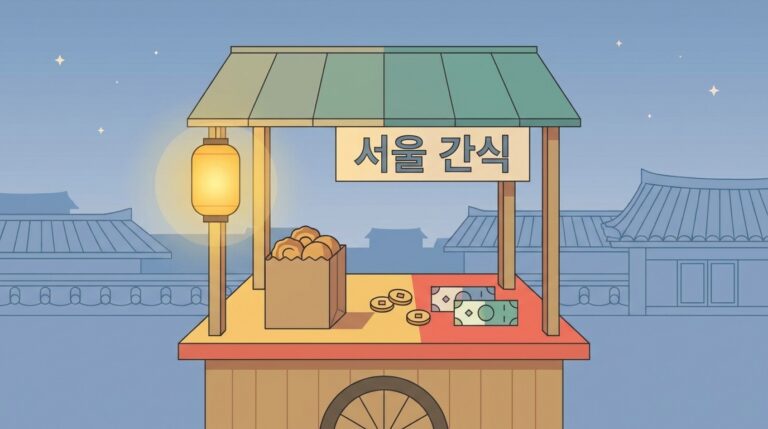
Picture this: You are standing under the vibrant neon lights of a bustling night market in Hongdae. The irresistible scent of sizzling hotteok (sweet stuffed pancakes) and steaming skewers of odeng (fish cakes) fills the cool evening air. You gather your courage, step up to the warm food stall run by a cheerful imo (auntie), and point at a golden skewer. She flashes a warm smile and says: “천 원이에요 (Cheon-won-ie-yo)!”
Suddenly, your mind goes blank. In your head, you are doing furious mental gymnastics with currency exchange rates, foreign syllables, and zero-counting anxiety. Did she say one hundred? One thousand? Ten thousand? You fumble through your wallet, eyes darting between green and blue banknotes, feeling a tiny wave of tourist panic.
Take a deep breath! You are definitely not alone. Every single Korean learner encounters the “Korean currency shock” because Korean prices jump straight into hundreds and thousands. But with just one easy pattern, you will order street food, shop at convenience stores, and pay your taxi fares with total swagger. Let’s unlock the magic of reading Korean prices today!
Phase 2: Top 3 Essential Expressions for Pricing
1. 얼마예요? (Eolmayeyo?)
- Pronunciation: [Eol-ma-ye-yo] (Sounds like All-mah-yay-yo)
- Meaning: “How much is it?”
- K-Culture Moment: Seen in nearly every K-Drama when the main character strolls through a traditional market or browses quirky flea market vintage shops in Ikseon-dong.
- Editor’s Insight: This is the ultimate Swiss-army-knife question in Korea. You can simply point at anything and say this sentence, and shopkeepers will immediately understand.
- Situation Spectrum: Casual: ⚠️ (too formal for close friends, say 얼마야?) | Semi-formal: ✅ (Perfect for shops & street stalls) | Formal: ✅
- 🤔 Think About It: In English, we often ask “How much does this cost?” focusing on the verb cost. In Korean, 얼마 (eolma) literally means what amount, paired directly with the polite ending 이에요/예요 (is/am/are). How does your native language ask for price?
2. 천 원이에요 (Cheon-won-ie-yo)
- Pronunciation: [Cheon-won-i-e-yo] (Cheon sounds like chun in chunk; won rhymes with dawn)
- Meaning: Literal: “It is one thousand Won” | Nuance: “That will be 1,000 won, please.”
- K-Culture Moment: The classic sound of street cart food stalls across Korea when you buy a single savory fish cake skewer or a warm roasted sweet potato.
- Editor’s Insight: In Korean, you never say 일천 (il-cheon / one thousand) for 1,000 won. You drop the number one and just say 천 (cheon)! This little shortcut instantly makes you sound like a local.
- Situation Spectrum: Casual: ⚠️ | Semi-formal: ✅ (The golden standard in daily commerce) | Formal: ✅
- 🤔 Think About It: English groups large numbers by thousands (k), while East Asian languages group large figures by tens of thousands (만 / man). Learning 천 (thousand) is your first bridge into the Korean numerical mindset.
3. 카드 돼요? (Kadeu dwaeyo?)
- Pronunciation: [Ka-deu dwae-yo] (Kadeu sounds like car-dew; dwaeyo sounds like dway-yo)
- Meaning: Literal: “Is card possible?” | Nuance: “Do you take cards? / Can I pay by card?”
- K-Culture Moment: When purchasing street snacks or shopping at trendy subterranean metro shopping malls in Gangnam.
- Editor’s Insight: South Korea is practically a cashless society, and even tiny mom-and-pop shops accept credit cards or smartphone tap-to-pay. Asking this sentence keeps transactions silky smooth.
- Situation Spectrum: Casual: ⚠️ | Semi-formal: ✅ | Formal: ✅
- 🤔 Think About It: Notice how Koreans use the versatile verb 되다 (to work / to be possible) instead of 받다 (to receive). It keeps the question soft, polite, and respectful.
Phase 3: Textbook Korean vs Real Korean
Situation 1: Asking for the price of an item
- 📖 교과서 한국어 (Textbook Korean): 이것의 가격은 얼마입니까? (Igeoseui gagyeogeun eolmaimnikka?)
- 🗣️ 진짜 한국어 (Real Korean): 이거 얼마예요? (Igeo eolmayeyo?)
- 💡 왜 다를까? (Why is it different?): Native Koreans shorten 이것의 (of this) to the punchy demonstrative 이거 (this) and prefer the friendly polite ending -예요 over the rigid, news-anchor style -입니까.
Situation 2: The vendor announcing the 1,000 Won price
- 📖 교과서 한국어 (Textbook Korean): 일천 원입니다. (Ilcheon-won-imnida.)
- 🗣️ 진짜 한국어 (Real Korean): 천 원이에요! (Cheon-won-ie-yo!) / 천 원이요! (Cheon-won-i-yo!)
- 💡 왜 다를까? (Why is it different?): Koreans completely drop the numeral “일 (one)” before 1,000 (천) and 100 (백). In casual retail banter, they often drop the syllable 에 and simply chant 천 원이요! with an inviting melody.
Phase 4: K-Culture Deep Dive & Non-Verbal Manners
4-1. 눈치 (Nunchi) & Polite Gestures: The Two-Handed Money Rule
In Korea, non-verbal etiquette speaks louder than words. When handing over your credit card, T-money transit card, or physical cash:
* The Two-Handed Handover: Always use both hands to present your payment and to receive your receipt or change. If both hands aren’t free, hold the card with your right hand while lightly placing your left hand under your right wrist or elbow. This subtle posture displays utmost respect and will immediately earn you an affectionate nod from the vendor!
* Eye Contact & Micro-Bow: Keep soft eye contact, followed by a slight 15-degree nod when saying 감사합니다 (Gamsahamnida / Thank you).
4-2. Culture Code: The Magic of “천 원 (1,000 Won)” in Korea
To understand Korean pricing, you have to understand the psychological weight of 천 원.
Roughly equivalent to $0.75 – $0.80 USD, 천 원 is the nostalgic symbol of affordable happiness in Korea. It’s the price of a legendary hot winter snack (붕어빵 / Bungeoppang), an instant iced coffee pouch in a convenience store, or everyday treasures inside 다이소 (Daiso)—Korea’s famous lifestyle retail paradise where almost every item starts at 1,000 won!
Phase 5: Real-World Roleplay Scenario
Setting: An aromatic outdoor street cart (포장마차 / Pojangmacha) in Ikseon-dong on a cool autumn evening.
NPC Character: Auntie Min-kyung (민경 이모), a cheerful street snack master wearing a floral apron and wielding a giant soup ladle.
- Turn 1 (You): 안녕하세요! 이 떡볶이 얼마예요? (Annyeonghaseyo! I tteokbokki eolmayeyo? – Hello! How much is this tteokbokki?)
🎭 Pointing politely with fingers held together at the bubbling red rice cakes - Turn 2 (Auntie): 떡볶이는 삼천 원이에요! (Tteokbokkineun samcheon-won-ie-yo! – Tteokbokki is 3,000 won!)
🎭 Smiling broadly while stirring the tteokbokki sauce - Turn 3 (You): 그럼 저기 붕어빵은 얼마예요? (Geureom jeogi bungeoppangeun eolmayeyo? – Then how much are those fish pastries over there?)
🎭 Glancing curiously toward the freshly pressed golden pastries - Turn 4 (Auntie): 붕어빵은 한 개에 천 원이에요. (Bungeoppangeun han gaee cheon-won-ie-yo. – Bungeoppang is 1,000 won each.)
🎭 Holding up one finger warmly with a friendly wink - Turn 5 (You): 붕어빵 두 개 주세요! (Bungeoppang du gae juseyo! – Please give me two bungeoppang!)
🎭 Flashing a big smile and holding up two fingers - Turn 6 (Auntie): 네~ 따뜻한 걸로 줄게요. 이천 원이에요! (Ne~ ttatteuthan geollo julgeyo. Icheon-won-ie-yo! – Sure~ I’ll give you warm ones. That’s 2,000 won!)
🎭 Tucking the pastries into a brown paper bag - Turn 7 (You): 여기 카드 돼요? (Yeogi kadeu dwaeyo? – Do you take cards here?)
🎭 Taking out your payment card ready between both hands - Turn 8 (Auntie): 그럼요! 카드 돼요, 여기 꽂아주세요~ (Geureomyo! Kadeu dwaeyo, yeogi kkojajuseyo~ – Of course! Cards work, please insert it right here~ )
🎭 Pointing happily to the card terminal on the counter
🔀 Interactive Decision Branch
What do you do next?
* Option A: Bow slightly and hand over your card with both hands while saying: “감사합니다!” (Gamsahamnida!)
Feedback: [BEST 🌟] You nailed it! Respectful, natural, and warm. Auntie might even slip in an extra treat (서비스 / service) for your kindness.
* Option B: Fling a 50,000 won bill on the counter with one hand and say nothing.
Feedback: [BAD ❌] Tossing money or using one hand feels dismissive and rude in Korea. Plus, breaking a 50,000 won note for a tiny 2,000 won street cart purchase without asking can be burdensome for vendors.
* Option C: Shout loudly in English: “Hey, do you take US Dollars?”
Feedback: [RISK ⚠️] Foreign currencies are not accepted at street stalls in Korea. Always have Won ready (via card or small cash bills)!
Phase 6: 10-Second Emotion Shadowing Drill
Practice reading these out loud at normal conversational speed! Follow the rhythm pauses marked by /.
[😊 Inquiring & Bright]
실례지만 / 이거 / 얼마예요?
(Sillyejiman / igeo / eolmayeyo?)
“Excuse me, how much is this?”-
[😮 Pleasant Surprise]
와, / 진짜 천 원이에요? / 대박!
(Wa, / jinjja cheon-won-ie-yo? / Daebak!)
“Wow, is it really 1,000 won? Awesome!” -
[💳 Polite & Smooth]
계산해 주세요, / 카드 돼요?
(Gyesanhae juseyo, / kadeu dwaeyo?)
“Check, please. Can I pay with card?”
Phase 7: K-Culture Mini Dictionary
- 원 (Won / KRW): The official currency of South Korea. Symbolized as ₩. In conversation, it always follows the number without space (e.g., 천 원).
- 천 (Cheon / Thousand): The counter unit for 1,000. In English we say “one thousand,” but Koreans never say 일천 (il-cheon) in conversational pricing; they just say 천 (cheon).
- 만 (Man / Ten Thousand): The standard large currency milestone (10,000 won, approximately $7.50 USD). 10,000 won is represented by the green King Sejong banknote.
- 현금 (Hyeongeum / Cash): Physical paper bills and metallic coins. Essential to keep in small denominations (천 원, 오천 원) for street markets and coin karaoke (코노 / Kono).
Phase 8: Traveler’s Survival Kit
Top 3 Survival Phrases for Shopping
- 영수증 버려주세요. (Yeongsujeung beoryeojuseyo.)
Romanization: [Yeong-su-jeung beo-ryeo-ju-se-yo.]
Pro Tip: At convenience stores, clerks often ask if you need a receipt. Say this with a smile to say “Please throw away the receipt.” - 봉투 필요하세요? (Bongtu piryohaseyo?)
Romanization: [Bong-tu pi-ryo-ha-se-yo?]
Pro Tip: This is the question clerks will ask you: “Do you need a shopping bag?” Answer “네 (Ne / Yes)” or “괜찮아요 (Gwaenchanayo / No thank you)”. - 계좌이체 돼요? (Gyejwa-iche dwaeyo?)
Romanization: [Gye-jwa-i-che dwae-yo?]
Pro Tip: If a traditional street cart vendor doesn’t have a card machine, ask if mobile bank transfer is accepted.
Editor’s Travel Note: Frictionless Payments in Seoul
- Map Navigation & Transit Balance: Never get stranded! Check transport routes and store payment options beforehand on 네이버 지도 앱 다운로드.
- Quick Price Math Rule: Strip the last three zeros and add about 25% discount due to current exchange rates. When you see 1,000 won, think of it mentally as roughly $0.75 – $0.80 USD.
Phase 9: “One Step Deeper” (Cultural Reflection)
In many Western cultures, transactions are purely economic exchanges: you swipe a card, grab your purchase, and walk away. In Korea, however, a retail purchase—even buying a humble 1,000 won skewer—is an extension of relational harmony known as 정 (Jeong / warm emotional bond).
When a shopkeeper hands you change with two hands, and you receive it with a gentle bow and say 천 원이에요!, you aren’t just exchanging coins; you are validating each other’s dignity and hard work in a communal society. It transforms routine spending into a tiny moment of human connection.
💬 Your Turn: What everyday snack or item in your home country costs roughly $0.75 (1,000 won)? Share your answers and local prices in the comments below!
Phase 10: FAQ & Avoiding Common Pitfalls
Q: Should I say “일천 원 (Il-cheon won)” or “천 원 (Cheon won)”?
A: Always say 천 원 (Cheon won)! In Korean, the number 1 (일 / il) is omitted before hundreds (백 / baek) and thousands (천 / cheon). Saying 일천 원 sounds like a legal contract reading or an automated banking voice.
Q: Can I pay with an international credit card for a 1,000 won purchase?
A: Technically yes! Korean merchants are legally required to accept card payments regardless of the amount. However, for items under 3,000 won at traditional open-air carts, paying with small cash notes is considered courteous and beloved by vendors.
Q: How do I say 2,000 won or 5,000 won?
A: Simply put the Sino-Korean number in front of 천 (cheon)!
* 2,000 won = 이천 원 (I-cheon won)
* 3,000 won = 삼천 원 (Sam-cheon won)
* 5,000 won = 오천 원 (O-cheon won)
🚨 Common Mistakes Alert
- Mistake: Pronouncing 원 (Won) as One (like the English number 1).
Correct Action: Round your lips like “wah-n” or “wawn”. - Mistake: Handing over a credit card with one casual hand while checking your phone.
Correct Action: Support your card-holding hand with your other arm and make brief friendly eye contact. - Mistake: Confusing 천 (1,000 / Cheon) with 만 (10,000 / Man).
Correct Action: Remember: Blue King Sejong bills are 10,000 won (만 원), while blue-grey Toegye Yi Hwang bills are 1,000 won (천 원)!
Phase 11: Action Mission & Engagement
- 🥉 Bronze Mission (Solo Mastery): Walk around your room, pick up 3 random items, and declare their imaginary price out loud in Korean using the sentence frame: [Item]은/는 천 원이에요!
- 🥈 Silver Mission (Social Connection): Snap a photo of your morning coffee, post it to your Instagram story, and tag us
@DailyHangulwith the caption: “이거 얼마예요?” - 🥇 Gold Mission (Real-World Test): Visit a local Korean grocery store or restaurant. Step up to the register and ask: “카드 돼요? (Kadeu dwaeyo?)” while offering your card with both hands!
- 🎮 K-Culture Mission: Watch an episode of a street food reality show (like Street Food Fighter or Jinny’s Kitchen) and see how many times you hear vendors say “천 원 (Cheon-won)” or “얼마예요? (Eolmayeyo?)”.
Phase 12: Interactive Quiz Challenge
Test what you’ve learned before your next shopping adventure!
1. Situational Judgment:
You want to ask an elder merchant at a traditional market how much one piece of hotteok is. Which sentence is the most natural and polite?
* A) 이거 가격이 얼마입니까? (Igeo gagyeogi eolmaimnikka?)
* B) 이거 얼마예요? (Igeo eolmayeyo?)
* C) 돈 얼마야? (Don eolmaya?)
2. Fill-in-the-Blank:
Complete the sentence to say: “It is 1,000 won.”
“______ 원이에요.”
* A) 일 (Il)
* B) 하나 (Hana)
* C) 천 (Cheon)
3. True or False Culture Check:
True or False: When paying for items in South Korea, it is polite to slide the card across the counter with one hand.
👉 Click here to reveal the answers and explanations!
- Answer: B (이거 얼마예요?) – B is the natural, polite semi-formal standard used by locals every day. A is overly stiff and formal, while C is rude casual talk.
- Answer: C (천) – We drop the numeral 일 (one) and directly say 천 원이에요 (Cheon-won-ie-yo)!
- Answer: FALSE – Always present your payment card or cash with both hands (or supporting your right wrist) as a gesture of basic respect.







