

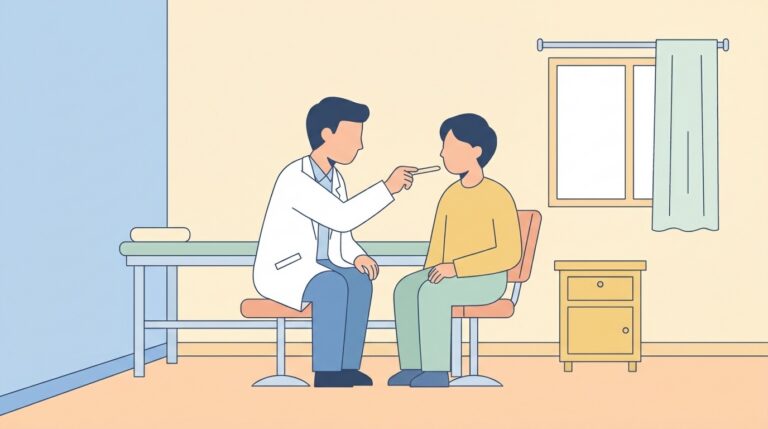
Everyday Korean for the Clinic: Explaining a Sore Throat and Hoarse Voice
Phase 1: Empathy (Story-Driven Opening)
안녕하세요! 매일한글 에디터입니다. (Hello! This is your Daily Hangul editor.)
Imagine this: You wake up on a crisp morning in Seoul. The autumn breeze through your window feels refreshing, but as soon as you swallow your saliva, a sharp, scratchy pain shoots through your throat. You try to say “Good morning” to your roommate or hotel staff, but only a raspy, cracked whisper comes out. You realize you have caught a classic Korean mokgamgi (throat cold).
You know you need to go to a local clinic—a 내과 (naegwa, internal medicine clinic) or 이비인후과 (ibiinhugwa, ENT clinic)—but anxiety instantly sets in. How do you explain this nuanced sensation in Korean without just resorting to frantic hand gestures? Will the doctor understand that it hurts specifically when you swallow?
Take a deep breath! Visiting a clinic in Korea is surprisingly affordable, fast, and friendly. Today, we are going to master practical A2-level phrases based on real feedback from foreign residents in Korea. By the end of this guide, you will be able to describe your sore throat, hoarse voice, and swelling clearly and confidently.
Phase 2: Top 3 Core Expressions Deep Dive
1. 침을 삼킬 때마다 목이 따끔거려요.
- Pronunciation: Chim-eul sam-kil ttae-ma-da mog-i tta-kkeum-geo-ryeo-yo. (Sounds like: chim as in ‘chime’ without the ‘e’, and tta-kkeum pronounced with a crisp, stinging double-t click)
- Meaning: “Every time I swallow saliva, my throat stings/pricks.”
- K-Culture Moment: You often hear this exact line in family K-dramas when a character wraps a warm towel around their neck while their mom hands them a steaming mug of honey-citron tea (kkul-yuja-cha).
- Editor’s Insight: The mimetic word 따끔거리다 (ttakkeumgeorida) describes a sharp, needle-like stinging sensation. Adding -때마다 (-ttaemada, “every time”) pinpoints the exact trigger for the doctor.
- Situation Spectrum:
- Casual: 침 삼킬 때 목 따끔거려. (⚠️ Friends only)
- Semi-formal / Clinic: 침을 삼킬 때마다 목이 따끔거려요. (✅ Perfect for doctor)
- Formal: 침을 삼킬 때마다 인후통이 있습니다. (🚫 Too stiff/clinical)
- 🤔 Think About It: English speakers usually say “It hurts when I swallow.” Korean speakers describe how it hurts (따끔거리다 – stinging prickle). How does your language express specific physical textures of pain?
2. 목이 많이 부었어요.
- Pronunciation: Mog-i man-i bu-eoss-eo-yo. (Pronounce man-i like ‘mah-nee’, and bu-eoss-eo-yo smoothly connected as ‘boo-uh-ssuh-yo’)
- Meaning: “My throat is swollen a lot.”
- K-Culture Moment: Seen in vlog videos of K-pop idols resting backstage before rehearsals, spraying propolis spray into their mouths while telling fans their throat feels swollen from dry air conditioning.
- Editor’s Insight: 붓다 (butda) means ‘to swell’. In past tense with polite ending, it becomes 부었어요 (bueosseoyo). Koreans frequently use 많이 (mani, “a lot/very”) to show severity.
- Situation Spectrum:
- Casual: 목 많이 부었어. (⚠️ Close peers)
- Semi-formal: 목이 많이 부었어요. (✅ Standard polite)
- Formal: 편도가 심하게 부었습니다. (✅ High formal / Medical phrasing)
- 🤔 Think About It: Notice how body parts take the subject marker -이/가 (-i/ga) here: 목이 (mogi). You are describing the state of the throat rather than saying “I have a swollen throat.”
3. 목소리가 쉬었어요.
- Pronunciation: Mok-so-ri-ga swi-eoss-eo-yo. (Pronounce swi like ‘shwee’ or ‘shee’ with slightly rounded lips)
- Meaning: “My voice is hoarse / I lost my voice.”
- K-Culture Moment: Reality TV shows where cast members return from a loud karaoke (노래방) night or outdoor winter filming with a crackly, raspy voice.
- Editor’s Insight: 쉬다 (swida) has two common meanings: ‘to rest’ and ‘to become hoarse/sour’. When paired with 목소리 (moksori, voice), it always means hoarseness.
- Situation Spectrum:
- Casual: 나 목소리 쉬었어. (⚠️ Casual)
- Semi-formal: 목소리가 쉬었어요. (✅ Best for clinic)
- Formal: 음성이 탁해졌습니다. (🚫 Overly poetic/formal)
- 🤔 Think About It: Isn’t it poetic that the word for “to rest” (swida) shares the sound with losing your voice? It is almost like your vocal cords are demanding a break!
Phase 3: Textbook Korean vs. Real-Life Korean
- Situation 1: Explaining your sore throat to the receptionist or doctor
- 📖 Textbook Korean: 저는 심한 인후통을 앓고 있습니다. (Jeo-neun sim-han in-hu-tong-eul al-go it-seumnida. – I am suffering from severe pharyngitis.)
- 🗣️ Real-Life Korean: 목이 부어서 침 삼킬 때 너무 아파요. (Mog-i bu-eo-seo chim sam-kil ttae neo-mu a-pa-yo. – My throat is swollen and it hurts so much when I swallow.)
- 💡 Why is it different? Real patients rarely use Latinate or medical Hanja words like inhutong (pharyngitis). Instead, native speakers describe functional sensations using plain verbs like butda (swell) and apada (hurt).
- Situation 2: Telling the doctor your voice changed
- 📖 Textbook Korean: 발성할 때 이상 증세가 나타납니다. (Bal-seong-hal ttae i-sang jeung-se-ga na-ta-namnida. – Abnormal symptoms appear when vocalizing.)
- 🗣️ Real-Life Korean: 목이 잠겨서 목소리가 잘 안 나와요. (Mog-i jam-gyeo-seo mok-so-ri-ga jal an na-wa-yo. – My throat is locked up, so my voice barely comes out.)
- 💡 Why is it different? Koreans colloquially say 목이 잠기다 (mogi jamgida, “the throat is locked/submerged”) when waking up with a heavy voice before shifting into 쉬었어요 (swieosseoyo).
Phase 4: K-Culture Deep Dive & Non-Verbal Etiquette
4-1. Nunchi & Clinic Body Language
- Remove your mask politely: When entering the examination room, keep your mask on until the doctor indicates to lower it. When the doctor says “아~ 해보세요” (Ah~ haeboseyo – “Say ah~”), pull your mask down to your chin, tilt your head slightly upward, and open your mouth wide without sticking your tongue out excessively.
- Point gently: Use an open palm or two fingers placed gently against the side of your neck to indicate whether the left, right, or inner neck hurts most.
- Two-Hand Rule: Hand over your ID card or passport, alien registration card (ARC), and payment card at the counter using both hands (or supporting your right wrist with your left hand). This shows good manners (ye-ui).
4-2. Cultural Insight: The Neighborhood Clinic Culture
In South Korea, you do not need to wait weeks for a general practitioner. Neighborhood clinics—specifically 내과 (naegwa, Internal Medicine) and 이비인후과 (ibiinhugwa, Ear, Nose, and Throat)—are on almost every commercial building floor near subway stations. Many clinics have a small nebulizer station where patients sit for 3 minutes breathing in soothing eucalyptus steam after the consultation!
Phase 5: Real-Life Roleplay Scenario
Setting: Seoul Station Neighborhood Internal Medicine Clinic (서울내과의원). Modern consultation room with Dr. Park sitting behind a dual-screen monitor.
- 의사 (Dr. Park): 어디가 불편해서 오셨어요?
(Eo-di-ga bul-pyeon-hae-seo o-syeoss-eo-yo?)
[English: What brings you in today / Where does it feel uncomfortable?]
🎭 Looking kindly at patient while reviewing check-in chart -
알렉스 (Alex): 선생님, 침을 삼킬 때마다 목이 따끔거려요.
(Seon-saeng-nim, chim-eul sam-kil ttae-ma-da mog-i tta-kkeum-geo-ryeo-yo.)
[English: Doctor, every time I swallow, my throat stings.]
🎭 Touching neck gently and speaking with a strained expression -
의사 (Dr. Park): 언제부터 그러셨어요? 열도 나나요?
(Eon-je-bu-teo geu-reo-syeoss-eo-yo? Yeol-do na-na-yo?)
[English: Since when has it been like this? Do you have a fever too?]
🎭 Picking up an otoscope with a sterile tip -
알렉스 (Alex): 어제 밤부터요. 열은 없는데 목이 많이 부었어요.
(Eo-je bam-bu-teo-yo. Yeol-eun eom-neun-de mog-i man-i bu-eoss-eo-yo.)
[English: Since last night. I don’t have a fever, but my throat is very swollen.]
🎭 Shaking head slightly -
의사 (Dr. Park): 자, 마스크 잠깐 내리시고 아~ 소리 내보세요.
(Ja, ma-seu-keu jam-kkan nae-ri-si-go a~ so-ri nae-bo-se-yo.)
[English: Well, lower your mask for a moment and say ‘ah~’.]
🎭 Holding a tongue depressor ready -
알렉스 (Alex): 아… (목소리가 갈라지며) 아~
(Ah… [raspy voice] Ah~)
[English: Ah… (voice cracking) Ah~]
🎭 Opening mouth wide under the examination light -
의사 (Dr. Park): 목 안쪽이 빨갛게 많이 부었네요. 목소리도 많이 쉬셨어요.
(Mok an-jjog-i ppal-gah-ke man-i bu-eon-ne-yo. Mok-so-ri-do man-i swi-syeoss-eo-yo.)
[English: The inside of your throat is red and quite swollen. Your voice is very hoarse, too.]
🎭 Typing findings onto the prescription screen -
알렉스 (Alex): 네, 약 먹으면 금방 나을까요?
(Ne, yak meog-eu-myeon geum-bang na-eul-kka-yo?)
[English: Yes, will it get better quickly if I take the medicine?]
🎭 Pulling mask back up politely
🔀 Interactive Choice Point
The doctor finishes writing the prescription and asks: “기침이나 가래도 있나요?” (Gi-chim-i-na ga-rae-do in-na-yo? – Do you also have a cough or phlegm?)
- Option A: “아니요, 기침은 없어요. 그냥 목만 따끔거려요.” (A-ni-yo, gi-chim-eun eop-seo-yo. Geu-nyang mong-man tta-kkeum-geo-ryeo-yo.)
👉 Feedback (Best!): Perfect! It gives an accurate diagnostic negative, preventing unnecessary cough medicine from being added to your prescription. - Option B: “몰라요. 다 아파요.” (Mol-la-yo. Da a-pa-yo.)
👉 Feedback (Risk): Too blunt and vague. The doctor won’t know which specific medication class (antitussive vs. anti-inflammatory) you require. - Option C: “네, 기침약 많이 주세요!” (Ne, gi-chim-yak man-i ju-se-yo!)
👉 Feedback (Bad): If you do not actually have a cough, taking strong cough suppressant medication might cause unnecessary drowsiness.
Phase 6: 10-Second Emotion Shadowing Drill
Practice these lines out loud, matching the rhythm marker (/) and emotional tone!
[😷 조금 힘없고 아프게 - Weak and in slight pain]
침을 / 삼킬 때마다 / 목이 / 너무 따끔거려요.
(Chim-eul / sam-kil ttae-ma-da / mog-i / neo-mu tta-kkeum-geo-ryeo-yo.)-
[🥺 걱정스럽고 조심스럽게 - Worried and cautious]
목이 많이 부어서 / 목소리가 / 완전히 쉬었어요.
(Mog-i man-i bu-eo-seo / mok-so-ri-ga / wan-jeon-hi swi-eoss-eo-yo.) -
[🙏 감사하고 정중하게 - Grateful and polite]
따뜻한 물 / 많이 마시면 / 괜찮아질까요?
(Tta-tteut-han mul / man-i ma-si-myeon / gwaen-chan-a-jil-kka-yo? / Will I be okay if I drink lots of warm water?)
Phase 7: K-Culture Mini Dictionary
- 내과 (Naegwa) | Internal Medicine Clinic
Your first stop in Korea for colds, stomach aches, fatigue, and general bodily discomfort. Look for signs ending in ‘내과의원’. - 처방전 (Cheobangjeon) | Prescription paper
After paying at the clinic, the receptionist hands you this paper slip. You must take it to a nearby pharmacy (yakguk) to pick up your pills. - 약국 (Yakguk) | Pharmacy
Recognizable by a giant red or blue letter “약”. Usually located on the ground floor of the same building as the clinic. - 목감기 (Mokgamgi) | Throat cold / Pharyngitis
A compound word of mok (neck/throat) + gamgi (cold). Koreans divide colds into mokgamgi (throat), kogamgi (runny nose), and momsal (body ache).
Phase 8: Traveler’s Survival Kit
Top 3 Survival Phrases
- 이 근처에 내과나 이비인후과 있어요?
(I geun-cheo-e nae-gwa-na i-bi-in-hu-gwa it-seo-yo?)
[Pro Tip: Ask this at your hotel reception or to a subway attendant if you need a clinic fast.] - 식후 30분에 먹어야 하나요?
(Sik-hu sam-sip-bun-e meog-eo-ya ha-na-yo?)
[Pro Tip: “Should I take this 30 minutes after meals?” Pharmacists will often stamp your medicine envelope with daily meal icons.] - 목에 뿌리는 스프레이도 하나 주세요.
(Mog-e ppu-ri-neun seu-peu-re-i-do ha-na ju-se-yo.)
[Pro Tip: Great for over-the-counter sore throat throat sprays like Betadine or propolis at any pharmacy.]
Editor’s Travel Note
Download the [Naver Map app download for foreign travelers] before your trip. Simply search “내과” (naegwa) or “이비인후과” (ibiinhugwa). Almost all clinics operate on a walk-in basis! Bring your passport, check in at the desk, and you will usually see a doctor within 15–30 minutes. The visit typically costs under 20,000–30,000 KRW even without Korean national insurance!
Phase 9: One Step Deeper
Korean bodily descriptions are deeply rooted in sensory adjectives. While Western medicine often requests a pain scale from 1 to 10, Korean doctors expect descriptive onomatopoeia and mimetic words: 따끔거리다 (ttakkeumgeorida – sharp prickle), 욱신거리다 (uksingeorida – throbbing deep ache), or 칼칼하다 (kalkalhada – raspy and dry). Learning these descriptive textures will not only improve your Korean communication—it opens a window into how Korean culture values vivid physical expression.
💬 Your Turn: Have you ever lost your voice while traveling abroad? How did you manage to ask for help? Share your stories and questions in the comments below!
Phase 10: FAQ & Avoiding Misunderstandings
Q: Should I visit a 내과 (Internal Medicine) or an 이비인후과 (ENT) for a sore throat?
A: Either clinic is completely fine! An ibiinhugwa has specialized camera scopes and inhalation machines specifically for ears, nose, and throat, making it ideal if your main issue is your vocal cords or throat. A naegwa is great if you also have digestive problems, fever, or full-body chills (momsal).
Q: Do I need to make an appointment in advance?
A: In 95% of local neighborhood clinics, no! Walk directly to the reception desk (jeop-su), hand them your ID, write down your name, phone number, and address, and wait for your name to be called.
Q: What should I do with the paper the clinic gives me after paying?
A: That is your 처방전 (cheobangjeon, prescription). Take it directly to any pharmacy (약국). You will see one on the ground floor or next door. You cannot get prescription medicine inside the clinic itself.
🚨 Common Mistakes Warning Board
- Mistake: Calling the doctor “의사님” (Uisa-nim).
❌ Uisa-nim sounds awkward.
✅ Correct Action: Always address medical doctors as 선생님 (Seon-saeng-nim, literally “Teacher/Master”). - Mistake: Confusing 목 (mok, neck/throat) with 목소리 (moksori, voice).
❌ Saying “목이 나왔어요” to mean “my voice returned.”
✅ Correct Action: Say 목소리가 나와요 (Moksoriga nawCurrent voice comes out) or 목소리가 쉬었어요 (Moksoriga swieosseoyo – My voice is hoarse). - Mistake: Leaving the clinic without the prescription paper.
❌ Leaving straight for your hotel thinking medicine is mailed or given at checkout.
✅ Correct Action: Always wait for the paper and walk into the nearest 약 (Yak) store.
Phase 11: Action Missions
- 🥉 Bronze Mission (Solo Practice): Stand in front of the mirror, gently touch your throat, and recite: “침을 삼킬 때마다 목이 따끔거려요” three times with authentic expression.
- 🥈 Silver Mission (Social / Audio): Record your voice saying “목이 많이 부어서 목소리가 쉬었어요” on your voice memo app. Listen back to check if your tt and swi sounds are crisp.
- 🥇 Gold Mission (Real Life): Next time you walk past a Korean pharmacy or clinic, read the signboards out loud: 찾았다, 내과! (Found it, internal medicine!) and 약국 (Pharmacy).
- 🎮 K-Culture Mission: Watch a medical K-drama episode (like Hospital Playlist) and listen for when patients address the doctor as 선생님 (Seonsaengnim).
Phase 12: Interactive Quiz Challenge
1. Situation Judgment
You are at the doctor’s office. You want to say that it stings every time you swallow water or saliva. What should you say?
* A) 목소리가 너무 커요. (My voice is too loud.)
* B) 침을 삼킬 때마다 목이 따끔거려요. (Every time I swallow saliva, my throat stings.)
* C) 배가 아파서 밥을 못 먹겠어요. (My stomach hurts so I cannot eat.)
2. Fill-in-the-Blank
“목이 많이 ________ 목소리가 쉬었어요.” (Because my throat is swollen, my voice became hoarse.)
* Hint: Form of 붓다 (to swell).
3. True or False
In Korea, you should address the clinic doctor as 의사님 (Uisanim). (True / False)
👉 Click here for Answers & Explanations!
-
Answer: B
Explanation: 따끔거리다 expresses the prickling, stinging feeling when swallowing (chim-eul samkil ttaemada). -
Answer: 부어서 (bueoseo)
Explanation: 붓다 (to swell) drops the ‘ㅅ’ before a vowel and connects with -어서 to express cause: 부어서 (because it is swollen). -
Answer: False
Explanation: Always address doctors respectfully as 선생님 (Seonsaengnim) in Korean clinics!






