

Phase 1: Empathy (Immersive Story Opening)
안녕하세요! 매일한글 에디터입니다. (Hello! This is your Daily Hangul editor.)
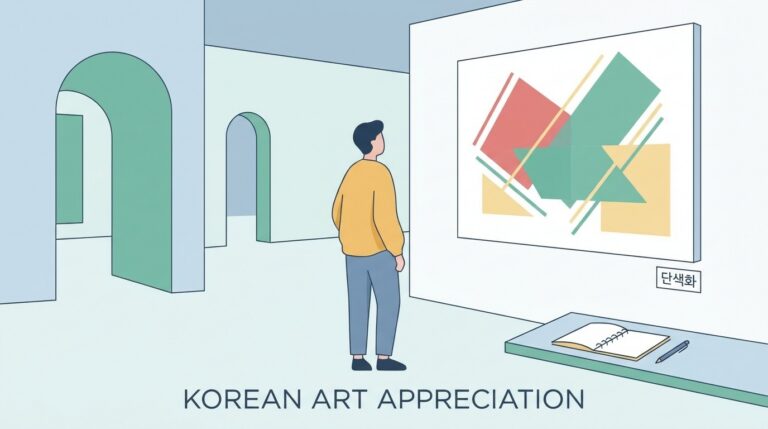
Picture this: It is early September, and you are standing inside the bustling exhibition halls of COEX in Gangnam for Frieze Seoul and Kiaf. All around you, stylish art collectors, gallery directors, and K-culture enthusiasts are sipping iced Americanos and whispering intently. You step into a serene white-cube booth and find yourself staring at an enormous canvas. It is covered entirely in repetitive charcoal strokes, with charred edges and uneven hemp textures. Next to it stands an installation composed of rusted steel plates and hanging river stones.
You tilt your head. Honestly? It feels completely cryptic. You wonder, “Am I supposed to understand this? Did someone just stick rocks on strings?” You feel that slight awkward prickle of alienation—like everyone in the gallery received a secret decoder ring except you.
Just as you are about to shrug and walk away, a docent gathers a small crowd and begins to speak. She explains that the artist survived the turbulent Korean War, scratching surfaces day after day as a quiet ritual of meditation, enduring trauma, and finding breath in empty space. Suddenly, the chaotic marks stop looking like random smudges. They feel like a beating heart. The quiet voice of the artist reaches across decades, and the work suddenly speaks directly to you.
Contemporary art—especially Korea’s internationally acclaimed Dansaekhwa (monochrome painting) and experimental installations—can feel intimidating without context. But once you master intermediate Korean expressions to describe artistic depth, emotional resonance, and creative intent, museum hopping in Seoul transforms from an overwhelming blur into a deeply personal, soulful dialogue. This guide was built straight from real feedback from our B2 learners who wanted to talk about art beyond just “예뻐요” (It’s pretty).
Phase 2: Deep Dive into 3 Core Expressions
1. 작품이 말을 걸어오는 것 같아요 (Jakpumi mareul georeo-oneun geot gatayo)
- Pronunciation: [Jak-pu-mi ma-reul geo-reo-o-neun geot ga-ta-yo] (Think: “Chak-poo-mee ma-reul kuh-ruh-oh-neun gut gah-tah-yo”)
- Meaning: Literally: “It feels like the artwork is talking to me.” | Actual Nuance: “The artwork deeply resonates with me; it feels alive and personally meaningful.”
- K-Culture Moment: Used by RM of BTS in gallery documentaries when describing how late-master Kim Whanki’s blue dot paintings connect intimately to his solitary thoughts on tour.
- Editor’s Insight: In Korean, when an inanimate object “걸어오다” (approaches/initiates conversation), it implies an intense, poetic encounter where the barrier between viewer and creation dissolves.
- Situation Spectrum:
- Casual (to a friend): ⚠️ (Use “작품이 완전 와닿아”)
- Semi-formal (in discussion): ✅
- Formal (writing a critique): ✅
- 🤔 Think About It: In English, we say “this piece speaks to me.” Korean uses the active motion “걸어오다” (to walk over and speak). Why do you think Korean cultural philosophy values the artwork approaching the viewer rather than the viewer simply evaluating the object?
2. 배경을 알고 나니 달리 보여요 (Bae-gyeongeul algo nani dalli boyeoyo)
- Pronunciation: [Bae-gyeong-eul al-go na-ni dal-li bo-yeo-yo] (Think: “Bay-gyung-eul ahl-go nah-nee dahl-lee boh-yuh-yo”)
- Meaning: Literally: “Now that I know the background, it looks different.” | Actual Nuance: “Learning the historical/artistic context has completely changed my perception of this piece.”
- K-Culture Moment: Often heard on Korean culture TV programs like National Museum of Modern and Contemporary Art Special when a guest suddenly grasps the weight of a post-modern installation.
- Editor’s Insight: The grammar pattern
-고 나니conveys an immediate perceptual shift or epiphany that happens right after acquiring new insight. - Situation Spectrum:
- Casual: ✅ (배경 알고 나니까 다르게 보여!)
- Semi-formal: ✅
- Formal: ✅
- 🤔 Think About It: How does this phrase reflect the Korean learning tradition of appreciating the go-sa (historical context) before judging any modern creation?
3. 단순한 난해함을 넘어서 깊은 울림을 줘요 (Dansunhan nanhaeham-eul neomeoseo gipeun ullim-eul jwoyo)
- Pronunciation: [Dan-sun-han nan-hae-ham-eul neo-meo-seo gi-peun ul-li-meul jwo-yo] (Think: “Dahn-soon-hahn nahn-hay-hahm-eul nuh-muh-suh kee-peun ool-leem-eul jwuh-yo”)
- Meaning: Literally: “Moving beyond simple difficulty, it gives a profound ringing/echo.” | Actual Nuance: “It’s not just cryptic for the sake of being weird; it leaves a lingering, powerful emotional impact.”
- K-Culture Moment: Art critics and docents use this exact phrasing when summarizing works at Kiaf Seoul to bridge the gap between abstract aesthetics and human empathy.
- Editor’s Insight: The word 울림 (ullim) is an exquisite Korean concept meaning acoustic resonance, but culturally refers to a lingering spiritual or emotional aftershock.
- Situation Spectrum:
- Casual: ⚠️ (A bit too literary for a casual brunch, unless you are discussing cinema or art passionately)
- Semi-formal: ✅
- Formal: ✅
- 🤔 Think About It: Why does Korean culture value lasting “울림” (reverberation) more than instantaneous visual shock or flashiness?
Phase 3: Textbook Korean vs. Real-World Korean
Situation 1: Expressing awe after a docent’s compelling explanation
- 📖 교과서 한국어 (Textbook Korean):
“이 그림은 매우 훌륭하고 감동적입니다.”
(I geurimeun maeu hullyunghago gamdongjeogimnida. / This painting is very excellent and touching.) - 🗣️ 진짜 한국어 (Real Native Korean):
“해설 듣고 나니까 소름 돋아요. 완전히 와닿네요.”
(Haeseol deutgo nanikka soreum dodoyo. Wanjeonhi wadannyeo. / Hearing the explanation gave me goosebumps. It completely hit home.) - 💡 왜 다를까? (Why the difference?):
Textbook phrases rely on stiff adjectives like “훌륭하다” (to be excellent). Native Korean speakers at an intermediate to advanced level use physical sensation idioms like “소름 돋다” (to get goosebumps) and visceral metaphors like “와닿다” (to touch/strike the heart directly).
Situation 2: Asking if there is an upcoming docent tour time slot
- 📖 교과서 한국어 (Textbook Korean):
“안내 해설 프로그램이 몇 시에 시작합니까?”
(Annae haeseol peurogeuraemi myeot sie sijakhamnikka? / At what time does the guidance explanation program start?) - 🗣️ 진짜 한국어 (Real Native Korean):
“혹시 오늘 도슨트 다음 타임이 언제예요?”
(Hoksi oneul doseunteu daeum taimi eonjeyeyo? / By any chance, when is the next docent time slot today?) - 💡 왜 다를까? (Why the difference?):
In Korean art venues, “도슨트” (docent) is treated as both the guide and the tour itself (e.g., “도슨트를 듣다”), and native speakers frequently use loanword-colloquialisms like “타임” (time slot) paired with softening cushions like “혹시” (by any chance).
Phase 4: K-Culture Deep Dive & Non-Verbal Manners
4-1. Gallery Nunchi (눈치) & Body Language
When standing in high-end fairs like Frieze Seoul or galleries in Samcheong-dong, non-verbal respect is paramount:
* The “Half-Step Back” Rule (반 보 물러서기): Never lean forward so close that security flinches. When genuinely admiring texture, tilt your upper torso slightly forward with your hands clasped behind your back. This demonstrates intentional restraint and deep respect.
* The Subdued Nod (끄덕임): When listening to a docent, maintain eye contact and give slow, deliberate vertical head nods at pivotal narrative points. It shows active listening without interrupting the ambient quietude.
* Whisper Decibels (속삭임 매너): Even when thrilled, keep your voice at a low murmur. Koreans appreciate an aura of contemplation (정적) in contemporary art spaces.
4-2. The Cultural Code: Why Korean Contemporary Art is Booming
Korean contemporary art today is shaped by the legacy of Dansaekhwa (단색화)—the monochrome movement that arose amid military dictatorship, rapid industrialization, and personal sorrow during the 1970s. Artists like Park Seo-bo and Lee Ufan treated painting not as drawing, but as suhaeng (수행)—a meditative physical discipline of endless repetition.
Today, fueled by international art fairs (Kiaf & Frieze) and figures like BTS’s RM who regularly shares his contemplative museum visits, young Koreans view gallery visits not as highbrow snobbery, but as healing therapy (힐링) and identity exploration. When you understand the hardship woven into the canvas, modern abstract art ceases to be cold geometry—it becomes living Korean history.
Phase 5: Real-Life Roleplay Scenario
- Setting: Inside the Frieze Seoul Main Hall at COEX. You are standing in front of an intricate mixed-media installation resembling charred wood and mirrors.
- Characters:
- 민지 도슨트 (Minji the Docent): Eloquent, soft-spoken, and passionate about Korean post-war avant-garde art.
- You (Intermediate Korean Speaker): Curious, respectful, eager to understand the historical context.
민지 도슨트:
“이 작품을 처음 마주하시면 다들 조금 당황스러워하세요. 거울에 그을린 자국만 가득하니까요.”
(I jakpumeul cheoeum majuhasimyeon dadeul jogeum danghwangseureowohaseyo. Geoure geueullin jagukman gadeukhanikkayo.)
“When people first encounter this work, most feel a bit bewildered. After all, it just looks like soot marks all over mirrors.”
🎭 [온화한 미소를 띠며 관객들의 표정을 살핀다 / Gently smiling while scanning the viewers' faces]
You:
“솔직히 저도 처음엔 조금 난해하게 느껴졌어요.”
(Soljiki jeodo cheoeumen jogeum nanhaehage neukkyeojyeosseoyo.)
“To be honest, it felt quite cryptic to me at first as well.”
🎭 [살짝 머리를 긁적이며 겸손하게 인정한다 / Slightly scratching head and admitting humbly]
민지 도슨트:
“충분히 그러실 수 있어요. 하지만 작가가 1980년대 민주화 운동 당시 겪었던 심리적 분열과 침묵을 형상화했다는 점을 떠올려보시면 어떨까요?”
(Chungbunhi geureosil su isseoyo. Hajiman jakgaga cheongubaekpalsimnyeondae minjuhwa undong dangsi gyeok-eotdeon simrijeok bunyeol-gwa chimmuk-eul hyeongsanghwahaetdaneun jeomeul tteoollyeobosimyeon eotteolkkayo?)
“That’s completely natural. But what if you consider that the artist was giving physical form to the psychological fracture and enforced silence experienced during the 1980s democratization movement?”
🎭 [두 손을 가슴 앞에 모으고 진지한 어조로 말한다 / Clasping hands in front of chest and speaking earnestly]
You:
“아… 그 시대적 배경을 알고 나니 작품이 완전히 달리 보여요.”
(A… geu sidaejeok baegyeongeul algo nani jakpumi wanjeonhi dalli boyeoyo.)
“Ah… now that I know that historical background, I see the piece in a completely different light.”
🎭 [눈이 커지며 작품의 그을음을 다시 응시한다 / Eyes widening as you re-examine the soot on the artwork]
민지 도슨트:
“맞아요. 거울 속 자신의 얼굴과 그을음이 겹쳐지는 순간, 작가의 상처가 현재의 우리에게 말을 건네는 구조죠.”
(Majayo. Geoul sok jasinui eolgulgwa geueureumi gyeopchyeojineun sungan, jakgaui sangcheoga hyeonjaeui uriege mareul geonneneun gujojo.)
“Exactly. The moment your own reflection overlaps with the soot, the artist’s trauma begins to converse with us in the present.”
🎭 [거울 표면을 부드럽게 가리키며 / Softly gesturing toward the mirrored surface]
You:
“단순한 추상 설치 미술이 아니라, 마음에 깊은 울림을 주네요.”
(Dansunhan chusang seolchi misuri anira, maeume gipeun ullimeul juneyo.)
“It’s not just a piece of abstract installation art; it leaves a profound emotional resonance in the heart.”
🎭 [가슴에 손을 얹으며 깊이 공감한다 / Placing a hand over the chest in deep empathy]
민지 도슨트:
“그렇게 느껴주셨다니 도슨트로서 정말 보람차네요!”
(Geureoke neukkyeojusyeotdani doseunteuroseo jeongmal boramchaneyo!)
“Hearing you say that makes my work as a docent so deeply rewarding!”
🎭 [기쁘게 화답하며 고개를 끄덕인다 / Nodding warmly in delight]
You:
“좋은 해설 덕분에 현대 미술의 매력에 푹 빠질 것 같아요.”
(Joeun haeseol deokbune hyeondae misurui maeryeoge puk ppajil geot gatayo.)
“Thanks to your wonderful explanation, I think I’m falling head over heels for contemporary art.”
🎭 [감사의 목례를 건넨다 / Offering a polite respectful bow]
🔀 Interactive Choice Point
The docent smiles and asks: “혹시 이 작가의 다른 초기 페인팅 시리즈도 보러 가실래요? 저쪽 부스에 있어요.” (Would you like to check out this artist’s early painting series over at that booth?)
- Choice A: “네, 꼭 보고 싶어요! 시대에 따라 작가의 시선이 어떻게 변했는지 궁금해요.”
(Ne, kkok bogo sipeoyo! Sidaee ttara jakgaui siseoni eotteoke byeonhaenneunji gunggeumhaeyo. / Yes, I would love to! I’m curious how the artist’s perspective shifted across eras.)
👉 Feedback [Best]: Natural, sophisticated B2 phrasing. Shows intelligent interest in the artist’s developmental timeline. The docent will happily guide you personally! -
Choice B: “거기 그림도 난해한가요? 쉬운 것만 보고 싶은데요.”
(Geogi geurimdo nanhaehangayo? Swiun geotman bogo sipeunde-yo. / Are those paintings cryptic too? I only want to look at easy stuff.)
👉 Feedback [Risk]: A bit blunt. While honest, in an art context, dismissively calling works “난해하다” without nuance can dampen the enthusiasm of the docent. -
Choice C: “야, 저기 가보자! 재미있겠다!”
(Ya, jeogi gaboja! Jaemiitgetda! / Hey, let’s go over there! Looks fun!)
👉 Feedback [Bad]: Uses informal banmal (야, 가보자) with a stranger/docent. Breaks Korean social hierarchy and creates instant awkwardness in a professional setting.
Phase 6: 10-Second Emotional Shadowing Drill
Practice reading these sentences aloud, matching the pause markers (/) and emotional tone!
[🧐 진지하고 지적인 톤으로 / Serious & Intellectual Tone]
배경지식 없이 봤을 때는 / 솔직히 난해했는데 / 해설을 듣고 나니 / 작품이 완전히 달리 보여요.
(Bae-gyeong-ji-sik eop-si bwasseul ttae-neun / sol-jik-i nan-hae-haen-neun-de / hae-seo-reul deut-go na-ni / jak-pu-mi wan-jeon-hi dal-li bo-yeo-yo.)-
[ 감동과 전율을 담아서 / Filled with Emotional Shivers]
작가의 의도를 이해하니까 / 단순한 추상화를 넘어서 / 가슴 깊이 / 큰 울림이 전해지네요.
(Jak-ga-ui ui-do-reul i-hae-ha-ni-kka / dan-sun-han chu-sang-hwa-reul neo-meo-seo / ga-seum gi-pi / keun ul-li-mi jeon-hae-ji-ne-yo.) -
[😊 감사와 여운을 전하며 / Warm Gratitude & Lingering Delight]
작품이 나에게 / 말을 걸어오는 듯한 기분이에요 / 오늘 설명 정말 감사합니다.
(Jak-pu-mi na-e-ge / ma-reul geo-reo-o-neun deutan gi-bu-ni-e-yo / o-neul seol-myeong jeong-mal gam-sa-ham-ni-da.)
Phase 7: K-Culture Mini Dictionary
- 단색화 (Dansaekhwa) [Dan-saek-hwa]: Korean monochrome painting movement from the 1970s. Rather than representing objects, it emphasizes endless physical repetition (pushing oil paint, carving lines, soaking hanji paper) as a spiritual discipline.
- 도슨트 (Doseunteu) [Do-seun-teu]: Loanword from English “docent,” but in Korea, top docents (like Kim Chan-yong or Han Yi-sak) enjoy celebrity status with devoted fandoms who follow their exhibition schedules.
- 설치 미술 (Seolchi Misul) [Seol-chi Mi-sul]: Installation art. A massive trend at Frieze Seoul where interactive, sculptural, or room-sized sensory installations dominate younger visitors’ photo streams.
- 울림 (Ullim) [Ul-lim]: Literally “resonance” or “echo.” Used to describe deep emotional aftertaste from literature, art, cinema, or a heartfelt speech that stays with you long after you leave.
Phase 8: Traveler’s Survival Kit
Top 3 Art Fair Survival Expressions
- “혹시 영어로 된 리플릿이나 오디오 가이드가 있나요?”
(Hoksi yeong-eoro doen ripeullisina odio gaideuga innayo?)
Pro Tip: Art fairs like Kiaf and Frieze offer English guide booklets or QR-code web guides at the central info desk. Always ask before entering! - “이 작가님의 주요 소장처나 갤러리가 어디인가요?”
(I jakganimui juyo sojangcheona gaelleoriga eodi-ingayo?)
Pro Tip: If you fall in love with an emerging artist, asking this impresses gallerists and opens doors to private gallery exhibitions in Hannam-dong or Samcheong-dong. - “작품 사진 촬영 가능한가요?”
(Jakpum sajin chwaryeong ganeunghangayo?)
Pro Tip: Most art fairs allow smartphone photography without flash, but certain high-value international booths strictly forbid close-ups. Always verify!
Editor’s Travel Note: Conquering Seoul Art Week
- Smart Booking: Frieze Seoul tickets sell out fast online. Secure your pass months ahead on the official ticketing portal or via the 인터파크 티켓 공식 사이트.
- Navigating the Gallery Districts: After COEX, head to the art clusters. Use the 네이버 지도 앱 다운로드 to bookmark hidden indie galleries across Samcheong-dong, Hannam-dong, and Seongsu-dong.
- Public Transit Etiquette: During major art weeks, taxis around COEX get stuck in legendary Gangnam traffic. Take the Subway Line 9 (Bongeunsa Station) directly connected to COEX for a stress-free arrival.
Phase 9: “One Step Deeper” (Reflective Humanities Essay)
In traditional Western aesthetics, art criticism historically prioritized form, light, perspective, and rational analysis. But in Korean art philosophy, there is an enduring reverence for 여백의 미 (Yeobaek-ui mi)—the beauty of empty margin—and 한 (Han) transformed into transcendent acceptance.
When a Korean artist leaves half the canvas empty or leaves raw, scorched wood in an installation, it is not an omission or laziness. It is an invitation. The artist deliberately retreats so that the viewer’s breath, context, and emotional luggage can inhabit that void. This is why abstract art in Korea feels so intimately conversational. You aren’t merely inspecting a finished product; you are completing the work through your shared presence.
💬 Your Turn: Have you ever seen an artwork that felt completely bizarre at first, but gave you goosebumps once you heard the story behind it? Share your memory in the comments below in Korean using -고 나니 달리 보여요!
Phase 10: FAQ & Common Mistakes
Q: 아트페어에서 도슨트 투어는 무료인가요?
A: 네, 대부분의 대형 아트페어나 국공립 미술관(MMCA 등)에서 제공하는 정규 도슨트 해설은 입장권에 포함되어 있어 무료입니다. 다만, 특별 소그룹 프라이빗 도슨트는 사전 예약이나 추가 비용이 발생할 수 있습니다.
Q: 난해하다(Nanhaehada)와 어렵다(Eoryeopda)의 정확한 뉘앙스 차이는 무엇인가요?
A: “어렵다”는 시험 문제나 수학 공식처럼 해결하기 힘든 보편적인 난이도를 뜻합니다. 반면 “난해하다”는 현대 미술, 철학 서적, 아방가르드 영화처럼 함축적이고 상징적인 의미가 얽혀 있어 쉽게 해석하기 힘들 때 사용하는 세련된 한자어 표현입니다.
Q: 도슨트 해설 도중에 질문해도 실례가 되지 않나요?
A: 해설이 진행되는 도중에 큰 소리로 말을 끊는 것은 피하는 것이 좋습니다. 도슨트가 “혹시 질문 있으신가요?”라고 묻는 타이밍이나, 다음 작품으로 이동하는 틈을 타 조용히 여쭤보는 것이 이상적인 갤러리 매너입니다.
🚨 Common Mistakes Alert
- Mistake: Complimenting a contemporary piece by shouting “그림이 참 예뻐요!” (The picture is pretty!).
Correct Action: While not offensive, calling complex, trauma-based installation art “pretty” sounds superficial. Use “작품의 울림이 참 깊네요” (The work’s resonance is profound) or “표현력이 인상적이에요” (The expressive power is impressive). - Mistake: Touching textured surfaces (마티에르) because “Dansaekhwa looks tactile.”
Correct Action: Natural oils on fingers permanently damage unvarnished Korean paper and canvas. Keep hands safely behind your back. - Mistake: Assuming silence means disinterest.
Correct Action: In Western art events, bubbly banter is common. In Korea, long silent gazes signify the highest form of respect and contemplation.
Phase 11: Action Missions & Participation
- 🥉 Bronze Mission (Solo Practice): Stand in front of your favorite object at home or a photo of a Kim Whanki painting. Practice saying aloud three times: “배경을 알고 나니 작품이 나에게 말을 걸어오는 것 같아요.”
- 🥈 Silver Mission (Social Media): Post an art piece on your Instagram Story and caption it in Korean with your feelings: “단순한 난해함을 넘어서 깊은 울림을 준다 🎨 #현대미술 #키아프”
- 🥇 Gold Mission (Real Life): Next time you visit an art museum or fair, approach the gallery staff or docent and ask: “혹시 이 작품의 제작 의도나 시대적 배경을 조금 더 들을 수 있을까요?”
- 🎮 K-Culture Mission: Watch a clip of BTS’s RM visiting an art gallery on YouTube or documentary. Listen carefully for when he uses words like 울림 (resonance), 위로 (consolation), or 시선 (gaze)!
Phase 12: Interactive Quiz Challenge
1. Situational Judgment (상황 판단)
You just heard a moving docent commentary about how an artist’s abstract sculptures were inspired by their struggles during Seoul’s rapid 1970s redevelopment. Which response sounds most natural, thoughtful, and appropriate for a B2 speaker?
* ① “진짜 신기하네요. 이거 얼마에 팔려요?”
* ② “배경 설명을 듣고 나니 단순한 조각을 넘어서 깊은 울림이 느껴져요.”
* ③ “선생님, 제가 보기엔 그냥 고철 덩어리 같은데요?”
🔍 정답 및 해설 보기 (Click to view answer & explanation)
정답: ②
* 해설: ②번은 도슨트의 해설을 경청하고 감정적 울림을 세련되게 표현한 최고의 문장입니다. ①번(asking the sale price abruptly) is impolite to ask a docent who focuses on art education rather than commercial sales, and ③번 is dismissive and rude to the artist’s historical experience.
2. Fill-in-the-Blank (빈칸 채우기)
Fill in the blank with the most natural post-positional grammar pattern learned in this lesson:
작가의 삶과 역사적 배경을 알고 ( _____ ), 난해했던 작품이 완전히 달리 보이기 시작했다.
- ① 나니까
- ② 탓에
- ③ 척하고
🔍 정답 및 해설 보기 (Click to view answer & explanation)
정답: ① (나니까 / 나니)
* 해설: -고 나니(까) is the essential intermediate pattern expressing an epiphany or perceptual transformation realized after completing an action. (배경을 알고 나니 = now that I learned the background).
3. True or False Culture Quiz (문화 상식)
* Q: In Korea, referring to an abstract artwork as possessing “깊은 울림 (deep resonance)” is considered an informal slang expression used only among teenagers.
🔍 정답 및 해설 보기 (Click to view answer & explanation)
정답: False
* 해설: ‘울림’ is an elegant, poetic, and high-register Korean noun meaning lingering acoustic/emotional echo. It is frequently employed by art critics, academics, authors, and mature art lovers.







