

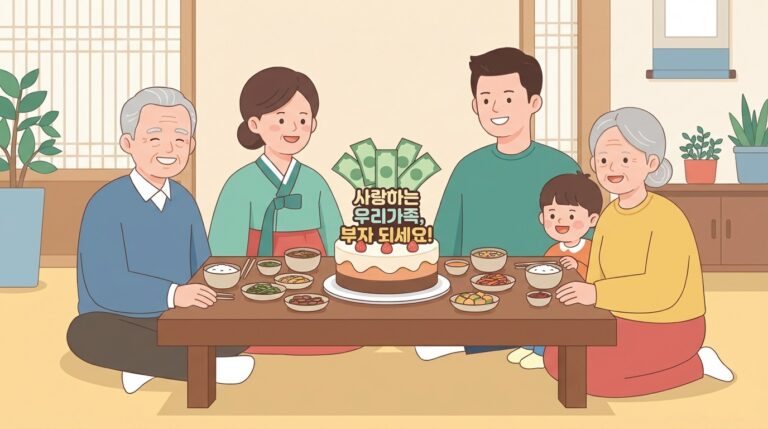
Phase 1: Empathy (Welcome to the Family Milestone Banquet!)
안녕하세요! 매일한글 에디터입니다. (Hello! I’m your Daily Hangul editor.)
Picture this: You are invited to an upscale Hanjeongsik (한정식, traditional Korean multi-course banquet) restaurant in Seoul with your Korean partner or close friends. As you slide open the elegant wooden door of the private room, the vibe is buzzing with energy. There’s a stunning custom-designed cake on the table, floral centerpieces, and an ornate topper that looks like a mini work of art. But wait—suddenly, the guest of honor pulls on the topper, and a long ribbon of crisp 50,000-won bills starts unfurling from inside the cake! Everyone bursts into applause, chanting and cheering, and then someone turns to you with a warm smile: “Say a few words for mother’s 60th!”
Your heart skips a beat. You know “생일 축하해요” (Happy birthday), but something in your gut whispers: Is that respectful enough for this historic family milestone?
Take a deep breath! Many of our intermediate learners encounter this exact dilemma when attending a Korean parent’s Hwangap (환갑, 60th birthday) or Chilsun (칠순, 70th birthday). Milestone birthdays in Korea are not just casual parties—they are heartfelt celebrations of resilience, family devotion, and the start of a golden new era. In this guide, you will master the exact native expressions, modern gift trends (like cash cakes and filial piety trips), and essential body manners so you can celebrate Korean parents with confidence and charm.
Phase 2: Core Expressions in-Depth
Here are three essential expressions tailored for intermediate learners that strike the sweet spot between deep respect and heartwarming warmth.
1. 인생은 육십부터예요! (Insaeng-eun yukship-buteoyeyo!)
- Pronunciation: [In-saeng-eun yuk-sip-boo-teo-ye-yo] (Think: “In-sang” + “Yuk” like yuck but soft + “ship” + “boo-tuh-ye-yo”)
- Meaning: Literal: “Life starts at sixty!” vs Nuance: “60 is the new 20! Your most vibrant and exciting chapter begins right now.”
- K-Culture Moment: This cheerful slogan is commonly piped in elegant icing on custom lettering cakes (레터링 케이크) or printed on celebration banners hung across restaurant private dining rooms.
- Editor’s Insight: Historically, turning 60 was an incredible rarity, so Hwangap was treated as a solemn thanksgiving feast. Today, 60-year-olds are youthful, healthy, and stylish! Saying this shows you honor their milestone while complimenting their youthful energy.
- Situation Spectrum: Casual (⚠️ – too informal if spoken without polite endings), Semi-formal (✅ – ideal for banquets with extended family), Formal (⚠️ – for an official stage toast, upgrade to: “인생은 육십부터라고 합니다”).
- 🤔 Think About It: In many Western contexts, turning 60 or 70 is met with “over the hill” jokes. Why do you think Korean culture balances playful energy with profound filial honor here?
2. 오래오래 건강하세요. (Orae-orae geongang-haseyo.)
- Pronunciation: [Oh-rae-oh-rae geon-gang-ha-se-yo] (Think: “Oh-ray, oh-ray” + “gun-gahng-ha-seh-yo”)
- Meaning: Literal: “Please be healthy for a long, long time.” vs Nuance: “Wishing you lasting health, vitality, and abundant longevity.”
- K-Culture Moment: Heard during the tear-jerking parent tribute scenes in beloved K-dramas like Reply 1988 and My Mister, usually accompanied by a warm embrace or a deep bow.
- Editor’s Insight: In Korean, duplicating an adverb like orae (long) into orae-orae (오래오래) adds an extra layer of tenderness and deep wishing. In Korean culture, health (geongang) is always prioritized as the highest blessing an elder can receive.
- Situation Spectrum: Casual (🚫 – never drop honorifics when wishing health to an elder), Semi-formal (✅ – quintessential card inscription & spoken wish), Formal (✅ – “오래오래 건강하십시오”).
- 🤔 Think About It: Why does Korean etiquette consider wishing for an elder’s health more profound than simply wishing for wealth or good luck?
3. 키워 주셔서 진심으로 감사드려요. (Kiwo jusyeoseo jinsim-euro gamsa-deuryeoyo.)
- Pronunciation: [Kee-wo joo-syeo-seo jin-sim-oo-ro gahm-sa-deu-ryeo-yo] (Think: “Key-war joo-shuh-suh” + “jean-seem-oo-ro” + “gahm-sah-deu-ryuh-yo”)
- Meaning: Literal: “Thank you sincerely for raising me.” vs Nuance: “From the bottom of my heart, thank you for all your sacrifices, guidance, and endless love.”
- K-Culture Moment: Spoken right before presenting the grand gift of the evening—whether it is a plane ticket envelope for a hyodo tour (filial piety vacation abroad) or the custom money box.
- Editor’s Insight: This sentence combines the benefactive honorific verb jusida (주시다, to give) with gamsa-deurida (감사드리다, to humbly offer thanks). It directly acknowledges the hardships parents went through.
- Situation Spectrum: Casual (🚫), Semi-formal (✅), Formal (✅).
- 🤔 Think About It: How does your native language express gratitude for parental devotion? Does it focus on gratitude for specific actions, or the holistic journey of raising you?
Phase 3: Textbook Korean vs. Real-World Korean
Intermediate learners often memorize stiff textbook phrases that sound like formal government speeches. Let’s see how native speakers modernize their milestone party greetings!
Situation 1: Congratulating Parents on their 60th / 70th Birthday
- 📖 교과서 한국어: 환갑을 진심으로 축하드립니다. 건강하시기를 기원합니다.
(Hwangap-eul jinsim-euro chukha-deurimnida. Geongang-hasigireul giwonhamnida. / I sincerely congratulate you on your 60th birthday and pray for your health.) - 🗣️ 진짜 한국어: 환갑 축하드려요! 앞으로 꽃길만 걸으세요!
(Hwangap chukha-deuryeoyo! Apeuro kkot-gil-man georeuseyo! / Happy 60th birthday! May your road ahead be paved only with flowers!) - 💡 왜 다를까?: While the textbook expression is grammatically flawless, modern families love the trendy, affectionate poetic idiom kkot-gil-man geotda (꽃길만 걷다, to walk only on flower paths), which brings warmth and youthful delight to the table.
Situation 2: Presenting the Birthday Gift or Cash Box
- 📖 교과서 한국어: 이 돈을 생일 축하 선물로 드립니다. 받으십시오.
(I don-eul saeng-il chukha seonmul-lo deurimnida. Badeusipsio. / I give you this money as a birthday gift. Please receive it.) - 🗣️ 진짜 한국어: 약소하지만 기분 좋게 써 주세요! 저희 마음이에요.
(Yakso-hajiman gibun joke sseo juseyo! Jeohui maeum-ieyo. / It is a modest token, but please enjoy spending it! It comes straight from our hearts.) - 💡 왜 다를까?: In Korean culture, directly announcing “Here is money” feels overly transactional. Natives use humble etiquette like yakso-hajiman (modest/small though it is) and focus on the sentiment (jeohui maeum-ieyo).
Phase 4: K-Culture Deep Dive & Non-Verbal Manners
4-1. Nunchi & Non-Verbal Manners at the Banquet
- The Two-Hand Rule (Du Son, 두 손): Whether you are handing the cash envelope, passing the cake-cutting knife, or pouring roasted corn tea (oksusu-cha), always use two hands! Alternatively, place your left hand lightly under your right forearm to show respect.
- Seating Etiquette (Sangseok, 상석): In a traditional Hanjeongsik private room, never pick a seat first. The seat farthest from the entrance door facing into the room is the seat of honor (sangseok), reserved exclusively for the parents.
- Clinking Glasses: When toasting the parents, hold your glass with both hands and make sure the rim of your glass touches slightly below the rim of the parent’s glass.
4-2. The Cultural Phenomenon: Modern Cash Culture & Hyodo Tours
Why are custom lettering cakes and cash toppers everywhere in modern Korea? In the past, children threw massive community banquets with traditional musicians. In today’s nuclear families, this has evolved into private boutique dinners paired with playful luxury:
* The Money-Pull Cake (Banjeon Cake, 반전 케이크): A cake equipped with a hidden inner roll where 50,000-won bills follow the message topper as it’s pulled up. It adds viral, hilarious fun while fulfilling the #1 gift Korean parents secretly prefer: cold, hard cash (hyeongeum).
* Hyodo Tour (효도 여행): The ultimate gift for a 60th or 70th milestone is an all-expenses-paid overseas trip (often to destinations like Da Nang, Fukuoka, or Switzerland) booked by the adult children so parents can finally relax after decades of work.
Phase 5: Real-World Roleplay Scenario
Setting: A private dining room at a renowned Hanjeongsik restaurant in Insadong. Soft traditional instrumental gayageum music plays in the background. You are attending the 70th birthday (Chilsun) of your partner’s mother along with your partner, Minho.
Characters:
* 어머니 (Eomeoni): The lovely, humble mother celebrating her 70th milestone.
* 민호 (Minho): Your Korean partner.
* You (Learner): Attentive, thoughtful, and culturally prepared!
- 민호: 어머니, 칠순 정말 축하드려요! 오늘 식당 마음에 드세요?
(Eomeoni, chilsun jeongmal chukha-deuryeoyo! Oneul sikdang maeume deuseyo?)
“Mother, happy 70th birthday! Do you like the restaurant today?” -
어머니: 아이구, 이런 비싼 한정식집을 왜 예약했어? 그냥 집에서 먹지. 🎭 [손사래를 치며 환하게 미소 짓는다]
(Aigu, ireon bissan hanjeongsik-jibeul wae yeyak-haesseo? Geunyang jib-eseo meokji.)
“Goodness, why book such an expensive Hanjeongsik place? We could have just eaten at home!” 🎭 [Waves hands dismissively while beaming happily] -
학습자 (You): 어머니, 특별한 날이잖아요. 오늘 맛있게 드세요! 🎭 [두 손으로 따뜻한 둥굴레차를 따라 드리며]
(Eomeonim, teukbyeolhan narijanayo. Oneul masikke deuseyo!)
“Mother, it’s a special day! Please enjoy the delicious food today!” 🎭 [Pouring warm Solomon’s seal tea using both hands] -
어머니: 아이고, 고마워라. 우리 며느리/사위가 최고네! 🎭 [따뜻한 손길로 손을 토닥인다]
(Aigo, gomaweora. Uri myeoneuri/sawi-ga choegone!)
“Oh, thank you dear. My daughter/son-in-law is truly the best!” 🎭 [Gently pats your hand] -
민호: 자, 식사 다 마쳤으니 이제 오늘의 메인 이벤트 가야죠? 🎭 [상자에서 예쁜 레터링 떡케이크를 꺼낸다]
(Ja, siksa da machyeosseuni ije oneurui mein ibenteu gayajyo?)
“Alright, now that the meal is done, shall we move to today’s main event?” 🎭 [Takes a gorgeous lettering rice cake out of the box] -
어머니: 어머나, 케이크 위에 적힌 글씨 좀 봐. 이게 다 앙금이니? 🎭 [안경을 고쳐 쓰며 케이크를 바라본다]
(Eomeona, ke-ikeu wie jeokhin geulssi jom bwa. Ige da anggeum-ini?)
“Oh my goodness, look at the writing on the cake! Is this all made of sweet bean paste?” 🎭 [Adjusts glasses and admires the cake] -
학습자 (You): 어머니, 케이크 위에 있는 토퍼를 위로 쑥 당겨보세요. 인생은 칠순부터예요! 🎭 [미소 지으며 손짓으로 토퍼를 가리킨다]
(Eomeonim, ke-ikeu wie inneun topeo-reul wiro ssuk danggyeoboseyo. Insaeng-eun chilsun-buteoyeyo!)
“Mother, pull that topper on the cake straight up. Life begins at seventy!” 🎭 [Smiling and gesturing gently toward the topper] -
어머니: 어머 세상에! 돈이 끝도 없이 나오네! 호호호! 얘들아, 고맙다! 🎭 [놀라서 입을 가리며 함박웃음을 터뜨린다]
(Eomeo sesang-e! Doni kkeutdo eopsi naone! Hohoho! Yaedeura, gomapda!)
“Oh heavens! Money is popping out without end! Hahaha! Children, thank you so much!” 🎭 [Covers her mouth in surprise and bursts into pure laughter]
🔀 Interactive Decision Branching
What would you say next as she pulls the cash roll out?
- Option A: “어머니, 이거 가지고 다음 달에 저희랑 다낭 여행 가서 맛있는 거 많이 드세요!” (Mother, use this to treat yourself when we go to Da Nang together next month!)
👉 Feedback [BEST]: Phenomenal! You connect the cash gift to the upcoming family holiday (hyodo tour), showing thoughtfulness, excitement, and filial care. - Option B: “얼마 안 되지만 그냥 받으세요.” (It’s not much, just take it.)
👉 Feedback [BAD]: Too blunt and emotionally flat. It deflates the celebratory, joyful atmosphere of the room. - Option C: “돈이 최고죠? 어머니도 돈이 제일 좋으시죠? 하하!” (Money is the best, right? You love cash the most too, right? Haha!)
👉 Feedback [RISK]: Risky banter! While friends might laugh, traditional elders might feel slightly embarrassed or feel that it trivializes the emotional bond.
Phase 6: 10-Second Emotion Shadowing Drill
Repeat these sentences out loud, paying close attention to the emotional inflection and natural pauses indicated by the slash marks (/).
- Drill 1: [😊 기쁘고 활기차게 – Bright & Joyous]
인생은 / 칠순부터! / 건강하고 / 행복하세요!
(Insaeng-eun / chilsun-buteo! / Geongang-hago / haengbok-haseyo!)
“Life begins / at seventy! / Please stay healthy / and happy!” -
Drill 2: [🥺 진심 어린 감동을 담아 – Deeply Heartfelt & Tender]
키워 주셔서 / 진심으로 감사드려요, / 어머니!
(Kiwo jusyeoseo / jinsim-euro gamsa-deuryeoyo, / eomeonim!)
“Thank you so much / from the bottom of my heart for raising me, / Mother!” -
Drill 3: [🎉 장난스럽고 신나게 – Playful & Excited]
토퍼를 / 위로 쑥 당겨보세요, / 대박 선물이 / 나와요!
(Topeo-reul / wiro ssuk danggyeoboseyo, / daebak seonmuri / nawayo!)
“Pull the topper / straight up, / an awesome surprise / will pop out!”
Phase 7: K-Culture Mini Dictionary
-
환갑 (Hwangap)
Meaning: 60th Birthday Milestone.
Context: Based on the Asian 60-year sexagenary cycle (ganji), turning 60 means you have completed an entire astrological cycle and have returned to your birth zodiac. Today, it symbolizes an active second youth. -
칠순 (Chilsun)
Meaning: 70th Birthday Milestone (also classically called Gohi, 고희).
Context: As life expectancy has risen beyond 80 in South Korea, Chilsun has replaced Hwangap as the main grand milestone requiring private dining banquet reservations. -
용돈 토퍼 (Yongdon Topper)
Meaning: Money Cake Topper.
Context: A creative decorative stick placed on cakes that, when pulled, extracts a connected chain of transparent vinyl pouches containing banknotes hidden inside the cake sponge. -
효도 여행 (Hyodo Yeohaeng)
Meaning: Filial Piety Vacation.
Context: An overseas or luxury domestic vacation planned, arranged, and financed entirely by adult children as an offering of devotion to their aging parents.
Phase 8: Traveler’s Survival Kit
Top 3 Survival Phrases for Celebration Dining
-
예약자 이름은 [이름]이고 조용한 룸으로 부탁드렸어요.
(Yeyakja ireum-eun [Name]-igo joyonghan rum-euro butak-deuryeosseoyo.)
Translation: “The reservation is under [Name], and we requested a quiet private room.”
Pro Tip: Essential when arriving at bustling Hanjeongsik spots in Insadong, Samcheong-dong, or Gangnam. -
가져온 케이크를 식사 끝날 때까지 냉장 보관해 주실 수 있나요?
(Gajyeoon ke-ikeu-reul siksa kkeunnal ttaekkaji naengjang bogwanhae jusil su innayo?)
Translation: “Could you store our cake in the refrigerator until the end of our meal?”
Pro Tip: Hanjeongsik course dining takes 1.5 to 2 hours. Delicate lettering cakes or rice cakes can melt or spoil at room temperature; the staff will gladly chill them for you. -
가족사진 한 장만 찍어 주실 수 있나요?
(Gajok-sajin han jang-man jjigeo jusil su innayo?)
Translation: “Could you take a quick family photo for us?”
Pro Tip: Waitstaff at celebratory restaurants are master photographers who will position everyone around the cake and custom banners perfectly.
Editor’s Travel Note
- Booking Hanjeongsik: To reserve high-end private rooms with multi-course traditional cuisine without needing a domestic phone number, check out the CatchTable reservation app guide. Filter by “private room” (rum) and “family gathering” (gajok moim).
- Navigation: Always verify room ambiance and parking availability using the Naver Map navigation tool.
- Paying the Bill Etiquette: Children never calculate the bill in front of the parents. One child quietly slips out to the reception desk during the final dessert tea course to settle the payment before the parents can even reach for their purses!
Phase 9: One Step Deeper (Cultural Reflection)
In Western individualist cultures, celebrating a milestone birthday often centers on personal achievements, wild parties, or self-pampering. In South Korea, however, a parent’s 60th or 70th birthday is an embodiment of Hyo (효, Filial Piety)—a shared collective rite of passage. Through hours of shared dining across ceramic course dishes, creative money-reveal novelties, and joint family travel funds, Korean children engage in a symbolic repayment of the tireless, invisible sacrifices their parents made to build their futures. Honoring an elder isn’t merely counting years; it is restoring their youth through family unity.
💬 Your Turn: How does your home culture commemorate parents’ milestone birthdays? Do you favor physical keepsakes, experiences, or fun surprise ceremonies like money cakes? Let us know in the comments below!
Phase 10: FAQ & Common Pitfalls
Q: Is giving cash directly considered impersonal or rude in Korean culture?
A: Not at all! In fact, surveys consistently show that cash (hyeongeum, 현금) is voted the absolute #1 most desired gift by Korean parents. However, handing over loose, bare banknotes is considered poor manners. Cash must always be presented elegantly—inside a formal silk envelope, a decorative flower box (yongdon box), or disguised inside a surprise lettering cake!
Q: What is the exact difference between Hwangap and Chilsun?
A: Hwangap (환갑) celebrates the 60th birthday (turning 61 in traditional Korean age reckoning), marking the completion of the 60-year zodiac calendar. Chilsun (칠순) is the 70th birthday. While Hwangap was once the grandest party in ancient times due to shorter lifespans, today people live well past 80. As a result, Hwangap is often celebrated with a chic dinner and family trip, while Chilsun receives the grander formal banquet treatment.
Q: Can I just say “생일 축하해요” (Saeng-il chukha-haeyo) to the parents?
A: It’s best to avoid it! “생일” (Saeng-il) is the standard word for birthday, but when addressing elders, Korean demands the honorific term 생신 (Saengsin). Always say: “생신 축하드려요!” (Saengsin chukha-deuryeoyo!) or “환갑/칠순 축하드립니다!” (Hwangap/Chilsun chukha-deurimnida!).
🚨 Common Mistakes Alert
- Saying “생일 축하해요” instead of “생신 축하드려요”: Forgetting to use the honorific word saengsin can make you sound unrefined.
- Handing gifts or pouring drinks with one hand: Always use both hands (du son) as a golden rule of respect around elders.
- Starting to eat before the elders pick up their spoons: At a Hanjeongsik table, wait until the birthday parents pick up their cutlery and taste the first bite before you begin.
Phase 11: Action Missions
- 🥉 Bronze Mission (Solo Shadowing): Stand in front of your mirror and practice Drill 1 from Phase 6 three times with a bright, beaming smile: “인생은 칠순부터! 오래오래 건강하세요!”
- 🥈 Silver Mission (Social Discovery): Go to Instagram or TikTok and search the hashtag
#환갑케이크or#용돈토퍼. Find a creative money cake video and write a comment in Korean: “정말 멋져요! 부모님이 정말 좋아하셨겠어요!” (So wonderful! The parents must have loved it!) - 🥇 Gold Mission (Real-Life Application): The next time you give a gift or card to an elder or respected colleague, practice handing it over using both hands while slightly bowing your head.
- 🎮 K-Culture Mission: Watch an episode of a weekend Korean family drama (such as Once Again or Father is Strange). Can you spot how the family behaves when gathered at a milestone meal table?
Phase 12: Interactive Quiz Challenge
Test your cultural and linguistic savvy! Pick your answers, then tap the toggle below to reveal the solutions.
1. [Situational Judgment] You are attending your Korean partner’s father’s 60th birthday dinner at a Hanjeongsik restaurant. Which of the following actions is the most culturally appropriate?
* A) Take the seat farthest from the door immediately so you don’t block anyone.
* B) Clink your glass so that the rim is slightly lower than his, using both hands.
* C) Hand him an unwrapped stack of 50,000-won bills with one hand saying “생일 축하해”.
2. [Fill-in-the-Blank] Complete the modern celebratory greeting:
* “어머니, 칠순 축하드려요! 앞으로 ________ 걸으세요!”
(Mother, happy 70th birthday! In the future, please walk only on flower paths!)
3. [True / False] In modern South Korea, because average life expectancy is high, 60th birthdays (Hwangap) are often celebrated with fun slogans like “인생은 육십부터” (Life begins at sixty) alongside cash cakes and overseas trips instead of somber elderly feasts.
* [ True / False ]
👉 Click here to check the answers and explanations!
- 1. Answer: B
Explanation: Lowering your glass slightly when toasting an elder and using both hands is peak Korean dining etiquette. Seating yourself first at the inner seat (seat of honor) or handing bare cash with one hand are major etiquette missteps. - 2. Answer: 꽃길만 (kkot-gil-man)
Explanation: The full idiom is “꽃길만 걸으세요” (Walk only on paths of flowers), wishing someone an easy, joyous, and blossoming journey ahead. - 3. Answer: True
Explanation: Exactly! 60 is viewed as a youthful prime today, so modern Koreans blend humor, stylish lettering cakes, and overseas family travel rather than holding solemn old-age gatherings.







