

Phase 1: 공감 (Story-driven Opening)
안녕하세요! 매일한글 에디터입니다.
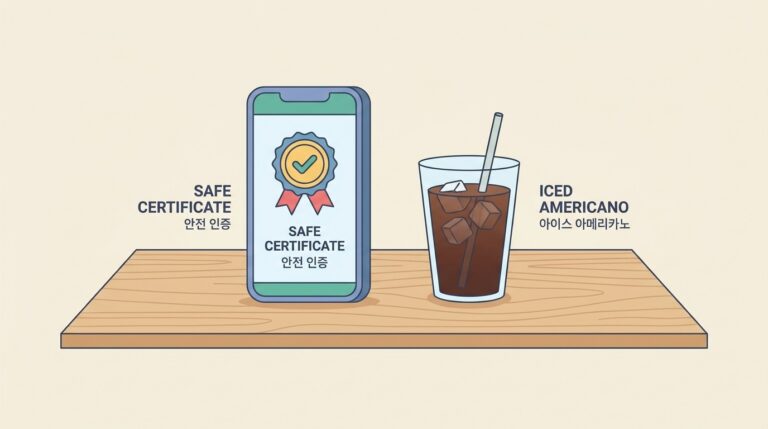
Imagine this: You have just moved into your new apartment in Seoul or landed for a long-term language program. You are sitting at a cozy local café, iced americano in hand, feeling like the main lead of a trendy slice-of-life K-Drama. Then comes the moment of truth: you need to pay for utilities, split the BBQ dinner bill with classmates, or shop online. Your Korean friend smiles and says, “Just send it to my account via the bank app!”
You confidently open your phone, download the bank app, and… BAM. You are confronted with a mountain of unfamiliar words: 인증서 (Certificate), 본인확인 (Identity Verification), 비밀번호 설정 (PIN Setup). Your heartbeat speeds up. Did you click the wrong button? Why is there an error pop-up? Is your money safe?
You are definitely not alone. Over the past ten years at Daily Hangul, mobile banking registration has consistently been voted the #1 administrative hurdle by beginner and elementary learners. Setting up your mobile certificate (모바일 인증서) isn’t just about tapping a screen—it’s your master key to navigating modern Korean life with zero stress. Today, we will walk through the exact phrases and cultural nuances you need so you can say, “I installed the bank app and issued my certificate!” with pure confidence.
Phase 2: 핵심 표현 3선 심층 분석 (Top 3 Essential Expressions)
1. 앱을 설치했어요 (Aebeul seolchihaesseoyo)
- Pronunciation: [Aebeul seol-chi-hae-sseo-yo] (Sounds like: “App-ul soul-chee-hae-so-yo”)
- Meaning: “I installed the app.” (Literal: App + installed).
- K-Culture Moment: In K-Dramas like Work Later, Drink Now, whenever friends introduce a new convenience or taxi app, you will hear someone proudly announce they’ve downloaded it using this sentence.
- Editor’s Insight: ‘설치하다’ (seolchihada) comes from Sino-Korean roots (設: establish, 置: place). While it sounds formal, it is the standard phrase for downloading software on phones and PCs.
- Situation Spectrum: Casual ⚠️ | Semi-formal ✅ | Formal ✅
- 🤔 Think About It: Notice how Koreans combine English loanwords like ‘앱 (app)’ with traditional Sino-Korean verbs like ‘설치하다’. Does your mother tongue blend technical loanwords this way?
2. 모바일 인증서를 발급받았어요 (Mobail injeungseoreul balgeupbadasseoyo)
- Pronunciation: [Mo-ba-il in-jeung-seo-reul bal-geup-ba-da-sseo-yo] (Sounds like: “Mo-bah-eel in-jeong-suh-rul bahl-geup-bah-dah-so-yo”)
- Meaning: “I got my mobile certificate issued.” (Literal: Mobile certificate + issuance received).
- K-Culture Moment: The moment an expat or foreign student posts a celebratory screenshot in KakaoTalk group chats after finally overcoming Korean digital bureaucracy!
- Editor’s Insight: ‘발급받다’ (balgeupbatda) combines ‘발급’ (issue) with ‘받다’ (to receive). In Korean, when an official authority grants you a document or credential, you always “receive an issuance.”
- Situation Spectrum: Casual ⚠️ | Semi-formal ✅ | Formal ✅
- 🤔 Think About It: In many Western countries, identity verification is tied to email or two-factor SMS. Why do you think Korea developed a centralized “certificate” system for banking?
3. 본인 확인을 해야 돼요 (Bonin hwagineul haeya dwaeyo)
- Pronunciation: [Bo-nin hwa-gi-neul hae-ya dwae-yo] (Sounds like: “Boh-neen hwah-gee-nul hae-yah dway-yo”)
- Meaning: “You need to verify your identity.” (Literal: In-person identity confirmation + must do).
- K-Culture Moment: Every time you see a Korean YouTuber or streamer blur their screen while squinting at an incoming 6-digit text message code.
- Editor’s Insight: ‘본인’ (bonin) specifically refers to “oneself in person.” The structure ‘-해야 돼요’ (-haeya dwaeyo) means “must do” or “have to do” in everyday conversational Korean.
- Situation Spectrum: Casual ⚠️ | Semi-formal ✅ | Formal ✅
- 🤔 Think About It: Korea treats phone numbers as legal proof of identity. How does this compare to how legal identities are confirmed in your country?
Phase 3: 교과서 한국어 vs 진짜 한국어 (Textbook vs Real Korean)
Situation 1: Talking about installing the banking app
- 📖 교과서 한국어 (Textbook): 스마트폰 애플리케이션 설치가 완료되었습니까? (Seumateupon aepeullikeisyeon seolchiga wanryodoeeossseumnikka? – Has the smartphone application installation completed?)
- 🗣️ 진짜 한국어 (Real Life): 은행 앱 깔았어요? (Eunhaeng aep kkarasseoyo? – Did you install/download the bank app?)
- 💡 왜 다를까? (Why the difference?): While textbooks use stiff technical terms, native speakers use the vivid verb 깔다 (kkalda), which literally means “to lay down a carpet or mattress,” as natural slang for installing software.
Situation 2: Explaining that you completed verification
- 📖 교과서 한국어 (Textbook): 본인 명의의 휴대전화로 인증 절차를 거쳤습니다. (Bonin myeong-uiui hyudaejeonhwaro injeung jeolchareul geochyeossseumnida. – I underwent the certification process through a mobile phone registered in my name.)
- 🗣️ 진짜 한국어 (Real Life): 핸드폰으로 본인인증 했어요. (Haendeuponeuro bonininjeung haesseoyo. – I verified my identity with my phone.)
- 💡 왜 다를까? (Why the difference?): In everyday speech, Koreans combine words into concise compounds like 본인인증 (identity verification) and use simple light verbs like 하다 (to do).
Phase 4: K-Culture 딥다이브 & 비언어적 매너 (Deep Dive & Manners)
4-1. 눈치 (Nunchi) & Screen Gestures
When seeking assistance from a bank teller or a Korean friend with your banking app:
* Two-Hand Hold: Always hold your phone with both hands when handing it or showing the screen to a bank clerk or elder. It displays respect and attentive care.
* 45-Degree Angle: Never shove your phone directly into someone’s face. Place it flat on the desk or tilt it politely at a 45-degree angle.
* Attentive Nodding: When a teller explains security steps, nod rhythmically while saying “네, 네” (Ne, ne). Total silence makes them wonder if the app screen crashed or if you did not understand.
4-2. Culture Code: The “Palli-Palli” Fintech Revolution
Korea is one of the world’s fastest cashless societies. In the past, Koreans struggled with bulky desktop certificates called 공동인증서 (Gongdong injeungseo). Today, thanks to fintech innovation seen in apps like KakaoBank and Toss, modern 모바일 금융인증서 (Mobile Financial Certificates) allow money transfers in under five seconds with just facial recognition or a 6-digit PIN. Being mobile-banking literate is considered an everyday adult survival skill in modern Korea.
Phase 5: 실전 롤플레이 시나리오 (Real-Life Roleplay)
Setting: A quiet café near Hongdae. Alex, an international student, is trying to activate mobile banking. Minji, an experienced Korean classmate, is helping him step by step.
- Turn 1 (Alex): 민지 씨, 은행 앱을 설치했어요. 다음엔 뭐 해요? (Minji ssi, eunhaeng aebeul seolchihaesseoyo. Daeumen mwo haeyo?) 🎭 [Alex taps his screen and shows it to Minji with both hands] “Minji, I installed the bank app. What do I do next?”
- Turn 2 (Minji): 먼저 모바일 인증서를 발급받아야 돼요. 여기 누르세요. (Meonjeo mobail injeungseoreul balgeupbadaya dwaeyo. Yeogi nureuseyo.) 🎭 [Minji points gently to the primary blue button on the display] “First, you need to issue a mobile certificate. Tap right here.”
- Turn 3 (Alex): 화면에 ‘본인 확인’이라고 나와요. (Hwameone ‘bonin hwagin’irago nawayo.) 🎭 [Alex furrows his brow, squinting at the Korean text] “It says ‘Identity Verification’ on the screen.”
- Turn 4 (Minji): 외국인등록증에 있는 이름 그대로 입력하세요. 띄어쓰기도 중요해요! (Oeguk-indeungrokjeung-e inneun ireum geudaero imnyeokhaseyo. Ttieosseugido jung-yohaeyo!) 🎭 [Minji gestures emphasizing exact spacing] “Enter your name exactly as it appears on your Alien Registration Card. Spacing matters a lot!”
- Turn 5 (Alex): 휴대전화로 인증번호가 왔어요. 입력할게요. (Hyudaejeonhwaro injeungbeonhoga wasseoyo. Imnyeokhalkkeyo.) 🎭 [Alex checks the SMS alert and quickly types 6 digits] “The verification code arrived on my phone. I’ll enter it.”
- Turn 6 (Minji): 잘했어요! 이제 간편 비밀번호 여섯 자리를 설정하세요. (Jalhaesseoyo! Ije ganpyeon bimilbeonho yeoseot jarireul seoljeonghaseyo.) 🎭 [Minji smiles and nods approvingly] “Great job! Now set up a 6-digit simple PIN.”
- Turn 7 (Alex): 와, 인증서 발급이 끝났어요! 진짜 편하네요. (Wa, injeungseo balgeubi kkeutnasseoyo! Jinjja pyeonhaneyo.) 🎭 [Alex gasps with a huge relieved smile] “Wow, the certificate issuance is finished! This is really convenient.”
- Turn 8 (Minji): 축하해요! 이제 스마트폰으로 바로 계좌이체 할 수 있어요. (Chukahahae-yo! Ije seumateuponeuro baro gyejwa-iche hal su isseoyo.) 🎭 [Minji gives a double thumbs-up] “Congratulations! Now you can do instant bank transfers directly from your smartphone.”
🔀 인터랙티브 분기점 (Interactive Fork)
Imagine Alex’s phone suddenly vibrates and shows a red warning pop-up: [본인 인증 실패] (Identity Verification Failed). What should Alex say to Minji?
- Choice A: “이거 고장 났어요! 은행 앱이 이상해요!” (Igeo gojang nasseoyo! Eunhaeng aebi isanghaeyo!)
- ⚠️ Risk: Blaming the technology or shouting that the app is “broken” sounds impatient and avoids checking common personal input mistakes.
- Choice B: “민지 씨, 이름 띄어쓰기나 통신사를 다시 확인해 볼까요?” (Minji ssi, ireum ttieosseugina tongsinsareul dasi hwaginhae bolkkayo?)
- ✅ Best: Calm, proactive, and polite. It targets the most common failure point (name format and phone carrier).
- Choice C: “안 되네요. 그냥 포기하고 은행 창구로 갈게요.” (An doeneyo. Geunyang pogihago eunhaeng chang-guro galkkeyo.)
- 🚫 Bad: Giving up instantly means waiting in long bank lines for an issue easily fixed in 10 seconds.
Phase 6: 10초 감정 섀도잉 드릴 (10-Second Emotion Shadowing Drill)
Practice reading these out loud. Pay attention to the pauses marked with / and channel the emotion listed inside the brackets!
[😊 Proud and Accomplished]
스마트폰에 / 은행 앱을 설치했어요!
(Seumateupone / eunhaeng aebeul / seolchihaesseoyo!)
“I installed the bank app / on my smartphone!”-
[🤔 Focused and Serious]
모바일 인증서를 / 발급받으려면 / 본인 확인이 필요해요.
(Mobail injeungseoreul / balgeupbadeuryeomyeon / bonin hwagini / piryohaeyo.)
“To issue a mobile certificate, / identity verification / is necessary.” -
[🎉 Relieved and Excited]
인증번호 입력하니까 / 한 번에 끝났어요!
(Injeungbeonho imnyeokanikka / han beone / kkeutnasseoyo!)
“Once I entered the verification code, / it finished / in one go!”
Phase 7: K-Culture 미니 사전 (Mini Dictionary)
- 인증번호 (Injeungbeonho) | Verification Code
- Meaning: The one-time 6-digit security PIN sent via SMS for logging in or signing approvals.
- 계좌번호 (Gyejwabeonho) | Bank Account Number
- Meaning: Your unique bank account number needed for receiving paychecks or sending transfers.
- 간편 비밀번호 (Ganpyeon bimilbeonho) | Simple PIN / Quick Password
- Meaning: A customized 6-digit numeric passcode used inside banking apps to authorize transfers instantly without physical security cards.
- 발급 (Balgeup) | Issuance
- Meaning: The official release or generation of a certificate, card, or formal digital license.
Phase 8: 여행자를 위한 생존 키트 (Traveler’s & Expat’s Survival Kit)
Top 3 Survival Phrases
- 영어 메뉴로 바꿀 수 있어요? (Yeong-eo menyuro bakkul su isseoyo?)
- “Can I switch this to the English menu?”
- Pro Tip: Look for the globe icon or “Language / 언어 설정” at the top right of most major Korean banking apps.
- 본인인증 문자가 안 와요. (Bonininjeung munjaga an wayo.)
- “The identity verification text is not arriving.”
- Pro Tip: Double-check if your phone plan is registered under your passport name or your Alien Registration Card name.
- 인증서 비밀번호를 재설정하고 싶어요. (Injeungseo bimilbeonhoreul jaeseoljeonghago sipeoyo.)
- “I would like to reset my certificate password.”
- Pro Tip: If you enter the wrong PIN 5 times, you must click “재설정 (Reset)” and verify your ID again.
Editor’s Travel Note
Before heading to a physical branch, we strongly suggest preparing your phone by downloading the [official Hana 1Q Global App download] or checking the Shinhan SOL Global banking tools. Make sure your local Korean SIM card accepts incoming SMS verification texts, as travel data-only eSIMs will block security SMS codes!
Phase 9: “한 발 더 깊이” (Cultural Essay)
In Korea, your mobile phone is much more than a gadget for texting and social media—it is your legal digital seal (인감도장). Because Korea built one of the world’s most tightly integrated telecommunication and banking networks, your identity is linked directly to your telecom carrier and bank account. While this creates a strict registration process for foreigners at first, it also guarantees unmatched protection against banking fraud. When you issue your mobile certificate, you are truly stepping inside the digital fabric of Korean society.
💬 Your Turn: Have you ever experienced mobile verification in Korea or another country? What was the hardest part? Leave a comment below and share your experience with fellow learners!
Phase 10: FAQ & 흔한 실수 (FAQ & Common Mistakes)
Q: Can I issue a mobile certificate using a tourist SIM card?
A: No. You must have a postpaid or prepaid SIM card officially registered under your legal name (tied to your Alien Registration Card or verified passport with a telecom carrier). Data-only roaming eSIMs cannot pass telecom identity checks.
Q: Why does the app keep saying my name does not match?
A: Korean verification systems are case-sensitive and spacing-sensitive. If your Alien Registration Card lists DOE JOHN MICHAEL, typing John Doe will fail. Always match the exact capital letters and spacing on your physical card.
Q: How long is a mobile banking certificate valid?
A: Most modern mobile financial certificates (금융인증서) remain valid for 3 years and renew automatically with a single tap inside your app.
🚨 흔한 실수 (Common Mistakes Alert)
- Selecting the wrong Mobile Carrier (통신사): Choosing “SKT” when you actually use an MVNO budget carrier (알뜰폰 SKT 망). Correct Action: Always check if your SIM is an “알뜰폰 (Budget Phone)” carrier!
- Name Order Reversal: Writing First Name first instead of Last Name. Correct Action: Follow the ARC order: LAST NAME FIRST NAME MIDDLE NAME.
- Forgetting the Simple PIN: Mixing up your 4-digit ATM card PIN with your 6-digit app banking PIN. Correct Action: Write down which is which in a secure password manager.
Phase 11: 액션 미션 (Action Missions)
- 🥉 Bronze Mission (Solo Practice): Read the Phase 6 shadowing sentences out loud three times while looking in the mirror.
- 🥈 Silver Mission (Social Challenge): Take a screenshot of your banking app icon or language setting and post a story with the caption: “스마트폰에 은행 앱을 설치했어요! #매일한글 #DailyHangul”
- 🥇 Gold Mission (Real-Life Mastery): Successfully log into your mobile banking app, navigate to the settings menu, and verify that your certificate status displays [발급 완료 (Issuance Complete)].
- 🎮 K-Culture Mission: Watch an episode of a modern office K-Drama (like Misaeng or Start-Up) and listen for words like 확인 (Confirmation) or 비밀번호 (PIN).
Phase 12: 인터랙티브 퀴즈 챌린지 (Interactive Quiz)
1. Situation Challenge: What should you say if you want to tell your coworker that you already finished downloading the bank application?
* ① 은행 앱을 삭제했어요. (Eunhaeng aebeul sakjeehaesseoyo.)
* ② 은행 앱을 설치했어요. (Eunhaeng aebeul seolchihaesseoyo.)
* ③ 은행 계좌를 닫았어요. (Eunhaeng gyejwareul dadasseoyo.)
2. Fill in the Blank:
모바일 _________를 발급받았어요. (I got my mobile certificate issued.)
* (A) 영수증 (Yeongsujeung)
* (B) 인증서 (Injeungseo)
* (C) 지도 (Jido)
3. True or False: In Korea, you can type your name with any spacing you like during mobile phone identity verification.
* True / False
👉 Click to reveal answers & explanations!
- Question 1 Answer: ② 은행 앱을 설치했어요.
- Explanation: ‘설치했어요’ means installed. (① means deleted; ③ means closed an account).
- Question 2 Answer: (B) 인증서 (Injeungseo).
- Explanation: ‘인증서’ means certificate. (영수증 = receipt, 지도 = map).
- Question 3 Answer: False.
- Explanation: Name spacing must match your registered Alien Registration Card character-for-character, or identity verification will fail!
- Explanation: Name spacing must match your registered Alien Registration Card character-for-character, or identity verification will fail!







