

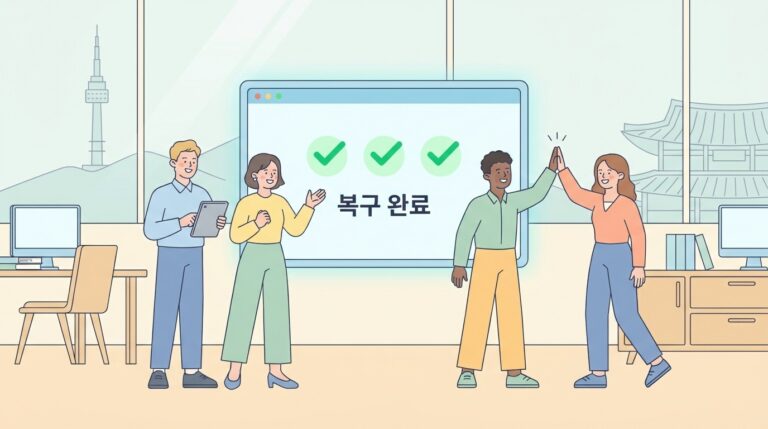
Phase 1: Empathy – When 40 Minutes Feels Like 40 Days in Seoul
안녕하세요! 매일한글 에디터입니다. (Hello! It’s your Daily Hangul editor.)
Picture this: It’s 7:30 PM on a buzzing Friday in Gangnam. Thousands of hungry Seoulites are trying to order late-night fried chicken on their food delivery apps, while others are scrambling to grab last-minute weekend concert tickets. Suddenly, the dreaded spinning wheel of death appears. Server 500 Error! If you’ve ever watched the tech-startup K-Drama Start-Up (스타트업), you can instantly visualize the developer team screaming into their iced Americanos while Slack notifications explode into chaos.
In South Korea’s hyper-connected, ultra-fast “Ppalli-Ppalli” (빨리빨리, hurry-hurry) culture, digital downtime is practically a national emergency. But here is the good news: thanks to your team’s superhero-level debugging, all systems are fully restored in just 40 minutes! Now comes the crucial step: how do you announce the recovery without sounding robotic or dismissive? How do you say, “We are back, we are truly sorry, and here is a discount coupon on us” in polished, natural Korean?
Posting an outage recovery notice isn’t just about technical jargon; it’s about rebuilding trust and showing Jeong (정, emotional warmth). Based on real-world experiences from learners working in Korean IT and e-commerce companies, this guide will equip you with authentic, respectful B1-level expressions to navigate post-incident customer communication like a seasoned Seoul professional.
Phase 2: Core Expressions – The Post-Outage Power Trio
Let’s break down the three most vital sentences you need when announcing service recovery and compensation.
1. 모든 서비스가 정상화되었습니다. (Modeun seobiseuga jeongsanghwadoeeossseumnida.)
- Pronunciation: mo-deun seo-bi-seu-ga jeong-sang-hwa-doe-eot-seum-ni-da (Think of the “hwa” like the energetic exhale in “whack!”)
- Meaning: Literal: “All services have undergone normalization.” / Natural: “All services are now back to normal.”
- K-Culture Moment: You’ll hear this solemn phrase on the evening news whenever a major subway line resumes operation after a glitch, or on banking apps after routine midnight maintenance.
- Editor’s Insight: The word 정상화 (jeongsanghwa) combines 정상 (normal) + 화 (-ization). In Korean professional culture, using “정상화” sounds far more reassuring and definitive than simply saying “it works now” (이제 돼요).
- Situation Spectrum: Casual: 🚫 | Semi-formal: ⚠️ | Formal: ✅
- 🤔 Think About It: Why does Korean corporate communication favor Sino-Korean vocabulary (한자어) like 정상화 over pure Korean words during emergencies?
2. 이용에 불편을 드려 진심으로 사과드립니다. (Iyonge bulpyeoneul deuryeo jinsimeuro sagwadeurimnida.)
- Pronunciation: ee-yong-eh bool-pyeon-eul deu-ryeo jin-shim-eu-ro sa-gwa-deu-rim-ni-da (Sound metaphor: “deuryeo” flows like gently handing a two-handed gift across a table).
- Meaning: Literal: “Giving inconvenience in your usage, we sincerely offer an apology.” / Natural: “We sincerely apologize for the inconvenience caused.”
- K-Culture Moment: The gold standard apology sentence displayed across Korean e-commerce banners, ticketing portals, and webtoon platforms whenever a glitch occurs.
- Editor’s Insight: Notice 드려 (deuryeo) instead of 줘 (jwo). In Korean honorifics, when you cause trouble to the customer, you “give” (humbly offer) the inconvenience and “offer” the apology with deep humility.
- Situation Spectrum: Casual: 🚫 | Semi-formal: ⚠️ | Formal: ✅
- 🤔 Think About It: How does this two-step acknowledgment (“causing inconvenience” + “apologizing”) differ from how companies apologize in your home country?
3. 감사의 마음을 담아 보상 쿠폰을 지급해 드렸습니다. (Gamsaui maeumeul dama bosang kuponeul jigeuphe deolyeossseumnida.)
- Pronunciation: gam-sa-eui ma-eum-eul da-ma bo-sang koo-pon-eul jee-geup-hae deu-ryeot-seum-ni-da (Rhyme “dama” with “drama”—it means packing heartfelt sincerity into a container!)
- Meaning: Literal: “Containing a heart of gratitude, we have issued a compensation coupon.” / Natural: “As a token of our gratitude for your patience, we have issued a compensation coupon to your account.”
- K-Culture Moment: In mobile gaming apps like Lineage or webtoon portals, this message is accompanied by free gems or coins in your digital inbox right after an unscheduled maintenance (긴급 점검).
- Editor’s Insight: Koreans love the poetic touch 마음을 담아 (maeumeul dama – putting one’s heart into it) even in corporate notices. It softens the cold nature of digital transactions and transforms a mere coupon into a gesture of goodwill.
- Situation Spectrum: Casual: 🚫 | Semi-formal: ⚠️ | Formal: ✅
- 🤔 Think About It: Does offering compensation immediately resolve user anger in your culture, or do customers perceive it as an excuse?
Phase 3: Textbook Korean vs. Real Korean
| Context | 📖 Textbook Korean | 🗣️ Real Native Korean |
|---|---|---|
| 1. Announcing System Fix | 시스템이 다시 잘 움직입니다. (Siseutemi dasi jal umjigimnida.) | 서버 복구가 완료되어 현재 모든 서비스가 정상 작동 중입니다. (Seobeo bokguga wanryeodoeeo hyeonjae modeun seobiseuga jeongsang jakdong jung-imnida.) |
| 2. Giving Out Compensation | 미안하니까 할인권을 계정에 넣었습니다. (Mianhanikka harinkwoneul gyejeonge neoeossseumnida.) | 기다려 주신 고객님들께 보상 쿠폰을 순차적으로 지급해 드렸습니다. (Gidaryeo jusin gogaeknimdeulkke bosang kuponeul sunchajeogeuro jigeuphe deolyeossseumnida.) |
💡 Why the difference? Textbook Korean often directly translates “the system moves well” or “we put coupons because we are sorry.” Native Korean business writing relies on noun-ending precision (복구 완료, 정상 작동 중) and polite honorific auxiliary verbs (~해 드렸습니다) to project reliability and respect.
Phase 4: K-Culture Deep Dive & Non-Verbal Manners
4-1. Nunchi (눈치) & Tone of Voice in Digital Notices
In Korea, written text has body language! When a service breaks down, public sentiment can sour within minutes on social media platforms like X (formerly Twitter) or Naver Cafe. Your written “Nunchi” (tact and quick situational awareness) must show through your syntax:
* No Excuses First: Never explain why the server crashed in the first sentence. Koreans value speed and direct accountability. State the current status (복구 완료 / Recovery Complete) first, apologize second, and explain the technical cause last.
* The 90-Degree Digital Bow: End your formal notice with 감사합니다 (Gamsahamnida) and the official company name. This serves as the virtual equivalent of the formal 90-degree bow seen in Korean press conferences.
4-2. The “Ppalli-Ppalli” vs. “AS (After Service)” Mindset
Korea boasts the fastest internet speeds in the world, which naturally creates extremely high consumer expectations. While a 40-minute downtime is technically brief, users consider it a major disruption. However, Korean consumers are also remarkably forgiving if the AS (After-sales Service / 사후 대응) is swift, transparent, and generous. The combination of a heartfelt notice and a tangible 3,000 KRW delivery coupon or extended subscription days turns frustrated users into lifelong brand advocates.
Phase 5: Real-Life Roleplay Scenario
Setting: The operations room of “K-Delivery,” a fast-growing food platform in Teheran-ro, Gangnam. The database crashed during the dinner peak and was fixed in 40 minutes.
Characters:
* Sarah: Global CS & Communications Specialist.
* Team Lead Min-jun (민준 팀장): The calm but exhausted engineering team lead.
- Sarah: 🎭 (checking the real-time server monitor with relief) 팀장님! 발생 40분 만에 모든 서버가 복구되었어요. (Timjangnim! Balsaeng sasipbun mane modeun seobeoga bokgudoeeosseoyo. / “Team leader! All servers have been restored in just 40 minutes.”)
- Min-jun: 🎭 (wiping sweat from his forehead) 다행이네요. 지금 즉시 정상화 공지를 올려야 합니다. (Dahaeng-ineyoyo. Jigeum jeuksi jeongsanghwa gongjireul ollyeoya hamnida. / “What a relief. We need to post the recovery notice immediately.”)
- Sarah: 🎭 (typing drafted text) 공지 문구에 사과와 보상 안내도 함께 포함할까요? (Gongji munggu-e sagwawa bosang annaedo hamkke pohamhalkkayo? / “Shall I include the apology and compensation details in the notice text?”)
- Min-jun: 🎭 (nodding firmly) 네, ‘불편을 드려 죄송하다’는 말씀과 함께 할인 쿠폰 지급 내용도 꼭 넣어 주세요. (Ne, ‘bulpyeoneul deuryeo joesonghada’neun malsseumgwa hamkke harin kupon jigeup naeyongdo kkok neoeo juseyo. / “Yes, please make sure to state our sincere apologies along with the issuance of discount coupons.”)
- Sarah: 🎭 (reading the screen out loud) ‘발생 40분 만에 정상화되었으며, 보상 쿠폰이 지급되었습니다.’ 이렇게요? (‘Balsaeng sasipbun mane jeongsanghwadoeeosseumyeo, bosang kuponi jigeupdoeeossseumnida.’ Ireokkeyo? / “‘All services returned to normal within 40 minutes, and compensation coupons have been issued.’ Like this?”)
- Min-jun: 🎭 (smiling approvingly) 아주 좋습니다. 앱 푸시 알림과 팝업으로 동시에 띄웁시다. (Aju joseumnida. Aep pusi allimgwa papeobeuro dongsie tti-upsi-da. / “Very good. Let’s send it via app push notifications and pop-ups simultaneously.”)
- Sarah: 🎭 (clicking the publish button) 네, 지금 즉시 공지 등록 완료했습니다! (Ne, jigeum jeuksi gongji deungnok wanryeohaessseumnida! / “Yes, the notice has been published right now!”)
- Min-jun: 🎭 (clapping hands) 수고 많으셨어요, 사라 씨. 이제 인바운드 문의 추이를 지켜봅시다. (Sugo maneusyeosseoyo, Sarah-ssi. Ije inbaundeu muni chu-ireul jikyeobopsida. / “Great job, Sarah. Now let’s monitor incoming inquiry trends.”)
🔀 Interactive Choice Point
A furious user comments on the app store: “I couldn’t order food for 40 minutes! What kind of terrible service is this?!” How should Sarah respond in the comment thread?
- Option A: 지금은 다 고쳐졌으니까 다시 주문해 보세요. 쿠폰 줬잖아요. (Jigeumeun da gochyeojyeosseumnikka dasi jumunhae boseyo. Kupon jwotjanayo. – It’s all fixed now so try ordering again. We gave you a coupon, didn’t we?)
- Option B: 고객님, 이용에 불편을 드려 대단히 죄송합니다. 서비스가 정상화되었으며, 죄송한 마음을 담아 쿠폰을 지급해 드렸으니 확인 부탁드립니다. (Gogaeknim, iyonge bulpyeoneul deuryeo daedanhi joesonghamnida. Seobiseuga jeongsanghwadoeeosseumyeo, joesonghan maeumeul dama kuponeul jigeuphe deolyeosseuni hwagin butakdeurimnida.)
- Option C: 서버 장애는 저희 잘못이 아니라 클라우드 업체 문제입니다. 조금만 참아 주세요. (Seobeo jang-aeneun jeohui jalmosi anira keullaudeu eopche munje-imnida. Jogeumman chama juseyo. – The server outage wasn’t our fault, it was the cloud provider’s problem. Please just endure it.)
Feedbacks:
* Option A (Bad): Extremely blunt and offensive! Using casual phrasing (줬잖아요) will trigger a PR disaster and viral screenshots on social media.
* Option B (Best!): Professional, deeply apologetic, highlights the fix, and gracefully mentions the compensation coupon without sounding defensive.
* Option C (Risk): Passing blame to third-party vendors makes the brand look immature and irresponsible to Korean customers.
Phase 6: 10-Second Emotion Shadowing Drill
Practice these natural rhythm pauses (/) and dynamic voice modulations.
[🙇♂️ 진심 어린 사과로 / With deep sincerity]
서비스 이용에 / 불편을 드려 / 진심으로 사과드립니다.
(Seobiseu iyonge / bulpyeoneul deuryeo / jinsimeuro sagwadeurimnida.)-
[✨ 당당하고 안도하며 / Confident & Reassuring]
현재 / 모든 시스템이 정상화되어 / 원활하게 이용하실 수 있습니다.
(Hyeonjae / modeun siseutemi jeongsanghwadoeeo / wonhwalhage 이용hasil su isseumnida.) -
[🎁 따뜻하고 정중하게 / Warm & Gracious]
기다려 주신 마음에 보답하고자 / 소정의 보상 쿠폰을 / 지급해 드렸습니다.
(Gidaryeo jusin maeume bodaphagoja / sojeong-ui bosang kuponeul / jigeuphe deolyeossseumnida.)
Phase 7: K-Culture Mini Dictionary
- 정상화 (Jeongsanghwa) | Normalization / Return to normal operations | Used exclusively in business and public announcements when an anomaly or shutdown has been resolved.
- 장애 공지 (Jang-ae gongji) | Outage notice / System disruption alert | “장애” literally means obstacle/disorder; in IT, it means a technical bug or crash.
- 보상 쿠폰 (Bosang kupon) | Compensation coupon | Digital voucher provided to make amends for service errors, late deliveries, or cancelled reservations.
- 긴급 점검 (Gingeup jeomgeom) | Emergency maintenance | The sudden screen freeze gamers and mobile shoppers see when servers undergo urgent bug-fixing.
Phase 8: Survival Kit for Travelers & Expats
If you live in or travel around Korea, apps like Kakao, Baemin, or Naver are your lifeline. Here is what to do when they freeze:
- Phrase 1: 결제 오류가 났는데 확인해 주시겠어요? (Gyeolje oryuga nanneunde hwaginhae jusigesseoyo? / “There was a payment error, could you please check it?”)
- Pro Tip: Useful in convenience stores when an app payment fails to register due to network timeout.
- Phrase 2: 서비스가 언제쯤 복구되나요? (Seobiseuga eonjejjeum bokgudoenayo? / “Around when will the service be restored?”)
- Pro Tip: Keep this handy when contacting support chat bots during a sudden app outage.
- Phrase 3: 쿠폰이 아직 안 들어왔어요. (Kuponi ajik an deureowasseoyo. / “The coupon hasn’t appeared in my account yet.”)
- Pro Tip: Use this if a promised recovery coupon is delayed.
Editor’s Travel Note:
When navigating transit disruptions or subway card errors in Seoul, check out the official Naver Map app navigation guide to find alternative bus routes instantly. Always carry at least one physical credit card or emergency cash, because even Korea’s hyper-efficient mobile pay infrastructure can occasionally encounter server hiccups!
Phase 9: A Step Deeper – The Cultural Anatomy of “Bosang” (보상)
In many Western corporate contexts, offering immediate compensation after an incident is handled carefully by legal departments to avoid an automatic admission of liability. In South Korea, however, 보상 (bosang, compensation) is fundamentally an issue of etiquette and Jeong (정). When a company makes its customers wait 40 minutes, an apology composed only of words is often seen as “lip service” (립서비스). Offering a tangible token—even if it is just a 1,000 KRW coupon or a free coffee voucher—signals, “We value your precious time.” It changes the narrative from an incompetent failure to an empathetic partnership.
💬 Your Turn: How would customers in your country react if an app gave them a $3 coupon every time the server crashed for 30 minutes? Share your thoughts in the comments below!
Phase 10: FAQ & Common Mistakes
Q: Can I use “고쳐졌어요” (It is fixed) in an official customer announcement?
A: While grammatically correct, “고쳐졌어요” sounds like everyday conversational slang you would say to a close friend. In professional customer support and notices, always opt for formal Sino-Korean expressions like “복구되었습니다” (Bokgudoeeossseumnida – Restored) or “정상화되었습니다” (Jeongsanghwadoeeossseumnida – Normalized).
Q: What is the difference between 사과드립니다 and 죄송합니다?
A: Both mean “I apologize,” but 사과드립니다 (Sagwadeurimnida) literally means “I humbly offer an apology.” It is the standard formula for written, official public notices. 죄송합니다 (Joesonghamnida) is slightly more spoken and personal, although both can be combined for emphasis.
Q: How do I say the service was down for “40 minutes”?
A: Use Sino-Korean numbers for minutes: 40분 (sasip-bun). If you want to emphasize that it was resolved within or in only 40 minutes, attach ~만에 (mane): 발생 40분 만에 (Balsaeng sasipbun mane).
🚨 Common Mistakes Alert
- Mistake: Writing “쿠폰을 받으세요” (Receive the coupon!) in a formal apology notice.
- Correct Action: Use humble benefactor honorifics: “쿠폰을 지급해 드렸습니다” (We have issued a coupon for you) or “쿠폰을 확인해 주시기 바랍니다” (Please kindly check your coupon).
- Mistake: Forgetting the recipient honorific suffix 고객님 (Gogaeknim – Valued Customer).
- Correct Action: In Korean CS, never address customers as 당신 (dangsin) or just 유저 (user). Always use 고객님 (Gogaeknim).
- Mistake: Saying “우리가 서버를 고쳤습니다” (We fixed the server).
- Correct Action: Avoid blunt active pronouns like “우리” (we) when taking credit for a fix after causing trouble. Use passive or objective formal constructions: “서버 복구가 완료되었습니다” (Server recovery has been completed).
Phase 11: Action Missions
- 🥉 Bronze Level (Solo Practice): Read Core Expression #1 aloud 5 times in front of your mirror, adopting a reassuring, composed business expression.
- 🥈 Silver Level (Social Sharing): Screenshot an unexpected error message or maintenance alert from a Korean app (like Webtoon, Melon, or Coupang) and translate the notice title into English on your study Instagram or Twitter using
#DailyHangul. - 🎮 K-Culture Mission: Watch an episode of a Korean workplace drama (like Misaeng or Start-Up) and listen carefully for when characters use honorific verbs like ~해 드리겠습니다 or formal nouns like 정상화 during business meetings.
Phase 12: Interactive Quiz Challenge
Test your knowledge from today’s lesson! Can you score 3 out of 3?
1. Situation Judgment:
Your mobile gaming app went down for 30 minutes. You need to write the popup notification banner title. Which one is the most professional?
* (A) 서버가 깨졌는데 이제 잘 돼요. (Seobeoga kkaejyeonneunde ije jal dwaeyo.)
* (B) 긴급 점검 완료 및 정상화 안내 (Gingeup jeomgeom wanryo mit jeongsanghwa annae)
* (C) 미안해서 쿠폰을 뿌립니다. (Mianhaeseo kuponeul ppurimnida.)
2. Fill-in-the-Blank:
불편을 드려 [ ______ ] 사과드립니다. (We sincerely apologize for the inconvenience.)
* (A) 마음대로 (maeumdaero)
* (B) 진심으로 (jinsimeuro)
* (C) 빨리빨리 (ppallippalli)
3. True or False:
In Korean corporate communication, it is considered polite to explain the complicated technical mistakes of your junior developers in detail before offering an apology to the users.
* True / False
👉 Click to reveal answers & explanations!
- Answer: (B)
- Explanation:
긴급 점검 완료 및 정상화 안내(Notice of Emergency Maintenance Completion & Service Normalization) is the pristine, industry-standard title for IT notices in Korea. (A) is too childish, and (C) sounds like street slang!
- Explanation:
- Answer: (B) 진심으로 (jinsimeuro – sincerely)
- Explanation:
진심으로 사과드립니다is the fixed collocation for “sincerely apologize.”마음대로means “as one pleases,” and빨리빨리means “hurry-hurry.”
- Explanation:
- Answer: False
- Explanation: Professional Korean business culture emphasizes taking swift responsibility, reassuring customers that the system is safe and functional, and providing an apology/compensation upfront before delving into technical post-mortems.
- Explanation: Professional Korean business culture emphasizes taking swift responsibility, reassuring customers that the system is safe and functional, and providing an apology/compensation upfront before delving into technical post-mortems.







