

안녕하세요! 매일한글 에디터입니다. (Hello! I’m your Daily Hangul editor.)
Phase 1: Empathy (Entering the Rabbit Hole of K-Webtoon Archetypes)
Picture this: It is 11:30 PM on a crisp Friday evening in Seoul. You are snuggled beneath your duvet with an iced barley tea on your nightstand, scrolling through KakaoPage or Naver Webtoon. You want a gripping romance fantasy (로판, ro-pan), but as you swipe through the tags, your screen fills with cryptic labels: #후회남, #집착광공, #츤데레, and #계략남.
You frantically open your standard Korean dictionary. 후회 (hu-hoe) means “regret,” and 남 (nam) means “man.” A “regretful man”? Why would anyone want to read about a guy feeling bad? And what on earth is a 집착광공? Does 광 mean madman or light? Suddenly, that B2-level grammar certification feels completely useless against the colorful, hyper-specialized subculture of Korean web novel fandoms.
Don’t panic! You have stumbled into one of the most vibrant, emotionally nuanced corners of modern Korean popular culture. In Korean digital storytelling, readers don’t just browse by generic genres like “Romance” or “Fantasy.” Instead, they filter stories through ultra-specific emotional arcs and psychological character tags. By the end of this guide, you will not only navigate these tags like an insider, but you will also understand the exact psychological and social cravings that make millions of Koreans stay up until 3:00 AM waiting for the next midnight chapter release.
Phase 2: Three Core Character Tropes Decoded
1. 후회남 (Hu-hoe-nam)
- Pronunciation: [Hu-hoe-nam] (Think “Whoa-way” + “nahm” pronounced smoothly)
- Meaning: Literal: “Regretful Male Lead.” Actual Nuance: An arrogant, emotionally distant male protagonist who mistreats or ignores the female lead, only to realize his unconditional love too late when she walks away—triggering an agonizing, soul-crushing arc of groveling and redemption.
- K-Culture Moment: The moment the female lead hands him a signed contract of separation and says, “We’re done.” The panel zooms in on his wide, trembling pupils as his glass of whiskey shatters on the marble floor.
- Editor’s Insight: 후회남 is an absolute obsession in Korean romance fantasy because it delivers deep emotional catharsis (사이다, sa-i-da). Korean readers love the poetic justice of seeing a powerful emperor or cold billionaire fall to his knees, literally begging for forgiveness on a rain-drenched doorstep.
- Situation Spectrum: Casual: ✅ | Semi-formal: ⚠️ (Only among peers discussing pop culture) | Formal: 🚫
- 🤔 Think About It: Why does the Western trope of the “Bad Boy” often keep his aloof edge, while the Korean 후회남 is culturally required to undergo public, gut-wrenching humiliation before he earns forgiveness?
2. 집착광공 (Jip-chak-gwang-gong)
- Pronunciation: [Jip-chak-gwang-gong] (Sounds like “Jeep-chahk” + “Gwang-gohng” with a firm, aspirated ending)
- Meaning: Literal: “Obsessive Mad Gong (Top/Dominant male).” Actual Nuance: A morally gray, dangerously hyper-fixated male lead who confines, surveils, and centers his entire psychological universe around the person he loves.
- K-Culture Moment: The male lead purchases an entire skyscraper or magically seals an entire fantasy empire’s borders just so the main character cannot step outside without his knowledge.
- Editor’s Insight: Originally born in the BL (Boys’ Love) web novel sphere, the suffix -광공 (mad dominant lead) became an overarching internet meme. Today, Koreans use it colloquially outside romance fiction to describe anyone terrifyingly obsessive about a niche interest (e.g., someone who only drinks one specific boutique brand of espresso is an “에스프레소 집착광공”).
- Situation Spectrum: Casual: ✅ | Semi-formal: 🚫 | Formal: 🚫
- 🤔 Think About It: What does the popularity of hyper-possessive characters reveal about modern urban loneliness and the yearning for absolute, unwavering devotion?
3. 츤데레 (Cheon-de-re) / 겉차속따 (Geot-cha-sok-tta)
- Pronunciation: [Cheun-de-re] / [Geot-cha-sok-dda] (Loanword from Japanese; the homegrown Korean equivalent is an abbreviation of “겉은 차갑고 속은 따뜻하다”)
- Meaning: Literal: Cold on the exterior, warm inside. Actual Nuance: Someone who scoffs, sighs, and complains while quietly taking care of your every need behind your back.
- K-Culture Moment: The male lead grunts with annoyance, throws his expensive cashmere coat onto the heroine’s shoulders while looking away, and barks: “Don’t catch a cold. It’s an inconvenience to my schedule.”
- Editor’s Insight: While borrowed from Japanese anime culture (tsundere), Koreans made it their own by linking it to traditional Korean masculine archetypes: the stoic, emotionally clumsy Gyeongsang-do father or the modern Seoul 차도남 (cold city guy). It feels less cartoonish and more deeply grounded in everyday Korean relational dynamics.
- Situation Spectrum: Casual: ✅ | Semi-formal: ✅ | Formal: 🚫
- 🤔 Think About It: How does Korean communication culture—which values indirect care (정, jeong) over flashy verbal affirmations—make 츤데레 characters feel unusually authentic?
Phase 3: Textbook Korean vs. Real Korean
Scenario 1: Describing a friend or character who acts grumpy but helps you out
- 📖 교과서 한국어 (Textbook Korean):
“그 사람은 겉으로는 무뚝뚝해 보이지만 속마음은 매우 다정합니다.”
(Geu sa-ram-eun geot-eu-ro-neun mu-ttuk-ttuk-hae bo-i-ji-man sok-ma-eum-eun mae-u da-jeong-ham-ni-da.)
“That person seems blunt on the outside, but their heart is very warm.” - 🗣️ 진짜 한국어 (Real Korean):
“완전 츤데레야! 겉바속촉 아니고 완전 겉차속따 남주 재질이야.”
(Wan-jeon cheon-de-re-ya! Geot-ba-sok-chok a-ni-go wan-jeon geot-cha-sok-tta nam-ju jae-jil-i-ya.)
“He’s such a tsundere! Not crispy outside juicy inside, but total cold outside warm inside male lead material!” - 💡 Why the difference?
Textbook phrases sound like a formal character assessment for a resume. Native speakers borrow popular food slang like 겉바속촉 (crispy outside, moist inside) and mutate it into character slang like 겉차속따 and the entertainment term 재질 (texture/material -> vibe/archetype).
Scenario 2: Reacting to a male lead who finally regrets mistreating the heroine
- 📖 교과서 한국어 (Textbook Korean):
“주인공이 자신의 잘못을 깨닫고 나중에 깊이 반성합니다.”
(Ju-in-gong-i ja-sin-ui jal-mot-eul kkae-dat-go na-jung-e gip-i ban-seong-ham-ni-da.)
“The protagonist realizes his mistake and deeply reflects later.” - 🗣️ 진짜 한국어 (Real Korean):
“초반에 여주 굴리더니 결국 무릎 꿇고 피눈물 흘리는 후회남 됐네. 꼴좋다!”
(Cho-ban-e yeo-ju gul-li-deo-ni gyeol-guk mu-reup kkul-ko pi-nun-mul heul-li-neun hu-hoe-nam dwaen-ne. Kkol-jot-da!)
“He put the female lead through hell early on, and now he’s down on his knees shedding tears of blood as a regretful lead. Serves him right!” - 💡 Why the difference?
The emotional release of web novels is intense. Koreans use visceral expressions like 여주를 굴리다 (putting the female lead through trials/rolling her in mud) and 피눈물을 흘리다 (crying tears of blood) to capture dramatic stakes.
Phase 4: K-Culture Deep Dive & Non-Verbal Manners
4-1. Nunchi & Visual Cues in Korean Webtoons
When Korean artists illustrate these distinct male tropes, they use standardized visual body language that every seasoned reader instantly spots:
* The Tsundere Stance: The chin is slightly tucked down, eyes flicking toward the lower corner of the screen (시선을 회피하다, avoiding eye contact), eyebrows slightly furrowed (미간을 찌푸리다), while one hand shoves something into the other person’s hands abruptly.
* The Regretful Breakdown: Clenched fists trembling so hard that blue veins (핏줄) pop out on the neck and forearms, accompanied by “pupil earthquake” (동공 지진)—an illustration technique where the irises shake to show absolute internal collapse.
* The Obsessive Gaze: A razor-sharp jawline angled down, accompanied by heavy shadows over the upper eyes (그림자 진 눈빛), a mocking half-smirk, and a casual tilt of the head that signals complete spatial control over the room.
4-2. The Cultural Shift: From Martyrdom to Cathartic Justice
In classic 2000s K-Dramas (like Winter Sonata or Stairway to Heaven), heroines wept silently, tolerated terrible in-laws, and forgave awful male leads with unending patience (인내).
However, the modern Webtoon and Web Novel generation rejected this traditional endurance culture (답답함, dap-dap-ham—a suffocating feeling). Today’s readers demand 사이다 (Cider/Sprite)—crisp, refreshing, instant retribution. If a male character acts cold or arrogant, the audience won’t accept him simply saying “I’m sorry.” He must transform into a 후회남, surrender his pride, and practically become her personal doormat (발닦개 남주). Understanding these tropes means understanding modern Korea’s cultural pushback against toxic hierarchy and patriarchal silence.
Phase 5: Real-Life Roleplay Scenario
Setting: You are chilling with your Korean friend Minji (민지) at Beoltoon (벌툰), a trendy honeycomb-style comic cafe in Hongdae. You are both sipping iced Americanos surrounded by stacks of full-color manhwa volumes.
- 민지 (Minji): 너 요즘 카카오페이지에서 뭐 봐? 재미있는 로판 추천 좀 해줘!
(Neo yo-jeum Ka-ka-o-pe-i-ji-e-seo mwo bwa? Jae-mi-it-neun ro-pan chu-cheon jom hae-jwo!)
“What are you reading on KakaoPage these days? Recommend a fun romance fantasy!”
🎭 Leaning over her drink, eyes glittering with curiosity. -
나 (You): 나 요새 ‘폭군의 비서관’ 보고 있어. 남주 성격이 진짜 독특해.
(Na yo-sae ‘Pok-gun-ui Bi-seo-gwan’ bo-go iss-eo. Nam-ju seong-gyeok-i jin-jja dok-teuk-hae.)
“I’m reading ‘The Tyrant’s Secretary’ lately. The male lead’s personality is really unique.”
🎭 Swiping through your phone to show her the cover art. -
민지 (Minji): 아, 그 작품? 거기 남주 키워드가 뭔데? 설마 흔한 다정남은 아니지?
(A, geu jak-pum? Geo-gi nam-ju ki-wo-deu-ga mwon-de? Seol-ma heun-han da-jeong-nam-eun a-ni-ji?)
“Oh, that one? What are the male lead’s character tags? Surely he’s not just a common sweet guy?”
🎭 Smirking playfully while tucking hair behind her ear. -
나 (You): 절대 아니야! 전형적인 츤데레인 줄 알았는데, 갈수록 완전 집착광공 재질이야.
(Jeol-dae a-ni-ya! Jeon-hyeong-jeok-in cheon-de-re-in jul ar-at-neun-de, gal-su-rok wan-jeon jip-chak-gwang-gong jae-jil-i-ya.)
“Definitely not! I thought he was a typical tsundere, but as it goes on, he has total obsessive-mad-lead vibes.”
🎭 Lowering your voice conspiratorially with wide eyes. -
민지 (Minji): 대박! 그럼 여주가 도망치려고 하니까 성 문 걸어 잠그고 그래?
(Dae-bak! Geu-reom yeo-ju-ga do-mang-chi-ryeo-go ha-ni-kka seong mun geol-eo jam-geu-go geu-rae?)
“Awesome! So when the female lead tries to run away, does he lock the castle gates and stuff?”
🎭 Clapping hands together in excited anticipation. -
나 (You): 맞아. 게다가 여주 떠나고 나서 땅을 치면서 후회남 루트 제대로 탔어.
(Mat-a. Ge-da-ga yeo-ju tteo-na-go na-seo ttang-eul chi-myeon-seo hu-hoe-nam ru-teu je-dae-ro tat-eo.)
“Exactly. And after she left, he beat the ground in despair and took the full regretful lead route.”
🎭 Nodding sagely like a seasoned webtoon connoisseur. -
민지 (Minji): 헐, 완전 내 취향 저격이다! 댓글창에 ‘사이다 전개 가자’고 난리 났겠네?
(Heol, wan-jeon nae chwi-hyang jeo-gyeok-i-da! Daet-geul-chang-e ‘sa-i-da jeon-gae ga-ja’-go nan-ri nat-get-ne?)
“Whoa, that totally hits my taste! The comment section must be going crazy demanding a cider plot development!”
🎭 Laughing enthusiastically, grabbing her tablet to subscribe. -
나 (You): 당연하지! 30화 넘어가면서 고구마 끝났고 이제 완전 사이다 파티야.
(Dang-yeon-ha-ji! Sam-sip-hwa neom-eo-ga-myeon-seo go-gu-ma kkeun-nat-go i-je wan-jeon sa-i-da pa-ti-ya.)
“Of course! Passing chapter 30, the suffocating sweet-potato phase ended and it’s a total cider party now.”
🔀 Interactive Decision Point
Minji asks: “너는 솔직히 다정한 댕댕남(강아지 같은 연하남)이 좋아, 아니면 이런 치명적인 계략남이 좋아?” (Do you honestly prefer a sweet puppy-like younger guy, or a lethal scheming male lead?)
- Choice A: “난 계략남이 좋아. 겉으로는 착한 척하면서 뒤에서 다 판 짜는 게 짜릿하잖아!” (Nan gye-ryak-nam-i jo-a. Geot-eu-ro-neun chak-han cheok-ha-myeon-seo dwi-e-seo da pan jja-neun ge jja-rit-ha-jan-a!)
Feedback (Best): Perfect! You picked a core fandom tag (계략남, scheming male lead) and matched the dramatic passion of a real manhwa enthusiast. - Choice B: “그냥 둘 다 별로고 평범한 사람이 제일 좋은 것 같아.” (Geu-nyang dul da byeol-ro-go pyeong-beom-han sa-ram-i je-il jo-eun geot gat-a.)
Feedback (Bad): Too literal and dampens the fun. Webtoon discussions thrive on exaggerated aesthetic extremes! - Choice C: “난 현실에서도 나를 가둬두는 집착광공 같은 남자를 만나고 싶어.” (Nan hyeon-sil-e-seo-do na-reul ga-dwo-du-neun jip-chak-gwang-gong gat-eun nam-ja-reul man-na-go sip-eo.)
Feedback (Risk): Be careful! Fandom tropes must stay within fantasy. Saying you want an obsessive stalker in real life might make your Korean friends genuinely worried for your well-being.
Phase 6: 10-Second Emotion Shadowing Drill
Practice reading these lines aloud using the emotion markers and rhythm pauses (/):
[😒 무심한 척 시선을 돌리며 / Pretending to be nonchalant, looking away]
“오다 주웠다. / 너 마시든지 / 버리든지 마음대로 해.”
(O-da ju-wot-da. / Neo ma-si-deun-ji / beo-ri-deun-ji ma-eum-dae-ro hae.)
“Picked it up on my way here. / Drink it / or throw it away, do whatever you want.”-
[😭 처절하게 무릎 꿇으며 / Desperately begging on knees]
“내가 다 잘못했어… / 제발 내 눈앞에서 / 사라지지만 마.”
(Nae-ga da jal-mot-haess-eo… / Je-bal nae nun-ap-e-seo / sa-ra-ji-ji-man ma.)
“It was all my fault… / Please / just don’t disappear from my sight.” -
[😏 능글맞고 여유로운 미소로 / With a calculated, sly smirk]
“날 벗어날 수 있을 거라고 생각했어? / 넌 처음부터 / 내 손바닥 안이었어.”
(Nal beot-eo-nal su iss-eul geo-ra-go saeng-gak-haess-eo? / Neon cheo-eum-bu-teo / nae son-ba-dak an-i-eoss-eo.)
“Did you really think you could escape me? / From the very beginning / you were in the palm of my hand.”
Phase 7: K-Culture Mini Dictionary
-
회빙환 (Hoe-bing-hwan)
Category: Subgenre Tag | Translation: Regression, Possession, Reincarnation.
Usage: The holy trinity of modern K-webtoon plots: 회귀 (returning to one’s past), 빙의 (possessing someone else’s body in a book/game), and 환생 (being reborn into a new fantasy realm). -
사이다 (Sa-i-da)
Category: Emotional Expression | Translation: Cider (Chilled lemon-lime soda) -> Instant catharsis.
Usage: Used whenever an annoying villain gets instantly destroyed or when long-awaited justice is served without lingering frustration. -
먼치킨 (Meon-chi-kin)
Category: Character Trope | Translation: Overpowered (OP) character.
Usage: Borrowed from tabletop gaming slang, this describes a protagonist so absurdly powerful that no obstacle or enemy poses a real physical threat. -
발닦개 (Bal-ddak-gae)
Category: Fandom Slang | Translation: Foot-towel / Doormat.
Usage: Describes an arrogant male lead who has fallen so deeply in regret that he is willing to do any menial chore or endure any humiliation for the heroine.
Phase 8: Traveler’s Survival Kit
Top 3 Survival Phrases for Webtoon Fans in Korea
-
“이 웹툰 단행본 혹시 재고 있나요?”
(I web-tun dan-haeng-bon hok-si jae-go it-na-yo?)
Pro Tip: Use this at Kyobo Book Centre when looking for printed book editions of digital webtoons. -
“벌툰 2시간 이용권이랑 아이스 아메리카노 세트로 할게요.”
(Beol-tun du-si-gan i-yong-gwon-i-rang a-i-seu a-me-ri-ka-no se-teu-ro hal-ge-yo.)
Pro Tip: Comic cafes offer packages combining room hours and a drink for the best value. -
“이 작가님 굿즈나 아크릴 스탠드는 어디에 진열되어 있어요?”
(I jak-ga-nim gut-jeu-na a-keu-ril seu-taen-deu-neun eo-di-e jin-yeol-doe-eo iss-eo-yo?)
Pro Tip: Essential when visiting pop-up stores in The Hyundai Seoul or Animate in Hongdae.
Editor’s Travel Note: The Ultimate Manhwa Walk
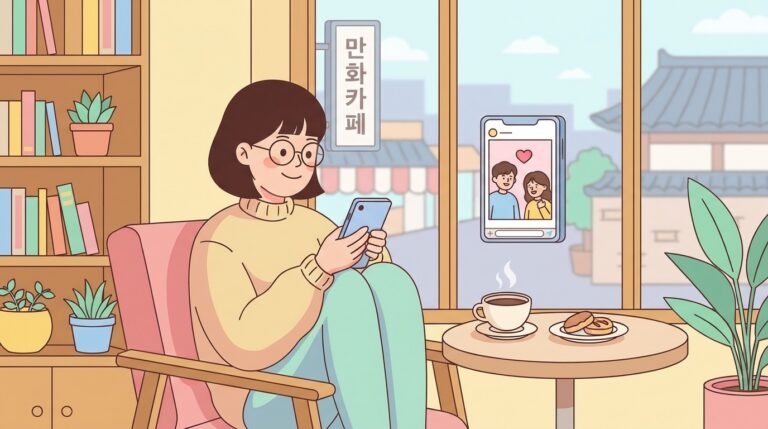
If you are visiting Seoul, don’t just stay in ordinary cafes. Download the 네이버 지도 (Naver Map) 앱 and search for 만화카페 (Manhwa Cafe). Brands like 벌툰 (Beoltoon) and 콩툰 (Kongtoon) offer cozy private sleeper pods, high-speed Wi-Fi, and delicious fried rice (김치볶음밥). To buy exclusive physical merchandise and art books, hop onto Subway Line 2 to Hongik University Station and explore 홍대 애니메이트 (Hongdae Animate) on the 5th floor of AK Plaza.
Phase 9: 한 발 더 깊이 (One Step Deeper)
Why does Korean narrative culture classify emotional relationship dynamics with such rigorous granularity? In many Western storytelling conventions, characters are defined by their deeds and overarching moral alignment (hero, anti-hero, villain). In contrast, Korean fiction is fundamentally relationship-centric (관계성, gwan-gye-seong). A character does not exist in isolation; they exist in how their social hierarchy, repressed affection (정), and pent-up emotional sorrow (한) clash against another soul. By categorizing leads as 후회남 or 집착광공, Korean readers aren’t just choosing a visual archetype—they are selecting the exact psychological roller coaster and emotional resolution they need after a long, exhausting week in a high-pressure society.
💬 Your Turn: Which webtoon male lead archetype appeals to you most: the cold-turned-warm 츤데레, the remorseful 후회남, or the terrifyingly dedicated 집착광공? Tell us your favorite webtoon in the comments below!
Phase 10: FAQ & Avoiding Misunderstandings
Q: Can I use words like 집착광공 to describe my real-life boyfriend?
A: Only in a very exaggerated, playful, self-deprecating joke with close friends! In real Korean society, 집착 (obsession/stalking) is taken very seriously as dating violence. If you describe someone in real life as 집착광공 seriously, Koreans will assume the relationship is genuinely toxic and advise you to call the police.
Q: What is the difference between 츤데레 and 그냥 무뚝뚝한 사람 (just a blunt person)?
A: The difference lies entirely in action! A truly blunt person simply doesn’t care. A 츤데레 pretends to be cold while expending enormous effort behind the scenes to help you (e.g., waking up 30 minutes early to buy you motion sickness pills before a group bus trip).
Q: What does ‘사이다’ mean in everyday conversation?
A: While it literally means lemon-lime soda, Koreans say “완전 사이다다!” (That’s totally cider!) whenever someone speaks uncomfortable truths to a rude boss, or when a frustrating situation gets resolved cleanly and instantly without hesitation.
🚨 Common Mistakes Board (외국인 학습자의 흔한 실수 TOP 3)
- Mistake: Calling an older male stranger 오빠 (oppa) because webtoon heroines do it.
Correct Action: In reality, reserve 오빠 only for close male friends or boyfriends. Call service workers 사장님 (boss/owner) or 저기요 (excuse me). - Mistake: Confusing 후회남 (regretful male lead) with 나쁜 남자 (bad boy).
Correct Action: A “bad boy” stays unrepentant. A true 후회남 is defined by his collapse into desperate repentance. - Mistake: Using literary web novel phrases like “너는 내 손바닥 안이다” (You are in the palm of my hand) in business or dating.
Correct Action: Keep dramatic webtoon rhetoric strictly inside digital fandom discussions!
Phase 11: Action Missions
- 🥉 Bronze Level: Open a webtoon app (Webtoon, KakaoPage, or Tappytoon) and spot three character archetype tags in the comment section.
- 🥈 Silver Level: Leave a short Korean comment under an episode you love: “이번 화 남주 완전 후회남 재질이네요! 얼른 사이다 전개 보고 싶어요.” (The male lead in this chapter is total regretful lead material! Can’t wait for the cider development.)
- 🥇 Gold Level: Visit a Korean comic cafe or an online K-community and explain to someone in Korean why your favorite manhwa character belongs to a specific tag.
- 🎮 K-Culture Mission: Watch an episode of a trending K-Drama (like Business Proposal or Marry My Husband) and identify the exact scene where the male lead transitions from 츤데레 to pure devotion.
Phase 12: Interactive Quiz Challenge
1. Situation Judgment: Your coworker grumbles about how loud and messy the office pantry is, but later you discover he quietly cleaned your desk and left your favorite canned cold brew. What tag best describes him?
* A) 먼치킨 (Meon-chi-kin)
* B) 츤데레 (Cheon-de-re)
* C) 사이다 (Sa-i-da)
2. Fill in the Blank: A story where an arrogant prince abandons his fiancée, but spends the next 50 chapters sobbing in the rain trying to win her back is called a ________ story.
* (힌트: 후__ 남)
3. True or False: The word 광공 in 집착광공 originally derived from sweet, gentle male leads in slice-of-life romance webtoons.
* True / False
👉 Click here to reveal the answers and explanations!
-
Answer: B) 츤데레 (Cheon-de-re).
Explanation: Complaining outwardly while performing thoughtful acts of service in secret is the definition of 츤데레 (겉차속따). -
Answer: 후회남 (Hu-hoe-nam).
Explanation: The core trope revolves around his belated realization and deep repentance (후회). -
Answer: False.
Explanation: 광공 (狂攻) literally translates to “mad dominant lead” and originated in intense, morally complex fiction, characterized by obsessive and boundary-pushing devotion rather than gentle softness.







