

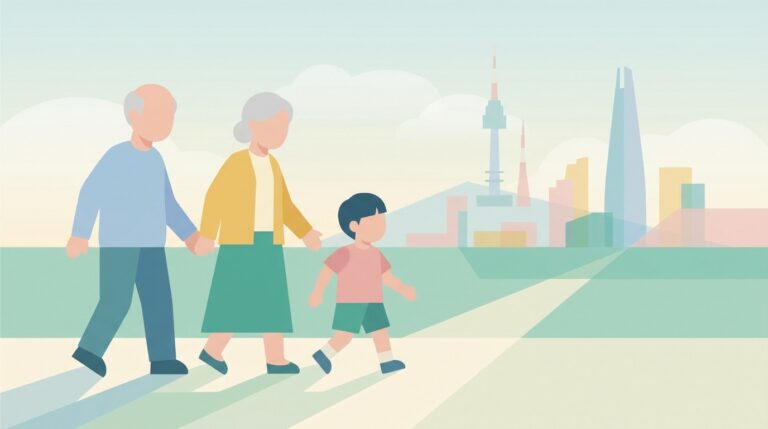
Phase 1: Empathy (Story-Driven Opening)
안녕하세요! 매일한글 에디터입니다. (Hello! I am your Daily Hangul editor.)
Imagine sitting at an upscale cafe in Yeouido, Seoul’s financial hub, flanked by colleagues from across the demographic divide: a senior manager nearing his retirement and a vibrant 28-year-old junior associate. The conversation drifts from project deadlines to the morning headline scrolling across the TV screen: Korea’s demographic cliff and the looming depletion of the National Pension fund. The junior colleague sighs, “우리는 내기만 하고 나중에 못 받는 거 아니에요?” (Aren’t we just paying in and never getting anything back?), while the senior team leader counters with quiet exhaustion, “그래도 지금까지 우리가 나라를 일궈왔잖아.” (Still, our generation built this country.)
Suddenly, the air feels heavy. You understand every individual word, yet you hesitate. In advanced Korean discourse, navigating demographic crises, public policy, and intergenerational fairness requires far more than basic political vocabulary. It requires nuance, empathy, and the exact conceptual lexicon native speakers rely on when negotiating fragile social balances. This lesson provides an insider guide based on real discussions with senior diplomats and corporate strategists, equipping you with natural, high-level Korean expressions that foster mutual respect even during contentious social debates.
Phase 2: Core Expressions Deep Dive
1. 고통을 분담하다 (Gotong-eul bundamhada)
- Pronunciation: [Go-tong-eul bun-dam-ha-da] (Think of go-tong sounding like “go-tongue” without the final hard g, and bun-dam like the English word “bundling” without ‘-ling’)
- Meaning: Literal: To divide and shoulder pain | Practical Nuance: Sharing mutual sacrifices or burdens equitably during a crisis
- K-Culture Moment: Frequently used in documentary specials (like KBS 시사기획 창) and high-stakes cabinet meetings when labor unions and corporate leadership discuss structural reforms.
- Editor’s Insight: This is a solemn, moral expression. Rather than focusing mechanically on budget cuts, saying ‘고통 분담’ (gotong bundam) signals that you acknowledge the emotional and economic strain endured by all parties.
- Situation Spectrum: Casual: 🚫 | Semi-formal: ⚠️ | Formal: ✅
- 🤔 Think About It: In many Western debates, policy focuses on individual contractual equity. Why does Korean public discourse so frequently frame economic adjustments as shared community “pain”?
2. 대타협을 이루다 (Daetahyeop-eul iruda)
- Pronunciation: [Dae-ta-hyeop-eul i-ru-da] (Pronounce dae as in “day”, ta-hyeop with an aspirated ‘t’ sound, and i-ru-da smoothly like “e-roo-dah”)
- Meaning: Literal: To accomplish a grand compromise | Practical Nuance: Forging a historic, landmark consensus across deeply conflicting interest groups
- K-Culture Moment: In political dramas such as Designated Survivor: 60 Days or Queenmaker, protagonists use this phrase during climactic negotiations to turn impending collapse into mutual survival.
- Editor’s Insight: ‘대타협’ (daetahyeop) implies that small concessions were abandoned in favor of a sweeping vision that safeguards the future of the nation.
- Situation Spectrum: Casual: 🚫 | Semi-formal: ⚠️ | Formal: ✅
- 🤔 Think About It: What distinguishes an ordinary agreement (합의, habui) from a ‘grand compromise’ (대타협) in your own culture?
3. 세대 간 형평성 (Sadae gan hyeongpyeongseong)
- Pronunciation: [Se-dae gan hyeong-pyeong-seong] (Se-dae rhymes with “say-day”; hyeong-pyeong carries balanced nasal tones ending in seong)
- Meaning: Literal: Inter-generation fairness | Practical Nuance: Intergenerational equity, ensuring future generations are not disproportionately burdened by aging demographics
- K-Culture Moment: Prominently featured on nightly economic panels when discussing whether retirement age extension must be paired with youth hiring quotas.
- Editor’s Insight: ‘형평성’ goes beyond simple equality (평등). It implies fairness achieved through proportional adjustment according to varying circumstances.
- Situation Spectrum: Casual: 🚫 | Semi-formal: ✅ | Formal: ✅
- 🤔 Think About It: How does your home country balance the welfare obligations owed to retirees against the career opportunities promised to youth?
Phase 3: Textbook Korean vs. Real Korean
Situation 1: Calling for Shared Sacrifices
- 📖 Textbook Korean: 우리는 세대 갈등을 피하고 모두 함께 돈을 더 내야 합니다. (Urineun sedae galdeung-eul pihago modu hamkke doneul deo naeya hamnida. / We must avoid generational conflict and all pay more money together.)
- 🗣️ 진짜 한국어: 연금 개혁은 단순한 수치 조정을 넘어 세대 간 고통을 분담하는 대타협이어야 해요. (Yeongeum gaehyeog-eun dansunhan suchi jojeong-eul neomeo sedae gan gotong-eul bundamhanean daetahyeobieoya haeyo. / Pension reform must transcend mere numerical adjustments to become a grand compact sharing sacrifices across generations.)
- 💡 왜 다를까?: Native C1 speakers rarely reduce macro-policy issues to blunt imperatives like “paying more money.” They contextualize the debate using institutional concepts like burden-sharing and grand compacts.
Situation 2: Emphasizing Community Sustainability
- 📖 Textbook Korean: 시스템이 망하지 않게 서둘러 합의합시다. (Siseutemi manghaji anke seodulleo hab-uihapsida. / Let’s reach an agreement quickly so the system doesn’t collapse.)
- 🗣️ 진짜 한국어: 공동체의 지속 가능성을 담보하려면 미래 세대의 부담을 덜어주는 사회적 합의가 불가피합니다. (Gongdongche-ui jisok ganeungseong-eul damboharyeomyeon mirae sedae-ui budam-eul deoreojuneun sahoejeok hab-uiga bulgahpihamnida. / To ensure the sustainability of our community, a social consensus that relieves the burden on future generations is unavoidable.)
- 💡 왜 다를까?: Advanced Korean relies on Sino-Korean paired concepts (지속 가능성, 담보하다, 불가피하다) to project analytical authority and strategic distance rather than emotional panic.
Phase 4: K-Culture Deep Dive & Non-verbal Manners
4-1. 눈치 (Nunchi) & Non-verbal Manners in Policy Discussions
When discussing demographic decline (인구절벽) and pension deficits with native speakers, generational tensions can surface quickly. Older Koreans may feel defensive about their lifetime contributions, while younger Koreans may feel anxiety over their economic futures.
* Body Language: Keep an open posture, avoid crossing your arms, and maintain steady, respectful eye contact. When speaking, nod slightly while acknowledging the opposing perspective before introducing your counter-argument (e.g., using transition markers like “물론 선배 세대의 헌신도 충분히 존중되어야 하지만…”).
* Nunchi Checklist: Never accuse an individual generation of selfishness. Always frame shortcomings around systemic constraints (구조적 한계) rather than personal entitlement.
4-2. Cultural Code Analysis: The Shift in Korea’s Social Contract
In classic Korean historical dramas and traditional society, elder care was handled via the family unit under filial piety (효도, hyodo). However, as Korea transformed into an ultra-aged society (초고령사회) alongside a steep fertility decline, elder welfare shifted onto the shoulders of the state via the National Pension (국민연금) and basic senior allowances. This institutional transition from family responsibility to civic obligation makes pension debates remarkably personal—touching the core of Korean familial respect and modern socioeconomic anxiety.
Phase 5: Real-World Roleplay Scenario
Setting: A quiet policy symposium dinner room in Gwanghwamun. Two colleagues are discussing an editorial on national pension reform.
- Character A: 부장님 (General Manager Park, 54, approaching retirement)
- Character B: 이 대리 (Assistant Manager Lee, 31, millennial professional)
- 부장님: 이 대리, 오늘 신문 봤어? 국민연금 개혁안을 두고 세대 간 갈등이 아주 첨예하더군. (I daeri, oneul sinmun bwasseo? Gungmin-yeongeum gaehyeogan-eul dugoo sedae gan galdeung-i aju cheom-yehadogun.)
- 🎭 행동 지문: 차를 한 모금 마시며 걱정스러운 눈빛으로 신문을 내려놓는다. (Sips tea and sets down the newspaper with a worried expression.)
- Translation: Assistant Manager Lee, did you see the newspaper today? The generational conflict over the pension reform bill is growing remarkably sharp.
- 이 대리: 네, 부장님. 저희 또래 사이에서는 연금 고갈에 대한 불안감이 극에 달한 상태입니다. (Ne, bujangnim. Jeohui ttoroe saieseoneun yeongeum gogare daehan burangami geuke dalhan sangtaeimnida.)
- 🎭 행동 지문: 찻잔을 조심스레 쥐며 차분하지만 단호하게 말한다. (Holds the teacup carefully, speaking calmly yet firmly.)
- Translation: Yes, General Manager. Among my peers, anxiety about the depletion of the fund has reached an all-time high.
- 부장님: 우리 세대도 평생 일하며 보험료를 부었는데, 마치 기성세대가 청년층의 미래를 착취하는 것처럼 비치는 건 억울한 면이 있어. (Uri sedaedo pyeongsaeng ilhamyeo boheomnyoreul bueotneunde, machi giseongsaedaega cheongnyeoncheung-ui miraereul chakchwihaneun geotcheoreom bichineun geon eogulhan myeoni isseo.)
- 🎭 행동 지문: 가볍게 헛기침을 하며 서운한 기색을 내비친다. (Clears his throat lightly, displaying a touch of hurt pride.)
- Translation: Our generation also worked our whole lives paying our premiums; it feels slightly unfair to be painted as if older generations are exploiting the youth’s future.
- 이 대리: 부장님 세대의 피땀 어린 헌신은 누구도 부정하지 않습니다. 다만 지속 가능성을 담보할 제도적 안전망이 시급하다는 뜻입니다. (Bujangnim sedae-ui pittam eorin heonsineun nugudo bujeonghaji anseumnida. Daman jisok ganeungseongeul dambohal jedojeok anjeonmangi sigeubh پیامda.)
- 🎭 행동 지문: 상사의 공헌을 충분히 인정하듯 가볍게 고개를 끄덕인다. (Nods gently to validate the senior’s lifetime contributions.)
- Translation: Nobody denies your generation’s blood, sweat, and devotion. It simply means that an institutional safety net to ensure sustainability is urgently needed.
- 부장님: 결국 보험료율 인상이나 수급 개시 연령 조정 같은 민감한 사안들이 걸려 있는데, 풀릴 기미가 안 보여. (Gyeolguk boheomnyoyul insang-ina sugeup gaesi yeollyeong jojeong gateun mingamhan sa-andeuri geollyeo itneunde, pullil gimiga an boyeo.)
- 🎭 행동 지문: 이마를 짚으며 깊은 한숨을 내쉰다. (Rests a hand on his forehead, letting out a deep sigh.)
- Translation: After all, sensitive issues like hiking premium rates or delaying the eligibility age are tied up, and there’s no sign of a breakthrough.
- 이 대리: 맞습니다. 연금 개혁은 산술적 계산을 넘어 세대 간 고통을 분담하는 대타협이어야 실마리가 풀릴 겁니다. (Matseumnida. Yeongeum gaehyeogeun sansuljeok gyesaneul neomeo sedae gan gotongeul bundamhaneun daetahyeobieoya silmariga pullil geomnida.)
- 🎭 행동 지문: 눈을 똑바로 응시하며 설득력 있는 어조로 무게를 싣는다. (Looks directly into his eyes, speaking with convincing gravity.)
- Translation: Exactly. A breakthrough will only emerge when pension reform becomes a grand compromise that shares sacrifices across generations rather than relying on mere arithmetic calculations.
- 부장님: 그래, 어느 한쪽만 희생하는 방식으로는 누구도 승복하지 않겠지. 결국 사회적 대타협이 유일한 해법이야. (Geurae, eoneu hanjjokman huisaenghaneun bangsigeuroneun nugudo seungbokhaji anketji. Gyeolguk sahoejeok daetahyeobi yuilhan haeheob-iya.)
- 🎭 행동 지문: 이 대리의 말에 공감하며 천천히 고개를 끄덕인다. (Slowly nods along, resonating with Lee’s balanced perspective.)
- Translation: Right. No one will accept a solution where only one side is forced to sacrifice. A grand social consensus truly is the only solution.
- 이 대리: 네, 미래 세대와 기성세대가 머리를 맞대고 형평성을 찾아가는 과정 자체가 가장 중요한 첫걸음이라고 생각해요. (Ne, mirae sedae-wa giseongsedaega meorireul matdaego hyeongpyeongseongeul chajaganeun gwajeong jachega gajang jung-yohan cheotgeoreum-irago saenggakhaeyo.)
- 🎭 행동 지문: 따뜻한 미소를 지으며 잔을 채워 올린다. (Offers a warm smile and refills the manager’s teacup.)
- Translation: Yes. I believe the very process of older and younger generations putting their heads together to seek fairness is the most crucial first step.
🔀 Interactive Decision Point
How would you frame the problem if the General Manager asked: “그렇다면 자네는 청년층의 불만을 해소할 핵심 열쇠가 뭐라고 보나?” (Then what do you see as the key to resolving the youth’s grievances?)
- Option A: “산술적인 삭감보다, 세대 간 형평성을 담보하는 법적 장치를 마련해 신뢰를 회복하는 대타협입니다.” (Establishing legal frameworks for intergenerational equity rather than mere arithmetic cuts to restore trust through a grand compromise.)
- Outcome: 🏆 Best – Exemplifies high-level diplomatic Korean, addresses systemic solutions, and aligns seamlessly with professional boardroom expectations.
- Option B: “기성세대가 연금을 너무 많이 받아 가시니까, 지급액을 대폭 깎아야 청년들이 납득합니다.” (Since older generations receive too much pension, payments to seniors must be slashed substantially for youth to be satisfied.)
- Outcome: ❌ Bad – Confrontational and lacks diplomatic grace; risks offending the speaker by trivializing past economic contributions.
- Option C: “솔직히 답이 없으니 그냥 각자 알아서 개인연금으로 노후를 대비하는 수밖에 없죠.” (To be honest there is no solution, so everyone just needs to prepare for old age on their own through private pensions.)
- Outcome: ⚠️ Risk – Cynical and evades civic discourse; shuts down the opportunity for a constructive policy conversation.
Phase 6: 10-Second Emotion Shadowing Drill
Practice reading these sentences aloud, pausing at the slash marks (/) and matching the emotional cues.
[🤝 차분하고 설득력 있게 / Calm and persuasive]
연금 개혁은 / 단순한 산술적 계산을 넘어 / 지속 가능한 공동체를 위한 / 대타협이에요.
(Yeongeum gaehyeogeun / dansunhan sansuljeok gyesaneul neomeo / jisok ganeung-han gongdongchereul wihan / daetahyeobieoyo.)
“Pension reform is / beyond mere arithmetic calculation / for a sustainable community / a grand compact.”-
[💡 단호하면서도 균형 잡힌 목소리로 / Firm and balanced]
어느 한 세대의 희생만 강요해서는 / 결코 세대 간 형평성을 / 달성할 수 없습니다.
(Eoneu han sedae-ui huisaengman gang-yohaeseoneun / gyeolko sedae gan hyeongpyeongseongeul / dalseonghal su eopseumnida.)
“By compelling sacrifices from only one generation / never can we / achieve intergenerational equity.” -
[🌱 희망적이고 미래지향적으로 / Hopeful and future-oriented]
고통을 분담하는 과정 속에서 / 비로소 사회적 신뢰와 / 연대의 가치가 / 복원될 것입니다.
(Gotong-eul bundamhaneun gwajeong sog-eseo / biroso sahoejeok sinroewa / yeondae-ui gachiga / bogwondoel geosimnida.)
“In the process of sharing sacrifices / finally social trust / and the value of solidarity / will be restored.”
Phase 7: K-Culture Mini Dictionary
- 인구절벽 (Ingujeolbyeok): Demographic Cliff. Originating from Harry Dent’s term, widely utilized in Korean media to denote the sharp drop in youth population alongside ultra-low fertility rates, threatening economic productivity.
- 국민연금 (Gungmin-yeon-geum): National Pension Scheme. Korea’s mandatory state-managed retirement insurance pool, central to ongoing tax, welfare, and social compact debates.
- 소득대체율 (Sodeukdaecheyul): Income Replacement Rate. The percentage of an individual’s pre-retirement earnings received through pension payouts. A cornerstone metric in every pension reform debate.
- 초고령사회 (Chogoryeongsahoe): Super-Aged Society. The demographic status when individuals aged 65 and older exceed 20% of the entire national population, reached by Korea around 2024-2025.
Phase 8: Expat & Professional Survival Kit
Top 3 High-Context Expressions for Social & Workplace Debates
- 사회적 공감대가 필요합니다. (Sahoejeok gonggamdaega piryohamnida.)
- Pro Tip: Use this to defuse a heated office debate without taking an extreme side. It translates to: “A broader social consensus is required.”
- 장기적인 안목에서 바라봐야 해요. (Jang-gijeokin anmog-eseo barabwaya haeyo.)
- Pro Tip: Elevates your argument instantly from quick fixes to strategic vision (“We must view this through a long-term perspective.”).
- 상생의 길을 모색해야 합니다. (Sangsaeng-ui gireul mosaekhaeya hamnida.)
- Pro Tip: A revered phrase in civic and corporate Korean signaling a win-win partnership (“We must seek a path of mutual coexistence.”).
Editor’s Travel & Life Note
If you reside or work in Korea, staying informed on social changes is critical. You can look up official data directly through the National Pension Service English portal or track legislative debates via domestic press using the Naver News Economic Policy tab. Remember that public debates around fiscal reform are vibrant and open; joining these conversations with analytical tact will win the admiration of your Korean peers.
Phase 9: A Step Deeper (Reflective Insight)
Traditionally, the Korean spirit of Pumasi (품앗이, communal exchange of labor) and Jeong (정, reciprocal warmth) formed an informal safety net for villages facing hardship. Modern Korea has essentially industrialized this concept into nation-state institutions. However, when economic growth slows and populations decline, the assumption that future generations will unconditionally carry the burdens of the past is challenged. Mastering these expressions means participating in Korea’s ongoing philosophical quest to redefine filial loyalty into a modern, democratic social contract.
💬 Your Turn: What metaphor best represents social welfare and intergenerational support in your culture? A relay race? A bridge? Share your thoughts below in Korean using the phrase “세대 간 형평성”!
Phase 10: FAQ & Common Pitfalls
Q: What is the difference between ‘대타협’ (daetahyeop) and ordinary ‘타협’ (tahyeop)?
A: While ‘타협’ simply means compromise (and can occasionally carry a slightly negative connotation of compromising one’s values or accepting substandard terms), ‘대타협’ refers specifically to a macro-level, historic breakthrough between polarized national or institutional factions for the greater good.
Q: Can I use ‘고통을 분담하다’ in casual personal situations?
A: It sounds dramatically exaggerated in light situations. If you and your roommate are dividing up chore duties or paying for a split pizza, do not say “고통을 분담하자.” Instead, say “각자 분담하자” (Let’s divide it up) or “반반 내자” (Let’s split 50-50). Reserve ‘고통을 분담하다’ for genuine economic, organizational, or national trials.
Q: How do ‘합의’ (hab-ui) and ‘공감대’ (gonggamdae) differ in debate contexts?
A: ‘합의’ is a formal agreement or accord that concludes a negotiation, whereas ‘공감대’ refers to the shared emotional or psychological climate of mutual understanding that makes an agreement feasible in the first place.
🚨 Common Mistakes Alert
- Mistake: Using “합의해요” (Let’s agree) as an order during policy arguments.
- Correction: Say “사회적 합의를 도출해야 합니다” (We must derive a social consensus).
- Mistake: Confusing ‘형평성’ (equity/fairness) with ‘평등’ (absolute uniform equality).
- Correction: Use ‘형평성’ when balancing differing burdens across age groups with varying capacities.
- Mistake: Labeling opposing generational views as “틀렸다” (wrong).
- Correction: Use “입장의 차이가 존재합니다” (There are differences in perspective) to maintain diplomatic discourse.
Phase 11: Action Missions
- 🥉 Bronze Level Mission: Recite the Phase 6 Emotion Shadowing Drill sentences 3 times in front of a mirror with clear pauses and formal intonation.
- 🥈 Silver Level Mission: Write two sentences on your personal social media analyzing a current economic policy in your country using the collocation: “산술적 계산을 넘어… 대타협을 이루다“.
- 🥇 Gold Level Mission: Next time you chat with an advanced Korean language partner or tutor, steer the topic toward demographics and use the full phrase: “연금 개혁은 세대 간 고통을 분담하는 대타협이어야 해요.“
- 🎮 K-Culture Mission: Watch a segment of a Korean parliamentary hearing (청문회) or the debate program 100분 토론 (100-Minute Debate) on YouTube, and note how many times policy panelists mention “세대 간 형평성” and “사회적 대타협”.
Phase 12: Interactive Quiz Challenge
1. Situation Judgment: You are speaking at a company symposium about long-term corporate pension structuring. Which statement best represents a C1-level analytical response?
* (A) 나중에 돈이 모자라면 젊은 직원들이 더 내면 그만입니다.
* (B) 단기적인 수치에 매몰되기보다, 세대 간 고통을 분담하는 원칙적인 대타협이 선행되어야 합니다.
* (C) 회사가 문을 닫기 전까지는 굳이 개혁에 대해 논의할 이유가 전혀 없습니다.
2. Fill-in-the-Blank: Complete the sentence with the appropriate Sino-Korean term:
미래 세대의 불안감을 해소하고 제도의 지속 가능성을 높이기 위해서는 세대 간 [ ]을(를) 확보하는 것이 급선무입니다.
3. True or False: In Korean public policy debates, ‘형평성’ (equity) and ‘평등’ (equality) can always be used interchangeably without changing the contextual nuance.
👉 Click to reveal answers & explanations!
- Answer: (B). Option B employs refined discourse vocabulary (매몰되다, 고통을 분담하다, 대타협, 선행되다) to demonstrate objective leadership.
- Answer: 형평성 (Intergenerational equity). Sentence translation: In order to resolve the anxieties of future generations and enhance institutional sustainability, securing intergenerational equity is the foremost priority.
- Answer: False. ‘평등’ implies treating everyone identically (such as paying the same amount or receiving the same rate), whereas ‘형평성’ accounts for disparate generational conditions to arrive at an equitable and fair equilibrium.







