

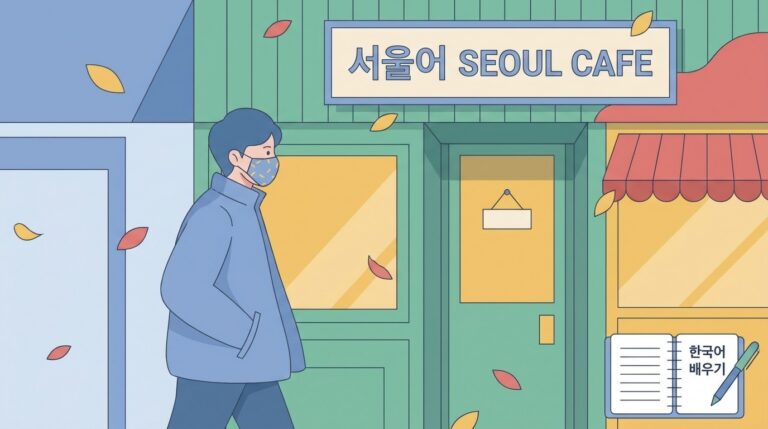
Why Everyone in Seoul Tells You to Wear a Mask (And How to Answer Like a Local)
Phase 1: Empathy & K-Culture Reality Check
안녕하세요! I’m your Daily Hangul editor.
Picture this: You wake up in a stylish guesthouse tucked along the leafy alleys of Yeonnam-dong. You are buzzing with excitement—today is the day you stroll through Gyeongbokgung Palace and hit up that trendy bakery you bookmarked on Instagram. But the moment you slide open the door to the lobby, the morning sky looks milky gray, and your host looks up from the counter with wide, genuinely worried eyes:
“마스크 쓰고 나가세요! (Maseukeu sseugo nagaseyo! / Please wear a mask when going out!)”
If you come from a culture where masks are only for hospitals or severe illnesses, you might freeze. Did I do something wrong? Is there a virus outbreak? Why is everyone at Hongik University Station wearing a sleek black or crisp white mask?
Take a deep breath—you are completely fine! In Korea, telling someone to wear a mask on a high fine dust (미세먼지) day or during a brisk seasonal chill is one of the warmest ways locals show love and everyday care. It is the Korean equivalent of tucking a scarf around your neck.
Many of our beginner students tell us they felt awkward or tongue-tied during sudden weather shifts in Korea. This guide is crafted specifically for A1 beginners so you can understand real-time weather warnings, talk about how the day feels, and reply with instant confidence and warmth.
Phase 2: Core 3 Expressions In-Depth
1. 마스크 쓰고 나가세요 (Maseukeu sseugo nagaseyo)
- Pronunciation: [Maseukeu sseugo nagaseyo] (Tip: Say “sseu” like ‘suh’ with tight, flat lips; “nagaseyo” flows like ‘nah-gah-say-yo’)
- Meaning: Literal: “Wear a mask and leave” | Real Nuance: “The air or chilly wind is harsh today—take care of your lungs before you head out!”
- K-Culture Moment: The iconic K-Drama morning routine scene where an affectionate roommate or doting mom presses an individually packed KF94 mask into the main lead’s hands right by the front door (현관).
- Editor’s Insight: The connective particle -고 (-go) links two actions in sequence (“put on” + “go out”). Meanwhile, -세요 (-seyo) transforms the command into a soft, polite piece of personal advice.
- Situation Spectrum: Casual ⚠️ (Use ‘마스크 써!’ with close peers) | Semi-formal ✅ (Ideal for guesthouses, cafes, and friendly colleagues) | Formal ✅
- 🤔 Think About It: In many Western contexts, commenting on what someone should put on their face might feel intrusive. Why do you think Korean culture views health reminders as fundamental hospitality?
2. 오늘 공기가 안 좋아요 (Oneul gong-giga an joayo)
- Pronunciation: [Oneul gong-giga an joayo] (Tip: “Gong-gi” sounds like a snappy ‘gong-ghee’, and “an jo-a-yo” sounds like ‘ahn joh-ah-yo’)
- Meaning: Literal: “Today the air is not good” | Real Nuance: “Fine dust levels are high today; you can definitely feel the haze.”
- K-Culture Moment: Standing in an apartment elevator in Seoul, sharing a quick commiserating sigh with a neighbor while checking the morning air quality app on your smartphone.
- Editor’s Insight: 공기 (gong-gi) refers to atmospheric air. Beginner learners love 안 (an) because putting it right before 좋아요 (joayo / good) effortlessly flips it into a negative (“not good”).
- Situation Spectrum: Casual ⚠️ | Semi-formal ✅ | Formal ✅
- 🤔 Think About It: Notice how Korean weather small talk immediately focuses on bodily comfort and air cleanliness rather than just sunshine.
3. 날씨가 쌀쌀해요 (Nalssiga ssalssalhaeyo)
- Pronunciation: [Nalssiga ssalssalhaeyo] (Tip: Emphasize the double ‘ss’—it sounds crisp and sharp like ‘sahl-sahl-hae-yo’)
- Meaning: Literal: “The weather is chilly” | Real Nuance: “Brrr! It’s not deep winter yet, but the breeze has a definite bite.”
- K-Culture Moment: Late October or early spring in a romance drama when characters pull their long trench coats tight as golden ginkgo leaves flutter across the pavement.
- Editor’s Insight: Korean has distinct words for degrees of cold. While 추워요 (chuwoyo) means “it’s cold/freezing,” 쌀쌀해요 (ssalssalhaeyo) captures that brisk, crisp, autumn-to-winter nip.
- Situation Spectrum: Casual ⚠️ | Semi-formal ✅ | Formal ✅
- 🤔 Think About It: Ssal-ssal is an onomatopoeic/mimetic word that mirrors the sensory rustle of dry cold air. Isn’t it fascinating how the sound matches the feeling?
Phase 3: Textbook Korean vs. Real Korean
Situation 1: Warning someone about bad air quality
- 📖 교과서 한국어 (Textbook): 마스크를 착용하십시오. (Maseukeureul chak-yonghasipsio.) — “Please wear a protective mask.”
- 🗣️ 진짜 한국어 (Real-Life): 마스크 꼭 챙겨요! (Maseukeu kkok chaenggyeoyo!) — “Make sure to grab your mask!”
- 💡 왜 다를까? (Why the difference?): Standard textbooks rely on formal Sino-Korean vocabulary like 착용 (wearing/donning). In real conversations, Koreans use the warm verb 챙기다 (chaeng-gida), which means “to look after, pack, or make sure not to forget.”
Situation 2: Suggesting warmer clothes for the wind
- 📖 교과서 한국어 (Textbook): 외투를 입으시기 바랍니다. (Oetureul ibeusigi baramnida.) — “It is requested that you put on an overcoat.”
- 🗣️ 진짜 한국어 (Real-Life): 따뜻하게 입고 나가요! (Ttatteuthage ipgo nagayo!) — “Dress warmly before you head out!”
- 💡 왜 다를까? (Why the difference?): Real-life Korean leans into feelings and caring adverbs. Saying 따뜻하게 (warmly) instantly makes you sound like a thoughtful local friend rather than a subway automated announcement.
Phase 4: K-Culture Deep Dive & Non-Verbal Manners
4-1. Nunchi (눈치) & Body Gestures
When a host, barista, or colleague tells you “마스크 쓰고 나가세요,” simply smiling blankly might make them think you didn’t understand the warning. Use your non-verbal etiquette:
* The Quick Pocket Tap: Lightly tap your bag or outer jacket pocket and give an appreciative 15-degree head bow while saying “네, 챙겼어요! (Ne, chaenggyeosseoyo! / Yes, I packed it!)”.
* The Eye Smile: If you are already wearing a mask, Koreans communicate friendliness through the “eye smile” (눈웃음) combined with a gentle nod. It shows you appreciate their thoughtful advice.
4-2. The Cultural Code: Fine Dust Alerts & “Airport Fashion”
In Korea, masks transcend medical emergencies—they are a staple of wellness and daily street culture.
1. Fine Dust (미세먼지) & Yellow Dust (황사): During seasonal transition periods, westerly winds can sweep particulate matter across the peninsula. Your phone will occasionally buzz with an emergency weather alert (안전안내문자). Don’t panic! It is simply a reminder to slip on a KF94 mask.
2. The K-Pop Mask Aesthetic: Long before global trends, K-pop idols popularized high-filtration masks at Incheon Airport to protect their vocal cords from dry air and travel dust. In Seoul, walking around in a mask is completely ordinary and socially considerate.
Phase 5: Real-Life Roleplay Scenario
- Setting: 9:00 AM inside a bustling guesthouse lobby in Hongdae. The morning sky outside looks misty and hazy. Host Min-ho (민호) is wiping the breakfast counter.
- Characters: Min-ho (The caring guesthouse host) & You (Ready for a day tour).
-
[Turn 1] Min-ho: 좋은 아침이에요! 오늘 어디 가요? (Joeun achim-ieyo! Oneul eodi gayo?)
- 🎭 Action Cue: [Smiling warmly while holding a clean coffee mug]
- Translation: “Good morning! Where are you headed today?”
- [Turn 2] You: 경복궁에 가요. 날씨가 어때요? (Gyeongbokgunge gayo. Nalssiga eottaeyo?)
- 🎭 Action Cue: [Zipping up your jacket and looking out the window]
- Translation: “I’m going to Gyeongbokgung Palace. How is the weather?”
- [Turn 3] Min-ho: 조금 쌀쌀해요. 그리고 오늘 공기가 안 좋아요. (Jogeum ssalssalhaeyo. Geurigo oneul gong-giga an joayo.)
- 🎭 Action Cue: [Glancing at the gray horizon with furrowed brows]
- Translation: “It’s a little chilly. And the air is not good today.”
- [Turn 4] You: 아, 미세먼지가 있어요? (A, misemeonjiga isseoyo?)
- 🎭 Action Cue: [Checking your smartphone weather widget]
- Translation: “Ah, is there fine dust?”
- [Turn 5] Min-ho: 네, 미세먼지 심해요. 마스크 쓰고 나가세요! (Ne, misemeonji simhaeyo. Maseukeu sseugo nagaseyo!)
- 🎭 Action Cue: [Reaching under the counter and offering an individually wrapped white KF94 mask]
- Translation: “Yes, the fine dust is bad. Please wear a mask when going out!”
- [Turn 6] You: 와, 고마워요! (Wa, gomawoyo!)
- 🎭 Action Cue: [Accepting the mask with both hands and bowing politely]
- Translation: “Wow, thank you!”
- [Turn 7] Min-ho: 따뜻하게 입고 나가요. 좋은 하루 보내요! (Ttatteuthage ipgo nagayo. Joeun haru bonaeyo!)
- 🎭 Action Cue: [Waving encouragingly with a reassuring nod]
- Translation: “Dress warmly before you head out. Have a wonderful day!”
- [Turn 8] You: 네, 다녀오겠습니다! (Ne, danyeo-ogesumnida!)
- 🎭 Action Cue: [Fitting the mask snugly over your nose and waving goodbye]
- Translation: “Yes, I will be back!”
🔀 Interactive Choice Point
What should you say if you left your mask upstairs in your room?
* Choice A: “괜찮아요, 저 건강해요! (Gwaenchanayo, jeo geonganghaeyo! / It’s fine, I’m healthy!)”
* Choice B: “방에서 마스크 가져올게요! 감사합니다. (Bang-eseo maseukeu gajyeoolgeyo! Gamsahamnida. / I’ll grab my mask from my room! Thank you.)”
* Choice C: “마스크 싫어요. (Maseukeu sireoyo. / I hate masks.)”
Feedback:
* Choice A [Risk]: While understandable, brushing it off might make you sound dismissive of their care, and Seoul’s fine dust really is tough on beginner lungs!
* Choice B [Best]: Polite, natural, and validates your host’s sweet gesture. 100 points!
* Choice C [Bad]: Too blunt and socially abrasive for daily conversational harmony.
Phase 6: 10-Second Emotion Shadowing Drill
Practice these three short sentences out loud. Pay attention to the rhythm pauses marked by /:
[😷 다정하고 진심 어린 걱정으로 / Caring & protective]- 마스크 / 쓰고 / 나가세요! (Maseukeu / sseugo / nagaseyo!)
[💨 살짝 어깨를 움츠리며 / Feeling the brisk seasonal chill]- 오늘 / 날씨가 / 쌀쌀해요. (Oneul / nalssiga / ssalssalhaeyo.)
[🌤️ 창밖을 살피며 솔직하게 / Observant & practical]- 오늘 / 공기가 / 안 좋아요. (Oneul / gong-giga / an joayo.)
Phase 7: K-Culture Mini Dictionary
- 미세먼지 (Misemeonji) | Fine Dust / Particulate Matter | The most common weather term checked daily on Korean portal sites alongside temperature.
- 꽃샘추위 (Kkotssaemchuwi) | The early spring cold snap | Poetically translates to “the cold that is jealous of the blooming spring flowers.” Used when March or April unexpectedly turns freezing.
- 일교차 (Ilgyocha) | Diurnal Temperature Range | The difference between daytime high and nighttime low. When TV anchors warn of a large ilgyocha, it means bring a jacket!
- 따뜻하게 (Ttatteuthage) | Warmly | The ultimate caring adverb. Pair it with verbs: 따뜻하게 입어요 (dress warmly) or 따뜻하게 드세요 (enjoy your warm food/tea).
Phase 8: Traveler’s Survival Kit
Survival TOP 3 Phrases
- 마스크 있어요? (Maseukeu isseoyo?)
- Meaning: “Do you have masks?”
- Pro Tip: Walk into any convenience store (CU, GS25, 7-Eleven) and say this near the register if you forgot yours.
- 오늘 미세먼지 심해요? (Oneul misemeonji simhaeyo?)
- Meaning: “Is the fine dust severe today?”
- Pro Tip: Ask hotel front desks or cafe baristas to spark an effortless everyday exchange.
- 감기 조심하세요! (Gamgi josimhaseyo!)
- Meaning: “Be careful not to catch a cold!”
- Pro Tip: Say this instead of a standard “goodbye” on chilly days. Locals will be amazed by your natural Korean!
Editor’s Travel Note
Before stepping out, always check local air forecasts via 에어코리아 실시간 대기정보 확인하기 or standard weather apps. Need an authentic KF94 certified mask? Use the 네이버 지도 앱 다운로드 to locate the nearest “약국” (yak-guk / pharmacy) or Olive Young branch where single and multipack masks are neatly organized by size (대형 for Large, 중형 for Medium).
Phase 9: A Step Deeper (Reflective Culture Essay)
In many Western cultures, independence is celebrated: an adult deciding not to wear a coat or mask is seen purely as a matter of personal autonomy. In Korea, however, communal affection is expressed through 정 (Jeong)—an unspoken, reciprocal bond of care. When someone tells you to bundle up or put on a mask, they are actively looking out for your physical well-being. Accepting this advice with gratitude is a wonderful step toward understanding the collective warmth of Korean daily life.
💬 Your Turn: How do people in your home country express everyday care when sudden weather strikes? Do friends tell you to grab an umbrella or wear a scarf? Share your thoughts in the comments below!
Phase 10: FAQ & Common Mistakes
Q: What does ‘KF94’ actually mean on Korean mask packages?
A: “KF” stands for Korean Filter, and the “94” certifies that it blocks more than 94% of micro-particles as small as 0.4 micrometers. It is the gold standard for blocking fine dust (미세먼지) during Korean winters and spring seasons.
Q: Can I just say ‘마스크 쓰세요’ instead of ‘마스크 쓰고 나가세요’?
A: Yes! 마스크 쓰세요 (Maseukeu sseuseyo) simply means “Please wear a mask.” Adding -고 나가세요 (-go nagaseyo) makes it more specific to leaving a building: “Wear a mask as you go outside.”
Q: Is it considered impolite if I choose not to wear a mask on yellow dust days?
A: Not impolite or illegal at all! However, older locals or friendly shopkeepers might look at you with genuine concern or offer you a spare mask because they worry about your health.
🚨 Common Mistakes Warning Board
| foreigner’s Common Mistake | Why It Sounds Unnatural | Correct Action |
|---|---|---|
| Saying “마스크를 입어요“ | In Korean, 입다 (ipda) is reserved exclusively for clothes (shirts, pants, coats). | Use 쓰다 (sseuda) for items placed on the head or face: “마스크를 써요.” |
| Mixing up 추워요 and 쌀쌀해요 | Calling a mild, breezy 15°C autumn day 추워요 sounds like you are enduring a Siberian blizzard! | Use 쌀쌀해요 (ssalssalhaeyo) for crisp, brisk autumn/spring chill. |
| Forgetting to remove the mask when eating in cafes | Trying to pull a tight KF94 down to your throat bends the nose wire and looks uncomfortable. | Take it off completely and fold it flat into your coat pocket or bag. |
Phase 11: Action Missions
- 🥉 Bronze Mission (Solo Practice): Stand in front of your mirror with a mask in hand. Say “마스크 쓰고 나가세요!” three times with your best warm, caring intonation.
- 🥈 Silver Mission (Social Media): Snap a photo of your cozy autumn jacket or your travel mask, post it on social media, and caption it: “오늘 날씨가 쌀쌀해요! 🍂 #DailyHangul”
- 🥇 Gold Mission (Real-Life Challenge): When parting ways with a Korean tutor, hotel staff, or friend on a windy day, wave and warmly say: “날씨가 쌀쌀해요. 감기 조심하세요!”
- 🎮 K-Culture Mission: Watch any reality travel show (like Youth Over Flowers) or an airport arrival video of your favorite K-pop group. Spot how many team members or staff remind each other to mask up against the cold wind!
Phase 12: Interactive Quiz Challenge
Test what you learned today before you step out into the Seoul breeze!
1. Situation Challenge:
You are walking out of your Hongdae hotel. The clerk smiles and says, “오늘 공기가 안 좋아요. 마스크 쓰고 나가세요!” What is the most natural reply?
* (A) 네, 안 입어요!
* (B) 네, 감사합니다! 마스크 챙겼어요.
* (C) 날씨가 더워요.
2. Fill-in-the-Blank:
* “바람이 많이 불어요. 날씨가 [ _______ ].” (The wind is blowing a lot. The weather is chilly.)
3. True or False:
* In Korean, the verb used for wearing a mask is the same verb used for wearing trousers and sweaters (입다).
👉 Click here to reveal answers and explanations!
- Answer: (B)
- Explanation: Replying with gratitude and confirming you packed your mask is the warmest, most natural response.
- Answer: 쌀쌀해요 (ssalssalhaeyo)
- Explanation: 쌀쌀해요 is the dedicated word for brisk, chilly, wind-blown weather.
- Answer: False
- Explanation: Clothes use 입다 (ipda), but masks, hats, and glasses use 쓰다 (sseuda)!
- Explanation: Clothes use 입다 (ipda), but masks, hats, and glasses use 쓰다 (sseuda)!







