

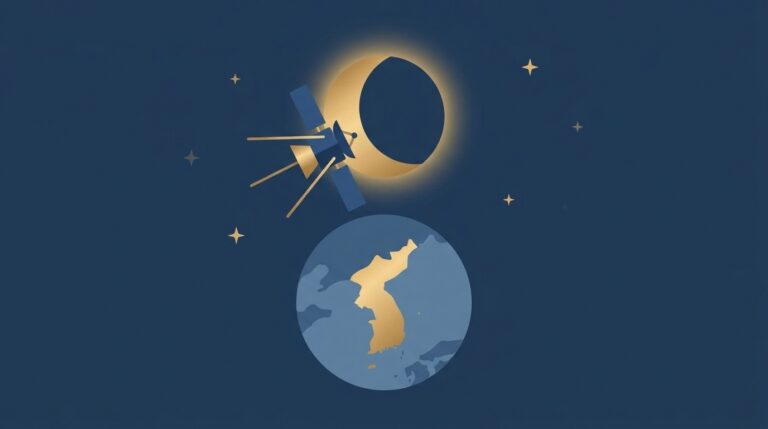
Phase 1: 공감 (Story-Driven Opening)
안녕하세요! 매일한글 에디터입니다. Have you ever watched the Korean sci-fi thriller The Silent Sea (고요의 바다) on Netflix and wondered about the diplomatic reality behind its gripping premise? In that series, elite South Korean researchers journey to the abandoned Balhae Lunar Station to retrieve mysterious lunar water samples. While it feels like pure science fiction, the international struggle over lunar water ice, Helium-3, and designated ‘safety zones’ under the Artemis Accords is happening right now in real-world diplomacy.
Many of our advanced C2-level learners share a major frustration: “I can handle everyday Korean or even business negotiations, but the moment international treaty interpretation, multilateral space law, and geopolitical sovereignty arise, I freeze!” It feels daunting because space diplomacy requires a delicate balance of assertive national sovereignty and multilateral legal decorum. This lesson is built directly from consultations with international policy analysts and legal scholars who negotiate these high-stakes topics in Seoul. By mastering this guide, you will transition from merely understanding academic jargon to fluently articulating nuanced legal positions on the New Space economy in high-level symposiums and policy dialogues.
Phase 2: 핵심 표현 3선 심층 분석
1. 우주 자원을 선점하다 (Uju jawon-eul seonjeomhada)
- Pronunciation: [Oo-joo jah-won-eul seon-jeom-hah-dah] (Think of ‘seon’ like the start of ‘Sunday’ and ‘jeom’ like ‘jump’ with a softer j)
- Meaning: Literal: To preempt space resources | Nuance: To strategically stake an early claim or monopolize extraterrestrial resources before multilateral frameworks are established.
- K-Culture Moment: Heard frequently in Korean parliamentary debates and policy broadcasts regarding the establishment of KASA (우주항공청, Korea Aerospace Administration).
- Editor’s Insight: The root word ‘선점 (seonjeom)’ implies gaining the upper hand by moving first. In diplomatic contexts, using this word signals strategic wariness about unilateral extraction without international consensus.
- Situation Spectrum: Casual 🚫 | Semi-formal ⚠️ | Formal ✅
- 🤔 Think About It: Does your native language view resource extraction as an act of “discovery” or “preemption”? Reflect on how ‘선점’ subtly frames resource acquisition as a race with winners and losers.
2. 평화적 이용 원칙을 준수하다 (Pyeonghwajeok iyong wonchik-eul junsuhada)
- Pronunciation: [Pyeong-hwah-jeok ee-yong won-cheek-eul joon-soo-hah-dah] (Rhymes smoothly; ‘junsu’ sounds like ‘June-sue’)
- Meaning: Literal: To observe the principle of peaceful use | Nuance: To strictly adhere to non-aggressive, transparent, and collaborative mandates under the 1967 Outer Space Treaty.
- K-Culture Moment: Evoked in diplomatic addresses at the United Nations Committee on the Peaceful Uses of Outer Space (COPUOS) by South Korean delegates.
- Editor’s Insight: ‘준수하다’ conveys absolute, uncompromising adherence to established covenants. It carries far more legal weight than simply ‘따르다’ (to follow).
- Situation Spectrum: Casual 🚫 | Semi-formal ⚠️ | Formal ✅
- 🤔 Think About It: Why do Korean legal scholars emphasize ‘평화적 이용’ (peaceful use) so strictly in treaties? Consider Korea’s modern history and its constitutional commitment to international peace.
3. 안전지대를 설정하다 (Anjeonjidae-reul seoljeonghada)
- Pronunciation: [Ahn-jeon-jee-dae-reul seol-jeong-hah-dah] (‘Anjeon’ as in ‘un-jun’, ‘jidae’ as in ‘gee-day’)
- Meaning: Literal: To establish safety zones | Nuance: Under the Artemis Accords, creating de facto exclusion or coordination zones around lunar operations, which critics fear might create de facto private property claims.
- K-Culture Moment: Central to the premise of Space Sweepers (승리호) where corporate giants carve out private zones in orbit, bypassing public accountability.
- Editor’s Insight: While ‘안전지대’ sounds purely protective, in legal debates it is a contentious euphemism for operational control. Native speakers use this phrase with deliberate rhetorical precision.
- Situation Spectrum: Casual 🚫 | Semi-formal ⚠️ | Formal ✅
- 🤔 Think About It: Is a “safety zone” a practical necessity to prevent space collisions, or a loophole around the prohibition of national appropriation? How does phrasing shape legitimacy?
Phase 3: 교과서 한국어 vs 진짜 한국어
Situation 1: Arguing against monopolistic lunar resource claims
- 📖 교과서 한국어 (Textbook): “우리는 달의 자원을 혼자 가지면 안 된다고 생각합니다.” (Uri-neun dal-ui jawon-eul honja gajimyeon an doendago saenggakhamnida. / “We think one shouldn’t take moon resources alone.”)
- 🗣️ 진짜 한국어 (Real C2): “특정국의 자원 독점은 외기권 조약의 비전유 원칙에 정면으로 위배됩니다.” (Teukjeong-guk-ui jawon dokjeom-eun oegigwon joyak-ui bijeonyu wonchik-e jeongmyeon-euro wibaedoemnida. / “A specific nation’s resource monopolization directly contravenes the non-appropriation principle of the Outer Space Treaty.”)
- 💡 왜 다를까?: C2 academic discourse completely avoids colloquial verbs like ‘가지다’ (to take). Instead, it deploys precise international legal terms like ‘비전유 원칙’ (principle of non-appropriation) and ‘정면으로 위배되다’ (to directly violate).
Situation 2: Expressing conditional agreement on safety zones
- 📖 교과서 한국어 (Textbook): “안전지대를 만드는 것은 좋지만 조심해야 합니다.” (Anjeonjidae-reul mandeuneun geos-eun jochiman josimhaeya hamnida. / “Making safety zones is good, but we must be careful.”)
- 🗣️ 진짜 한국어 (Real C2): “충돌 방지를 위한 안전지대의 취지에는 공감하나, 자칫 실효적 지배로 변질될 우려를 경계해야 합니다.” (Chungdol bangji-reul wihan anjeonjidae-ui chwiji-eneun gong-gamhana, jachit silhyojeok jibaero byeonjildoel u-ryeo-reul gyeong-gyehaeya hamnida. / “While we appreciate the intent of safety zones to prevent collisions, we must guard against the risk of them deteriorating into de facto territorial control.”)
- 💡 왜 다를까?: Elite diplomatic Korean uses concessive connectors (‘~취지에는 공감하나’) followed by analytical risk assessments (‘~로 변질될 우려를 경계하다’) to maintain professional neutrality.
Phase 4: K-Culture 딥다이브 & 비언어적 매너
4-1. 눈치 (Nunchi) & Diplomatic Decorum
In Korean policy forums, direct confrontation is seen as intellectually crude. When critiquing a superpower’s treaty framework (like the Artemis Accords):
* The Cushion Phrase (쿠션어): Never open with “그것은 틀렸습니다” (That is incorrect). Begin with “충분히 숙고할 가치가 있습니다만…” (While it certainly deserves deep consideration…).
* Eye Contact & Micro-nods: Maintain composed eye contact, accompanied by slow, measured nods to demonstrate that you are parsing the opposing argument’s underlying legal doctrine.
* Hand Gestures: Avoid pointing pens or fingers. Keep your hands gently clasped over your notebook or placed open on the conference table to project openness and disciplined composure.
4-2. Cultural Code Analysis: The K-Space Ambition
South Korea’s rapid ascent from developing the Nuri (누리호) rocket and the Danuri (다누리) lunar orbiter to launching the Korea Aerospace Administration (KASA) reflects a cultural ethos called ‘추격자에서 선도자로’ (from fast follower to first mover). Korean space discussions are infused with an acute awareness of geopolitical balance: caught between major space powers, Korea prioritizes the rule of law, multilateralism, and preventing space from becoming an unregulated frontier dominated exclusively by private tech billionaires.
Phase 5: 실전 롤플레이 시나리오
- Setting: A high-level roundtable at the International Space Law Symposium held at the Science & Technology Policy Institute (STEPI) in Sejong City.
- NPC: Dr. Min-woo Kang (강민우 박사), Senior Fellow of Space Geopolitics at KASA.
Turn 1 (Dr. Kang):
“이번 아르테미스 협정의 안전지대 조항을 두고 비전유 원칙 침해라는 비판이 거셉니다. 선생님께서는 이 규범적 불확실성을 어떻게 진단하십니까?”
(Ibeon areutemiseu hyeopjeong-ui anjeonjidae johang-eul dudo bijeonyu wonchik chimhaeraneun bipan-i geoseumnida. Seonsaengnim-kkeseoneun i gyubeomjeok bulhwaksilseong-eul eotteoke jindanhasimnikka?)
“Criticism is mounting that the safety zone clause in the Artemis Accords infringes upon the non-appropriation principle. How do you assess this normative uncertainty?”
🎭 서류를 차분히 넘기며 날카로운 눈빛으로 의견을 묻는다.
Turn 2 (You):
“외기권 조약 제2조가 명시한 영유권 주장 금지와 자원 채굴권 사이의 법적 괴리가 여전히 해소되지 않았다고 봅니다.”
(Oegigwon joyak je-i-joga myeong-sihan yeong-yugwon jujang geumji-wa jawon chaegulgwon sai-ui beopjeok goeriga yeojeonhi haesodoeji anatdago bomnida.)
“I believe the legal gap between the prohibition of territorial appropriation stipulated in Article II of the Outer Space Treaty and resource extraction rights remains unresolved.”
🎭 단정한 자세로 양손을 모으고 명확한 어조로 발언한다.
Turn 3 (Dr. Kang):
“그렇다면 민간 기업의 채굴 행위까지 국가의 영유권 행사로 간주해야 한다는 입장이신가요?”
(Geureotdamyeon mingan gi-eop-ui chaegul haeng-wikkaji gukga-ui yeong-yugwon haengsaro ganjuhaeya handaneun ipjang-isin-gayo?)
“Do you maintain the position that even private commercial extraction should be deemed an exercise of national territorial sovereignty?”
🎭 안경을 고쳐 쓰며 흥미롭다는 듯 고개를 끄덕인다.
Turn 4 (You):
“민간 기업의 활동이라 할지라도 국가의 인가와 지속적인 감독 의무가 수반되므로 궁극적인 책임은 국가에 귀속됩니다.”
(Mingan gi-eop-ui hwaldong-ira haljirado gukga-ui in-gawa jisokjeogin gamdok uimuga subandoemeuro gung-geukjeogin chaegim-eun gukga-e gwisokdoemnida.)
“Even if conducted by private entities, state authorization and continuing supervision are mandatory, meaning ultimate responsibility is attributed to the state.”
🎭 시선을 차분히 맞추며 설득력 있는 손짓을 취한다.
Turn 5 (Dr. Kang):
“매우 일리 있는 지적이군요. 그렇다면 한국은 우주 자원 개발과 평화적 이용 사이에서 어떤 독자적 외교 노선을 취해야 할까요?”
(Mae-u illi inneun jijeog-igun-yo. Geureotdamyeon hanguk-eun uju jawon gaebal-gwa pyeonghwajeok iyong saieseo eotteon dokjadeok oegyo noseon-eul chwihaeya halkkayo?)
“A very cogent point. In that case, what independent diplomatic line should Korea pursue between space resource exploitation and peaceful use?”
🎭 펜을 내려놓고 진지하게 귀를 기울인다.
Turn 6 (You):
“아르테미스 협정의 실용적 이점을 수용하되, 다자주의 협의체인 COPUOS를 통해 구속력 있는 국제 규범 수립을 견인해야 합니다.”
(Areutemiseu hyeopjeong-ui siryongjeok ijeom-eul suyonghade, daju-u-ui hyeob-uiche-in COPUOS-reul tonghae gusongnyeok inneun gukje gyubeom surip-eul gyeon-inhaeya hamnida.)
“While embracing the pragmatic benefits of the Artemis Accords, we must steer the creation of binding international norms through the multilateral COPUOS framework.”
🎭 절제된 고개 끄덕임과 함께 당당한 어조로 답변한다.
Turn 7 (Dr. Kang):
“균형 잡힌 시각입니다. 다만 신흥 우주 강국들과의 이해관계 조율이 현실적인 난제가 되겠군요.”
(Gyunhyeong jap-in sigak-imnida. Daman sinheung uju gang-gukdeul-gwa-ui ihaegwan-gye joyul-i hyeonsiljeogin nanje-ga doegessgun-yo.)
“A well-balanced perspective. However, coordinating conflicting interests with emerging spacefaring powers will prove to be a practical hurdle.”
🎭 미소를 띠며 긍정적인 평가의 눈빛을 보낸다.
Turn 8 (You):
“그렇기에 한국이 기술적 역량과 중견국 외교력을 결합하여 규범 형성의 가교 역할을 수행해야 합니다.”
(Geureotgie hanguk-i gisuljeok yeongnyang-gwa jung-gyeon-guk oegyoryeok-eul gyeolhapayeo gyubeom hyeongseong-ui gagyo yeokhal-eul suhaenghaeya hamnida.)
“That is precisely why Korea must combine its technological capability with middle-power diplomacy to act as a bridge in establishing global norms.”
🎭 신뢰감을 주는 온화하면서도 확신에 찬 미소를 짓는다.
🔀 인터랙티브 분기점 (Interactive Choices)
If Dr. Kang asks whether Korea should independently legislate lunar mining rights:
* Choice A: “국내법을 조속히 제정하여 민간 기업의 투자 안정성을 선제적으로 확보해야 합니다.” (Enact domestic law quickly to preemptively secure investment certainty for private enterprise.)
* Feedback (Best): Demonstrates realpolitik and forward-looking economic insight while acknowledging institutional practicalities.
* Choice B: “국제법이 없으니 그냥 미국 협정만 무조건 따라가면 됩니다.” (Since international law is lacking, we should just follow US agreements unconditionally.)
* Feedback (Bad): Fails C2 sophistication; dismisses sovereignty and multilateral diplomatic agency entirely.
* Choice C: “자원 채굴권 논의는 시기상조이므로 모든 논의를 중단해야 합니다.” (Discussing mining rights is premature, so all discussions should cease.)
* Feedback (Risk): Ignores rapid New Space industrial momentum and portrays a defeatist, passive foreign policy stance.
Phase 6: 10초 감정 섀도잉 드릴
- Sentence 1 [🧐 진지하고 논리적으로]:
우주 자원의 상업적 전유는 / 외기권 조약의 평화적 이용 원칙과 / 긴밀히 조율되어야 합니다.
(Uju jawon-ui sang-eopjeok jeonyu-neun / oegigwon joyak-ui pyeonghwajeok iyong wonchik-gwa / ginmilhi joyuldoe-eoya hamnida.)
“Commercial appropriation of space resources / must be closely harmonized / with the principle of peaceful use under the Outer Space Treaty.” -
Sentence 2 [⚖️ 단호하고 학술적으로]:
안전지대 설정이 / 실질적인 영유권 행사로 / 변질되지 않도록 / 국제적 감시 체계가 필수적입니다.
(Anjeonjidae seoljeong-i / siljiljeogin yeong-yugwon haengsaro / byeonjildoeji antorok / gukjejeok gamsi chegye-ga pilsujeogimnida.)
“Lest the creation of safety zones / deteriorate into de facto territorial claims / an international verification system / is absolutely indispensable.” -
Sentence 3 [🌐 외교적 품격을 담아 부드럽게]:
대한민국은 / 기술 혁신을 선도함과 동시에 / 보편적 우주 규범 수립에 / 기여할 책무가 있습니다.
(Daehanmin-guk-eun / gisul hyeoksin-eul seondohamgwa dongsi-e / bopyeonjeok uju gyubeom surip-e / giyeohal chaekmuga itseumnida.)
“The Republic of Korea / while spearheading technological innovation / has a profound duty / to contribute to universal space norms.”
Phase 7: K-Culture 미니 사전 (핵심 키워드 4선)
- 우주 주권 (Uju Jugwon) | Space Sovereignty
Refers to a nation’s autonomous right to explore space, control its orbital slots, and operate independent space assets without foreign dependence. - 비전유 원칙 (Bijeonyu Wonchik) | Principle of Non-Appropriation
A bedrock principle of the 1967 Outer Space Treaty stating that outer space, including the Moon and other celestial bodies, is not subject to national appropriation by claim of sovereignty. - 전유 (Jeonyu) | Appropriation / Exclusive Possession
The act of taking exclusive possession of a resource for oneself. In legal discussions, it denotes the turning of common heritage into private property. - 우주항공청 (KASA – Ujuhanggongcheong) | Korea Aerospace Administration
Established in 2024 in Sacheon, Gyeongsangnam-do, this government agency serves as Korea’s NASA, driving national launch vehicle independence and space exploration policy.
Phase 8: 여행자를 위한 생존 키트 (Field & Academic Visit)
Survival Expressions for Visiting Aerospace Institutions
- “외교안보 포럼 자료집을 열람할 수 있을까요?” (Oegyo-anbo poreom jaryojip-eul yeollamhal su isseulkkayo?)
- Meaning: May I examine the diplomatic security forum proceedings?
- Pro Tip: Use this at academic libraries or think-tank symposium registration desks.
- “우주항공청 주관 공개 세미나 사전 등록을 확인하러 왔습니다.” (Ujuhanggongcheong jugwan gonggae semina sajeon deungnok-eul hwaginhareo watseumnida.)
- Meaning: I am here to verify my pre-registration for the KASA open seminar.
- Pro Tip: Shows extreme administrative politeness and professional decorum.
- “질의응답 세션에서 마이크를 요청해도 되겠습니까?” (Jiri-eungdap sesyeon-eseo maikeu-reul yocheonghaedo doegesseumnikka?)
- Meaning: May I request the microphone during the Q&A session?
- Pro Tip: Elevates your conference presence instantly.
Editor’s Travel Note
If you are traveling to Korea to explore its space tech sector, make sure to visit the Naro Space Center (나로우주센터) in Goheung or attend events organized by KASA in Sacheon. To travel smoothly outside of Seoul, be sure to use the 코레일톡 앱 다운로드 to book high-speed KTX train seats in advance, and navigate regional bus connections effortlessly via the 네이버 지도 앱 다운로드.
Phase 9: “한 발 더 깊이” (인문학 에세이 & 생각 질문)
In traditional Korean philosophical thought, common resources like mountain water, clean air, and village springs were understood through the lens of Gong-yu (공유 – communal sharing) rather than unfettered private exploitation. This cultural memory heavily colors South Korea’s perspective on international space law today. When Korean diplomats advocate for multilateralism in space, they reflect a deep-rooted cultural intuition: true power lies not in building exclusionary fences around common treasures, but in orchestrating harmony so that no community member is disenfranchised. Space, in the Korean diplomatic mindset, is the ultimate communal spring.
💬 Your Turn: Do you believe lunar water ice should be treated as the “common heritage of mankind,” or should pioneering private corporations hold exclusive ownership of what they extract? Share your thoughts below in Korean! (여러분의 생각을 한국어로 들려주세요!)
Phase 10: FAQ & 오해 방지 (FAQ Schema)
Q: Can I use the word ‘소유권’ (ownership) instead of ‘전유’ (appropriation) in space law debates?
A: While ‘소유권’ (soyugwon) means private property ownership in civil law, international public law and the Outer Space Treaty specifically use ‘전유’ (jeonyu – appropriation) to denote sovereign or unilateral claiming of territory and resources. At the C2 level, using ‘전유’ demonstrates rigorous legal accuracy.
Q: What is the exact difference between ‘우주 영유권’ and ‘우주 주권’?
A: ‘우주 영유권’ (Uju yeong-yugwon) refers to territorial claims over extraterrestrial bodies (which is strictly prohibited under international law), whereas ‘우주 주권’ (Uju jugwon) refers to a sovereign state’s independent right to develop, launch, and operate its own space technology without foreign interference.
Q: Is the Artemis Accords a legally binding treaty in Korea?
A: No. The Artemis Accords (아르테미스 협정) are non-binding bilateral political principles led by the United States. In Korean academic debates, it is formally characterized as an ‘정치적 선언’ (political declaration) or ‘연성법’ (soft law), not a ratifiable formal treaty (‘조약’).
🚨 흔한 실수 (Common Mistakes) TOP 3
- Mistake: Saying “달을 가질 수 없다” (You can’t have the moon) in formal panels.
- Correct Action: Use “외기권의 비전유 원칙에 따라 영유권 주장이 금지됩니다” (Territorial claims are prohibited under the principle of non-appropriation).
- Mistake: Confusing ‘위성’ (satellite) with ‘발사체’ (launch vehicle/rocket).
- Correct Action: Use ‘재사용 발사체’ for reusable rockets (like SpaceX Falcon 9) and ‘저궤도 군집위성’ for LEO satellite constellations.
- Mistake: Using aggressive debate markers like “그건 아니죠” (That’s not it!).
- Correct Action: Soften your objection with “그 해석에는 다소 무리가 따릅니다” (That interpretation involves considerable theoretical strain).
Phase 11: 액션 미션 & 참여 유도
- 🥉 Bronze Mission (Solo Practice): Read Phase 6’s three shadowing drill sentences aloud three times each, focusing on the pitch-drop on formal endings (~ㅂ니다/습니다).
- 🥈 Silver Mission (SNS & Audio): Record your voice analyzing the sentence: “우주 자원의 상업적 채굴권은 다자간 협약으로 규율되어야 합니다” and post it on your study social media with the hashtag #DailyHangulC2.
- 🥇 Gold Mission (Real-world Application): Write a 3-sentence critique in Korean addressing lunar safety zones and post it as a comment on an aerospace news article or in our discussion forum.
- 🎮 K-Culture Mission: Watch Episode 1 of The Silent Sea (고요의 바다) or the climax of Space Sweepers (승리호) and spot how state power vs corporate ambition is depicted in Korean dialogue!
Phase 12: 인터랙티브 퀴즈 챌린지
Q1. Situational Judgment:
During a symposium, someone argues that whichever nation lands on a lunar ice crater first owns it entirely. What is the most refined C2 rebuttal?
* (A) “그건 말도 안 되는 소리입니다.”
* (B) “외기권 조약상 비전유 원칙에 위배되므로 법적 효력을 인정받기 어렵습니다.”
* (C) “미국 법률에 그렇게 나와 있으니 맞을 수도 있습니다.”
Q2. Fill-in-the-Blank:
“아르테미스 협정의 (________) 설정은 충돌 예방 목적을 넘어 실효적 지배로 이어질 수 있다는 우려가 존재합니다.”
Q3. True or False:
Under international space law, private commercial mining automatically exempts a country from sovereign state responsibility. (참 / 거짓)
👉 정답과 해설 확인하기 (Click to reveal answers)
- Q1 정답: (B) — (A) is overly colloquial and combative; (C) forfeits critical legal analysis. (B) expresses sharp international legal reasoning with academic poise.
- Q2 정답: 안전지대 (Anjeonjidae / Safety zone).
- Q3 정답: 거짓 (False) — Article VI of the Outer Space Treaty stipulates that states bear international responsibility for national activities in outer space, whether carried out by governmental agencies or non-governmental entities.







