

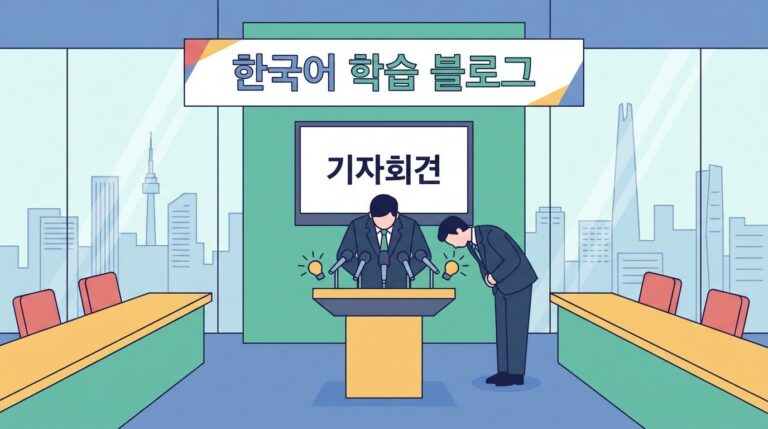
When Apology is an Art: Navigating Korean Corporate Crisis PR
Phase 1: 공감 (Story-driven Empathy Opening)
안녕하세요! 매일한글 (Daily Hangul) 에디터입니다.
Imagine the blinding flash of hundreds of camera lenses inside a packed auditorium in Yeouido, Seoul. Microphones from SBS, KBS, and JTBC are clustered on a podium like a metal bouquet. On screen, the chaebol chairman or tech CEO steps forward, impeccably dressed in charcoal gray. Instead of reading a combative legal disclaimer, he steps to the side of the lectern and bends his waist at a precise 90-degree angle. He stays down for five excruciatingly quiet seconds. The camera shutters sound like a torrential downpour. He then steps back up and proclaims: “기자회견에서 대표이사가 직접 고개를 숙이고 끝까지 질의응답에 성실히 임했어요 (At the press conference, the CEO bowed and answered every question sincerely).”
If you have watched high-stakes K-Dramas like Queen of Tears, Misaeng, or Vincenzo, you know this iconic scene. But in the real world of Korean business, this is not melodrama—it is a sophisticated, high-stakes communication protocol. Many global professionals stumble here. In Western corporate PR, executives are often trained to protect liability, maintain steady eye contact, and defer to legal counsel. In Korea, however, a defensive posture can ignite immediate public fury. Our advanced C1 learners frequently share their anxiety: “How do I express deep accountability and sincere crisis response without sounding legally negligent or insincere?” Today, we are breaking down the refined, formal rhetoric of Korean crisis management so you can analyze, discuss, and command the highest tier of corporate Korean.
Phase 2: 핵심 표현 3선 심층 분석 (Top 3 Key Expressions Deep Dive)
1. 머리 숙여 사죄드립니다 (Meori suk-yeo sajoedeurimnida)
- Pronunciation: [Meo-ri suk-yeo sa-joe-deu-rim-ni-da] (Think of ‘meo’ like the first sound in ‘mercy’, ‘suk’ like ‘soup’ with a sharp k, and ‘joe’ sounding like ‘jweh’ in ‘duel’)
- Meaning: Literal: “I apologize while lowering my head.” | Real Nuance: “I offer my deepest, humblest apologies from the bottom of my heart.”
- K-Culture Moment: Heard during public apology press conferences (대국민 사과) after service outages, data breaches, or executive misconduct in major Korean corporations.
- Editor’s Insight: Unlike the everyday “죄송합니다 (Joesonghamnida),” 사죄 (sajoe) combines ‘사’ (謝 – apologize) and ‘죄’ (罪 – guilt/sin). Pairing it with 머리 숙여 signals total physical and ethical surrender of personal ego to soothe public sentiment.
- Situation Spectrum:
- Casual: 🚫 (Sounds excessively dramatic or satirical)
- Semi-formal: ⚠️ (Only applicable when resolving severe personal betrayals)
- Formal: ✅ (The ultimate gold standard in official crisis statements)
- 🤔 Think About It: Why does Korean culture value physical posture (bowing) as an inseparable element of verbal sincerity, whereas Western legal culture often views an apology as an admission of legal fault?
2. 질의응답에 성실히 임하다 (Jiri-eungdabe seongsilhi imhada)
- Pronunciation: [Ji-ri-eung-da-be seong-sil-hi im-ha-da] (Pronounce ‘eung-dab’ smoothly: ‘eung’ like the sound in ‘song’, ‘dab’ like ‘dub’)
- Meaning: Literal: “To enter/engage in the Q&A sincerely.” | Real Nuance: “To address every tough question transparently without deflecting or dodging.”
- K-Culture Moment: A journalist live-tweeting an emergency press briefing: “The CEO didn’t run away via the back door; he took every hostile press inquiry until the end.”
- Editor’s Insight: The verb 임하다 (imhada) carries gravitas—confronting a duty or battle with complete presence. 성실히 임하다 demonstrates that leadership is not hiding behind PR managers or pre-screened questions.
- Situation Spectrum:
- Casual: 🚫
- Semi-formal: ⚠️
- Formal: ✅
- 🤔 Think About It: In your native culture, is taking open-ended press questions seen as transparent leadership or as an unnecessary public relations hazard?
3. 사태 수습에 총력을 기울이다 (Satae susube chongnyeogeul giurida)
- Pronunciation: [Sa-tae su-su-be chong-nyeo-geul gi-u-ri-da] (‘chong-nyeok’ undergoes nasal assimilation, sounding like ‘chong-nyeok’)
- Meaning: Literal: “To tilt all available power toward gathering up the situation.” | Real Nuance: “To mobilize all corporate resources and spare no effort to rectify the crisis.”
- K-Culture Moment: The climactic press briefing in an investigative business thriller where the reformed board of directors commits all contingency funds to victim restitution.
- Editor’s Insight: 수습 (suseup) means picking up scattered pieces after a disaster. 총력을 기울이다 shows proactive, dynamic action rather than passive regret.
- Situation Spectrum:
- Casual: 🚫
- Semi-formal: ⚠️
- Formal: ✅
- 🤔 Think About It: Notice the imagery of 기울이다 (to tilt/pour). Korean conceptualizes effort as pouring out water until the vessel is completely emptied.
Phase 3: 교과서 한국어 vs 진짜 한국어 (Textbook vs. Real Native Korean)
Situation A: Explaining ongoing corporate fault
- 📖 교과서 한국어: 이번 일은 저희 회사 잘못이고 다시는 안 그러겠습니다. (Ibeon ireun jeohi hoesa jalmosigo dasineun an geureogessseumnida. – “This incident is our company’s fault, and we won’t do it again.”)
- 🗣️ 진짜 한국어: 이번 사안에 대해 무거운 책임을 통감하며, 뼈를 깎는 자성의 시간을 갖겠습니다. (Ibeon saane daehae mugeoun chaegimeul tonggamhamyeo, ppyeoreul kkakneun jaseongui siganeul gatgessseumnida. – “We deeply acknowledge our grave responsibility in this matter, and we will engage in rigorous, bone-deep self-reflection.”)
- 💡 왜 다를까?: In C1 executive communication, simplistic expressions like 잘못 sound childish and evasive. Words like 책임을 통감하다 (keenly feel the weight of responsibility) and idioms like 뼈를 깎는 (bone-carving effort/reproach) elevate the statement to institutional solemnity.
Situation B: Answering whether the CEO will step down
- 📖 교과서 한국어: 저는 지금 당장 사임할 생각이 없습니다. (Jeoneun jigeum dangjang sa-imhal saeng-gagi eopseumnida. – “I have no intention of resigning right now.”)
- 🗣️ 진짜 한국어: 거취 문제를 포함하여 모든 가능성을 열어두고 있으나, 지금은 조속한 피해 복구와 사태 수습이 최우선 과제입니다. (Geochwi munjereul pohamhayeo modeun ganeungseongeul yeoreodugo isseuna, jigeumeun josokhan pihae bokguwa satae susubi choe-useon gwaje-imnida. – “While leaving all options open, including my own position, our top priority right now is prompt damage recovery and crisis remediation.”)
- 💡 왜 다를까?: Directly saying “I won’t resign” sounds arrogant and defiant to the Korean public. Framing resignation as a 거취 문제 (question of staying or leaving) that is subordinate to 피해 복구 (restitution) displays ethical maturity.
Phase 4: K-Culture 딥다이브 & 비언어적 매너 (Deep Dive & Non-Verbal Nuances)
4-1. 눈치 (Nunchi) & Crisis Body Language
In a Korean crisis press briefing, verbal statements account for only 40% of public evaluation; the remaining 60% rests upon non-verbal semiotics:
* The 90-Degree Bow (폴더 인사 / Folder Bow): The executive does not bow from behind the podium. They step into the open center, hands kept firmly at their side or folded at the lower abdomen, bending precisely from the hips to at least a 90-degree angle. They must hold this posture for a minimum of 3 to 5 seconds. Raising your head too fast conveys perfunctory obligation rather than genuine repentance.
* Gaze and Eye Movement: Never make defiant, direct eye contact with flashing cameras. The gaze should be lowered downward at a 45-degree angle when listening to accusations, followed by calm, unblinking focus on the inquiring reporter when providing factual remediation details.
* Tone & Cadence: High-pitched or rapid speech is perceived as panicked or defensive. The speaker must use a steady, resonant lower register with slow deliberate pacing.
4-2. Cultural Code Analysis: The Media Gauntlet (포토라인과 대국민 사과)
In Korean corporate reporting, the 포토라인 (Photo Line)—a marked tape box on the pavement outside prosecutors’ offices or press halls—is a modern public trial arena. Unlike Western corporate practice where legal teams issue sterile written PDF press releases, Korean corporate leadership is bound by Confucian civic expectations where public figures must personally offer emotional catharsis to the society. Sincerity (진정성) is judged by the leader’s willingness to endure uncomfortable questions until journalists run out of inquiries.
Phase 5: 실전 롤플레이 시나리오 (Interactive Crisis Roleplay)
Setting: The VIP briefing room at Hansung Tech headquarters in Gangnam. Five minutes before facing 80 aggressive financial tech journalists.
Characters:
* Min-woo: Veteran Crisis PR Director (calm, sharp, protective of the brand).
* Elena: Interim Co-CEO facing her first national media briefing after a major server outage.
- Turn 1 (Min-woo): 🎭 초조하게 타이머를 확인하며 (Checking the timer anxiously)
대표님, 기자들이 이미 장내를 가득 채웠습니다. 시작 전 90도 사과는 최소 3초 이상 유지하셔야 합니다.
(Dae-pyo-nim, gijadeuri imi jangnae-reul gadeuk chaewosseumnida. Sijak jeon gusip-do sagwaneun choeso sam-cho isang yujihasyeoya hamnida.)
“CEO, the reporters have already filled the room. You must maintain the 90-degree bow for at least three seconds before beginning.” -
Turn 2 (Elena): 🎭 양복 옷깃을 단정히 정리하며 (Straightening her suit lapels)
알겠습니다. 사과문을 낭독한 뒤 질의응답은 제가 직접 전담하겠습니다.
(Algesseumnida. Sagwamuneul nangdokhan dwi jiri-eungdabeun jega jikjeop jeondamhagessseumnida.)
“Understood. After reading the apology, I will handle the Q&A personally.” -
Turn 3 (Min-woo): 🎭 우려 섞인 눈빛으로 태블릿을 건네며 (Handing over the tablet with a worried look)
민감한 법적 책임에 대한 질문이 쏟아질 텐데, 괜찮으시겠습니까?
(Mingamhan beopjeok chaegime daehan jilmuni ssodajil tende, gwaenchaneusi-gessseumnikka?)
“A barrage of questions regarding sensitive legal liability will be thrown. Will you be alright?” -
Turn 4 (Elena): 🎭 단호하지만 차분한 목소리로 (With a firm yet composed tone)
회피하는 모습을 보이면 여론이 더 악화됩니다. 성실히 소명해야죠.
(Hoepihaneun moseubeul bo-imyeon yeoroni deo ak-hwadoemnida. Seongsilhi somyeonghaeyajyo.)
“If we appear evasive, public sentiment will worsen. We must explain thoroughly and sincerely.” -
Turn 5 (Min-woo): 🎭 기자회견장 문을 열며 (Opening the briefing room door)
그럼 입장하시겠습니다. 카메라 플래시가 터져도 당황하지 마십시오.
(Geureom ipjanghasigessseumnida. Kamera peullaesiga teojyeodo danghwanghaji masipsio.)
“Then let us enter. Even when the camera flashes go off, do not flinch.” -
Turn 6 (Elena): 🎭 연단 중앙으로 걸어나가 고개를 깊이 숙이며 (Walking to center stage and bowing deeply)
머리 숙여 사죄드립니다. 이번 사태 수습에 당사의 모든 역량을 집중하겠습니다.
(Meori suk-yeo sajoedeurimnida. Ibeon satae susube dangsaui modeun yeongnyangeul jipjunghagessseumnida.)
“I bow my head in apology. We will concentrate all our company’s capabilities on resolving this crisis.” -
Turn 7 (Hostile Reporter): 🎭 마이크를 쥐고 공격적으로 (Holding the microphone aggressively)
피해 보상 규모와 대표직 사임 여부는 왜 언급이 없습니까?
(Pihae bosang gyumowa daepyojik sa-im yeobuneun wae eongeubi eopseumnikka?)
“Why is there no mention of compensation scale or your resignation as CEO?” -
Turn 8 (Elena): 🎭 흔들림 없이 기자의 눈을 응시하며 (Looking steadily at the reporter)
질의응답을 통해 단 하나의 의혹도 남지 않도록 소상히 말씀드리겠습니다.
(Jiri-eungdabeul tonghae dan hana-ui uihokdo namji antorok sosanghi malsseumdeurigessseumnida.)
“Through this Q&A session, I will explain in meticulous detail so that not a single doubt remains.”
🔀 Interactive Choice Point
A senior economic reporter abruptly shouts: “Are you buying time with hollow words? Give us a concrete deadline for full compensation right now!”
- Choice A: “그 부분은 법무팀과 상의 중이므로 지금 답변드리기 곤란합니다.” (That part is under review with our legal team, so it’s difficult to answer right now.)
- Choice B: “피해자 구제를 위한 구체적 로드맵을 48시간 이내에 전면 공개하고, 대표이사인 제가 직접 최종 책임을 지겠습니다.” (We will unveil a comprehensive roadmap for victim restitution within 48 hours, and as CEO, I will bear final responsibility.)
- Choice C: “기자님, 목소리를 낮추시고 차례대로 질문해 주시기 바랍니다.” (Reporter, please lower your voice and wait your turn to ask questions.)
[Feedback]
- Choice A [Bad]: Invoking '법무팀' (legal team) triggers public cynicism. It feels like legal stonewalling.
- Choice B [Best]: Commits to a specific timeframe (48 hours), shows leadership ownership, and soothes market volatility.
- Choice C [Risk]: Tone-policing the press in a crisis briefing instantly creates front-page headlines about executive arrogance.
Phase 6: 10초 감정 섀도잉 드릴 (10-Second Emotional Shadowing Drill)
Practice reading these sentences aloud, pausing precisely at the / markers with the emotional inflection indicated.
[😔 비장하고 깊은 참회의 감정으로 / Solemn and deeply remorseful]
“이번 사태로 큰 실망을 안겨드려 / 머리 숙여 사죄드리며, / 모든 책임을 겸허히 수용하겠습니다.”
(Ibeon sataero keun silmangeul angyeodeuryeo / meori suk-yeo sajoedeurimyeo, / modeun chaegimeul gyeomheohi suyonghagessseumnida.)-
[🏛️ 차분하고 단호한 책임감으로 / Calm and unwavering sense of responsibility]
“질의응답에 성실히 임하여 / 한 점의 의혹도 남지 않도록 / 투명하게 밝히겠습니다.”
(Jiri-eungdabe seongsilhi imhayeo / han jeomui uihokdo namji antorok / tumyeonghage balkhigessseumnida.) -
[🔥 총력을 결집하는 단호함으로 / Resolute determination to rebuild]
“환골탈태의 각오로 / 시스템을 전면 쇄신하고 / 사태 수습에 총력을 기울이겠습니다.”
(Hwan-gol-tal-tae-ui gagoro / siseutemeul jeonmyeon swaesinhago / satae susube chongnyeogeul giurigessseumnida.)
Phase 7: K-Culture 미니 사전 (Core Vocabulary Builder)
-
대국민 사과 (Daegukmin Sagwa)
- Meaning: Public apology to the nation.
- Practical Use: Applied when corporate or political crises affect public infrastructure, national health, consumer safety, or widespread financial investments.
- 책임 통감 (Chaegim Tonggam)
- Meaning: Keenly feeling grave responsibility deep in one’s heart.
- Practical Use: The foundational phrase in formal Korean corporate statements. Replaces everyday apologies to convey profound awareness of institutional duty.
- 유감 표명 (Yugam Pyomyeong)
- Meaning: Expression of regret / expressing diplomatic sympathy.
- Practical Use: A calculated, lower-tier diplomatic or corporate statement indicating sorrow without formally assuming legal or financial culpability.
- 쇄신안 (Saeshinan)
- Meaning: Comprehensive organizational overhaul / reform plan.
- Practical Use: The structural rescue blueprint published immediately following an apology, detailing changes in governance, leadership restructuring, and compliance measures.
Phase 8: 여행자 & 직장인을 위한 생존 키트 (Survival Kit for Expats & Business Travelers)
Top 3 Crisis Survival Expressions
- “혼선을 드려 대단히 죄송합니다.” (Honseoneul deuryeo daedanhi joesonghamnida.)
- Pro Tip: Perfect for business emergencies when scheduling mistakes, service disruptions, or communication delays inconvenience clients.
- “즉각 시정 조치하도록 하겠습니다.” (Jeuk-gak sijeong jochihadorok hagessseumnida.)
- Pro Tip: Use this to defuse complaints; it confirms prompt corrective action rather than disputing fault.
- “사안의 엄중함을 인지하고 있습니다.” (Saanui eomjunghameul injihago isseumnida.)
- Pro Tip: High-level corporate phrase signaling to stakeholders that you take the situation very seriously.
Editor’s Travel Note: Business Crisis Preparedness
When managing executive delegations or media briefings in Seoul, install and verify communications apps beforehand. Ensure your team utilizes 네이버 지도 앱 다운로드 to coordinate secure executive vehicle routing between corporate headquarters in Yeouido, Teheran-ro, and official press institutions like the Korea Press Center in Gwanghwamun.
Phase 9: “한 발 더 깊이” (Deep Cultural Reflection)
In Western jurisprudence, an apology is frequently dissected as an admission of liability in a courtroom. However, Korean society views crisis communication through the philosophical lens of collective moral accountability (공동체적 도의). When an organization falters, the Korean public demands to see the human soul behind the corporation. The CEO’s 90-degree bow and willingness to stand before the press is not simply a public relations maneuver; it is an ancient societal restoration ceremony that re-establishes trust between leadership and the community.
💬 Your Turn: How does corporate crisis response differ in your country? Does leadership step forward to take personal emotional responsibility, or do legal teams tightly control public communication from behind closed doors? Share your insights in the comments below!
Phase 10: FAQ & 오해 방지 (FAQ & Common Mistakes)
Q: Is saying “유감입니다 (I feel regret)” considered enough during a serious Korean corporate scandal?
A: No. In fact, relying solely on 유감입니다 during a severe corporate crisis is frequently condemned by Korean media as an insincere, evasive “half-apology” (반쪽짜리 사과). When real harm or public distrust has occurred, leadership must use definitive expressions such as 진심으로 사죄드립니다 or 책임을 통감합니다.
Q: Why do Korean executives bow in unison at press conferences?
A: The coordinated bow (단체 배꼽인사/폴더인사) by board members visibly conveys corporate alignment. It signals to stakeholders, employees, and regulators that the entire leadership collective accepts blame and is committed to unified remedial action.
Q: Does a Korean apology statement automatically mean legal liability in court?
A: Historically, corporate statements were scrutinized for legal ramifications. However, modern Korean crisis management skillfully divides communication into emotional accountability (도의적 책임) and factual investigation (진상 규명), allowing leaders to heal public sentiment without immediately forfeiting legal defense.
🚨 Common Mistakes Warning Board
- Mistake: Using casual honorifics like 죄송해요 (Joesonghaeyo) in an official media statement.
- Correct Action: Always adhere to the superlative formal 하십시오체 (e.g., 사죄드립니다, 송구스럽습니다).
- Mistake: Crossing arms or holding hands in front of the chest while speaking at the podium.
- Correct Action: Keep hands resting flat on the lectern or positioned modestly below the waistline.
- Mistake: Rushing off the stage immediately after delivering a statement without taking unscripted questions.
- Correct Action: Even a brief, earnest engagement with press questions signals transparency and courage.
Phase 11: 액션 미션 & 참여 유도 (Action Missions)
- 🥉 Bronze Mission (Solo Practice): Record yourself delivering Phase 6’s first shadowing sentence using the exact emotional pitch and pause markers.
- 🥈 Silver Mission (Community Share): Write a 3-sentence crisis response in formal C1 Korean on your LinkedIn or study blog addressing a hypothetical product delay.
- 🥇 Gold Mission (Real Application): Watch an actual Korean corporate press conference on YouTube (e.g., search 대국민 사과 기자회견). Track how many times the CEO uses 통감, 수습, and 송구.
- 🎮 K-Culture Mission: Find a dramatic press conference scene in a corporate K-Drama (like Reborn Rich or Queen of Tears) and identify the non-verbal cues utilized by the spokesperson.
Phase 12: 인터랙티브 퀴즈 챌린지 (Interactive Quiz Challenge)
1. 상황 판단 (Situational Judgment)
Your corporate server experienced a 12-hour outage across Korea. You are standing before reporters. Which statement is the most professional C1 crisis response?
– A) 서버가 다운된 것은 불가항력적이었으니 조금만 기다려 주세요.
– B) 이번 장애로 큰 불편을 겪으신 이용자분들께 머리 숙여 사과드리며, 신속한 복구와 재발 방지에 총력을 다하겠습니다.
– C) 저희 개발팀이 밤새 고생하고 있으니 억측성 보도는 자제해 주십시오.
🔍 정답 및 해설 보기 (Click to reveal answer)
정답: B
해설: Choice B demonstrates complete, professional C1 mastery by prioritizing sincere apology (머리 숙여 사과드리며) and committing institutional resources to remediation (총력을 다하겠습니다). Choice A is dismissive, while Choice C antagonizes the press.
2. 빈칸 채우기 (Fill in the Blank)
대표이사는 이번 사태에 대해 무거운 책임을 ( )하며 전사적 쇄신안을 발표했다.
🔍 정답 및 해설 보기 (Click to reveal answer)
정답: 통감 (통감하며)
해설: The collocation for feeling grave responsibility deep in one’s core is 책임을 통감하다 (Chaegimeul tonggamhada).
3. 문화 진위 퀴즈 (True or False)
In Korean corporate crisis press briefings, reading a legal disclaimer and exiting without taking questions is favored as strong risk management.
– [ ] True
– [ ] False
🔍 정답 및 해설 보기 (Click to reveal answer)
정답: False
해설: Refusing to answer questions (질의응답 회피) is widely seen in Korea as a severe sign of corporate cowardice and insincerity, often provoking a harsher media and public backlash.







