

Phase 1: Empathy & Storytelling Opening
안녕하세요! 매일한글 에디터입니다.
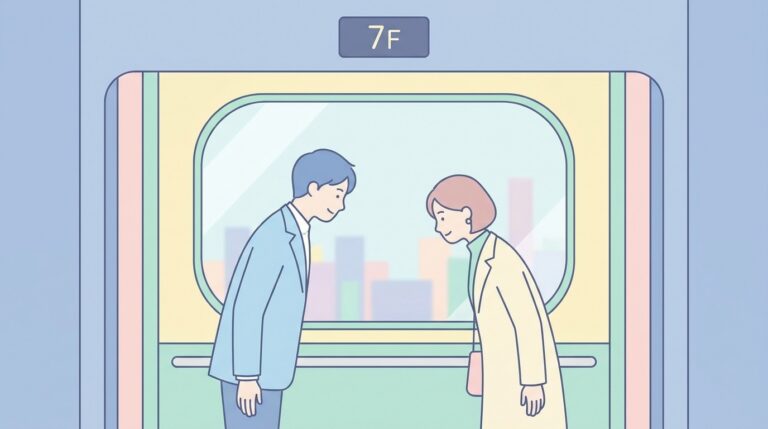
Imagine this: It is 8:15 AM on a crisp autumn morning in a bustling officetel in Mapo-gu, Seoul. You step into the sleek, mirror-paneled elevator on the 14th floor. The doors glide open, and an elderly neighbor wearing a fleece vest looks up, holding a tote bag of recycling. Your eyes meet for a split second. A sudden wave of awkward tension sweeps through the two-square-meter metallic box. Do you bow? Do you say hello? Or do you stare intensely at the glowing digital floor display like your life depends on it?
If you chose to glue your eyes to the floor numbers, you are not alone. In contemporary South Korea, over 34% of households are now single-person households (1인 가구 – ilin gagu). Modern high-rises provide privacy and hyper-convenience, but they have also created invisible glass walls between neighbors, paving the way for acute urban isolation and the rising societal concern known as godoksa (고독사 – lonely death). In K-dramas like My Liberation Notes and My Mister, we often see characters suffocated by this heavy, detached quietude.
Over the past ten years of coaching foreign residents in Seoul, the number one anxiety learners share with me is the fear of intruding on someone’s personal boundary. But here is the secret: Koreans do not want cold detachment; they just do not want to burden others. A gentle nod and a two-second warm remark inside that elevator can disarm the heaviest morning gloom and bridge the gap between complete strangers. In this guide, tailored for B2 intermediate learners, we will move past robotic textbook greetings and explore the nuanced, culturally fluent micro-phrases that transform a cold metal lift into a moment of human warmth.
Phase 2: 3 Core Expressions In-Depth Analysis
1. 안녕하세요, 좋은 하루 보내세요! (Annyeonghaseyo, joeun haru bonaeseyo!)
- Pronunciation: [An-nyeong-ha-se-yo, jo-eun ha-ru bo-nae-se-yo!] (Sounds like: Ahn-young-ha-say-yo, joh-oon ha-roo bo-neh-say-yo)
- Meaning: “Hello, have a wonderful day!”
- Literal: Hello, please spend a good day.
- Nuance: A bright, non-intrusive elevator exit phrase that wraps up a brief encounter with dignified warmth.
- K-Culture Moment: Seen frequently in slice-of-life dramas like Hospital Playlist when doctors or neighbors exit residential lifts, offering a polite parting blessing without lingering.
- Editor’s Insight: Combining the standard greeting with the polite imperative ~보내세요 (~bonaeseyo) demonstrates B2-level natural phrasing. It gives closure to the encounter so neither party feels pressured to sustain a conversation.
- Situation Spectrum: Casual: ⚠️ | Semi-formal: ✅ | Formal: ✅
- 🤔 Think About It: In many Western countries, saying “Have a nice day” happens reflexively at store checkouts. Why do you think modern Koreans reserve this mostly for departing situations where personal space has already been respected?
2. 오늘 날씨가 참 쌀쌀하죠? (Oneul nalssiga cham ssalssalhajyo?)
- Pronunciation: [O-neul nal-ssi-ga cham ssal-ssal-ha-jyo?] (Sounds like: Oh-neul nahl-sshi-gah chahm sahl-sahl-hah-jyo? Note the crisp, tense ‘ss’ sound like the hiss of steam)
- Meaning: “The weather is quite chilly today, isn’t it?”
- Literal: Today weather truly is chilly, right?
- Nuance: The ultimate safe, universal icebreaker across all age demographics in Korea.
- K-Culture Moment: An essential scene in Our Blues or everyday variety shows where two people break awkward silence by validating a shared physical sensation.
- Editor’s Insight: Notice the mimetic word 쌀쌀하다 (ssalssalhada – pleasantly or noticeably crisp/chilly) combined with the empathetic ending ~지요/죠 (~jyo). Using ~죠 assumes the other person feels the same way, instantly creating psychological rapport (gong-gam).
- Situation Spectrum: Casual: ⚠️ | Semi-formal: ✅ | Formal: ⚠️
- 🤔 Think About It: How does talking about the weather serve as an emotional shock absorber across different cultures before deeper topics are introduced?
3. 먼저 타세요 / 먼저 내리세요 (Meonjeo taseyo / meonjeo naeriseyo)
- Pronunciation: [Meon-jeo ta-se-yo / Meon-jeo nae-ri-se-yo] (Sounds like: Mun-juh tah-say-yo / Mun-juh neh-ree-say-yo)
- Meaning: “Please go ahead and get on / Please go ahead and step out.”
- Literal: First ride / First get off.
- Nuance: A gracious yielding phrase paired with an open-palm hand gesture.
- K-Culture Moment: The signature move of considerate protagonists in Korean workplace dramas who hold the elevator door open for an elderly resident or an overloaded courier.
- Editor’s Insight: The word 먼저 (meonjeo – first/ahead) is a social lubrication word in Korea. It signals courtesy without hierarchy, making the confined space feel collaborative rather than competitive.
- Situation Spectrum: Casual: ⚠️ | Semi-formal: ✅ | Formal: ✅
- 🤔 Think About It: How does physical yielding in public transit reflect the broader East Asian community ethos of collective consideration?
Phase 3: Textbook Korean vs. Real Korean
Situation 1: Greeting an elder in your apartment building
- 📖 교과서 한국어 (Textbook): 안녕하십니까? 오늘 날씨가 대단히 춥습니다. (Annyeonghasimnikka? Oneul nalssiga daedanhi chupsumnida.) – “How do you do? Today the weather is exceedingly cold.”
- 🗣️ 진짜 한국어 (Real Korean): 안녕하세요! 오늘 갑자기 날씨가 확 추워졌죠? (Annyeonghaseyo! Oneul gapjagi nalssiga hwak chuwojyeotjyo?) – “Hello! The weather suddenly got so cold overnight, didn’t it?”
- 💡 왜 다를까? Standard textbooks drill the hyper-formal ~하십시오 style, which makes you sound like a television news anchor or a military officer. Real urban Koreans use the friendly, polite ~해요 style paired with dynamic adverbial color like 확 (hwak – abruptly/sharply) and the consensus-seeking ending ~죠 (~jyo).
Situation 2: Stepping aside for a neighbor carrying groceries
- 📖 교과서 한국어 (Textbook): 당신이 먼저 나가십시오. (Dangsini meonjeo nagasipsio.) – “You, please exit first.”
- 🗣️ 진짜 한국어 (Real Korean): 짐 무거우실 텐데, 먼저 내리세요! (Jim mugeousil tende, meonjeo naeriseyo!) – “Your bags must be heavy, please go ahead and step off first!”
- 💡 왜 다를까? Using the pronoun 당신 (dangsin) directly to a stranger can sound confrontational or bizarrely intimate. Native speakers instead identify the situation with compassion (짐 무거우실 텐데 – your load must be heavy) and omit the second-person pronoun entirely.
Phase 4: K-Culture Deep Dive & Non-Verbal Manners
4-1. 눈치 (Nunchi) & Elevator Body Language
In a Korean elevator, non-verbal cues carry 70% of the message:
* The 15-Degree Mokrye (목례 – Eye-Contact Nod): A full 90-degree bow inside an elevator is overwhelming and physically awkward. Instead, make soft eye contact for half a second, offer a gentle half-smile, and tilt your upper neck and shoulders down about 15 degrees.
* The Open Button Anchor: If you are closest to the control panel, you are the temporary guardian of the lift. Place your index finger firmly on the 열림 (Open) button, face slightly toward the entering neighbors, and nod. Never let the doors clamp shut on someone running toward the elevator; holding the door is viewed as fundamental communal civility.
* The Line of Sight: After greeting, soften your gaze and look either down at your own feet or toward the digital floor indicator. Prolonged staring after exchanging greetings is perceived as an invasion of privacy.
4-2. Cultural Code: The Silent Epidemic of Godoksa
South Korea’s rapid transformation from rural clan villages to high-density apartment blocks happened in less than two generations. The traditional safety net of jeong (정 – deep communal bonding) and i-utsachon (이웃사촌 – neighbors who are as close as cousins) dissolved into apartment corridors where people rarely know who lives across the hallway. Local district offices (gu-cheong) across Seoul now run proactive community campaigns urging residents to look out for isolated single seniors and youth. A casual daily “좋은 하루 되세요” in the elevator is more than politeness; it is a vital micro-pulse of human recognition that reaffirms someone’s existence in an increasingly solitary society.
Phase 5: Real-Life Roleplay Scenario
Setting & Characters
- Location: Building 103 elevator of a high-rise apartment complex in Sangam-dong, Seoul. 8:30 AM.
- NPC: Mr. Park (박 아저씨), a warm-hearted retired teacher in his late 60s holding a small paper recycling box.
- Learner: A foreign professional living alone on the 9th floor.
[1] 🎭 (Elevator stops at the 9th floor. The doors open. The Learner steps in, holding the open button.)
Learner: 안녕하세요! 타세요, 제가 누르고 있을게요.
         (Annyeonghaseyo! Taseyo, jega nureugo isseulgeyo.)
         "Hello! Please come in, I will hold the button."

[2] 🎭 (Mr. Park steps in and gives a warm, appreciative nod.)
Mr. Park: 아이고, 고마워요. 출근하나 봐요?
          (Aigo, gomawoyo. Chulgeunhana bwayo?)
          "Oh my, thank you. Looks like you're heading off to work?"

[3] Learner: 네, 오늘 회의가 좀 일찍 있어서요.
            (Ne, oneul hoe-uiga jom iljjik isseoseoyo.)
            "Yes, I have an early meeting scheduled today."

[4] Mr. Park: 요즘 날씨가 아침저녁으로 꽤 쌀쌀하니까 옷 따뜻하게 입고 다녀요.
             (Yojeum nalssiga achim-jeonyeog-euro kkwae ssalssalhanikka ot ttatteuthage ipgo danyeoyo.)
             "The weather has been quite chilly morning and evening lately, so make sure to dress warmly."

[5] Learner: 안 그래도 겉옷 챙겨 나왔어요. 어르신도 감기 조심하세요!
            (An geuraedo geot-ot chaenggyeo nawasseoyo. Eoreusindo gamgi josimhaseyo!)
            "I actually brought an extra layer just in case. Please take care not to catch a cold as well!"

[6] 🎭 (Elevator chimes: '1층입니다' / Arrived at the 1st floor.)
Learner: 🎭 (Stepping aside while holding the open button with an open palm gesture.)
         먼저 내리세요, 어르신.
         (Meonjeo naeriseyo, eoreusin.)
         "Please step out first, sir."

[7] Mr. Park: 🎭 (Smiling warmly, patting the Learner's arm lightly as he walks past.)
          고마워요, 젊은이. 오늘 하루도 파이팅해요!
          (Gomawoyo, jeolmeuni. Oneul harudo paitinghaeyo!)
          "Thank you, young friend. Have a spirited day!"

[8] Learner: 감사합니다! 좋은 하루 보내세요!
            (Gamsahamnida! Joeun haru bonaeseyo!)
            "Thank you! Have a wonderful day!"
🔀 Interactive Branching Moment
When the elevator reaches the ground floor, Mr. Park is struggling slightly to balance his recycling box. What do you do?
- Option A: Silently sprint out first to catch your subway, avoiding eye contact because you don’t want to make him uncomfortable.
- Option B: Say: “어르신, 제가 1층 분리수거장까지 들어다 드릴까요?” (Eoreusin, jega il-cheung bunrisugeojang-kkaji deureoda deurilkkayo? – “Sir, may I help carry that to the 1st-floor recycling area for you?”)
- Option C: Shout loudly: “당신은 노인이니까 제가 쓰레기를 버리겠습니다!” (Dangsineun no-ininikka jega sseuregireul beorigesseumnida! – “Because you are an elderly person, I will throw away your trash!”)
Branch Feedback
- Option A (Risk): Culturally neutral, but misses a golden opportunity to cultivate community safety. He may feel invisible.
- Option B (BEST): Outstanding! Offering lightweight, contextual help (들어다 드릴까요?) demonstrates high emotional intelligence (눈치) and deeply respects elder care without condescension.
- Option C (BAD): Social disaster! Using 당신 (dangsin) paired with the blunt label 노인 (no-in – aged person) sounds shockingly rude and insulting.
Phase 6: 10-Second Emotional Shadowing Drill
Practice these lines aloud with the indicated pause marks (/) and emotional tone anchors:
[😊 따뜻하고 정중하게 - Warm & Courteous]
안녕하세요! / 오늘 날씨 / 정말 화창하죠?
(Annyeonghaseyo! / Oneul nalssi / jeongmal hwachanghajyo?)
“Hello! / The weather today / is truly radiant, isn’t it?”-
[🤝 배려 깊고 차분하게 - Considerate & Calm]
문 열려 있으니까 / 천천히 / 먼저 타세요.
(Mun yeollyeo isseunikka / cheoncheonhi / meonjeo taseyo.)
“The door is held open / so take your time / please enter first.” -
[👋 경쾌하고 다정하게 - Cheerful & Affectionate]
조심히 들어가시고요, / 이번 주도 / 힘내세요!
(Josimhi deureogasigoyo, / ibeon judo / himnaeseyo!)
“Have a safe day returning home, / and this week too, / hang in there!”
Phase 7: K-Culture Mini Dictionary
- 고독사 (Godoksa – Lonely Death): Dying alone in isolation without family or friends, discovered only after a prolonged period. A serious social issue driving Korean civic groups to promote elevator hellos and neighborhood welfare check-ins.
- 일인 가구 (Ilin gagu – Single-Person Household): Individuals living alone in studio apartments (one-rooms) or officetels. Now representing more than a third of Seoul’s population.
- 목례 (Mokrye – Eye-and-Neck Nod): A silent bow executed strictly from the neck and shoulders (around 15 degrees) while maintaining soft, polite facial warmth. The gold standard of high-density Korean etiquette.
- 이웃사촌 (I-utsachon – Neighbor-Cousin): An old Korean proverb stating that a close neighbor living next door is more helpful than a cousin living far away. Revived today as an ideal for building urban community micro-networks.
Phase 8: Survival Kit for Travelers & Expats
Top 3 Elevator Survival Expressions
- 몇 층 가세요? (Myeot cheung gaseyo?)
- Meaning: “Which floor are you going to?”
- Pro Tip: If you are standing next to the button panel and others enter with full hands, asking this and pressing their floor button earns you instant respect.
- 먼저 타세요, 괜찮습니다. (Meonjeo taseyo, gwaenchanseumnida.)
- Meaning: “Please go ahead and board, I am completely fine.”
- Pro Tip: Use this when the elevator is almost full and you prefer to catch the next car without awkward squeezing.
- 문 좀 잡아주시겠어요? (Mun jom jabajusigesseoyo?)
- Meaning: “Could you please hold the door for a second?”
- Pro Tip: When rushing with groceries, call this out politely before the door closes.
Editor’s Travel Note: Living Smart in Korea
If you encounter a neighborhood facility issue, street hazard, or elderly neighbor needing municipal assistance, you don’t have to navigate confusing local websites. Download the official 서울 스마트 불편신고 모바일 앱 설치 to report civic maintenance issues directly. Furthermore, when exploring unfamiliar residential communities, navigating via the 네이버 지도 길찾기 서비스 공식 다운로드 guarantees up-to-date residential layout maps that Western map services often miss.
Phase 9: “One Step Deeper” (Reflective Essay)
In traditional Korean agrarian society, private boundaries were porous; neighbors walked into each other’s courtyards without knocking, sharing kimchi and seasonal harvests under the sacred banner of Jeong (정). But modern urban Korea swung dramatically toward the opposite extreme: hyper-individualism protected by electronic keypads and soundproof concrete walls. Today, the challenge is neither total intimacy nor cold alienation. It is finding a “courteous third space” where we acknowledge another human being’s presence without demanding their personal time. That elevator nod is not small talk; it is a profound social handshake affirming that even in a city of millions living alone, no one is completely invisible.
💬 Your Turn: What is elevator etiquette like in your home country? Would a friendly remark from a stranger make your day, or would it feel intrusive? Share your thoughts below!
Phase 10: FAQ & Common Mistakes
Q: Should I say hello to young adults or teenagers in my apartment elevator?
A: Yes, but keep it light! A subtle 목례 (15-degree nod) or a quiet “안녕하세요” is universally appreciated. Younger Koreans may feel startled if you ask personal questions like “Where are you going?” but an open-door gesture and a warm smile will never offend anyone.
Q: What if the neighbor ignores my greeting and looks away?
A: Do not take it personally! Many urban residents are lost in heavy work stress, wearing noise-canceling earbuds, or feeling socially shy (내향인 – introverted). Your greeting was a gift of warmth; whether they open it immediately or not is up to them. Just soften your gaze and enjoy the quiet ride.
Q: Is it okay to ask someone if they have eaten, like “식사하셨어요?” in the elevator?
A: Only if you already know them well! While “식사하셨어요?” is a classic Korean caring greeting, saying it to someone you have only seen twice in the lift can feel slightly intrusive. Stick to weather, daily wishes, or elevator yielding until a natural bond forms.
🚨 Common Mistakes Warning Board
- Mistake 1: The 90-Degree Airport Bow in a Crowded Lift
- Why it fails: Bending down deeply takes up precious physical space and can accidentally bump into the person behind you.
- Correct Action: Keep your spine straight, nod 15 degrees from your neck, and maintain a soft smile.
- Mistake 2: Calling a Stranger “당신” (Dangsin)
- Why it fails: Translating English “you” into 당신 sounds accusatory or overly intimate in spoken Korean.
- Correct Action: Drop the pronoun entirely: say “먼저 타세요” instead of “당신 먼저 타세요”.
- Mistake 3: Turning Your Back Completely Without Acknowledgment
- Why it fails: While avoiding direct eye contact is polite, standing stiffly like a statue and ignoring a held door comes across as cold.
- Correct Action: Give a quick nod and a brief “감사합니다” as you step through the doors.
Phase 11: Action Mission & Engagement
- 🥉 Bronze Mission (Solo Shadowing): Stand in front of your bathroom mirror. Practice holding an imaginary elevator door button while looking up, smiling softly, and saying: “안녕하세요, 먼저 타세요!” repeat 5 times until the intonation flows smoothly.
- 🥈 Silver Mission (Community Journal): Next time you step into an elevator or apartment lobby, practice executing the 15-degree 목례 (nod) to one person. Write down your impression in your Korean study journal.
- 🥇 Gold Mission (Real-World Connection): Greet a neighbor or a convenience store cashier using: “안녕하세요, 오늘 날씨 정말 좋죠? 좋은 하루 보내세요!”
- 🎮 K-Culture Drama Hunt Mission: Watch an episode of a modern slice-of-life K-drama (like My Liberation Notes, Hospital Playlist, or Run On). Spot an elevator or hallway interaction and write down the exact non-verbal gestures used by the characters!
Phase 12: Interactive Quiz Challenge
Quiz 1. Situational Judgment
You are riding down from the 20th floor. On the 12th floor, an elderly woman gets on carrying two large grocery bags. Which response shows the highest B2 cultural fluency?
* A) “어르신, 왜 이렇게 무거운 걸 들고 다니세요?”
* B) “짐이 무거우실 텐데, 1층 도착하면 먼저 내리세요.”
* C) “당신은 조용히 구석에 서 계십시오.”
🔍 Click to Reveal Answer & Explanation
Correct Answer: B
* Explanation: Option B combines empathetic observation (짐이 무거우실 텐데 – your load must be heavy) with courteous yielding (먼저 내리세요). Option A sounds like scolding, and Option C is shockingly rude.
Quiz 2. Fill-in-the-Blank
Complete the natural farewell line for an elevator neighbor:
“오늘도 화이팅하시고, 좋은 하루 (_______)!”
* A) 보내십시오만
* B) 보내세요
* C) 보냅니다요
🔍 Click to Reveal Answer & Explanation
Correct Answer: B (보내세요)
* Explanation: 좋은 하루 보내세요 is the standard, natural, semi-formal honorific wish for someone to have a wonderful day.
Quiz 3. True / False Cultural Etiquette
Statement: “In a high-rise Korean apartment elevator, it is considered polite and necessary to execute a full 90-degree bow to anyone who enters.”
* [ True / False ]
🔍 Click to Reveal Answer & Explanation
Correct Answer: False
* Explanation: A 90-degree bow is inappropriate for tight, confined elevator spaces. The polite standard is 목례 (a 15-degree slight neck/shoulder nod accompanied by a gentle half-smile).







