

Phase 1: Empathy (Story-Immersive Opening)
안녕하세요! 매일한글 에디터입니다. (Hello! I’m your Daily Hangul editor.)
Picture this: You have just spent two blissful hours exploring the National Museum of Korea or the MMCA in Seoul. You were mesmerized by the serene Joseon moon jars, contemporary art installations, and breathtaking traditional paintings. As you reach the end of the exhibition, you follow the gentle hum of excited visitors right into every traveler’s paradise: the museum gift shop.
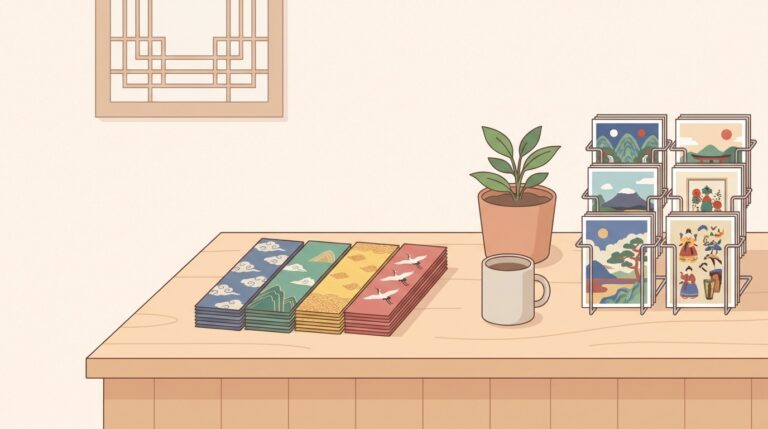
In Korea, museum shops are not an afterthought—they are cultural goldmines. You spot gorgeous mother-of-pearl bookmarks, sleek stationery, and art postcards of the exact masterpiece that touched your heart. You pick up a bookmark and a postcard set. But as you walk up to the counter, your pulse quickens.
How do you say you want these specific items together? What if you want to ask if they have another design, or ask them to wrap it as a gift for your best friend back home? Many of our A2 learners tell us: “I knew how to say ‘이거 주세요 (Please give me this)’, but the moment the cashier asked me about bags or receipts, my mind went completely blank, and I just pointed awkwardly!”
You are not alone! Navigating a Korean museum boutique is an exciting milestone in your language journey. With just a handful of conversational tools, you will transform this quick errand into a warm cultural memory. This practical guide is crafted from real traveler experiences and step-by-step classroom feedback. Let’s dive in together!
Phase 2: Top 3 Core Expressions Deep Dive
1. 이 엽서랑 책갈피 주세요. (I yeopseorang chaekgalpi juseyo.)
- Pronunciation: [I yeop-seo-rang chaek-gal-pi ju-se-yo] (Sounds like: ‘ee yup-suh-rahng check-gahl-pee joo-seh-yoh’)
- Meaning: “Please give me this postcard and bookmark.” (Literal: “This postcard-and bookmark please give.”)
- K-Culture Moment: Seen frequently in K-dramas when the lead characters buy matching souvenirs in romantic artsy districts like Insadong or Samcheong-dong.
- Editor’s Insight: Notice the particle ~랑/이랑 (~rang/irang). At the A2 level, you might have learned ~하고 (~hago) in your textbook. While ~하고 is completely correct, native speakers chatting at a store almost always use ~랑/이랑 because it rolls off the tongue much faster!
- Situation Spectrum:
- Casual (Friends): ⚠️ (Use ‘이거랑 이거 줘’)
- Semi-formal (Polite everyday shopping): ✅ (Perfect!)
- Formal (Official business): ⚠️ (Use ‘이 상품으로 부탁드립니다’)
- 🤔 Think About It: In English, we list items with commas and put “and” right before the last item. In Korean, the connective particle attaches directly to the noun before it. How does this change the rhythm of how you speak?
2. 이거 다른 디자인도 있어요? (Igeo dareun dijaindo isseoyo?)
- Pronunciation: [I-geo da-reun di-ja-in-do it-seo-yo] (Sounds like: ‘ee-guh dah-reun dee-jah-een-doh ees-suh-yoh’)
- Meaning: “Do you have this in other designs too?”
- K-Culture Moment: Browsing through limited-edition museum merchandise (“뮷즈” / MU:DS) where items often come in three or four historical motif variations.
- Editor’s Insight: The tiny particle ~도 (~do) means “also/too.” Adding it turns a basic inquiry into a natural question implying: “I see this one, but are there other options as well?”
- Situation Spectrum:
- Casual: ⚠️ (Use ‘다른 디자인도 있어?’)
- Semi-formal: ✅ (Ideal for museum counters, cafes, and indie bookstores)
- Formal: ⚠️ (Use ‘다른 디자인 상품도 있습니까?’)
- 🤔 Think About It: Korean often leaves out the subject (“Do you…”) because the shared context between you and the clerk is already clear. Do you find omitting “you” intimidating or liberating?
3. 선물용으로 포장해 주실 수 있나요? (Seonmulyong-euro pojanghae jusil su innayo?)
- Pronunciation: [Seon-mul-yong-eu-ro po-jang-hae ju-sil su in-na-yo] (Sounds like: ‘sun-mool-yong-eu-roh poh-jahng-hae joo-sheel soo een-nah-yoh’)
- Meaning: “Could you gift-wrap this for me?” (Literal: “For gift use, can you kindly wrap?”)
- K-Culture Moment: Preparing thoughtful souvenirs (선물) for colleagues or friends before heading to Incheon airport.
- Editor’s Insight: ~용 (~yong) indicates purpose (선물용 = gift purpose, 개인용 = personal use). Asking with ~해 주실 수 있나요? adds an extra layer of soft courtesy that shopkeepers truly appreciate.
- Situation Spectrum:
- Casual: 🚫 (Too polite for close friends)
- Semi-formal: ✅ (Super polite and pleasant)
- Formal: ✅ (Totally acceptable in high-end galleries)
- 🤔 Think About It: Why do Koreans place so much emphasis on delicate wrapping even for small items like bookmarks? It reflects the cultural value of 정 (Jeong)—caring for the recipient’s feeling upon receiving the gift.
Phase 3: Textbook Korean vs. Real Korean
Situation 1: Deciding what to buy at the register
- 📖 Textbook Korean: 이것들을 구매하고 싶습니다. (Igeotdeureul gumaehago sipsumnida. / “I wish to purchase these items.”)
- 🗣️ Real Korean: 이걸로 할게요. (Igeollo halkkeyo. / “I’ll go with these.”)
- 💡 Why it differs: Nobody uses formal words like “구매 (purchase)” in everyday museum boutiques. “이걸로 할게요” is the warm, natural phrase native Koreans use every single day.
Situation 2: The staff asks if you need a shopping bag
- 📖 Textbook Korean: 봉투를 원하십니까? (Bongtureul wonhasimnikka? / “Do you desire a bag?”)
- 🗣️ Real Korean: 담아 드릴까요? / 봉투 필요하세요? (Dama deurilkkayo? / Bongtu piryohaseyo? / “Shall I put it in a bag for you? / Do you need a bag?”)
- 💡 Why it differs: Eco-laws in Korea require shops to charge a tiny fee (usually 100–200 KRW) for shopping bags. Staff naturally ask “담아 드릴까요? (Shall I bag it?)” rather than using textbook vocabulary.
Phase 4: K-Culture Deep Dive & Non-Verbal Manners
4-1. 눈치 (Nunchi) & Gestures
- Two-Handed Delivery: When handing over your credit card or cash, hold it with both hands, or support your right forearm lightly with your left hand. Do the same when receiving your wrapped postcards. This subtle gesture signals respect.
- Delicate Handling: Korean museum merchandise is considered artistic heritage items. Handle paper goods and metal bookmarks with care, holding them by the corners when checking them out on display tables.
- The Quick Polite Bow: When leaving, a slight nod of the head (목례) with “감사합니다 (Gamsahamnida)” completes the interaction beautifully.
4-2. Cultural Code: The ‘뮷즈 (MU:DS)’ Craze
Did you know museum souvenirs in Korea have their own trendy nickname? They are called 뮷즈 (Myutjeu), a playful blend of “Museum” and “Goods (굿즈)”. Young Koreans often queue outside museum stores to collect miniature Joseon-era desk items, celestial map tumblers, and mother-of-pearl phone grips. Souvenirs are no longer tacky trinkets—they are lifestyle statements.
Phase 5: Real-Life Roleplay Scenario
Setting: The sun-drenched museum boutique inside the National Museum of Modern and Contemporary Art (MMCA) in Seoul. Soft instrumental music plays in the background.
Characters: Alex (Curious learner) & Minsu (Attentive museum store clerk).
- Alex: 🎭 Approaching the counter holding a postcard and bookmark
저기요, 이 엽서랑 책갈피 주세요. (Jeogiyo, i yeopseorang chaekgalpi juseyo. / “Excuse me, I’d like this postcard and bookmark, please.”) - Minsu: 🎭 Scanning the items with a welcoming smile
네, 알겠습니다. 이 그림 엽서 정말 인기 많아요! (Ne, algetseumnida. I geurim yeopseo jeongmal ingi manayo! / “Sure! This art postcard is really popular!”) - Alex: 🎭 Smiling back proudly
맞아요, 전시에서 보고 반했어요. (Majayo, jeonsieseo bogo banhaesseoyo. / “Right, I fell in love with it after seeing the exhibition.”) - Minsu: 🎭 Gently holding up the bookmark
혹시 봉투 필요하세요? 백 원 추가되세요. (Hoksi bongtu piryohaseyo? Baek won chugadoeseyo. / “Do you happen to need a bag? It is an extra 100 won.”) - Alex: 🎭 Nodding
네, 담아 주세요. 그리고 선물용으로 포장해 주실 수 있나요? (Ne, dama juseyo. Geurigo seonmulyong-euro pojanghae jusil su innayo? / “Yes, please bag it. And could you wrap it as a gift?”) - Minsu: 🎭 Tucking the bookmark into a small sleeve
그럼요! 작은 선물 봉투에 넣어 드릴게요. (Geureomyo! Jageun seonmul bongtue neoeo deurilgeyo. / “Of course! I’ll put it in a small gift sleeve for you.”) - Alex: 🎭 Handing over the credit card with both hands
감사합니다. 카드로 계산할게요. (Gamsahamnida. Kadeuro gyesanhalgeyo. / “Thank you. I’ll pay by card.”) - Minsu: 🎭 Handing back the receipt and pretty paper bag with both hands
결제 완료되었습니다. 좋은 하루 보내세요! (Gyeolje wanryodoeeotseumnida. Joeun haru bonaeseyo! / “Payment is complete. Have a wonderful day!”)
🔀 Interactive Choice Point
Minsu asks: “영수증 드릴까요? (Yeongsujeung deurilkkayo? / Would you like a receipt?)” How do you respond?
- Option A: “네, 버려 주세요.” (Ne, beoryeo juseyo. / “Yes, please throw it away for me.”)
Feedback: ⚠️ Risk! You said “Yes” but then asked him to throw it away. Instead, say: “아니요, 괜찮아요 (No, I’m okay)” or “버려 주세요 (Please discard it).” - Option B: “아니요, 버려 주세요. 감사합니다!” (Aniyo, beoryeo juseyo. Gamsahamnida! / “No, please throw it away. Thank you!”)
Feedback: 🌟 Best! Natural, direct, and universally understood at any Korean cash register. - Option C: “영수증을 주지 마십시오.” (Yeongsujeungeul juji masipsio. / “Do not give me a receipt.”)
Feedback: 🚫 Bad! Extremely stiff and sounds like a military command. Stick to polite conversational forms!
Phase 6: 10-Second Emotion Shadowing Drill
Practice matching the cadence and emotion of a native speaker! Pay attention to the pauses marked with /.
[😊 Delighted and excited]
이 엽서랑 / 책갈피 주세요!
(I yeopseorang / chaekgalpi juseyo!)-
[🤔 Curious and hopeful]
혹시 / 다른 디자인도 / 있어요?
(Hoksi / dareun dijaindo / isseoyo?) -
[💖 Polite and requesting softly]
선물용으로 / 예쁘게 포장해 주실 수 있나요?
(Seonmulyong-euro / yeppeuge pojanghae jusil su innayo?)
Phase 7: K-Culture Mini Dictionary
- 뮷즈 (Myutjeu) | Museum Merchandise
- Usage: Slang for trendy, aesthetic souvenirs sold exclusively at Korean national museums and art galleries.
- 책갈피 (Chaekgalpi) | Bookmark
- Usage: Essential stationery item. You will often see ‘자개 책갈피’ (mother-of-pearl bookmarks) which make top-tier souvenirs.
- 소장각 (Sojanggak) | “Must-keep” / Worth collecting
- Usage: Slang used when an item is so visually pleasing or meaningful that you feel compelled to own it.
- 포장 (Pojang) | Packaging / Wrapping / Takeout
- Usage: Used widely across retail and restaurants. In food, it means takeout; in shops, it refers to gift wrapping.
Phase 8: Traveler’s Survival Kit
Top 3 Survival Lines
- 이거 하나 더 있어요? (Igeo hana deo isseoyo?)
- Meaning: “Do you have one more of this?”
- Pro Tip: Great when the display shelf only has one item left and you want to buy matching pairs.
- 봉투 안 주셔도 돼요. (Bongtu an jusyeodo dwaeyo.)
- Meaning: *”You don’t need to give me a bag.”
- Pro Tip: Perfect when you have your own tote bag or backpack handy.
- 따로따로 담아 주실 수 있나요? (Ttarottaro dama jusil su innayo?)
- Meaning: *”Could you bag them separately?”
- Pro Tip: Invaluable when buying small gifts for multiple coworkers.
Editor’s Travel Note
- App Navigation: Don’t rely on generic global maps in Korea. Use 네이버 지도 앱 다운로드 to find exact museum store opening hours and hidden exhibition gift shops.
- Payment Culture: South Korea is almost entirely cashless. Even a 500-won postcard can easily be purchased with international credit cards or transportation cards (T-money).
Phase 9: Going One Step Deeper
In many Western cultures, a museum shop visit is an individual souvenir hunt—something to remind you of your personal travels. In Korea, however, shopping at the end of an outing is deeply tied to the philosophy of 선물 문화 (gift-giving culture).
Bringing back a delicate bookmark or a mini postcard print is a way of saying: “While I was admiring this breathtaking art, I thought of you.” It demonstrates attentiveness and community bonding. Even small stationery items act as emotional bridges.
💬 Your Turn: Do you prefer buying souvenirs for yourself to remember a trip, or picking up gifts for others? What is your favorite kind of museum souvenir? Share with us in the comments below!
Phase 10: FAQ & Common Pitfalls
Q: Can I ask the staff to wrap items separately if I buy several bookmarks?
A: Yes! Simply say: “따로따로 포장해 주세요 (Ttarottaro pojanghae juseyo / Please wrap them separately).” Most museum staff are very accommodating and have small envelopes ready.
Q: What is the difference between ‘엽서 (yeopseo)’ and ‘카드 (kadeu)’?
A: ‘엽서 (yeopseo)’ specifically refers to flat postcards without folding, while ‘카드 (kadeu)’ usually refers to greeting cards that open and come with an envelope (or credit cards, depending on context!).
Q: Do museum shops charge for gift wrapping?
A: Simple envelope packaging is almost always free. However, premium box packaging with traditional ribbon or Bojagi (cloth wrapping) may incur a small fee (usually 2,000 to 5,000 KRW).
🚨 Common Mistakes Warning Board
- Mistake: Pointing and saying “저거 주세요” when holding the item in your hand.
- Correct Action: If you are holding the item, say “이거 주세요 (Igeo juseyo)”. “저거 (Jeogeo)” refers to something far away from both you and the clerk.
- Mistake: Saying “감사합니다” while handing your card with one limp hand.
- Correct Action: Always use both hands or hold your elbow. It shows instant respect and warmth!
- Mistake: Confusing “봉투 (Bongtu / Bag, envelope)” with “포장 (Pojang / Wrapping)”.
- Correct Action: If you just want a carrier bag to carry your items, ask for a “봉투”. If you want it wrapped nicely as a present, ask for “선물 포장”.
Phase 11: Action Missions & Engagement
- 🥉 Bronze Mission (Solo): Read the Phase 6 Shadowing Drill aloud 3 times, focusing on natural pauses and friendly intonation.
- 🥈 Silver Mission (Social): Leave a comment below translating this sentence into Korean: “Please give me two postcards and one bookmark!”
- 🥇 Gold Mission (Real Life): On your next visit to a museum or stationery shop in Korea, order without switching to English, using “이거랑 이거 주세요!”
- 🎮 K-Culture Mission: Search the hashtag
#뮷즈on Instagram or YouTube. Spot three unique souvenirs you would love to buy on your next trip to Seoul!
Phase 12: Interactive Quiz Challenge
Quiz 1: Situation Judgment
You picked up a beautiful ceramic magnet, but you want to check if they have a blue version. What do you say?
* A) 이거 파란색도 있어요? (Igeo paransaekdo isseoyo?)
* B) 파란색을 사십시오. (Paransaegeul sasipsio.)
* C) 파란색이 없습니다. (Paransaegi eopseumnida.)
👉 Click to reveal Answer & Explanation
Answer: A
Explanation: Adding ~도 있어요? asks politely if that color/option is also available. Option B is a command to someone else to buy it, and Option C merely states that blue does not exist!
Quiz 2: Fill in the Blank
Complete the sentence to say: “Please give me this postcard AND (this) bookmark.”
* “이 엽서____ 책갈피 주세요.”
👉 Click to reveal Answer & Explanation
Answer: 랑 (rang)
Explanation: Since ‘엽서’ ends in a vowel (서), the natural conversational particle is ~랑. (If it ended with a consonant, we would use ~이랑).
Quiz 3: True or False (Culture Check)
True or False: In Korea, plastic or paper shopping bags at stores are always provided free of charge by law.
👉 Click to reveal Answer & Explanation
Answer: False
Explanation: Environmental protection regulations in South Korea require retail stores to charge a small fee (typically 100-200 won) for disposable shopping bags. That is why clerks always ask: “봉투 필요하세요? (Do you need a bag?)”







