

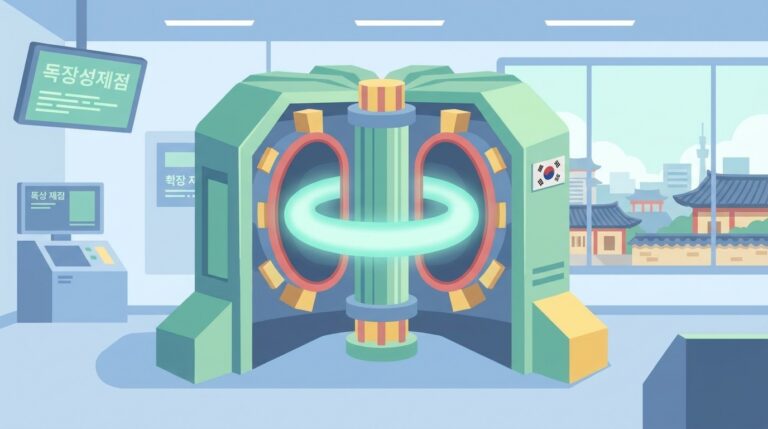
Mastering Deep-Tech Korean: Inside the High-Stakes World of Nuclear Fusion & SMRs
Phase 1: Empathy (Immersive Opening)
안녕하세요! 매일한글 에디터입니다. (Hello! It’s your Daily Hangul editor.)
Picture this: You are sitting in an upscale cafe near Pangyo Techno Valley or having a post-symposium dinner in Daedeok Science Town in Daejeon. Across the table sits a seasoned lead engineer from a cutting-edge deep-tech startup, someone who spends their days wrestling with plasma instabilities inside tokamak reactors and miniaturizing high-temperature superconducting (HTS) magnets. You understand the core physics inside out. In English, you can dissect beta limits, magnetic confinement, and small modular reactor (SMR) supply chains with surgical precision. But the moment the dialogue shifts to Korean, you find yourself stuck using stilted, textbook phrases like “그것은 매우 중요하고 어렵습니다” (That is very important and difficult).
Suddenly, the dynamic room full of venture capitalists, quantum physicists, and national lab directors leaves you on the sidelines. You nod along while hearing phrases like “상용화 시계를 앞당기다” (accelerating the timeline to commercialization) or “난제를 돌파하다” (breaking through an intractable bottleneck), wishing you could articulate your high-stakes insights with the sophistication expected at the C2 level.
Learning to debate nuclear fusion and next-gen baseload power in Korean is not just about translating technical vocabulary—it is about commanding the authoritative, momentum-driven rhetorical style of Korean high-tech pioneers. This guide is built directly on real feedback from foreign researchers, venture analysts, and engineers working in Korea’s world-leading energy sector. By the end of this deep dive, you won’t just follow the technical jargon; you will speak with the gravitas of an elite Korean deep-tech insider.
Phase 2: Core Expressions Deep Dive
1. 상용화 시계를 앞당기다 (Sang-yong-hwa si-gye-reul ap-dang-gi-da)
- Pronunciation: [Sang-yong-hwa shi-gye-reul ap-dang-gi-da] (Think of sang-yong like the automaker SsangYong, shigye like a ticking wristwatch, and ap-dang-gi-da as pulling a rope forward toward yourself).
- Meaning: Literally “To pull forward the commercialization clock”; practically means radically accelerating the timeline to market deployment through disruptive innovation.
- K-Culture Moment: Seen frequently in tech thrillers and boardroom dramas like Start-Up or Search: WWW, where a visionary founder delivers a high-stakes pitch to skeptical venture capitalists.
- Editor’s Insight: Everyday speakers might say “빨리 개발하다” (to develop quickly), but elite corporate and scientific circles personify the calendar as a physical clock (시계) that can be wrenched forward through sheer technological breakthroughs (기술적 돌파구).
- Situation Spectrum: Casual ⚠️ | Semi-formal ✅ | Formal ✅
- 🤔 Think About It: Why does Korean corporate discourse favor active chronological metaphors like “pulling the clock forward” instead of passive milestones like “the schedule was shortened”?
2. 난제를 돌파하다 (Nan-je-reul dol-pa-ha-da)
- Pronunciation: [Nan-je-reul dol-pa-ha-da] (Nan-je rhymes with ‘pan-day’; dol-pa sounds like smashing through a concrete wall).
- Meaning: Literally “To break through an intractable problem”; practically means cracking an overwhelming scientific bottleneck or technical impasse.
- K-Culture Moment: Featured in documentary specials covering the Korea Superconducting Tokamak Advanced Research (KSTAR) facility, often dubbed “Korea’s Artificial Sun,” celebrating a world-record plasma run.
- Editor’s Insight: Do not confuse this with “문제를 해결하다” (to solve a problem). 난제 (難題) implies a challenge so colossal that standard methods fail, while 돌파 (突破) conveys kinetic momentum—physically battering through a barricade.
- Situation Spectrum: Casual ⚠️ | Semi-formal ✅ | Formal ✅
- 🤔 Think About It: In your native language, do you “solve,” “crack,” or “charge through” scientific bottlenecks? What does “돌파” (breakthrough/penetration) say about Korea’s historic catch-up industrial drive?
3. 기저부하를 뒷받침하다 (Gi-jeo-bu-ha-reul dwit-bat-chim-ha-da)
- Pronunciation: [Gi-jeo-bu-ha-reul dwit-pat-chim-ha-da] (Gi-jeo like ground/base, bu-ha like electrical load, dwit-bat-chim like structural scaffolding bolstering a wall from behind).
- Meaning: Literally “To prop up / support the baseload from behind”; practically means providing the unshakeable foundation for grid reliability and uninterrupted carbon-free energy.
- K-Culture Moment: A staple phrase on late-night political panel debates on JTBC or KBS when energy policymakers discuss replacing fossil fuels with SMRs.
- Editor’s Insight: 뒷받침하다 is one of the most powerful C2 verbs in executive Korean. It implies serving as the unheralded yet indispensable structural spine that allows other systems (like volatile renewables) to flourish.
- Situation Spectrum: Casual 🚫 | Semi-formal ✅ | Formal ✅
- 🤔 Think About It: Contrast the visual imagery of Western phrases like “anchoring the grid” or “spearheading baseload” with the Korean concept of “bolstering from the rear” (뒷받침).
Phase 3: Textbook Korean vs. Real Korean
Situation 1: Explaining that AI plasma control has cut development time
- 📖 교과서 한국어 (Textbook): 인공지능 기술 덕분에 핵융합 상용화가 더 빨라질 것으로 생각됩니다. (In-gong-ji-neung gi-sul deok-bun-e haek-yung-hap sang-yong-hwa-ga deo bpal-la-jil geot-eu-ro saeng-gak-doem-ni-da.) — Due to artificial intelligence technology, nuclear fusion commercialization is thought to become faster.
- 🗣️ 진짜 한국어 (Real-World C2): AI 기반 플라스마 제어 기술이 안착되면서 민간 스타트업들의 상용화 시계가 눈에 띄게 앞당겨지고 있습니다. (AI gi-ban peul-la-seu-ma je-eo gi-sul-i an-chak-doe-myeon-seo min-gan seu-ta-teu-eop-deul-ui sang-yong-hwa si-gye-ga nun-e ttui-ge ap-dang-gyeo-ji-go it-seumnida.)
- 💡 왜 다를까? (Why is it different?): Native tech executives avoid passive, uncertain phrases like “생각됩니다” (it is thought). They weave in precise operational verbs like “안착되다” (to take root / stabilize securely) and idiomatic time-compression imagery like “상용화 시계가 앞당겨지다.”
Situation 2: Stating that magnetic confinement has hit an engineering wall
- 📖 교과서 한국어 (Textbook): 현재 자석 기술에 많은 문제가 있어서 플라스마 제어가 어렵습니다. (Hyeon-jae ja-seok gi-sul-e man-eun mun-je-ga it-seo-seo peul-la-seu-ma je-eo-ga eo-ryeop-seumnida.) — Currently, because of many problems in magnet technology, plasma control is difficult.
- 🗣️ 진짜 한국어 (Real-World C2): 초전도 자석의 소형화 과정에서 발생하는 열적 난제를 돌파하지 못하면 치명적인 병목 현상에 직면하게 됩니다. (Cho-jeon-do ja-seok-ui so-hyeong-hwa gwa-jeong-e-seo bal-saeng-ha-neun yeol-jeok nan-je-reul dol-pa-ha-ji mot-ha-myeon chi-myeong-jeok-in byeong-mok hyeon-sang-e jik-myeon-ha-ge doem-ni-da.)
- 💡 왜 다를까? (Why is it different?): High-level discussions substitute pedestrian words like “문제” (problem) and “어렵다” (difficult) with razor-sharp technical terminology such as “열적 난제” (thermal bottleneck/conundrum) and “치명적인 병목 현상” (fatal bottleneck).
Phase 4: K-Culture Deep Dive & Non-Verbal Manners
4-1. 눈치 (Nunchi) & Non-Verbal Boardroom Manners
When presenting deep-tech breakthroughs or discussing contentious engineering failures in a Korean R&D setting:
1. The Dual-Handed Point: Never point at a slide or a tokamak CAD model with a single index finger. Hold your presentation pointer with both hands or rest your non-dominant hand lightly beneath your pointing forearm. This conveys profound respect for the collective effort of the engineering cohort.
2. The Measured Nod (고개 끄덕임): When senior scientists or venture partners raise skepticism about high-temperature superconducting (HTS) degradation, do not immediately counter them. Pause, nod slowly twice to signal intellectual receptivity (경청), and open your rebuttal with: “지적해 주신 리스크에 전적으로 공감하며…” (Fully agreeing with the risk you pointed out…).
3. Controlled Posture: In high-stakes technological negotiations, leaning back casually is interpreted as arrogance or technological flippancy. Keep both forearms gently resting on the conference table, leaning forward slightly (about 10 degrees) to project intense focus and scientific humility.
4-2. Cultural Code: The “Pangyo-Daedeok Corridor”
Korea’s nuclear and clean-tech landscape is uniquely divided into two cultural hubs: Daedeok (Daejeon), the birthplace of government-backed research institutes (출연연) known for deep-rooted academic hierarchy, and Pangyo (Gyeonggi-do), the Silicon Valley of Korea, driven by agile, venture-backed tech startups. Today, private fusion startups are blending Daedeok’s rigorous nuclear engineering pedigree with Pangyo’s Silicon-Valley-style “fail fast” AI culture. Mastering this linguistic blend—marrying formal academic deference with dynamic startup urgency—marks you instantly as an elite insider.
Phase 5: Real-World Roleplay Scenario
Setting: A sleek executive meeting room overlooking the R&D center of “NovaFusion Korea” in Daejeon. You are consulting with Dr. Kang Min-seok, Chief Technology Officer.
- Turn 1 (Dr. Kang): 이번 분기 고온 초전도 자석 테스트 결과는 확인하셨습니까? (I-beon bun-gi go-on cho-jeon-do ja-seok te-seu-teu gyeol-gwa-neun hwak-in-ha-syeot-seumnikka?) [🎭 Tapping a stack of plasma diagnostic reports with a stern, analytical expression] (Have you reviewed this quarter’s high-temperature superconducting magnet test results?)
- Turn 2 (You): 네, 강 박사님. 자석 소형화에 따른 열 부하 데이터가 예상보다 훨씬 고무적이었습니다. (Ne, Kang bak-sa-nim. Ja-seok so-hyeong-hwa-e tta-reun yeol bu-ha de-i-teo-ga ye-sang-bo-da hwol-ssin go-mu-jeok-i-eot-seumnida.) [🎭 Leaning forward with confidence, maintaining steady eye contact] (Yes, Dr. Kang. The thermal load data from magnet miniaturization was far more encouraging than anticipated.)
- Turn 3 (Dr. Kang): 고무적이긴 합니다만, 1억 도 이상의 초고온 플라스마 불안정성을 과연 AI 모델이 실시간으로 통제할 수 있을지가 여전히 미지수입니다. (Go-mu-jeok-i-gin ham-ni-da-man, il-eok do i-sang-ui cho-go-on peul-la-seu-ma bul-an-jeong-seong-eul gwa-yeon AI mo-del-i sil-si-gan-eu-ro tong-je-hal su iss-eul-ji-ga yeo-jeon-hi mi-ji-su-im-ni-da.) [🎭 Crossing his arms thoughtfully, furrowing his brow] (Encouraging as it may be, whether an AI model can control plasma instabilities exceeding 100 million degrees in real time remains a massive unknown.)
- Turn 4 (You): 바로 그 지점입니다. 강화학습 알고리즘의 반응 속도를 마이크로초 단위로 단축시켜 플라스마 난제를 돌파했습니다. (Ba-ro geu ji-jeom-im-ni-da. Gang-hwa-hak-seup al-go-ri-jeum-ui ban-eung sok-do-reul ma-i-keu-ro-cho dan-wi-ro dan-chuk-si-kyeo peul-la-seu-ma nan-je-reul dol-pa-haet-seumnida.) [🎭 Presenting a real-time latency benchmark graph with a poised two-handed gesture] (That is precisely the point. By compressing the reinforcement learning model’s response latency down to microseconds, we broke through that plasma bottleneck.)
- Turn 5 (Dr. Kang): 마이크로초 단위 제어라… 그렇다면 파일럿 원자로의 실증 일정도 재조정할 수 있겠군요? (Ma-i-keu-ro-cho dan-wi je-eo-ra… Geu-reoh-da-myeon pa-il-lot won-ja-ro-ui sil-jeung il-jeong-do jae-jo-jeong-hal su it-get-gun-yo?) [🎭 Eyes widening slightly, adjusting his glasses in quiet astonishment] (Microsecond control… Does that mean we can recalibrate the pilot reactor demonstration roadmap?)
- Turn 6 (You): 맞습니다. 이 기술적 돌파구 덕분에 당사의 상용화 시계를 최소 3년 이상 앞당길 수 있습니다. (Mat-seumnida. I gi-sul-jeok dol-pa-gu deok-bun-e dang-sa-ui sang-yong-hwa si-gye-reul choe-so sam-nyeon i-sang ap-dang-gil su it-seumnida.) [🎭 Delivering the statement with steady cadence and unwavering composure] (Exactly. Thanks to this engineering breakthrough, we can pull forward our commercialization timeline by at least three years.)
- Turn 7 (Dr. Kang): 대단하군요. 이것이 입증된다면 재생에너지의 간헐성을 보완할 최고의 무탄소 기저부하가 완성되는 셈입니다. (Dae-dan-ha-gun-yo. I-geot-i ip-jeung-doen-da-myeon jae-saeng-e-neo-ji-ui gan-hyeol-seong-eul bo-wan-hal choe-go-ui mu-tan-so gi-jeo-bu-ha-ga wan-seong-doe-neun sem-im-ni-da.) [🎭 Nodding deeply in agreement, a rare smile appearing] (Remarkable. If verified, this essentially completes the ultimate carbon-free baseload to offset the intermittency of renewables.)
- Turn 8 (You): 청정 전력망 구축을 위해 정부 실증 사업과 연계하여 기저부하를 뒷받침하는 데 만전을 기하겠습니다. (Cheong-jeong jeon-ryeok-mang gu-chuk-eul wi-hae jeong-bu sil-jeung sa-eop-gwa yeon-gye-ha-yeo gi-jeo-bu-ha-reul dwit-bat-chim-ha-neun de man-jeon-eul gi-ha-get-seumnida.) [🎭 Bowing head courteously at a clean 15-degree angle] (We will do our utmost to support the baseload grid in tandem with state demonstration programs to build a clean power infrastructure.)
🔀 Interactive Decision Point
How do you conclude your pitch when Dr. Kang asks: “Can your team guarantee stability in next week’s live test?”
- Option A: “무조건 100% 성공할 테니 아무 걱정 하지 마십시오!” (Mu-jo-geon baek-pro seong-gong-hal te-ni a-mu geok-jeong ha-ji ma-sip-si-o! / It will succeed 100% unconditionally, so don’t worry at all!)
- Option B: “시뮬레이션 오차 범위를 0.01% 내로 억제했으므로, 실증 단계에서도 안정적인 기저부하 성능을 입증해 보이겠습니다.” (Si-myul-le-i-syeon o-cha beom-wi-reul yeong-jeom-yeong-il-pro nae-ro eok-je-haet-seu-meu-ro, sil-jeung dan-gye-e-seo-do an-jeong-jeok-in gi-jeo-bu-ha seong-neung-eul ip-jeung-hae bo-i-get-seumnida. / Since we suppressed simulation margin of error within 0.01%, we will prove stable baseload performance during the demonstration phase.)
- Option C: “글쎄요, 양자역학적 변수가 워낙 많아서 솔직히 저도 잘 모르겠습니다.” (Geul-sse-yo, yang-ja-yeok-hak-jeok byeon-su-ga wo-nak man-a-seo sol-jik-hi jeo-do jal mo-reu-get-seumnida. / Well, there are so many quantum variables that honestly even I don’t know.)
Feedback on Options:
- Option A (Risk): In Korean R&D environments, claiming “무조건 100%” (unconditionally 100%) sounds like amateurish bluster and erodes scientific credibility immediately.
- Option B (Best!): Professional, quantitative, and reassuring. It marries technical prudence with resolute leadership (입증해 보이겠습니다).
- Option C (Bad): While scientific humility is valued, expressing helpless uncertainty (잘 모르겠습니다) in an executive briefing signals a total lack of readiness.
Phase 6: 10-Second Emotion Shadowing Drill
Practice reading these sentences aloud. Observe the cadence markers (/) for natural breath control, and embody the emotional stage directions.
[🔥 단호하고 자신감 넘치게 — Resolute & Confident]
“초전도 자석의 혁신 덕분에 / 민간 주도의 상용화 시계가 / 눈부시게 앞당겨지고 있습니다.”
(Cho-jeon-do ja-seok-ui hyeok-sin deok-bun-e / min-gan ju-do-ui sang-yong-hwa si-gye-ga / nun-bu-si-ge ap-dang-gyeo-ji-go it-seumnida.)-
[🧐 지적이고 냉철하게 — Analytical & Poised]
“플라스마 불안정성이라는 난제를 돌파해야만 / 진정한 무탄소 에너지원으로서 / 기저부하를 뒷받침할 수 있습니다.”
(Peul-la-seu-ma bul-an-jeong-seong-i-ra-neun nan-je-reul dol-pa-hae-ya-man / jin-jeong-han mu-tan-so e-neo-ji-won-eu-ro-seo / gi-jeo-bu-ha-reul dwit-bat-chim-hal su it-seumnida.) -
[🤝 신뢰감을 주는 어조로 — Trustworthy & Visionary]
“저희 연구팀은 / 이번 실증 사업을 통해 / 차세대 원자력 분야의 초격차를 / 반드시 달성하겠습니다.”
(Jeo-hui yeon-gu-tim-eun / i-beon sil-jeung sa-eop-eul tong-hae / cha-se-dae won-ja-ryeok bun-ya-ui cho-gyeok-cha-reul / ban-deu-si dal-seong-ha-get-seumnida.)
Phase 7: K-Culture Mini Dictionary
-
초전도 (Cho-jeon-do) | Superconductivity
Usage: From the viral LK-99 craze that swept Korean social media to elite scientific discourse around high-temperature superconducting (HTS) magnets, this term is a national buzzword. In business: “초전도 기술을 적용한 소형화” (Miniaturization applying superconductivity). -
병목 현상 (Byeong-mok hyeon-sang) | Bottleneck
Usage: Literally “bottle-neck phenomenon.” Widely used across Korean venture capital pitches, manufacturing audits, and traffic reports to pinpoint the single chokepoint strangling throughput. -
초격차 (Cho-gyeok-cha) | Super-Gap / Unassailable Lead
Usage: Coined originally within Samsung Electronics’ semiconductor strategy, this denotes widening a technological lead so massively that competitors cannot bridge it. Used heavily by SMR and fusion developers. -
마일스톤 (Ma-il-seu-ton) | Milestone
Usage: While “중간 목표” (intermediate target) exists, high-tech executives in Korea almost exclusively use the loanword “마일스톤을 달성하다” (to hit a milestone) in grant applications and investor updates.
Phase 8: Traveler & Professional Survival Kit
Top 3 Survival Expressions for High-Tech Industry Expos (COEX / BEXCO)
- “부스에서 기술 시연을 직접 볼 수 있을까요?” (Bu-seu-e-seo gi-sul si-yeon-eul jik-jeop bol su iss-eul-kka-yo?)
Can I watch the live technology demonstration at your booth?
Pro Tip: Use this at major energy summits like ENTECH or Korea Energy Show to bypass generic sales pitches and talk directly to engineers. - “핵심 특허와 상용화 로드맵 자료가 구비되어 있습니까?” (Haek-sim teuk-heo-wa sang-yong-hwa ro-deu-maep ja-ryo-ga gu-bi-doe-eo it-seumnikka?)
Do you have materials available regarding your core patents and commercialization roadmap?
Pro Tip: Handing over your business card with both hands while asking this instantly unlocks technical white papers. - “명함 한 장 건네드려도 되겠습니까? 추후 미팅 일정을 조율하고 싶습니다.” (Myeong-ham han jang geon-ne-deu-ryeo-do doe-get-seumnikka? Chu-hu mi-ting il-jeong-eul jo-yul-ha-go sip-seumnida.)
May I offer you my business card? I would love to coordinate a follow-up meeting.
Pro Tip: Never write notes on the other person’s business card in front of them; it is seen as disrespectful to their corporate persona.
Editor’s Travel Note
- Navigating Korea’s Tech Spine: If you are visiting scientific facilities in Daejeon or KINGS (KEPCO International Nuclear Graduate School) in Ulsan, book your tickets using the official Korail Talk App on Google Play well in advance. Commuting between Seoul Station and Daejeon takes just 55 minutes via KTX.
- Local Navigation: Google Maps does not provide walking/driving directions effectively in Korea due to local security regulations. Download the Naver Map Navigation App to find research institute gates, secret lab lounges, and university tech corridors with seamless GPS accuracy.
Phase 9: “One Step Deeper” (Cultural Reflection)
In Korean corporate and technological discourse, words like 초격차 (Cho-gyeok-cha / Super-gap) and 자립 (Ja-rip / Self-reliance) carry historical weight far beyond economic metrics. Having transformed from an agrarian war-torn country into a nuclear-exporting powerhouse within half a century, Korea views baseload energy technology not merely as a commercial asset, but as a sovereign safeguard.
When a Korean deep-tech founder tells you they are trying to “상용화 시계를 앞당기다,” they are not just discussing venture ROI; they are invoking the spirit of Ppalli-ppalli (빨리빨리 / fast-paced dynamism) elevated to the level of planetary survival. Language is a window into a culture’s survival instincts.
💬 Your Turn: Does your home country prioritize public-funded mega-projects (like ITER) or venture-backed private startups when addressing clean-energy baseload challenges? Share your thoughts below in Korean using today’s vocabulary!
Phase 10: FAQ & Common Pitfalls
Q: Can I use “돌파하다” for everyday personal troubles, like passing a driver’s test?
A: Technically yes, but it sounds hyper-dramatic. If you say “운전면허 시험이라는 난제를 돌파했다” (I broke through the intractable conundrum of the driver’s license test), native speakers will laugh because 난제 and 돌파 are reserved for colossal academic, industrial, or life-defining impasses.
Q: What is the exact difference between “원자력” (Won-ja-ryeok) and “핵융합” (Haek-yung-hap)?
A: “원자력” (Atomic/Nuclear power) in standard Korean usually implies conventional nuclear fission (핵분열). When discussing fusion, always explicitly use “핵융합” (Nuclear Fusion) to avoid political or environmental confusion regarding radioactive waste debates.
Q: Is “SMR” pronounced as letters in Korean or translated?
A: In industry panels, Koreans frequently pronounce it letter-by-letter as “에스-엠-알” (S-M-R) or formally translate it as “소형 모듈 원전” (So-hyeong mo-dyul won-jeon). Both are accepted at the C2 executive level.
🚨 흔한 실수 (Common Mistakes)
| Mistake | Why It’s Awkward | Correct Action |
|---|---|---|
| “우리는 상용화 시간을 빠르게 했어요.” | “시간을 빠르게 하다” sounds like accelerating the flow of time itself in a sci-fi movie. | Use “상용화 시계를 앞당겼습니다” (pulled the commercialization clock forward). |
| Saying “원전문제를 풀다” in a board pitch. | Too colloquial; sounds like doing grade-school math homework. | Upgrade to “원전 엔지니어링의 난제를 돌파하다”. |
| Referring to baseload power simply as “기본 전기”. | “기본 전기” means basic household electricity. | Always use the technical term “기저부하” (Baseload power). |
Phase 11: Action Mission & Engagement
- 🥉 Bronze Mission: Read the Phase 6 Emotion Shadowing Drill aloud three times. Focus on holding your breath at the slashes (
/) and exploding with conviction on “앞당겨지고 있습니다!” - 🥈 Silver Mission: Write a 2-sentence comment on LinkedIn or Twitter/X discussing clean energy, incorporating the expression “기저부하를 뒷받침하다”.
- 🥇 Gold Mission: Watch a short YouTube clip from KSTAR or KAERI (Korea Atomic Energy Research Institute), pause when you hear terms like 초전도 or 상용화, and shadow the speaker’s intonation in real-time.
- 🎮 K-Culture Quest: Search the hashtag
#KSTARor#인공태양(Artificial Sun) on Korean portal sites like Naver and find one news headline using the verb “돌파하다”.
Phase 12: Interactive Quiz Challenge
1. Situational Judgment
You are presenting to the Ministry of Science and ICT. You want to convey that your private fusion startup’s high-temperature superconducting magnet has eliminated the risk of overheating. Which sentence sounds most sophisticated and native?
* A) 우리 자석이 시원해서 이제 안 뜨겁습니다.
* B) 고온 초전도 자석의 열 방출 난제를 완벽히 돌파하여 시스템 안정성을 확보했습니다.
* C) 자석 문제 해결이 빨라져서 개발 시간이 없어졌습니다.
2. Fill-in-the-Blank
“신재생에너지의 간헐성을 극복하고 안정적인 전력망을 구축하기 위해서는 차세대 SMR이 탄탄한 (_________)를 뒷받침해야 합니다.”
* A) 기저부하 (Baseload)
* B) 초격차 (Super-gap)
* C) 마일스톤 (Milestone)
3. True or False
In Korean corporate tech vocabulary, “상용화 시계를 앞당기다” implies delaying the product launch to ensure higher scientific accuracy.
* (True / False)
👉 Click here to reveal Answers & Detailed Explanations
-
Answer: B
Explanation: Option B uses professional lexicon (“열 방출 난제를 완벽히 돌파하여” — completely breaking through the heat dissipation bottleneck), projecting supreme C2 authority. Option A is childishly informal, while Option C is grammatically clumsy. -
Answer: A (기저부하)
Explanation: The sentence discusses balancing renewable intermittency with round-the-clock power, which refers specifically to “기저부하” (Baseload power). -
Answer: False
Explanation: “앞당기다” means to pull forward or advance a date (making it happen sooner), not to postpone it (which would be “미루다” or “연기하다”).







