

Phase 1: Empathy (Immersion Opening)
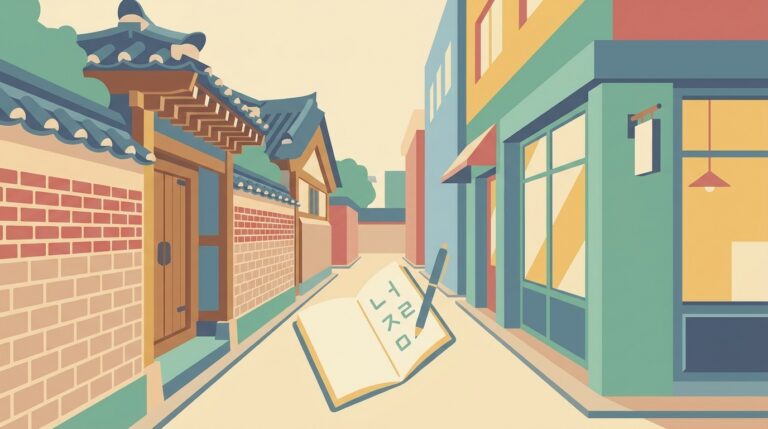
안녕하세요! 매일한글 에디터입니다. (Hello! This is your Daily Hangul Editor.) Have you ever had this heartbreaking experience in Seoul? You discover a charming, labyrinthine back alley in Mullae-dong or Ikseon-dong—tucked away behind old metalworks or fading 1970s brick homes—where an independent ceramicist serves hand-brewed filter coffee among exhibition frames. You fall in love with its soul. Yet, when you eagerly take a friend back just six months later, that cozy atelier is gone. In its place stands a generic franchise cosmetic boutique or an overpriced chain bakery, accompanied by stark ‘For Lease’ signs and glossy neon lights.
This phenomenon is the heart of 젠트리피케이션 (jenteuripikeisyeon – gentrification) and the painful loss of 장소성 (jangsoseong – placelessness/sense of place). For advanced C1 Korean learners, moving beyond basic everyday chit-chat means being able to articulate these socio-spatial transformations. When you discuss urban evolution, neighborhood preservation, and economic displacement with native Korean speakers, you are stepping directly into the living room of contemporary Korean socio-political debates. Drawing from years of working with advanced international residents, artists, and researchers in Seoul, this guide provides the exact nuanced vocabulary, conversational idioms, and sociocultural insights you need to debate this complex reality like an educated local.
Phase 2: Core Expressions In-Depth Analysis
1. 둥지 내몰림 (Dungji naemollim)
- Pronunciation: [Dung-ji nae-mol-lim] (Think of dung-ji like the cozy ‘nest’ of a bird, and nae-mol-lim sounding like an abrupt ‘shoving outward’)
- Meaning: Literal: “Being driven out of one’s nest.” Actual Nuance: The organic Korean term for commercial and residential displacement caused by rapid gentrification.
- K-Culture Moment: Seen frequently in investigative journalism shows like PD Notebook or indie social-issue documentaries covering urban renewal conflicts in Seongsu-dong and Euljiro.
- Editor’s Insight: While academics originally imported the English loanword 젠트리피케이션, the public and civic organizations coined 둥지 내몰림 to evoke raw emotional empathy. It portrays vulnerable local merchants and bohemian creators as birds violently stripped of their sheltering nests.
- Situation Spectrum: Casual: ⚠️ | Semi-formal: ✅ | Formal: ✅
- 🤔 Think About It: English often uses technical, structural terms like displacement or eviction. Why do you think Korean society embraces an avian metaphor (nest) to describe real estate pressures?
2. 무분별한 상업화로 골목의 고유성이 퇴색되다 (Mubunbyeolhan sang-eophwaro golmok-ui goyuseong-i toesaekdoeda)
- Pronunciation: [Mu-bun-byeol-han sang-eop-hwa-ro gol-mok-ui go-yu-seong-i toe-saek-doe-da]
- Meaning: Literal: “The alleyway’s uniqueness fades away due to indiscreet commercialization.” Actual Nuance: A sophisticated analytical statement describing how authentic neighborhood character is homogenized into commercial tourist traps.
- K-Culture Moment: Frequently used by architecture critics, culture journalists on JTBC debate panels, or reflective travel essayists.
- Editor’s Insight: The verb 퇴색되다 (to discolor/fade) elevates this phrase into genuine C1-level discourse. It does not simply mean ‘to disappear’ (사라지다); it captures the gradual bleaching out of character, just like vintage fabric exposed to too much harsh sunlight.
- Situation Spectrum: Casual: 🚫 | Semi-formal: ✅ | Formal: ✅
- 🤔 Think About It: How does your native language describe the loss of local atmosphere? Does it focus on monetary loss or cultural dilution?
3. 상생 방안을 마련하다 (Sangsaeng bang-an-eul maryeonhada)
- Pronunciation: [Sang-saeng bang-an-eul ma-ryeon-ha-da]
- Meaning: Literal: “To prepare a mutual coexistence plan.” Actual Nuance: Crafting pragmatic policies or tenant-landlord agreements where original creators, residents, and property owners thrive symbiotically without exploitation.
- K-Culture Moment: Heard constantly during local district town halls, municipal speeches by Seoul’s mayor, or corporate ESG strategy meetings.
- Editor’s Insight: 상생 (Sangsaeng – mutual flourishing) is rooted in East Asian philosophy (coexistence in harmony). In modern civil discourse, proposing a 상생 방안 demonstrates maturity and constructive conflict-resolution skills rather than pure cynicism.
- Situation Spectrum: Casual: ⚠️ | Semi-formal: ✅ | Formal: ✅
- 🤔 Think About It: Does corporate revitalization in your home country usually seek voluntary community compacts, or does it rely solely on strict statutory zoning laws?
Phase 3: Textbook Korean vs. Real Korean
Situation 1: Describing a sudden rent hike driving out an indie coffee shop
- 📖 교과서 한국어 (Textbook):
임대료가 너무 많이 올라서 상인들이 다른 곳으로 이사를 가야 합니다.
(Imdaeryoga neomu mani ollaseo sang-indeuri dareun goseuro isareul gaya hamnida.)
“Because the rent rose too much, merchants have to move to another place.” - 🗣️ 진짜 한국어 (Real-life C1 Korean):
임대료가 하룻밤 사이에 치솟아서, 결국 원년 멤버들은 외곽으로 밀려나고 있어요.
(Imdaeryoga harutbam saie chisosaseo, gyeolguk wonnyeon membeodeureun oegwageuro millyeonago isseoyo.)
“Rents spiked practically overnight, so the foundational trailblazers are inevitably being pushed out to the fringes.” - 💡 왜 다를까? (Why the difference?): Native speakers use colorful compound verbs like 치솟다 (to skyrocket/surge upward) and expressive cultural metaphors like 원년 멤버 (foundational members/trailblazers) to capture the human drama of urban displacement.
Situation 2: Expressing regret over a neighborhood losing its soul to corporate chains
- 📖 교과서 한국어 (Textbook):
이 동네는 옛날 분위기가 없어지고 유명한 가게들만 생겼어요.
(I dongneneun yennal bunwigiga eopseojigo yumyeonghan gagedeulman saenggyeosseoyo.)
“This neighborhood lost its old atmosphere and only famous stores opened.” - 🗣️ 진짜 한국어 (Real-life C1 Korean):
골목 특유의 정취는 온데간데없고, 대기업 프랜차이즈가 점령해서 씁쓸하네요.
(Golmok teugyui jeongchwineun onde-gande-eopgo, daegieop peuraenchaijeuga jeomnyeonghaeseo sseupsseulhaneyo.)
*”The alley’s distinctive sentimental charm is nowhere to be found, and it leaves a bitter taste to see big corporate franchises conquer it.” - 💡 왜 다를까? (Why the difference?): C1 discourse harnesses evocative idioms like 온데간데없다 (vanished without a trace) and psychological adjectives like 씁쓸하다 (bittersweet/regretfully empty).
Phase 4: K-Culture Deep Dive & Non-Verbal Manners
4-1. 눈치 (Nunchi) & Non-Verbal Manners
When exploring transitioning urban spaces (like the steel-mill backstreets of Mullae Art Village or the narrow steps of Haebangchon), cultural sensitivity is paramount:
* The Empathetic Sigh (씁쓸한 한숨): When an elder workshop owner or indie barista explains that their building was recently bought out by a property speculator, never offer upbeat business cliches like “Well, at least the area is famous!” Instead, nod slowly with a subtle downward tilt of the head, maintain gentle eye contact, and let out a quiet sigh expressing shared regret: “아… 정말 안타깝네요.” (Ah… that is truly disheartening).
* Respecting Visual Privacy: Never thrust camera lenses directly into workshops where craftsmen are working, nor into small residential windows. In modern Korea, complaints against 골목길 소음 공해 (alleyway noise pollution) and privacy invasion have led long-time residents to hang protest banners.
4-2. Cultural Code Analysis: The “Hot-ple” (핫플레이스) vs. “Newtro” Paradox
Modern South Korea moves at astronomical digital speeds. A sleepy residential alleyway can transform into an Instagram sensation overnight due to hashtag virality, becoming a 핫플 (hot-ple – hotspot). Younger generations crave 뉴트로 (Newtro – new retro), seeking emotional refuge in aged industrial brick and vintage typography.
However, this cultural appetite contains an ironic systemic trap: youth-driven aesthetic appreciation drives sudden foot traffic; real estate investors arrive with capital; commercial landlords demand exorbitant 권리금 (key money/premiums); and the very artists who crafted that irresistible aesthetic are forced into outer suburban isolation. Discussing this paradox shows a profound appreciation of Seoul’s rapid transition from post-war industrial rebuilding to hyper-digital consumption.
Phase 5: Real-Life Roleplay Scenario
Setting: A sunlit yet cluttered independent leathercraft studio in Mullae-dong. Boxes are stacked near the entrance. 민우 (Min-woo), an artisan who opened this workshop seven years ago, is taping up a shipping carton. 지수 (Ji-soo), a longtime customer and cultural researcher, steps inside.
- 지수 (Ji-soo):
민우 작가님, 문 앞에 짐이 왜 이렇게 많아요? 혹시 공방 정리하시는 거예요?
(Min-u jakganim, mun ape jimi wae ireoke manayo? Hoksi gongbang jeongrihasineun geoyeyo?)
🎭 Eyes widening in concern, glancing at the cardboard boxes.
“Writer Min-woo, why are there so many boxes out front? Are you… packing up the studio?” -
민우 (Min-woo):
네, 지수 씨. 건물주가 바뀌면서 재계약 때 임대료를 두 배나 올려달라더군요. 감당이 안 돼서요.
(Ne, Jisu ssi. Geonmuljuga bakkwimyeonseo jaegye-yak ttae imdaeryoreul du baena ollyeodalladeogunyo. Gamdangi an dwaeseoyo.)
🎭 Sighs softly, putting down the packing tape with a weary smile.
“Yes, Ji-soo. The building got sold, and the new landlord demanded double the rent upon lease renewal. It’s simply beyond my means.” -
지수 (Ji-soo):
세상에… 여기가 바로 문래동 예술 골목의 터줏대감 같은 공간이었잖아요.
(Sesang-e… yeogiga baro Mullaedong yesul golmogui teojutdaegam gateun gong-gan-ieotjanayo.)
🎭 Shaking head in disbelief, clasping hands together.
“Goodness… but this very place was an iconic cornerstone of Mullae’s art alleys!” -
민우 (Min-woo):
처음 여기에 올 때만 해도 쇠 깎는 소리만 가득한 버려진 골목이었는데, 참 씁쓸하네요.
(Cheo-eum yeogie ol ttaeman haedo soe kkakneun soriman gadeukhan beoryeojin golmogieonneunde, cham sseupsseulhaneyo.)
🎭 Looking out toward the renovated trendy dessert cafe across the alley.
“When we first settled here, this was just an abandoned alley humming with metal-grinding noises. It feels deeply bittersweet.” -
지수 (Ji-soo):
결국 예술가들이 피땀 흘려 일군 장소성을 대형 자본이 가로채는 꼴이네요.
(Gyeolguk yesulgadoeri pittam heullyeo ilgun jangsoseong-eul daehyeong jaboni garochaeneun kkorineyyo.)
🎭 Voice firm, conveying analytical frustration.
“In the end, it feels as if massive corporate capital is hijacking the sense of place built by the sweat and blood of artists.” -
민우 (Min-woo):
어쩌겠어요. 상권이 뜨면 원주민이 쫓겨나는 이 뫼비우스의 띠를 끊기가 참 어렵네요.
(Eojjeogesseoyo. Sang-gwoni tteumyeon wonjumini jjotgyeonaneun i moebieuseu-ui ttireul kkeunhkiga cham eoryeomneyo.)
🎭 Chuckling dryly, dusting off hands.
“What can we do? Once an alley district booms, the original creators get ousted—it’s like an unbreakable Mobius strip.” -
지수 (Ji-soo):
새로 옮기시는 작업실은 정하셨어요? 부디 지속 가능한 곳이어야 할 텐데요.
(Saero olmgisineun jageopsireun jeonghasyeosseoyo? Budi jisok ganeunghan gosieoya hal tendeyo.)
🎭 Leaning forward attentively.
“Have you decided on a new workspace? I genuinely hope it’s somewhere sustainable.” -
민우 (Min-woo):
경기도 외곽 쪽을 알아보고 있어요. 다시 바닥부터 시작해야죠.
(Gyeonggido oegwak jjogeul arabogo isseoyo. Dasi badakbuteo sijakhaeyajyo.)
🎭 Straightening back, showing resilience.
“I’m scouting the outskirts of Gyeonggi-do province. Guess I’ll have to build from the ground up once more.”
🔀 Interactive Choice Point
How should Ji-soo respond to offer sincere, sophisticated solidarity?
- Option A: “그래도 유명해져서 건물 가치가 올랐으니 전체 경제에는 좋은 일 아닐까요?” (Well, since it got famous and property values rose, isn’t it good for the macro economy?)
- Feedback [Bad]: Insensitive and cold. Dismisses the human dimension of urban displacement and invalidates the artist’s personal loss.
- Option B: “작가님이 일궈놓으신 고유한 색채는 어디서든 빛날 거예요. 이전하셔도 전시와 워크숍에 꼭 찾아갈게요.” (The distinct color and identity you cultivated here will shine anywhere. Wherever you relocate, I will definitely attend your exhibitions and workshops.)
- Feedback [Best]: Empathetic, respectful, and reassuring. Acknowledges the creator’s intangible cultural value while promising ongoing patronage.
- Option C: “건물주를 상대로 법적 소송을 걸어서 절대 나가지 말고 끝까지 버텨보세요!” (File a direct civil lawsuit against the landlord and stubbornly hold out till the bitter end!)
- Feedback [Risk]: Overly aggressive and legally uninformed. Korean commercial lease protection laws have specific lease duration limits, and unsolicited legal escalation can worsen an already stressful eviction.
Phase 6: 10-Second Emotion Shadowing Drill
Practicing these rhythmic pauses (/) and emotional inflections will make your Korean sound authentic, sophisticated, and deeply felt.
[😔 씁쓸하고 담담하게 - Bittersweet and restrained]
개성 넘치던 골목들이 / 대기업 자본에 잠식당하면서 / 도시의 다채로움이 / 사라지는 것 같아 아쉬워요.
(Gaeseong neomchideon golmokdeuri / daegieop jabone jamsikdanghamyeonseo / dosiui dachaeroumi / sarajineun geot gata aswiwoyo.)
“As unique alleys get swallowed by corporate conglomerates, it feels tragic to see our city’s cultural diversity vanish.”-
[🔥 안타깝고 격앙되어 - Empathetic and socially alert]
청년 창업가들이 / 피땀 흘려 상권을 살려놓으면 / 임대료 폭등으로 쫓겨나는 악순환을 / 언제까지 방치해야 할까요?
(Cheongnyeon changeopgadeuri / pittam heullyeo sang-gwoneul sallyeonoh-eumyeon / imdaeryo pokdeung-euro jjotgyeonaneun aksunhwaneul / eonjekkaji bangchihaeya halkkayo?)
“How long must we neglect this vicious cycle where young entrepreneurs revitalize a district with their sweat and tears, only to be cast out by skyrocketing rents?” -
[🤝 진지하고 희망을 품고 - Earnest and constructive]
상가 임차인과 임대인이 / 상생할 수 있는 / 제도적 안전장치가 / 시급히 마련되어야 합니다.
(Sang-ga imchain-gwa imdae-ini / sangsaenghal su inneun / jedojeok anjeonjangchiga / sigeuphi maryeondoeeoya hamnida.)
“Systemic institutional safety nets that enable commercial tenants and landlords to co-prosper must be established urgently.”
Phase 7: K-Culture Mini Dictionary
-
핫플레이스 (Hat-peul-le-i-seu)
- Translation: Hotspot / Trending district (“Hot-ple”).
- Real-world Usage: Originally a positive label for emerging micro-neighborhoods; nowadays, critics often use it ironically to indicate an area on the verge of commercial saturation and impending rent inflation.
- 권리금 (Gwon-ri-geum)
- Translation: Premium / Goodwill money (commercial lease).
- Real-world Usage: A non-refundable lump sum paid by a new tenant to the outgoing tenant for customer base, interior fittings, and geographical prestige. In gentrifying areas, sudden disputes over inflated 권리금 frequently trigger severe tenant-landlord conflicts.
- 장소성 상실 (Jang-so-seong sang-sil)
- Translation: Placelessness (Loss of authentic place identity).
- Real-world Usage: Essential academic and journalistic C1 terminology derived from humanistic geography, used to describe an urban area stripped of historical memory and filled with interchangeable chain stores.
- 오래가게 (O-rae-ga-ge)
- Translation: Long-standing Heritage Store.
- Real-world Usage: An official title designated by the Seoul Metropolitan Government to identify craft ateliers, bookbinderies, and restaurants that have preserved neighborhood history for more than 30 years amidst rampant commercial redevelopment.
Phase 8: Survival Kit for Travelers & Urban Explorers
Top 3 Survival Phrases
- 이 근처에 오래된 토박이 가게가 어디 있나요?
(I geuncheoe oraedoen tobagi gagega eodi innayo?)
Pro Tip: Ask this to local elders or laundromat owners to bypass tourist traps and locate genuine, multi-generational neighborhood treasures. - 여기도 최근에 임대료가 많이 올랐나요?
(Yeogido choegeune imdaeryoga mani ollannayo?)
Pro Tip: A sensitive conversation starter with cafe proprietors or gallery curators when seeking to understand local economic climate. - 이 골목만의 독특한 분위기가 오래 유지되면 좋겠어요.
(I golmokmanui dokteukhan bunwigiga orae yujidoemyeon jokesseoyo.)
Pro Tip: A warm, respectful blessing to write in a guestbook when visiting an independent indie bookstore or ceramics shop.
Editor’s Travel Note: Responsible Alley Exploration
When strolling through famous transformed districts like Euljiro (Hipjiro), Seongsu-dong, or Seochon, download the Naver Map Application on mobile and search for the phrase ‘서울 미래유산’ (Seoul Future Heritage) or ‘오래가게’. This routes you past identical photo-booths and franchised bubble tea hubs straight into community-anchored bookshops, artisanal stationery studios, and neighborhood restaurants. Practice responsible urban tourism: support indie makers directly, keep voices down in residential backlanes, and preserve the delicate ecosystem you came to admire.
Phase 9: “One Step Deeper” (Reflective Essay)
South Korea’s modern compressed economic development propelled the nation from post-war ashes to a global technological powerhouse within a single generation. Yet this relentless 빨리빨리 (ppallippalli – hurry-hurry) mindset has treated physical urban space as temporary, consumable real estate rather than a vessel for collective memory. When a transformed alleyway becomes famous, market capitalism treats it like a disposable commodity to be monetized immediately, expelling the dreamers whose creative spirits imbued it with life.
Preserving a neighborhood’s soul requires recognizing that cities are living tapestries woven from human relationships, generational craft, and slow memories. When we lose our historic alleys, we don’t just lose charming cafes—we lose our urban compass.
💬 Your Turn: Have you witnessed a beloved, artsy district in your home city fade away due to skyrocketing corporate commercialization? How does your culture negotiate the tension between economic redevelopment and architectural heritage? Drop your thoughts in the comments below! (댓글로 여러분의 생각을 공유해 주세요!)
Phase 10: FAQ & Common Mistakes
Q: Isn’t ‘젠트리피케이션’ always viewed negatively in Korea?
A: Primarily yes in media discourse, as it usually highlights vulnerable artists and long-time mom-and-pop shopkeepers being evicted. However, municipal economists and real estate developers will occasionally argue that initial revitalization revitalizes dying commercial sectors, raises infrastructure safety standards, and upgrades deteriorated fire-hazard buildings. Advanced Korean debates analyze both the revitalization effect (상권 활성화) and displacement trauma (원주민 내몰림).
Q: Can I use the word ‘핫플’ (Hot-ple) in formal presentations or essays?
A: It is an informal slang abbreviation (핫플레이스). While acceptable in trendy travel broadcasting or casual marketing copy, in formal C1-level academic papers, urban policy briefs, or formal news debates, you should substitute terms like 신흥 상권 (emerging commercial zone), 문화적 번화가 (cultural commercial district), or 밀집 상권 (concentrated retail district).
Q: How can an international visitor distinguish authentic historical shops from corporate retro replicas?
A: Look for the blue-and-gold 오래가게 (Oraegage) plaque affixed next to entrances in Seoul. Furthermore, checking the store’s interior layout often reveals the truth: authentic neighborhood spaces integrate working tools and family memorabilia, while corporate replicas rely on prefabricated “vintage” decor.
🚨 Common Mistakes Warning Board
- Saying “이 동네가 죽었어요” to mean the neighborhood lost its historic charm.
- Why it’s wrong: In Korean, 상권이 죽다 means economic death (nobody visits and businesses are bankrupt). If an alley is gentrified, it is actually hyper-crowded!
- Correct Action: Say “골목의 고유한 정체성이 퇴색되었어요” (The alley’s unique identity has faded).
- Confusing ‘재개발’ (Jaegaebal) with ‘도시재생’ (Dosijaesaeng).
- Why it’s wrong: 재개발 (Redevelopment) implies demolishing buildings with bulldozers to erect high-rise apartments or malls. 도시재생 (Urban Regeneration) focuses on preserving existing physical structures while restoring artistic, community, and economic vitality.
- Correct Action: Use 도시재생 when talking about revitalizing old alleyways, and 재개발 when discussing total demolition.
- Calling long-term shop owners ‘손님’ instead of ‘원주민’ or ‘상가 임차인’.
- Why it’s wrong: Calling them 손님 implies they are casual customers.
- Correct Action: Refer to them as 상가 임차인 (commercial tenants), 터줏대감 (traditional cornerstone residents), or 원주민 (original inhabitants).
Phase 11: Action Mission & Engagement
- 🥉 Bronze Level: Read the 3 shadowing drill sentences in Phase 6 out loud five times, recording your voice on your smartphone and matching the emotional cues.
- 🥈 Silver Level: Choose an iconic Seoul neighborhood (e.g., Seongsu, Ikseon, Euljiro) and write a 3-sentence critique in Korean on your social media using the keywords 둥지 내몰림, 장소성, and 상생.
- 🥇 Gold Level: During your next visit to an independent cafe or artisan shop in an older neighborhood, politely ask the staff in Korean: “이 동네에서 공방을 하신 지 얼마나 되셨어요?” (How long have you run your workshop in this neighborhood?) and engage in a respectful C1-level exchange.
🎮 K-Culture Mission: Watch a contemporary Korean indie documentary (such as films focusing on Mullae-dong or Okbarago displacement) or an investigative reporting segment on YouTube searching for the phrase ‘골목상권 젠트리피케이션의 그늘’ (The Shadow of Alley Gentrification). Spot at least two of our Phase 7 vocabulary words in the wild!
Phase 12: Interactive Quiz Challenge
Test your mastery of Korean urban discourse! Choose your answers, then toggle the dropdown to check.
1. 상황 판단 (Scenario Judgment)
다음 중 젠트리피케이션으로 인해 개성 있는 상인들이 쫓겨나는 상황을 가장 비판적이고 세련되게(C1 수준) 표현한 문장은 무엇일까요?
(Which sentence most critically and sophisticatedly expresses the situation where unique merchants are displaced due to gentrification?)
- A) 비싼 가게가 많이 들어와서 물건 사기가 참 편리해졌네요.
- B) 예술가들이 일군 독창적인 터전이 임대료 폭등으로 잠식당하고 있어 안타깝습니다.
- C) 손님들이 많아지면 모든 원주민이 다 부자가 되니까 좋은 현상입니다.
2. 빈칸 채우기 (Fill-in-the-Blank)
“임대인과 임차인이 갈등을 멈추고 서로 번영하는 길을 찾기 위해 구청에서 ( )을/를 마련했습니다.”
(“The district office prepared a ________ in order for landlords and tenants to halt conflicts and find a path toward mutual prosperity.”)
- 힌트: ‘함께 살아간다’는 의미를 지닌 유교/철학적 어휘.
3. True / False 문화 퀴즈 (Cultural T/F)
서울시가 지정하는 ‘오래가게’는 최근 2~3년 사이에 인스타그램 핫플레이스로 급부상한 현대식 디저트 프랜차이즈 카페들을 보조하기 위해 만들어진 제도이다. (True / False)
👉 Click to view answers and explanations (정답과 해설 확인하기)
- 정답: B
- 해설: B는 ‘독창적인 터전’, ‘잠식당하다’와 같은 고급 어휘를 사용하여 예술가의 창작 공간이 자본에 밀려나는 비극을 깊이 있게 묘사합니다. A와 C는 젠트리피케이션의 사회적 모순을 간과한 표면적 진술입니다.
- 정답: 상생 방안 (Sangsaeng bang-an)
- 해설: 임대인과 임차인의 공존을 뜻하는 가장 표준적이고 품격 있는 표현은 ‘상생 방안’ 또는 ‘상생 협약’입니다.
- 정답: False
- 해설: ‘오래가게’는 적어도 30년 이상 오랜 시간 동안 전통과 개성을 지키며 동네의 장소성을 보존해 온 전통 장인과 노포들을 보호하고 알리기 위한 제도입니다.
- 해설: ‘오래가게’는 적어도 30년 이상 오랜 시간 동안 전통과 개성을 지키며 동네의 장소성을 보존해 온 전통 장인과 노포들을 보호하고 알리기 위한 제도입니다.







