

Don’t Get Left Behind! The 15-Minute Korean Rest Area Survival Guide
Phase 1: Empathy & Storytelling
안녕하세요! 매일한글 에디터입니다. (Hello! I’m your Daily Hangul editor.)
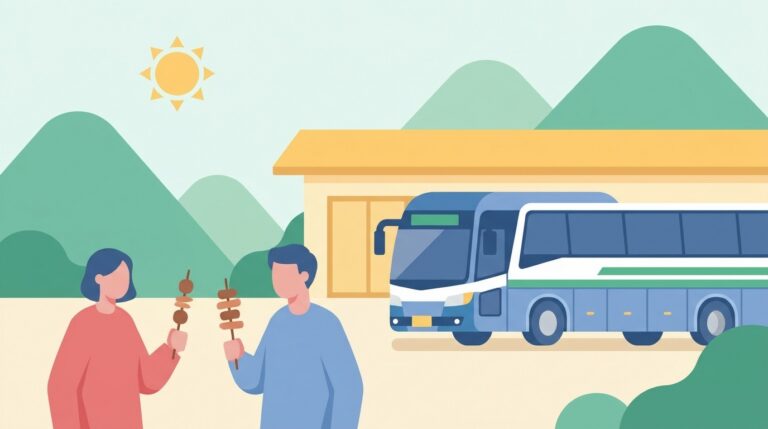
Imagine this: You are on a sleek, comfortable express bus riding from Seoul to Busan. You’re gazing out at the misty green mountains, humming your favorite K-drama OST, when suddenly the bus pulls into a massive, bustling parking lot. The driver’s voice crackles over the loudspeaker: “십오 분 쉬어갑니다!” (Sib-o bun swieogamnida! / We will stop for 15 minutes!)
You step outside. The air smells heavenly—roasted butter potatoes, sweet walnut cakes (호두과자), and sizzling skewers. You head to the restroom, grab a snack, walk out… and freeze. In front of you sits a sea of nearly identical red, white, and blue express buses. Dozens of them! Your phone clock says 13 minutes have passed. Your heart races. Which one is yours? Did the bus leave with your backpack, passport, and jacket?
If this scenario sends a chill down your spine, you are not alone! Every year, hundreds of first-time travelers to Korea experience the sheer panic of the 15-minute Korean highway rest stop (휴게소 – hyugeso). But don’t worry. This guide was crafted directly from real beginner feedback to turn your rest stop nightmare into the tastiest, stress-free mini-adventure of your Korean journey. Let’s master the exact phrases you need!
Phase 2: Top 3 Core Expressions In-Depth
1. 몇 분 쉬어요? (Myeot bun swieoyo?)
- Pronunciation: [Myeot bun swi-eo-yo?] (Think: “Myut” like “mutt” with a ‘y’ + “boon” like a gift + “she-oh-yo”)
- Meaning: “How many minutes do we rest?” (Asking for the exact break duration)
- K-Culture Moment: You often hear this in travel variety shows like 2 Days & 1 Night (1박 2일) whenever the cast desperately negotiates for snack time.
- Editor’s Insight: Bus drivers are on a tight schedule. Even if you didn’t catch the announcement, asking this simple sentence will prompt the driver to flash their fingers—usually showing ‘1’ and ‘5’ for 15 minutes.
- Situation Spectrum: Casual: ⚠️ (Only with friends: 몇 분 쉬어?) | Semi-formal: ✅ (몇 분 쉬어요?) | Formal: ✅ (몇 분 동안 쉬어갑니까?)
- 🤔 Think About It: In English, we often ask “When do we leave?” while Koreans frequently ask “How many minutes do we rest?” Focus on the countdown!
2. 화장실 어디예요? (Hwajangsil eodiyeyo?)
- Pronunciation: [Hwa-jang-sil eo-di-ye-yo?] (Say: “Hwa-jahng-seel” + “uh-dee-yay-yo”)
- Meaning: “Where is the restroom?”
- K-Culture Moment: The ultimate survival sentence seen in literally every K-drama travel episode when characters bolt out of the bus.
- Editor’s Insight: Korean highway rest stop restrooms are world-class, clean, and futuristic—often equipped with real-time occupancy screens! Memorize this word: 화장실 (Hwajangsil). Look for the signs near the central entrance.
- Situation Spectrum: Casual: ⚠️ | Semi-formal: ✅ (Polite & friendly) | Formal: ✅ (화장실이 어디에 있습니까?)
- 🤔 Think About It: Notice how Korean doesn’t require words like “the” or “a”. You just name the place and ask “where is it?” Simple and direct!
3. 이 버스 맞아요? (I beoseu majayo?)
- Pronunciation: [I beo-seu ma-ja-yo?] (Say: “Ee bus” + “mah-jah-yo”)
- Meaning: “Is this the right bus?”
- K-Culture Moment: The anxious protagonist holding a lukewarm coffee, checking the windshield with fellow travelers in slice-of-life dramas.
- Editor’s Insight: When in doubt before stepping onto the bus, show your ticket or point to the bus and ask the driver or a passenger this question. It saves you from traveling to Gwangju instead of Busan!
- Situation Spectrum: Casual: ⚠️ (이 버스 맞아?) | Semi-formal: ✅ (이 버스 맞아요?) | Formal: ✅ (이 버스가 맞습니까?)
- 🤔 Think About It: The root word 맞다 (matda) means “to be correct” or “to fit.” It is one of the most reassuring words you will ever hear in Korea.
Phase 3: Textbook Korean vs. Real-World Korean
Situation 1: Asking when the bus departs
- 📖 Textbook Korean: 버스는 몇 시에 출발합니까? (Beoseuneun myeot sie chulbalhamnikka? – “At what time does the bus depart?”)
- 🗣️ Real-World Korean: 몇 분에 출발해요? (Myeot bune chulbalhaeyo? – “At what minute do we leave?”)
- 💡 Why is it different? Highway rest stops usually grant 12 to 15 minutes. Drivers rarely specify the hour (e.g., “2:15 PM”); they yell the minute mark: “15분에 출발해요!” (Leaving at minute 15!).
Situation 2: Asking if a seat is taken
- 📖 Textbook Korean: 여기에 앉아도 되겠습니까? (Yeogie anjaseo doegesseumnikka? – “May I sit here?”)
- 🗣️ Real-World Korean: 여기 자리 있어요? (Yeogi jari isseoyo? – “Is this seat taken / Is there someone here?”)
- 💡 Why is it different? Everyday spoken Korean prefers conversational, short questions focused on state of presence (있어요 – exists / 없어요 – does not exist).
Phase 4: K-Culture Deep Dive & Non-Verbal Manners
4-1. Nunchi (눈치) & Essential Gestures
- The Golden Bus Rule (Phone Camera Trick): The moment you step off your bus at the rest stop, turn around and take a photo of the bus license plate (번호판) and the parking bay column number. All buses look identical, but license plates never lie.
- The Driver Head Nod: When boarding after your snack run, make eye contact with the driver, bow your head slightly (about 15 degrees), and say: 안녕하세요! (Annyeonghaseyo!). This lets the driver mentally count heads.
- Leave a Personal Item: Never leave your passport or wallet, but leaving a water bottle or an umbrella on your seat signals to the driver and seatmate: “I am definitely coming back!”
4-2. The Delicious World of Hyugeso Food Culture
In Korea, highway rest stops are not just pit stops; they are culinary destinations! Made famous by celebrity Lee Young-ja on Korean variety shows, you will find iconic snacks:
* 소떡소떡 (Sotteok-sotteok): Alternating grilled sausage (소시지) and chewy rice cake (떡) skewers brushed with sweet-spicy gochujang glaze.
* 호두과자 (Hodu-gwaja): Piping-hot walnut-shaped pastries filled with sweet red bean paste and crunchy walnuts.
* 통감자 (Tong-gamja): Whole baby potatoes pan-roasted in butter and dusted with granulated sugar.
Phase 5: Real-World Roleplay Scenario
Setting: Anseong Rest Area (안성휴게소). The bus doors hiss open. Aromas of fried street snacks drift in.
Characters:
* You (A1 Korean Explorer): Slightly nervous traveler craving a quick snack.
* 기사님 (Gisanim – Bus Driver): A friendly veteran driver in a crisp blue uniform.
- Turn 1 (Driver): 15분 쉬었다 갑니다! 화장실 다녀오세요.
(Sibo-bun swieotda gamnida! Hwajangsil danyeo-oseyo.)
“Stopping for 15 minutes! Please feel free to use the restroom.”
🎭 [Announces over the microphone and opens the automated bus door] -
Turn 2 (You): 저기요, 기사님! 몇 분 쉬어요?
(Jeogiyo, gisanim! Myeot bun swieoyo?)
“Excuse me, driver! How many minutes do we rest?”
🎭 [Politely walking up to the driver's seat] -
Turn 3 (Driver): 15분 쉬어요. 지금 2시니까 2시 15분까지 오세요!
(Sibo-bun swieoyo. Jigeum du-sinikka du-si sibo-bunkkaji oseyo!)
“We rest 15 minutes. It’s 2:00 now, so please be back by 2:15!”
🎭 [Points to his wrist watch with a smile] -
Turn 4 (You): 네, 감사합니다! 화장실 어디예요?
(Ne, gamsahamnida! Hwajangsil eodiyeyo?)
“Yes, thank you! Where is the restroom?”
🎭 [Nods politely and points toward the rest stop building] -
Turn 5 (Driver): 저기 편의점 오른쪽으로 가면 있어요.
(Jeogi pyeon-uijeom oreunjjogeuro gamyeon isseoyo.)
“Go right past that convenience store over there.”
🎭 [Points out the windshield toward the glass doors] -
Turn 6 (You): 알겠습니다! 금방 올게요.
(Algetseumnida! Geumbang olgeyo.)
“Understood! I’ll be back right away.”
🎭 [Snaps a quick photo of the bus license plate and jogs toward the lobby] -
(12 minutes pass. You return holding a warm bag of walnut cakes. You pause outside the bus door to be certain.)
-
Turn 7 (You): 저기요, 부산 가는 버스 맞아요?
(Jeogiyo, Busan ganeun beoseu majayo?)
“Excuse me, is this the bus going to Busan?”
🎭 [Shows your mobile ticket on your phone to the driver] -
Turn 8 (Driver): 네, 맞아요! 어서 타세요, 곧 출발합니다.
(Ne, majayo! Eoseo taseyo, got chulbalhamnida.)
“Yes, that’s right! Hurry on in, we are departing soon.”
🎭 [Waves you inside warmly]
🔀 Interactive Choice Point
You exit the restroom, and you have 4 minutes left. You really want to buy Sotteok-sotteok, but there is a line of 3 people. What do you do?
- Choice A: Say “소떡소떡 하나 주세요!” (Sotteok-sotteok hana juseyo!) and wait in line, hoping the driver waits for you.
- Outcome: Risk! Highway express buses do not wait for late passengers. If you miss departure, your bus will literally leave without you!
- Choice B: Skip the hot snack, walk back toward the bus immediately, and snap a confirmation photo of your bus number plate.
- Outcome: Best! Rest stop snacks are tempting, but boarding 3 minutes before departure ensures 100% peace of mind.
- Choice C: Panic, run toward a random red bus, and sit down without asking anyone.
- Outcome: Bad! You might wake up 3 hours later in Mokpo instead of Busan!
Phase 6: 10-Second Emotional Shadowing Drill
Practice these lines with rhythm, feeling the emotion behind every syllable!
[😰 급하고 다급하게 / Urgent & Hurried]
저기요, / 화장실 / 어디예요?
(Jeogiyo, / hwajangsil / eodiyeyo?)
“Excuse me, / restroom / where is it?”-
[🤔 꼼꼼하고 조심스럽게 / Careful & Inquiring]
기사님, / 몇 분에 / 출발해요?
(Gisanim, / myeot bune / chulbalhaeyo?)
“Driver, / at what minute / do we leave?” -
[😊 안도하며 환하게 / Relieved & Cheerful]
감사합니다! / 이 버스 / 맞네요!
(Gamsahamnida! / I beoseu / manneyo!)
“Thank you! / This bus / is indeed the right one!”
Phase 7: K-Culture Mini Dictionary
-
휴게소 (Hyugeso)
Literal translation: Rest stop / Highway service area.
Real-life usage: In Korea, these are huge complexes with gas stations, gourmet food courts, local gift shops, and clean parks. -
소떡소떡 (Sotteok-sotteok)
Literal translation: Sausage-rice cake skewer.
Real-life usage: Korea’s signature rest-area food. The golden rule is to bite both a sausage and rice cake together in one single mouthful! -
번호판 (Beonhopan)
Literal translation: Number plate (License plate).
Real-life usage: Always look for the 4 digits at the bottom of the bus plate (e.g., “1234”) before walking away into the food court. -
출발 (Chulbal)
Literal translation: Departure / Start.
Real-life usage: When the driver shouts “출발합니다!” (Chulbalhamnida!), the bus wheels are already rolling!
Phase 8: Traveler’s Survival Kit
TOP 3 Express Bus Survival Expressions
- 1. 몇 시까지 와야 해요? (Myeot sikkaji waya haeyo?)
What time do I need to be back by?
Pro Tip: Tap your wrist/watch while saying this. The driver will show you the exact return time. - 2. 영수증 주세요 (Yeongsujeung juseyo)
Please give me a receipt.
Pro Tip: At food court snack kiosks, your pick-up number is printed on your receipt. - 3. 잠깐만요! (Jamkkanmanyo!)
Wait a moment! / Just a second!
Pro Tip: If the bus doors are starting to close as you run toward it, shout this loudly with one hand raised.
Editor’s Travel Note
- Pre-trip Preparation: Before your bus journey, install Naver Map App Download to track your real-time GPS location while traveling along the highway.
- Payment Tip: Nearly 100% of rest-stop snack stands and food courts use electronic kiosks (키오스크) supporting international credit cards (Visa, Mastercard).
- Don’t Forget the 4 Digits: Korean buses from companies like Kumho (금호), Jungang (중앙), or Hanbiddul (한빛) often share identical colors. Always memorize your bus company name and the last 4 license digits!
Phase 9: “One Step Deeper” (Cultural Reflection)
Korea’s legendary 빨리빨리 (Ppalli-ppalli / Quick-quick) culture shines brightest at highway rest areas. Why only 15 minutes? Korean express bus systems operate on tightly synchronized highway dispatch grids. A five-minute delay cascades into heavy traffic jams near toll gates. Because Korean society places profound value on communal punctuality, passengers view boarding 2 minutes early not as an inconvenience, but as an act of shared respect for everyone else on board.
💬 Your Turn: Have you ever experienced a highway rest stop in another country? How does a 15-minute timer compare to road trips in your hometown? Share your thoughts below in the comments!
Phase 10: FAQ & Avoiding Misunderstandings
Q: What happens if the bus actually leaves without me?
A: Don’t panic! Immediately go inside to the rest stop Information Desk (안내소 – Annaeso) or call the Express Bus helpline (1644-9030). Give them your bus company and ticket number. They will contact the driver and arrange for your luggage to be dropped at the destination terminal, and help you board the next bus.
Q: Can I bring rest stop food inside the express bus?
A: Odorless snacks, bottled water, coffee with tight lids, and walnut cakes are generally fine! However, hot soup dishes (like ramen or udon) and strong-smelling foods are strictly forbidden inside Korean express buses for passenger comfort.
Q: How do I know when the 15 minutes start?
A: The timer starts the exact moment the driver parks and turns off the engine, not when you finish stepping down the bus stairs! Always look at your phone clock immediately upon standing up.
🚨 Common Mistakes Warning Board
- Mistake: Trusting your memory of bus color alone.
Correct Action: Take a smartphone photo of the bus license plate (번호판) the second you step off. - Mistake: Ordering cooked meals like Tonkatsu (돈가스) or Udon with only 15 minutes on the clock.
Correct Action: Stick to grab-and-go counters (호두과자, 소떡소떡, coffee) to avoid being stranded. - Mistake: Assuming the driver will do a roll call with your name.
Correct Action: Korean express bus drivers count empty seats, not personal names. Always return to your seat 3 minutes early!
Phase 11: Action Missions
- 🥉 Bronze Mission (Solo Practice): Stand in front of your mirror and practice saying: “이 버스 맞아요?” (I beoseu majayo?) three times with a friendly smile.
- 🥈 Silver Mission (Social Share): Snap your next road-trip snack, tag our community, and caption it: “휴게소 가고 싶어요!” (I want to go to a Korean rest stop!).
- 🥇 Gold Mission (Real-life Action): Next time you board an intercity bus or train in Korea, greet the driver or attendant politely with “안녕하세요!” (Annyeonghaseyo!) and check your ticket number!
🎮 K-Culture Mission: Watch an episode of the Korean variety show Omniscient Interfering View (전지적 참견 시점) featuring comedian Lee Young-ja’s rest-stop gourmet tour. Spot how many times someone orders Sotteok-sotteok!
Phase 12: Interactive Quiz Challenge
1. Situational Judgment:
You have just exited the rest stop restroom. There are 2 minutes left before departure. You see three nearly identical white and blue buses. What is your best action?
(A) Shout for the driver in English from the middle of the parking lot.
(B) Check your smartphone photo of the license plate number and match the last 4 digits.
(C) Board the nearest bus and assume it’s going to the same city.
2. Fill-in-the-Blank:
“Where is the restroom?” in polite Korean is:
“________ 어디예요?” (________ eodiyeyo?)
3. True or False:
Express bus drivers in Korea will call your phone and wait up to 10 minutes if you are missing at a highway rest stop. (True / False)
👉 Click to view answers and explanations!
-
Answer: (B)
Explanation: Checking the 4-digit license plate number (번호판) that you photographed before leaving the bus is the safest and quickest method to find your exact bus! -
Answer: 화장실 (Hwajangsil)
Explanation: 화장실 (Hwajangsil) means restroom/toilet. Combine it with 어디예요? (Eodiyeyo? / Where is it?) to ask for directions. -
Answer: False
Explanation: Buses adhere to strict national highway timetables. If a passenger is not back after the announced break (usually 15 minutes), the bus will depart to prevent timetable chaos.







