

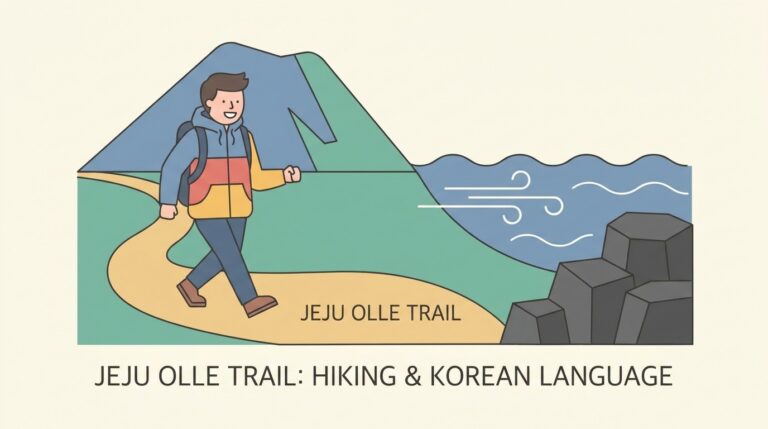
Conquer Jeju Island’s Trails: The Ultimate Survival Guide for Hallasan and Olle Walks
Phase 1: Empathy (Story Immersion Opening)
안녕하세요! 매일한글 에디터입니다. (Hello! I’m your Daily Hangul editor.)
Picture this: You step off the morning bus at the foot of Mount Hallasan or along the rugged basalt coastline of Jeju Olle Trail Route 7. The morning sun warms your face, and the coastal breeze feels like a scene straight out of Welcome to Samdal-ri or Our Blues. Confident in your light cotton hoodie and sneakers, you start your trek. But within forty-five minutes, thick volcanic sea mist rolls over the ridge, the temperature drops eight degrees, and gusty winds whip rain across the exposed trail. Your hands freeze, your phone battery plummets, and your stomach grumbles with two hours left to the nearest shelter.
Every year, hundreds of enthusiastic travelers face this exact situation. Jeju’s unique microclimates mean sunny sea-level weather can morph into freezing alpine mist in minutes. This comprehensive guide is built on real hiker feedback and local mountain safety guidelines to ensure you never get caught unprepared. By learning just a few tactical Korean phrases and packing secrets, you won’t just survive Jeju’s wild elements—you’ll hike like a savvy local.
Phase 2: Core Expressions Deep Dive
Here are the three life-saving phrases you need when preparing your backpack and coordinating trail logistics:
1. 날씨가 시시각각 변해요 (Nalssiga sisigakgak byeonhaeyo)
- Pronunciation: [Nal-ssi-ga shi-shi-gak-gak byon-hae-yo] (Think of ‘sisi’ like ‘see-see’ and ‘gak’ like the start of ‘gawk’ said briskly)
- Meaning: Literal: “The weather changes hour-by-hour / moment-by-moment.” | Nuance: “The weather is completely unpredictable right now!”
- K-Culture Moment: Commonly heard in travel reality shows like 2 Days & 1 Night when cast members get stranded on windy islands.
- Editor’s Insight: The onomatopoeia-like reduplication 시시각각 (時時刻刻) adds urgency. It conveys continuous, rapid shifting rather than a simple gradual change.
- Situation Spectrum: Casual (✅ with friends: 날씨가 시시각각 변해) / Semi-formal (✅ 날씨가 시시각각 변해요) / Formal (✅ 날씨가 시시각각 변합니다)
- 🤔 Think About It: In English, we often say “the weather is fickle” or “four seasons in one day.” How does the visual repetition in “시시각각” (moment by moment) change how you visualize nature?
2. 방풍 자켓 꼭 챙기세요 (Bangpung jaket kkok chaenggiseyo)
- Pronunciation: [Bahng-poong jah-ket kok cheng-gee-seh-yo] (Pronounce ‘kkok’ like a tight, sharp ‘cork’ without the ‘r’)
- Meaning: Literal: “Please pack a windproof jacket without fail.” | Nuance: “A windbreaker is an absolute non-negotiable must-have.”
- K-Culture Moment: In outdoor adventure vlogs, experienced hiking leaders remind beginners right before boarding the early morning ferry or trail bus.
- Editor’s Insight: 방풍 (防風) literally means “guarding against wind.” In Korean hiking culture, 챙기다 (chaenggida) is an affectionate, caring verb meaning to pack, look after, or take care of someone or something.
- Situation Spectrum: Casual (✅ 방풍 자켓 꼭 챙겨) / Semi-formal (✅ 방풍 자켓 꼭 챙기세요) / Formal (✅ 방풍 자켓을 반드시 챙기시기 바랍니다)
- 🤔 Think About It: Notice how Korean speakers use “챙기다” both for packing gear and caring for people’s well-being. What does that say about communal care in Korean culture?
3. 비상식량 챙겨왔어요? (Bisangsikryang chaenggyeowasseoyo?)
- Pronunciation: [Bee-sang-shik-ryang cheng-gyeo-wa-sseo-yo?] (Blend ‘shik’ and ‘ryang’ smoothly into ‘shing-nyang’)
- Meaning: Literal: “Did you pack emergency food?” | Nuance: “Do you have snacks, chocolate, or trail rations just in case?”
- K-Culture Moment: Standard question asked by trail guides and hiking club (산악회) elders before starting steep ascents on Jeju’s Gwaneumsa course.
- Editor’s Insight: While “emergency food” sounds intense in English, in Korean trail culture it usually refers to dark chocolate bars, energy gel packets, mini sausages, or sliced cucumbers (오이).
- Situation Spectrum: Casual (✅ 비상식량 챙겨왔어?) / Semi-formal (✅ 비상식량 챙겨왔어요?) / Formal (✅ 비상식량을 준비하셨습니까?)
- 🤔 Think About It: What counts as “emergency food” in your country compared to the iconic Korean mountain cucumber or wrapped gimbap?
Phase 3: Textbook Korean vs. Real Korean
Situation 1: Warning someone about erratic mountain weather
- 📖 교과서 한국어 (Textbook Korean): 산의 기후는 변화가 심하므로 주의하십시오. (San-ui gihuneun byeonhwaga simhameuro ju-uihasipsio. / As mountain climate fluctuates severely, please take caution.)
- 🗣️ 진짜 한국어 (Real Korean): 산 날씨 변덕 장난 아니에요! (San nalssi byeondeok jangnan anieyo! / Mountain weather mood swings are seriously no joke!)
- 💡 Why is it different?: Native speakers describe volatile weather as 변덕 (capriciousness/mood swings) and add 장난 아니다 (it’s no joke) for vivid, natural emphasis instead of clinical meteorological jargon.
Situation 2: Suggesting an energy boost on the trail
- 📖 교과서 한국어 (Textbook Korean): 피로를 회복하기 위해 당분을 섭취하세요. (Piroreul hoebokhabi wihae dangbuneul seopchwihaseyo. / In order to recover fatigue, ingest sugars.)
- 🗣️ 진짜 한국어 (Real Korean): 당 떨어질 때 초콜릿 드세요! (Dang tteoleojil ttae chokollit deuseyo! / Eat some chocolate when your blood sugar drops!)
- 💡 Why is it different?: 당 떨어지다 (sugar is dropping) is an essential colloquial idiom across Korea for feeling depleted or dizzy, used both on hiking trails and after tough office meetings.
Phase 4: K-Culture Deep Dive & Non-Verbal Manners
4-1. 눈치 (Nunchi) & Trail Etiquette
- Passing Greetings (산중 인사): Whenever you cross paths on a narrow trail, make warm eye contact, offer a subtle 15-degree head nod, and say, “안녕하세요~” (Annyeonghaseyo~). Staying completely silent while brushing past is considered cold and standoffish.
- Right of Way (양보): In Korean mountain culture, the hiker climbing uphill has the right of way because stopping uphill breaks rhythm and stamina. If you are descending, step slightly toward the mountain wall (not the cliff edge!) and signal with an open hand.
- Clean Trail Rule (흔적 남기지 않기): Olle and Hallasan paths strictly enforce “Leave No Trace.” Always keep a small plastic bag in your pocket for your snack wrappers and orange peels.
4-2. Cultural Code: ‘K-Deung-san’ (Korean Hiking Culture)
Korean hiking isn’t merely sport; it is a full sensory lifestyle. You will notice colorful technical apparel (등산복), trekking poles, and branded backpacks even on mild 5km coastal strolls. Most crucially, Korean hiking revolves around high-energy shared treats. At mountain peaks or halfway rests (쉼터), it is customary to sit on mini foam mats (방석), unwrap aluminum foil containing freshly bought Gimbap, and hand chocolate pieces or peeled Jeju tangerines (감귤) to nearby hikers. Accepting food with two hands and expressing sincere gratitude is the hallmark of hiking camaraderie.
Phase 5: Real-Life Roleplay Scenario
- Setting: Seongpanak Information Center & Convenience Store at the base of Hallasan.
- Characters:
- Alex: An enthusiastic intermediate learner eager to summit Baengnokdam crater lake.
- Ranger Min (민 주임): A friendly Jeju National Park safety ranger checking reservation QR codes.
- Dialogue:
- 🎭 Alex: (Approaching desk, showing phone screen) 안녕하세요! 한라산 탐방 예약 QR코드 여기 있어요. (Annyeonghaseyo! Hallasan tambang yeyak QR-kodeu yeogi isseoyo. / Hello! Here is my Hallasan trail reservation QR code.)
- 🎭 Ranger Min: (Scans QR code and checks monitor) 네, 확인되었습니다. 오늘 바람이 센데, 방풍 자켓 챙기셨나요? (Ne, hwagindoe-eossseumnida. Oneul barami sende, bangpung jaket chaenggisyeonnayo? / Yes, confirmed. The wind is fierce today—did you pack a windbreaker?)
- 🎭 Alex: (Pats backpack proudly) 네! 가방 안에 방풍 자켓이랑 보온병 있어요. (Ne! Gabang ane bangpung jaket-irang bo-onbyeong isseoyo. / Yes! I have a windbreaker and a thermos in my bag.)
- 🎭 Ranger Min: (Nods approvingly) 아주 잘하셨어요. 정상 부근은 날씨가 시시각각 변하거든요. (Aju jalhasyeosseoyo. Jeong-sang bugeuneun nalssiga sisigakgak byeonhageodeunyo. / Excellent job. The weather near the summit changes by the minute.)
- 🎭 Alex: (Looking at the long trail ahead) 백록담까지 물은 얼마나 필요할까요? (Baengnokdam-kkaji mureun eolmana piryohalkkayo? / How much water will I need up to Baengnokdam?)
- 🎭 Ranger Min: (Points to trail map) 왕복 8시간 코스니까 최소 1.5리터는 챙기셔야 해요. (Wangbok yeodeol-sigan koseunikka choeso il-jeom-o-riteoneun chaenggisyeoya haeyo. / It’s an 8-hour round trip, so you must carry at least 1.5 liters.)
- 🎭 Alex: (Reaching into pocket) 초콜릿이랑 에너지바 같은 비상식량도 샀어요! (Chokollit-irang eneoji-ba gateun bisangsikryangdo sasseoyo! / I also bought emergency snacks like chocolate and energy bars!)
- 🎭 Ranger Min: (Smiling warmly) 완벽하네요! 무리하지 마시고 안전하게 다녀오세요. (Wanbyeokhani-eyo! Murihaji masigo anjeonhage danyeo-oseyo. / Perfect! Don’t overexert yourself and have a safe hike.)
🔀 Interactive Choice Point
You suddenly notice that dark fog is descending at the Azalea Field Shelter (진달래밭 대피소), 1.5 hours before the peak. What do you do?
- Option A: “정상까지 얼마 안 남았으니까 그냥 뛰어갈래요!” (Jeongsang-kkaji eolma an nam-asseunikka geunyang ttwieogallaeyo! / There’s not much left to the summit, so I’ll just run up!)
- Option B: “날씨가 안 좋으니 방풍 자켓을 입고 통제 시간을 확인할게요.” (Nalssiga an joeuni bangpung jaketeul ipgo tongje siganeul hwaginhalkeyo. / The weather looks bad, so I’ll put on my windbreaker and check the cutoff time.)
- Option C: “비상식량도 다 떨어졌는데 다른 사람한테 물만 달라고 할게요.” (Bisangsikryangdo da tteoreojyeonneunde dareun saramhante mulman dallago halkeyo. / I’ve run out of emergency food, so I’ll just beg other hikers for water.)
Feedback:
* Choice A (Risk): High risk of hypothermia or tripping on wet basalt stones. Hallasan strictly closes upper trails if you miss the cutoff time!
* Choice B (Best): Perfect! Putting on protective wind layers and complying with park cutoff times is what smart hikers do.
* Choice C (Bad): Unprepared and unsafe. Relying on other hikers for bare essentials puts an unfair burden on fellow trekkers.
Phase 6: 10-Second Emotional Shadowing Drill
Practice matching pitch and breath pauses marked with /:
[🌬️ 덜덜 떨며 진지하게 - Shivering and serious]
바람 부니까 / 방풍 자켓 꼭 챙겨요! (Baram bunikka / bangpung jaket kkok chaenggyeoyo! / It’s windy, so make sure to pack a windbreaker!)-
[😲 눈을 동그랗게 뜨고 실감나게 - Wide-eyed with astonishment]
제주도 날씨는 / 시시각각 변하더라고요! (Jejudo nalssineun / sisigakgak byeonhadeon-goyo! / I realized Jeju weather changes minute by minute!) -
[🍫 지친 목소리에서 생기있게 - Tired, then reviving with energy]
당 떨어졌는데 / 초콜릿 하나만 먹을게요. (Dang tteoreojyeonneunde / chokollit hanaman meogeulkeyo. / My sugar level dropped, so let me eat just one chocolate piece.)
Phase 7: K-Culture Mini Dictionary
- 방풍 자켓 (Bangpung jaket) | Windbreaker
- Meaning: A lightweight hooded nylon jacket designed to block whipping seaside or mountain winds.
- Usage: A daily staple in Jeju backpack setups, even in midsummer.
- 당 떨어지다 (Dang tteoleojida) | To run out of stamina / blood sugar drop
- Meaning: Combining “당” (sugar) and “떨어지다” (to fall).
- Usage: Said humorously when feeling exhausted: “나 지금 당 떨어졌어, 간식 먹자.” (My sugar is low; let’s have a snack.)
- 올레길 패스포트 (Olle-gil paeseupoteu) | Jeju Olle Trail Passport
- Meaning: A dedicated stamp booklet purchased at Olle Tourist Information Centers.
- Usage: Collect horse-shaped (Ganse) ink stamps at the start, midpoint, and finish of each 15km trail segment.
- 탐방 예약 (Tambang yeyak) | National Park Trail Permit/Reservation
- Meaning: Advance reservation required to hike Hallasan’s Seongpanak or Gwaneumsa summit routes.
- Usage: Checked via QR code before park rangers let you pass the trailhead turnstiles.
Phase 8: Traveler’s Survival Kit
Top 3 On-Trail Survival Phrases
- 등산 스틱 대여할 수 있나요? (Deungsan seutik daeyeohal su innayo?)
- Can I rent trekking poles?
- Pro Tip: Many guesthouses and outdoor shops near Jeju City hall and Seogwipo rent poles and crampons (아이젠) for modest daily fees.
- 정상까지 몇 시간 걸려요? (Jeongsang-kkaji myeot sigan geollyeoyo?)
- How many hours does it take to the summit?
- Pro Tip: Use this when passing descending hikers to gauge your physical pace.
- 물 보충할 곳이 있나요? (Mul bochunghal gosi innayo?)
- Is there a place to refill water?
- Pro Tip: Unlike mainland mountains with natural spring taps (약수터), Hallasan shelters do not sell bottled water or food! You must pack all fluids.
Editor’s Travel Note
- Permit Website: Book Hallasan summit access well in advance via the Hallasan National Park Trail Reservation System as slots fill up weeks ahead during peak spring and autumn months.
- Public Transit Tip: Don’t waste money on rental cars for summit hikes (since start and finish routes like Seongpanak and Gwaneumsa differ). Take Jeju Red Express Bus No. 181 or Blue Bus No. 281 directly to the trail gate using your T-money transit card.
- Navigation: Google Maps struggles with pedestrian hiking paths in Korea. Download and use the KakaoMap Walking Route Planner for real-time Olle Trail tracking and bus arrival alerts.
Phase 9: “한 발 더 깊이” (One Step Deeper)
In Korean culture, food is never a solo pursuit—especially when physical endurance is involved. On trails, sharing food reflects the deep-seated value of 정 (Jeong – warm social bonding). When a fellow hiker offers you a tangerine (귤) or a handful of roasted almonds at an Olle pavilion, they aren’t implying that you forgot your supplies; it is an instinctual act of collective goodwill rooted in the belief that everyone on the mountain shares the same journey. Accepting it with a bright smile and reciprocating with a snack of your own instantly dissolves nationality and language barriers.
💬 Your Turn: What snack from your home country would you pack to share with Korean hikers on the Jeju Olle Trail? Leave your picks in the comments below!
Phase 10: FAQ & Common Mistakes
Q: Can I hike Hallasan without a permit reservation?
A: No. For the two peak-reaching trails (Seongpanak and Gwaneumsa), strict daily quotas are enforced via mandatory QR code check-in. Shorter scenic trails like Yeongsil, Eorimok, and Donnaeko do not require reservations, but they do not lead to the crater lake rim.
Q: Are there trash cans along the Jeju Olle Trail or Hallasan?
A: Absolutely not. Korea operates on strict waste separation and zero-waste trail policies. Keep all wrappers, fruit peelings, and empty bottles inside your pack until you return to your hotel or transit hub.
Q: What should I wear if the forecast says sunny and 20°C in Jeju City?
A: Always dress in modular layers! Wear a moisture-wicking base t-shirt, a light long-sleeve fleece or UV-blocking layer, and carry a compact windbreaker (방풍 자켓) in your backpack. Temperatures on the volcano rim are routinely 10 to 12 degrees colder than downtown Jeju.
🚨 Common Mistakes on Jeju Trails
- Mistake: Relying on trail shelter vending machines for food/water.
- Correct Action: Buy at least 1.5–2L of water and trail bars at a convenience store (편의점) before boarding the bus.
- Mistake: Hiking volcanic rock trails in smooth-soled street sneakers.
- Correct Action: Wear sturdy trail-running shoes or hiking boots with deep rubber tread to prevent ankle rolls on porous volcanic stones (현무암).
- Mistake: Ignoring trail curfew cut-offs (입산 통제 시간).
- Correct Action: Always check seasonal cutoff hours posted at trail checkpoints. If you don’t pass the shelter before the deadline, rangers will turn you around.
Phase 11: Action Missions
- 🥉 Bronze Mission (Solo Practice): Speak the sentence: “날씨가 시시각각 변하니 방풍 자켓 꼭 챙기세요!” out loud three times using your phone’s voice recorder.
- 🥈 Silver Mission (Social/Writing): Snap a photo of your hiking backpack gear (or a flat lay of your daily bag) and write an Instagram or note caption using: #방풍자켓 #비상식량 #매일한글.
- 🥇 Gold Mission (Real Life): Visit a convenience store (편의점) or outdoor shop in Korea and ask the clerk: “초콜릿이나 에너지바 같은 비상식량 어디에 있어요?”
🎮 K-Culture Mission: Watch an episode of a variety show filmed in Jeju (like Hyori’s Homestay or Europe Outside Your Tent) and spot someone pulling a windbreaker from their pack as the wind picks up!
Phase 12: Interactive Quiz Challenge
1. Situation Judgment: You are packing for a 6-hour Olle Trail hike along windy coastal cliffs. Which item is LEAST appropriate?
* A) 가벼운 방풍 자켓 (A lightweight windbreaker)
* B) 두꺼운 면 청바지와 흰색 스니커즈 (Heavy cotton blue jeans and flat white street sneakers)
* C) 비상식량용 초콜릿과 생수 (Emergency chocolate snacks and fresh water)
👉 Click to see the answer & explanation!
Correct Answer: B
Explanation: Heavy cotton jeans absorb sea spray and sweat, becoming stiff, wet, and heavy. Flat sneakers offer no grip on slippery volcanic basalt rocks. Always choose technical stretch pants and sturdy footwear!
2. Fill in the Blank: Complete the sentence with the natural Korean idiom:
등산하다가 힘이 없고 어지러울 때는 ( ) 때니까 초콜릿을 드세요!
* A) 눈이 올
* B) 당 떨어질
* C) 잠이 올
👉 Click to see the answer & explanation!
Correct Answer: B (당 떨어질)
Explanation: “당 떨어질 때” literally means “when your blood sugar drops” and is the quintessential Korean idiom for replenishing energy on hiking routes.
3. True or False: You can purchase hot cup noodles and bottled water at the mountain shelter near Hallasan’s summit crater.
* [ ] True
* [ ] False
👉 Click to see the answer & explanation!
Correct Answer: False
Explanation: Commercial food and beverage sales at Hallasan shelters were completely eliminated years ago to protect the delicate mountain ecosystem. You must carry all your water, snacks, and thermoses up and pack all trash back down!







