

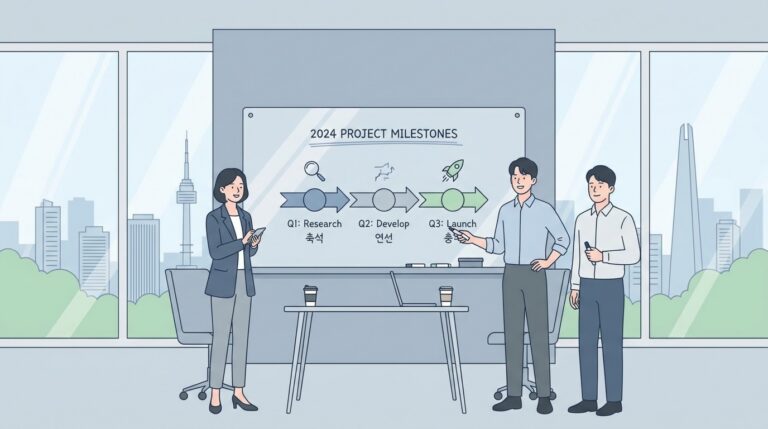
Phase 1: 공감 (스토리 몰입형 오프닝)
안녕하세요! 매일한글 에디터입니다.
Picture this: You are standing in a sleek, glass-walled conference room in Pangyo Techno Valley—Korea’s bustling Silicon Valley. Around the table sit your team leads: planning (기획), design (디자인), development (개발), and QA (품질보증). Your laptop is hooked to the big monitor, displaying your brand-new sprint board. It feels just like an intense scene from the K-Drama Start-Up (스타트업) or Search: WWW (검색어를 입력하세요 WWW). You have mapped out the entire roadmap, but the moment you open your mouth to run through deadlines and assign R&R (Roles and Responsibilities), your mind blanks. How do you say “We broke the master schedule into milestones and visualized it on a timeline” without sounding like an automated translation bot?
Many intermediate Korean learners hit a wall here. You know how to order food or chat about your favorite K-pop idols, but stepping up as a meeting facilitator who aligns cross-functional roadmaps in Korean requires nuance, collaborative tact, and sharp professional vocabulary. A clunky phrase can make you sound detached or overly blunt. Based on direct feedback from international project managers and developers working inside Korean tech firms, this guide will transform your kick-off leadership. By the end of this lesson, you will confidently run kick-off meetings, break down milestones, and align deadlines with authentic native phrasing.
Phase 2: 핵심 표현 3선 심층 분석
1. 전체 일정을 마일스톤별로 쪼갰어요 (Jeonche iljeong-eul maeillseuton-byeollo jjogae-sseoyo)
- Pronunciation: [Jeon-che il-jeong-eul ma-il-seu-ton-byeol-lo jjo-gae-sseo-yo] (Think of jjo like a sharp pop, similar to the start of choke, blended with gae like get without the t).
- Meaning: Literally “We cracked/split the whole schedule by milestones,” used idiomatically as “We broke down the overall project schedule into distinct milestone phases.”
- K-Culture Moment: You will hear tech founders and product managers in dramas like Start-Up use this when pitching sprints to venture capitalists or rallying their engineering squad.
- Editor’s Insight: The verb 쪼개다 (jjogaeda) literally means “to split or chop into small pieces” (like firewood or bread). In modern Korean project management, it is the quintessential buzzword for breaking down high-level roadmaps into bite-sized epics, sprints, or deliverables.
- Situation Spectrum:
- Casual: ✅ (우리 일정 좀 쪼개보자 / Let’s break down our schedule)
- Semi-formal: ✅ (마일스톤별로 쪼갰어요 / We broke it down into milestones)
- Formal: ⚠️ (공식 보고서나 임원 보고에서는 ‘세분화했습니다’가 더 선호됩니다 / In formal executive reports, ‘세분화했습니다 [sebunhwahaessseumnida]’ is preferred)
- 🤔 Think About It: English uses analytical terms like “decompose” or “granulate,” whereas Korean leans on the tactile, physical action of “splitting into pieces” (쪼개다). How does conceptualizing tasks as physical chunks change your team’s perception of workload?
2. 타임라인으로 시각화해서 한눈에 들어와요 (Taimrain-euro sigwakhwa-haeseo hannun-e deureowayo)
- Pronunciation: [Ta-im-ra-in-eu-ro si-gak-hwa-hae-seo han-nun-e deu-reo-wa-yo] (Hannun-e sounds like hahn-noo-neh, linking smoothly).
- Meaning: “We visualized it on a timeline, so it is clear at a single glance.”
- K-Culture Moment: A sharp project lead in an office drama like Misaeng (미생) flipping on a projector and commanding the room with intuitive visuals.
- Editor’s Insight: The idiom 한눈에 들어오다 (hannun-e deureooda) literally translates to “enters in one eye.” It is the ultimate compliment for UX/UI designers and project managers alike, signaling that information is intuitive, visually balanced, and instantly graspable.
- Situation Spectrum:
- Casual: ✅ (한눈에 확 들어온다! / It pops right away!)
- Semi-formal: ✅ (한눈에 들어와서 보기 편해요 / It’s easy to read since it’s clear at a glance)
- Formal: ✅ (한눈에 파악하실 수 있도록 시각화했습니다 / Visualized so you can grasp it at a single glance)
- 🤔 Think About It: Korean culture values quick contextual consensus. Why do you think tools that allow information to “enter in one eye” are praised so highly in fast-paced Korean workspaces?
3. 각 파트별 마감 기한을 확실히 짚고 넘어갈게요 (Gak pateubyeol magam gihan-eul hwaksilhi jipgo neomeogalkeoyo)
- Pronunciation: [Gak pa-teu-byeol ma-gam gi-han-eul hwak-sil-hi jip-go neo-meo-gal-ge-yo] (Jipgo sounds like jeep-go with a firm unreleased p).
- Meaning: “I will make sure to clearly address and confirm the deadlines for each track before moving on.”
- K-Culture Moment: When a meeting mediator prevents future finger-pointing by setting mutual expectations upfront.
- Editor’s Insight: The compound expression 짚고 넘어가다 (jipgo neomeogada) blends 짚다 (to point out / touch upon) and 넘어가다 (to cross over / proceed). It indicates that the speaker is deliberately pausing to ensure everyone is aligned on critical parameters before proceeding to the next agenda item.
- Situation Spectrum:
- Casual: ⚠️ (짚고 가자 / Let’s check this first – use only with close peers)
- Semi-formal: ✅ (확실히 짚고 넘어갈게요 / Let’s clarify and then move forward)
- Formal: ✅ (짚고 넘어가고자 합니다 / I would like to address this clearly before proceeding)
- 🤔 Think About It: Why does Korean corporate etiquette emphasize public verbal alignment over simply assuming team members will read the shared calendar later?
Phase 3: 교과서 한국어 vs 진짜 한국어
Situation 1: Explaining how the schedule is split
- 📖 교과서 한국어 (Textbook): 우리는 프로젝트 일정을 단계별로 분할하였습니다. (Uri-neun peurojekteu iljeong-eul dangyebyeollo bunhalhayeossseumnida. / “We have segmented the project schedule by stages.”)
- 🗣️ 진짜 한국어 (Real-world): 전체 일정을 마일스톤 단위로 잘게 쪼갰어요. (Jeonche iljeong-eul maeillseuton danwiro jalge jjogae-sseoyo. / “We broke the overall schedule into fine milestone units.”)
- 💡 왜 다를까? (Why is it different?): Textbook Korean overuses Sino-Korean formal verbs like 분할하다 (to partition/divide), which sounds like a dry legal contract. Real Korean tech professionals use the active native verb 쪼개다, often paired with 잘게 (finely) to convey agile granularity.
Situation 2: Asking if team deadlines align on the roadmap
- 📖 교과서 한국어 (Textbook): 각 부서의 마감일을 시간표에서 검토해 주십시오. (Gak buseo-ui magam-il-eul siganpyo-eseo geomtohae jusipsio. / “Please inspect each department’s deadline on the timetable.”)
- 🗣️ 진짜 한국어 (Real-world): 파트별 마감일 타임라인에 맞는지 싱크 한번 맞춰볼까요? (Pateubyeol magam-il taimrain-e matneunji singkeu hanbeon matchwobolkkayo? / “Shall we sync up to see if each track’s deadline matches the timeline?”)
- 💡 왜 다를까? (Why is it different?): Textbook Korean relies on rigid terms like 시간표 (school timetable) and 검토 (formal review). Modern Korean workplaces borrow loanwords like 싱크를 맞추다 (to sync) and use conversational softeners like ~볼까요? to invite collaboration rather than issue an authoritarian command.
Phase 4: K-Culture 딥다이브 & 비언어적 매너
4-1. 눈치 (Nunchi) & Non-Verbal Manners on the Stage
Leading a meeting in Korea requires balanced spatial awareness and social antenna—your 눈치 (Nunchi):
* The Cursor & Laser Pointer Etiquette: When presenting a timeline Gantt chart or visual roadmap, avoid rapidly dragging or flickering your mouse across departments. Steadily hover over each track (기획 ➔ 디자인 ➔ 개발 ➔ QA) sequentially. This demonstrates visual respect for each team’s dedicated workload.
* The Nodding Check (고개 끄덕임): As you state each milestone, pause for 1.5 seconds and make brief eye contact with the respective department lead (e.g., looking toward the Dev Lead when stating the API freeze date). Wait for a subtle nod (끄덕임) before clicking to the next slide.
* Softening Tone for Heavy Deadlines: In Korean meetings, stating a rigid deadline with high, flat pitch can sound like an aggressive mandate. Slightly lower your vocal register and conclude with ~해 주시면 감사하겠습니다 (We would appreciate it if you could…) or ~방향으로 잡았습니다 (We framed it in this direction) to preserve collaborative harmony.
4-2. Culture Code: The “Pangyo Agile” Working Culture
In the past, traditional Korean conglomerates (Chaebols) operated on top-down waterfall management where upper management dictated dates without input. Today, Korea’s dynamic IT hub—represented by giants like Naver, Kakao, and Coupang—pioneers a blended culture called 애자일 (Agile) workspace. While deadlines remain tight and the famous 빨리빨리 (hurry-hurry) mindset persists, cross-functional leads are expected to clarify R&R collaboratively. Stating “우리가 일정을 시각화해서 마일스톤으로 쪼갰다” shows that you respect everyone’s cognitive load and seek clarity over chaotic pressure.
Phase 5: 실전 롤플레이 시나리오
Setting: Conference Room B at a mobile gaming startup in Gangnam. Sunlight pours through smart glass windows onto an interactive digital whiteboard displaying a detailed timeline.
Characters:
* 민지 (Minji): Senior Project Lead. Strategic, attentive, and collaborative.
* 알렉스 (Alex – You): Product Owner & Facilitator. Clear, supportive, and driving the kick-off.
- 알렉스: 자, 팀원 여러분, 이번 신규 프로젝트 킥오프 시작하겠습니다. (Ja, tim-won yeoreobun, ibeon singyu peurojekteu kik-o-peu sijakhagessseumnida. / Well, team members, let’s begin the kick-off for our new project.)
🎭 [화면을 켜며 청중을 둘러본다 / Turns on the screen and looks around the room] - 민지: 네, 알렉스 님. 전체 일정 로드맵이 어떻게 나왔는지 궁금하네요. (Ne, Alex nim. Jeonche iljeong rodeumaeb-i eotteoke nawatneunji gunggeumhaneyo. / Yes, Alex. We are curious to see how the overall roadmap turned out.)
🎭 [노트북을 열고 펜을 쥐며 집중한다 / Opens her laptop and holds a pen, focusing] - 알렉스: 전체 일정을 마일스톤 단위로 쪼개서 타임라인으로 시각화했어요. (Jeonche iljeong-eul maeillseuton danwiro jgogaeseo taimrain-euro sigwakhwahaesseoyo. / We broke down the master schedule into milestones and visualized it on a timeline.)
🎭 [타임라인 보드를 가리키며 자신감 있게 미소 짓는다 / Points at the timeline board with a confident smile] - 민지: 오, 기획부터 디자인, 개발, QA까지 한눈에 들어오네요! (O, gihoek-buteo dijain, gaebal, QA-kkaji hannun-e deureo-oneyo! / Oh, from planning to design, development, and QA, it’s clear at a single glance!)
- 알렉스: 네, 각 파트별 마감 기한을 확실히 짚고 넘어갈게요. 기획 마감은 다음 주 금요일입니다. (Ne, gak pateubyeol magam gihan-eul hwaksilhi jipgo neomeogalkeoyo. Gihoek magam-eun daeum ju geum-yoil-imnida. / Yes, let’s clearly confirm the deadlines for each part. The planning deadline is next Friday.)
🎭 [기획 일정 블록을 탭하며 기획 리드와 눈을 맞춘다 / Taps the planning block and makes eye contact with the planning lead] - 민지: 알겠습니다. 다만 개발과 QA 사이 버퍼가 조금 빠듯해 보이는데 괜찮을까요? (Algesseumnida. Daman gaebalgwa QA sai beopeoga jogeum ppadeuthae boineunde gwaenchaneulkkayo? / Understood. However, the buffer between dev and QA looks a bit tight; will that be okay?)
🎭 [안경을 살짝 올리며 일정표의 간격을 가리킨다 / Slightly adjusts her glasses and points at the gap on the chart] - 알렉스: 그 점을 고려해서 개발 스프린트 중간에 사전 QA 싱크를 한 번 잡겠습니다. (Geu jeom-eul goryeohaeseo gaebal seupeurinteu junggan-e sajeon QA singkeu-reul han beon japgessseumnida. / Taking that into consideration, we will set an early QA sync right in the middle of the dev sprint.)
🎭 [고개를 끄덕이며 메모를 적고 안도감을 준다 / Nods, writes a note, and provides reassurance] - 민지: 좋습니다! 그렇게 R&R과 일정이 명확하면 문제없이 진행할 수 있겠어요. (Jotsseumnida! Geureoke R&R-gwa iljeong-i myeonghwakhwamyeon munje-eopsi jinhaenghal su itgesseoyo. / Great! With clear R&R and schedules like that, we can execute without any problems.)
🔀 인터랙티브 분기점 (Interactive Choice)
When Minji voices concern about the tight buffer between Dev and QA, how should you respond?
- Option A (Best): “네, 민지 님 말씀대로 그 부분 병목이 생길 수 있으니 중간 점검 일정을 추가할게요.” (Ne, Minji nim malsseumdaero geu bubun byeongmok-i saenggil su isseuni junggan jeomgeom iljeong-eul chugahalkeoyo. / “Yes, as you noted Minji, a bottleneck could occur there, so I’ll add an interim check schedule.”)
Feedback: Best! Demonstrates active listening, acknowledges potential risks (병목), and provides an agile compromise without defensive pushback. - Option B (Bad): “정해진 일정이니 개발팀이 야근해서 맞춰야 합니다.” (Jeonghaejin iljeong-ini gaebaltim-i yageunhaeseo matchwoya hamnida. / “It’s a fixed schedule, so the dev team will have to work overtime to meet it.”)
Feedback: Bad! Forcing overtime (야근) dismisses collaborative psychological safety and damages cross-functional team morale instantly. - Option C (Risk): “어떻게든 되겠죠. 일단 그냥 진행해 보시죠.” (Eotteokedeun doegessjyo. Ildan geunyang jinhaenghae bosijyo. / “It will work out somehow. Let’s just proceed for now.”)
Feedback: Risk! Sounds irresponsible and vague (어떻게든), undermining your authority and credibility as a project lead.
Phase 6: 10초 감정 섀도잉 드릴
Read these key lines out loud. Pay close attention to the / pause markers and emotional notes!
- [💼 프로페셔널하고 명쾌하게 / Professional and lucid]
전체 일정을 / 마일스톤 단위로 쪼개서 / 타임라인으로 시각화했어요.
(Jeonche iljeong-eul / maeillseuton danwiro jgogaeseo / taimrain-euro sigwakhwahaesseoyo.)
Tip: Pause slightly after 쪼개서 to emphasize the smart structuring of your work. -
[✨ 자신감 넘치고 시원시원하게 / Confident and crisp]
기획부터 / 디자인, 개발, QA까지 / 한눈에 쏙 들어오죠?
(Gihoek-buteo / dijain, gaebal, QA-kkaji / hannun-e ssok deureo-ojyo?)
Tip: Add the emphatic particle ‘쏙’ before 들어오죠 to highlight how effortless the visual is. -
[🤝 협력적이고 유연하게 / Collaborative and reassuring]
각 파트별 마감 기한을 / 확실히 짚고 / 넘어가도록 하겠습니다.
(Gak pateubyeol magam gihan-eul / hwaksilhi jipgo / neomeogadolog hagessseumnida.)
Tip: Keep your intonation grounded at 짚고 to show firm responsibility, then rise gently at 하겠습니다.
Phase 7: K-Culture 미니 사전
-
싱크를 맞추다 (Singkeu-reul matchuda)
Meaning: To sync up / To align expectations.
Usage: Used daily in tech and corporate settings: “오후에 기획팀이랑 싱크 한번 맞출게요” (I’ll sync with the planning team this afternoon). -
쪼개다 (Jjogaeda)
Meaning: To break down / To split into smaller tasks or sprints.
Usage: “태스크를 일단위로 잘게 쪼갭시다” (Let’s break down tasks finely into daily units). -
디데이 (D-Day)
Meaning: The launch date or project release target day.
Usage: Originally military jargon, but in Korea used for everything from project rollouts (배포 디데이) to personal anniversaries. -
병목 (Byeongmok)
Meaning: Bottleneck (literally “bottleneck”).
Usage: Pinpointing workflow delays: “QA 구간에서 병목 현상이 생기지 않게 미리 조율해 주세요” (Please coordinate early so bottlenecks don’t occur in QA).
Phase 8: 여행자를 위한 생존 키트 (Professional & Traveler Edition)
서바이벌 표현 TOP 3
- 마감 일정 조율이 가능할까요? (Magam iljeong joyur-i ganeunghalkkayo?)
Meaning: Is it possible to adjust the deadline schedule?
Pro Tip: Use this respectful phrase whenever you face scope creep or unavoidable technical blockers. - R&R을 한 번 더 정리해 주세요. (Arellal-eul han beon deo jeongnihae juseyo.)
Meaning: Please clarify the roles and responsibilities one more time.
Pro Tip: Essential when two team leads assume the other person is responsible for an integration task. - 이 부분에서 병목이 생길 것 같아요. (I bubun-eseo byeongmok-i saenggil geot gat-ayo.)
Meaning: I think a bottleneck might occur in this phase.
Pro Tip: Raise this early in sprints to earn trust as a proactive team player.
Editor’s Travel & Remote Work Note
If you are collaborating with Korean teams remotely or traveling to Seoul for on-site kick-offs, seamless connectivity is essential. Ensure you download and set up productivity tools tailored to the local market:
* For real-time updates and calendar syncing, check the Notion and Slack mobile integration app.
* When traveling between meeting hubs in Pangyo and Yeouido, download the Naver Map navigation application rather than relying on global map apps, as local mapping provides accurate sub-meter transit transfer times.
Phase 9: “한 발 더 깊이” (생각 질문)
In Korean corporate culture, a timeline is rarely viewed as an individual contract; it is seen as a collective promise (우리들의 약속). When one part slips—be it planning, design, or engineering—the burden shifts downstream onto QA and deployment. This is why breaking a roadmap into visible milestones is not just technical logistics; it is an act of consideration (배려) that prevents domino-effect overtime for your teammates. The goal is never to showcase personal efficiency, but to preserve harmony across the entire team.
💬 Your Turn: How does your home culture handle cross-departmental deadline alignment? Is individual autonomy prioritized, or do you focus on synchronous team check-ins? Share your thoughts below in the comments!
Phase 10: FAQ & 오해 방지 (FAQ Schema)
Q: Is it natural to use English acronyms like ‘QA’ and ‘R&R’ in Korean business meetings?
A: Yes, absolutely! Korean tech, marketing, and startup environments regularly use loanwords and English acronyms such as QA (품질보증), R&R (역할과 책임), PM (프로젝트 매니저), and 스프린트 (Sprint). Pronounce them clearly with Korean phonetic flow: 큐에이 (Kyu-ei) and 알앤알 (Ar-aen-ar).
Q: Does the word ‘쪼개다’ sound too informal for client presentations?
A: In internal sprint kick-offs and peer team meetings, 쪼개다 is widely used and sounds very dynamic. However, if you are presenting to C-level executives or external clients in formal settings, replace it with 세분화하다 (sebunhwahada – to granulate/detail) or 단계별로 나누다 (dangyebyeollo nanuda – to divide by stages).
Q: How can I ask for a deadline extension without sounding unprofessional?
A: Never simply say “늦을 것 같아요” (I think I’ll be late). Instead, present the cause and the solution together: “완성도를 높이기 위해 기획 검토 시간이 조금 더 필요합니다. 일정을 이틀 정도 조정 가능할까요?” (To enhance deliverables quality, we need a bit more time for planning review. Would it be possible to adjust the schedule by about two days?).
🚨 흔한 실수 (Common Mistakes) 경고판
- Mistake: Telling a colleague “마감일을 꼭 끝내세요” (Finish the deadline definitely).
Correction: Say “마감 기한을 지켜주세요” (Please observe/keep the deadline) or “일정에 맞춰 진행 부탁드립니다” (Please proceed according to schedule). - Mistake: Translating “visualize” word-for-word as “시각을 만들다” (Make eyesight).
Correction: Always use 시각화하다 (sigwakhwahada) or 한눈에 보이게 정리하다 (organize so it shows at a glance). - Mistake: Claiming “제가 책임집니다” (I take all responsibility) prematurely during kick-offs.
Correction: Use collaborative ownership phrases like “저희 파트에서 확실히 챙기겠습니다” (Our track will make sure to take good care of this).
Phase 11: 액션 미션 & 참여 유도
- 🥉 Bronze Mission (Solo Practice): Stand in front of your mirror or open your digital calendar. Say out loud three times: “전체 일정을 마일스톤 단위로 쪼개서 타임라인으로 시각화했어요.”
- 🥈 Silver Mission (Social Audio): Record your voice saying Phase 6’s three shadowing lines on Instagram Stories or Twitter/X. Tag
@DailyHangulwith#KoreanBusinessTalkto receive pronunciation feedback! - 🥇 Gold Mission (Real Application): In your next stand-up or team message, suggest: “우리 파트별 마감 일정 싱크 한번 맞춰볼까요?” Notice how smoothly your Korean teammates respond.
- 🎮 K-Culture Mission: Watch Episode 5 of the K-Drama Start-Up. Pay attention to how the characters use whiteboards and sticky notes to divide their sprint milestones before the demo day!
Phase 12: 인터랙티브 퀴즈 챌린지
Quiz 1. Situation Judgment
You are introducing your sprint board during a team kick-off and want to highlight that the design and dev milestones are cleanly laid out on the screen. Which sentence is the most natural?
* (A) 디자인이랑 개발 일정을 다 깨버렸어요.
* (B) 디자인과 개발 일정을 마일스톤별로 쪼개서 시각화했어요.
* (C) 타임라인을 파괴해서 보기 어렵게 만들었어요.
👉 정답 및 해설 보기 (Click to view answer)
정답: (B)
해설: (B) correctly uses the technical yet natural phrase ‘마일스톤별로 쪼개서 시각화했어요’ (Broke down by milestones and visualized). Option (A) means you destroyed/smashed the schedule, and Option (C) means you demolished the timeline!
Quiz 2. Fill in the Blank
Complete the sentence to say: “It’s organized so you can grasp it at a single glance.”
타임라인으로 정리해서 ______ 들어와요.
* (A) 한눈에 (hannun-e)
* (B) 두눈에 (dunun-e)
* (C) 손안에 (son-an-e)
👉 정답 및 해설 보기 (Click to view answer)
정답: (A) 한눈에
해설: The set idiom for taking in information effortlessly at a glance is ‘한눈에 들어오다’ (enters in one eye).
Quiz 3. True / False Cultural Check
In modern Korean agile teams, asking “싱크 한번 맞춰볼까요?” is considered rude because it implies you don’t trust your colleagues’ work speed.
* (A) True
* (B) False
👉 정답 및 해설 보기 (Click to view answer)
정답: (B) False
해설: ‘싱크 맞추다’ (syncing up) is a polite, proactive way to ensure everyone is aligned on deliverables, milestones, and dependencies without placing blame on anyone.







