

Master Academic Seminar Presentations: Tracing Research Logic Like a Pro
Phase 1: 공감 (Story-Driven Opening)
안녕하세요! 매일한글 에디터입니다.
Imagine this scene: You are sitting in a sunlit seminar room at a top university in Seoul, surrounded by professors and fellow graduate students sipping iced Americanos. Your name is called to deliver today’s 발제 (balje, seminar presentation). You’ve spent sleepless nights combing through dense Korean academic papers, highlighting every paragraph with pastel highlighters. But as you click to your first slide, your throat tightens. How do you articulate that you didn’t just summarize the text, but carefully traced the author’s path from their core research question through methodology to the final conclusion?
If you’ve ever watched K-dramas like Law School or campus series where scholars engage in rapid-fire intellectual debates, you know that presenting academic logic in Korean demands precision and cultural finesse. Expressing analytical flow without sounding overly aggressive or vaguely superficial is a major pain point for intermediate (B2) learners. This guide was crafted directly from real classroom feedback and graduate seminar mentorship. By mastering these expressions, you will transform your presentations from simple book reports into razor-sharp, scholarly critiques that command respect.
Phase 2: 핵심 표현 3선 심층 분석 (Core Expressions In-Depth)
1. 저자가 어떤 문제의식에서 출발했는지 짚어보았습니다 (Jeojaga eotteon munje-uisik-eseo chulbalhaenneunji jipeobowatseumnida)
- Pronunciation: [Jeo-ja-ga eo-tteon mun-je-ui-sing-e-seo chul-bal-haen-neun-ji ji-peo-bo-wat-seum-ni-da] (Think of mun-je like ‘moon-jay’ and chul-bal like ‘chool-bahl’).
- Meaning: Literal: “I checked what consciousness of the problem the author departed from.” vs. Nuance: “I traced the foundational research question and underlying motivation that initiated the author’s inquiry.”
- K-Culture Moment: In university debate scenes in K-dramas, professors often nod approvingly when a presenter identifies the writer’s 문제의식 (munje-uisik, critical awareness/research motive) rather than just stating the title.
- Editor’s Insight: 문제의식 (munje-uisik) is an indispensable academic buzzword in Korea. It shows that you understand why the research had to be conducted in the first place.
- Situation Spectrum: Casual: 🚫 | Semi-formal: ⚠️ | Formal: ✅
- 🤔 Think About It: In English, we often say “The author aims to investigate…”, but Korean emphasizes the departure point (출발, chulbal). How does focusing on where a thought starts change how you evaluate an argument?
2. 방법론과 데이터 수집 과정을 비판적으로 검토했습니다 (Bangbeopnon-gwa deiteo sujip gwajeong-eul bipanjeog-euro geomtohaetseumnida)
- Pronunciation: [Bang-beom-non-gwa de-i-teo su-jip gwa-jeong-eul bi-pan-jeo-geu-ro geom-to-haet-seum-ni-da] (Remember the assimilation in 방법론: ‘bang-beop-ron’ softens into bang-beom-non).
- Meaning: Literal: “I critically examined the methodology and data collection process.” vs. Nuance: “I rigorously scrutinized the research design and empirical data to check for validity and limitations.”
- K-Culture Moment: This mirrors graduate students in research labs (lab-shil) meticulously reviewing thesis drafts before submitting them to Korean scholarly journals (KCI).
- Editor’s Insight: The word 비판적 (bipanjeok) in Korean academic contexts does not mean hostile attacking; it signifies constructive, logical evaluation.
- Situation Spectrum: Casual: 🚫 | Semi-formal: ⚠️ | Formal: ✅
- 🤔 Think About It: Why do Korean scholars prefer 검토했습니다 (geomtohaetseumnida, ‘I examined/reviewed’) over 지적했습니다 (jijeokhaetseumnida, ‘I pointed out faults’) during presentations?
3. 결론에 도달하는 논리적 흐름을 짚었습니다 (Gyeollon-e dodalhaneun nollijeok heureum-eul jipeotseumnida)
- Pronunciation: [Gyeol-lo-ne do-dal-ha-neun nol-li-jeok heu-reu-meul ji-peot-seum-ni-da] (Pronounce heureum smoothly like the gentle flow of the Han River).
- Meaning: Literal: “I pinpointed the logical flow reaching the conclusion.” vs. Nuance: “I connected the dots to demonstrate how the evidence systematically builds toward the final outcome.”
- K-Culture Moment: Used frequently during capstone thesis defenses when faculty ask a student to demonstrate the coherence between their findings and conclusion.
- Editor’s Insight: 짚다 (jipda) literally means to touch with a cane or put one’s finger on something. Using 짚었습니다 indicates you highlighted essential analytical milestones.
- Situation Spectrum: Casual: 🚫 | Semi-formal: ⚠️ | Formal: ✅
- 🤔 Think About It: Notice the metaphor of “flow” (흐름, heureum). Does your native language view logic as a static structure (like building blocks) or a moving current (like a river)?
Phase 3: 교과서 한국어 vs 진짜 한국어 (Textbook vs. Real Korean)
Situation 1: Explaining the overall thesis progression
- 📖 교과서 한국어: 이 논문은 서론, 본론, 결론으로 구성되어 있습니다. (I nonmuneun seoron, bollon, gyeolloneuro guseongdoe-eo itseumnida. / This paper is composed of introduction, body, and conclusion.)
- 🗣️ 진짜 한국어: 저자가 설정한 가설이 분석 틀을 거쳐 어떤 결론으로 이어지는지 흐름을 추적해 보았습니다. (Jeojaga seoljeonghan gaseori bunseok teureul geocheo eotteon gyeolloneuro ieojineunji heureumeul chujeokhae boatseumnida. / I tracked how the author’s initial hypothesis evolves through their analytical framework into the final conclusion.)
- 💡 왜 다를까?: Textbook Korean describes structural divisions that everyone can already see on the slide. Authentic scholarly Korean shows active intellectual engagement with how ideas transition and mature.
Situation 2: Highlighting analytical gaps in prior literature
- 📖 교과서 한국어: 이 연구는 데이터가 부족해서 틀렸습니다. (I yeon-guneun deiteoga bujokhaeseo teullyeotseumnida. / This study is wrong because it lacks data.)
- 🗣️ 진짜 한국어: 표본 설정에 다소 한계가 있어, 결론의 일반화에는 신중을 기할 필요가 있어 보입니다. (Pyobon seoljeonge daso han-gyega isseo, gyeollonui ilbanhwaneun sinjungeul gihal piryoga isseo boimnida. / Due to sampling constraints, we may need to exercise caution when generalizing these conclusions.)
- 💡 왜 다를까?: Outright claiming a published scholar is “wrong” violates academic etiquette in Korea. True academic Korean uses cautious hedges (신중을 기할 필요가 있다) to maintain professional respect while still being intellectually sharp.
Phase 4: K-Culture 딥다이브 & 비언어적 매너 (Deep Dive & Non-Verbal Manners)
4-1. 눈치(Nunchi) & Gestures in Academic Seminars
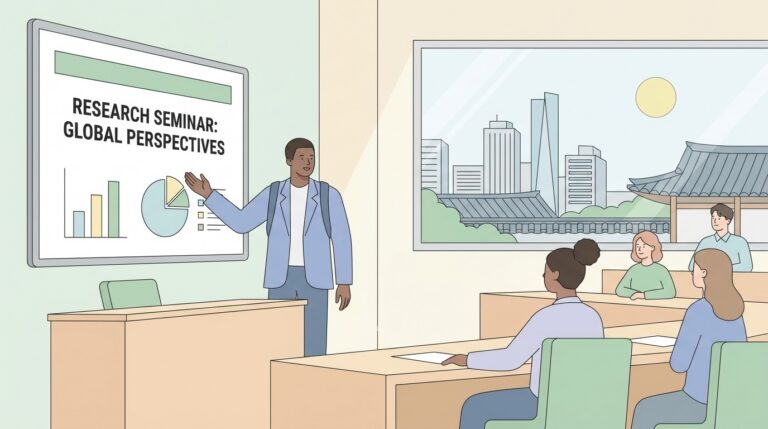
- The Open-Palm Slide Gesture: When referring to your presentation slide or printed handouts, avoid pointing with a single index finger. Extend your whole hand, palm tilted slightly upward toward the screen or document. It displays modesty and clarity.
- Eye Contact Distribution: Alternate eye contact in a 50-30-20 ratio: 50% toward the guiding professor or chair, 30% toward fellow graduate peers, and 20% down toward your 발제문 (presentation text). Never stare exclusively at your laptop screen.
- The Humble Pivot: When critiquing a respected author, slightly lower your head by 5 degrees as you say 부족하지만 (bujokhajiman, although I may fall short) or 제가 파악한 바로는 (jega pa-akhan baroneun, from what I have gathered).
4-2. Cultural Code: The Korean Graduate Lab Lifestyle (랩실 문화)
In Korean graduate schools, seminars are collaborative intellectual rituals. Presentations rarely occur in isolation; they are deeply tied to the lab’s hierarchy, collaborative research projects, and communal coffee runs before the meeting begins. Presenting a prior study’s logical flow shows that you honor the academic lineage (hag-maek) while proving your capability to contribute original, independent thought to the seminar table.
Phase 5: 실전 롤플레이 시나리오 (Real-World Roleplay Scenario)
Setting: Room 402, Humanities Hall. Graduate seminar on contemporary social policy. Professor Park sits at the head of the table; Min-su, your senior labmate (선배, sunbae), sits beside you as you begin presenting your literature review.
- Turn 1 (Professor Park): 자, 그럼 오늘 발제 맡으신 분, 선행 연구 검토 결과 공유해 주실까요? (Ja, geureom oneul balje mateusin bun, seonhaeng yeon-gu geomto gyeolgwa gong-yuhae jusilkkayo? / Well then, will today’s presenter share the findings from the literature review?)
- Turn 2 (You): 🎭 Taking a steady breath, turning on the projector pointer with two hands. 네, 교수님. 오늘 발표에서는 김 교수님의 2023년 논문을 중심으로 논의를 전개하겠습니다. (Ne, gyosunim. Oneul balpyo-eseoneun Gim gyosunim-ui icheon-isipsamnyeon nonmuneul jungsim-euro non-uireul jeon-gaeha-getseumnida. / Yes, Professor. In today’s presentation, I will develop our discussion centered around Professor Kim’s 2023 paper.)
- Turn 3 (Professor Park): 좋습니다. 저자가 어떤 문제의식에서 출발했는지 짚어 주시죠. (Jotseumnida. Jeojaga eotteon munje-uisik-eseo chulbalhaenneunji jipeo jusijo. / Good. Please highlight the research question and motivation the author departed from.)
- Turn 4 (You): 🎭 Switching to slide 2, looking at the entire seminar group calmly. 저자는 기존 연구들이 놓친 청년 세대의 실질적 소득 격차라는 문제의식에서 논의를 출발시켰습니다. (Jeojaneun gijon yeon-gudeuri notchil cheongnyeon sedae-ui siljiljeok sodeuk gyeokcharaneun munje-uisik-eseo non-uireul chulbalsikyeotseumnida. / The author initiated the discussion from a critical awareness of real income disparity among the youth generation, which prior studies had overlooked.)
- Turn 5 (Min-su Sunbae): 🎭 Jotting down notes and leaning in slightly. 그 질문을 규명하기 위해 어떤 방법론과 데이터를 활용했나요? (Geu jilmuneul gyumyeonghagi wihae eotteon bangbeopnon-gwa deiteoreul hwalyonghaennayo? / What methodology and data did they utilize to investigate that question?)
- Turn 6 (You): 🎭 Using an open palm toward the data methodology table. 5개년 패널 데이터를 바탕으로 다중회귀분석을 적용하여 변수 간 인과관계를 체계적으로 도출했습니다. (Ogaenyeon paeneol deiteoreul batang-euro dajunghoe-gwibunseogeul jeok-yonghayeo byeonsu gan in-gwagwan-gyereul che-gye-jeog-euro dochulhaetseumnida. / Based on five-year panel data, they applied multiple regression analysis to systematically derive causal relationships between variables.)
- Turn 7 (Professor Park): 🎭 Nodding thoughtfully. 결론부의 타당성은 어떻게 보십니까? (Gyeollonbu-ui tadangseong-eun eotteoke bosimnikka? / How do you evaluate the validity of the conclusion?)
- Turn 8 (You): 🎭 Smiling subtly, making polite eye contact. 데이터에서 도출된 결론에 이르는 논리적 흐름은 매우 탄탄하지만, 정책적 제언 부분에서는 약간의 비약이 관찰되었습니다. (Deiteo-eseo dochuldoen gyeollon-e ireuneun nollijeok heureum-eun maeu tantanhajiman, jeongchaekjeok jeeon bubun-eseoneun yak-gan-ui biyagi gwanchaldoe-eotseumnida. / The logical flow reaching the conclusion derived from data is very robust, yet a slight logical leap was observed in the policy recommendation section.)
🔀 인터랙티브 분기점 (Interactive Fork)
How would you conclude your 발제 (presentation) before taking Q&A?
- Choice A: 저자의 주장은 완벽하므로 반박할 점이 전혀 없습니다. 감사합니다. (Jeojaui jujangeun wanbyeokhameuro banbakhal jeomi jeonhyeo eopseumnida. Gamsahamnida. / The author’s argument is perfect, so there is nothing to refute. Thank you.)
- Choice B: 이상으로 논리적 흐름 정리를 마치며, 한계점에 대한 학우분들의 고견을 청해 듣고자 합니다. (Isang-euro nollijeok heureum jeongnireul machimyeo, han-gyejeom-e daehan hagu-bundeul-ui gogyeoneul cheonghae deutgoja hamnida. / With this, I conclude my summary of the logical flow and would like to welcome my peers’ insightful opinions regarding its limitations.)
- Choice C: 제 생각에는 이 논문의 데이터가 너무 옛날 거라서 별로 쓸모가 없는 것 같습니다. (Je saenggak-eneun i nonmun-ui deiteoga neomu yennal georaseo byeollo sseulmoga eomneun geot gateumnida. / In my opinion, this paper’s data is way too old so it seems pretty useless.)
Feedback:
* Choice A (Risk): Claiming an academic paper is “unquestionably perfect” implies lack of critical thinking, which defeats the purpose of an academic review.
* Choice B (Best): Demonstrates academic modesty, seamlessly bridges synthesis with peer discussion, and uses sophisticated honorific vocabulary (고견을 청하다).
* Choice C (Bad): Disrespectful colloquial phrasing (별로 쓸모가 없다) that undermines the scholarly tone of the seminar.
Phase 6: 10초 감정 섀도잉 드릴 (Shadowing Drill)
Practice these pauses (/) and tones aloud to master your seminar presence!
[🧐 진지하고 차분하게 / Serious and composed]
저자가 어떤 문제의식에서 / 출발했는지 짚어보고, / 연구의 분석 틀을 / 상세히 검토했습니다.
(Jeojaga eotteon munje-uisik-eseo / chulbalhaenneunji jipeobogo, / yeon-gu-ui bunseok teureul / sangsehi geomtohaetseumnida.)
“I traced the author’s initial research question / and critically examined / the study’s analytical framework in detail.”-
[💡 명쾌하고 자신감 있게 / Clear and confident]
데이터 수집 과정과 방법론을 거쳐 / 결론에 도달하는 / 논리적 흐름이 / 설득력 있게 제시되었습니다.
(Deiteo sujip gwajeong-gwa bangbeopnoneul geocheo / gyeollone dodalhaneun / nollijeok heureumi / seoldeungnyeok itge jesidoeeotseumnida.)
“Through the data collection process and methodology, / the logical flow leading to the conclusion / was presented convincingly.” -
[🤝 겸손하면서도 예리하게 / Modest yet perceptive]
실증적 분석 결과는 타당하지만, / 논리적 전개 과정에서 / 보완되어야 할 지점을 / 짚어보았습니다.
(Siljeungjeok bunseok gyeolgwaneun tadanghajiman, / nollijeok jeon-gae gwajeong-eseo / bowandoeeo-ya hal jijeomeul / jipeobowatseumnida.)
“While the empirical findings are valid, / I pinpointed areas / in the progression of logic / that warrant further supplementation.”
Phase 7: K-Culture 미니 사전 (Mini Dictionary)
- 발제 (Balje / Seminar Presentation): An oral report where a designated speaker summarizes assigned literature, dissects critical issues, and raises questions to initiate group debate.
- 선행 연구 (Seonhaeng yeon-gu / Prior Literature): Studies and publications previously conducted on the subject, which serve as the baseline for new research.
- 문제의식 (Munje-uisik / Critical Problem Awareness): The specific intellectual urgency, curiosity, or philosophical starting point that leads a researcher to conduct a study.
- 논리적 비약 (Nollijeok biyak / Logical Leap or Fallacy): An abrupt jump in reasoning where the premise or data does not adequately support the asserted conclusion.
Phase 8: 여행자를 위한 생존 키트 (Campus & Scholar Survival Kit)
Campus Academic Survival Expressions TOP 3
- 발제문 출력 어디서 해요? (Baljemun chulryeok eodiseo haeyo?)
Romanization: [Bal-je-mun chul-lyeok eo-di-seo hae-yo?]
Pro Tip: Use this at student union copy rooms. Most university print shops charge 50–100 KRW per page via T-money or check cards. - 오늘 세미나 자료집 배부되었나요? (Oneul semina jaryojip baebudoeeonnayo?)
Romanization: [O-neul se-mi-na ja-ryo-jip bae-bu-doe-eon-na-yo?]
Pro Tip: Ask this to the graduate assistant (조교, jogyo) upon entering the seminar room to secure your printed booklet. - 교수님, 질문 한 가지 드려도 되겠습니까? (Gyosunim, jilmun han gaji deuryeodo doegetseumnikka?)
Romanization: [Gyo-su-nim, jil-mun han ga-ji deu-ryeo-do doe-get-seum-ni-kka?]
Pro Tip: The golden polite line to ask for clarification during seminar office hours.
Editor’s Campus Travel Note
If you are visiting a Korean university library to conduct literature research, download the RISS academic thesis portal mobile app to locate public research papers, and set up your campus route using the NAVER Map transit and navigation app. Remember: campus libraries usually require visitors to issue a temporary barcode pass at the digital information counter.
Phase 9: “한 발 더 깊이” (Deep Cultural Insight)
In Korean scholarly circles, the pursuit of truth is viewed not as a battlefield of aggressive confrontation, but as a communal process of collective refinement. When presenting a literature review, Korean academics intentionally balance critique with deference. You highlight gaps not to tear down the author, but to illuminate where the next generation of scholars—including yourself—can build upon their foundation. This harmonious tension between sharp intellectual rigor and collective modesty (겸양의 미덕) defines the elegance of modern Korean academic discourse.
💬 Your Turn: In your home academic culture, do presenters typically emphasize what the author got right, or do they immediately jump into dissecting the flaws? Leave a comment below and share your seminar experiences with us!
Phase 10: FAQ & 오해 방지 (FAQ & Common Mistakes)
Q: Can I use “요” (yo) endings instead of “습니다” (seumnida) in an academic seminar presentation?
A: It is strongly recommended to use formal style (-습니다/ㅂ니다) when delivering your actual presentation and presenting your slides. During casual follow-up exchanges with classmates, polite style (-아요/어요) is acceptable, but -습니다 establishes scholarly authority and respect.
Q: What is the difference between “요약했습니다” and “논리적 흐름을 짚었습니다”?
A: 요약했습니다 (yoyakhaetseumnida) merely means you shortened and condensed the text (passive). 논리적 흐름을 짚었습니다 (nollijeok heureumeul jipeotseumnida) indicates that you actively analyzed the underlying connection between the research question, data, and conclusion.
Q: How do I disagree with a senior professor’s paper without being disrespectful?
A: Begin by validating the author’s contribution: “이러한 선행 연구의 성과에도 불구하고…” (Ireohan seonhaeng yeon-gu-ui seong-gwa-edo bulguhago… / Despite the achievements of this prior study…), then frame your critique as an extension: “…추가적인 변인 검토의 여지가 있어 보입니다” (…there appears to be room for examining additional variables).
🚨 Common Mistakes (흔한 실수 TOP 3)
- Saying “저자가 틀렸습니다” (The author is wrong): Too blunt! Instead, say “저자의 결론에는 다소 재고의 여지가 있습니다” (Jeojaui gyeolloneneun daso jaego-ui yeojiga itseumnida / The author’s conclusion leaves room for reconsideration).
- Relying solely on English terminology (e.g., “Research Question”, “Methodology”): While terms like RQ are understood, using Korean academic vocabulary like 문제의식 (munje-uisik) and 방법론 (bangbeopnon) signals true B2+ fluency.
- Overusing “제가 생각했을 때” (In my opinion): In formal presentations, replace this with “본 발표자의 견해로는…” (Bon balpyojaui gyeonhaeroneun… / From this presenter’s standpoint…) or “분석 결과에 비추어 볼 때…” (Bunseok gyeol-gwa-e bichueo bol ttae… / In light of the analytical findings…).
Phase 11: 액션 미션 & 참여 유도 (Action Missions)
- 🥉 Bronze Mission (Solo Practice): Stand before a mirror with a timer. Read aloud the 3 core expressions from Phase 2 using the provided emotion shadowing cues in under 45 seconds.
- 🥈 Silver Mission (Social Share): Find a Korean abstract on RISS or Google Scholar. Write one sentence in Korean summarizing its research question and conclusion flow, and post it to your study group or social feed with #DailyHangul.
- 🥇 Gold Mission (Real Application): Use “저자가 어떤 문제의식에서 출발했는지 짚어보았습니다” during your next Korean class presentation or language exchange session.
- 🎮 K-Culture Mission: Watch an episode of a Korean legal or campus drama (e.g., Law School or Black Dog) and write down every time a character uses words like 검토 (review), 한계 (limitation), or 논리 (logic).
Phase 12: 인터랙티브 퀴즈 챌린지 (Interactive Quiz)
1. Situational Judgment: You are presenting the methodology section of a published thesis and want to politely mention that the sample size was too small. Which sentence is most appropriate?
* A) 데이터가 적어서 논문이 엉망입니다. (Deiteoga jeogeoseo nonmuni eongmang-imnida.)
* B) 표본 수의 제약으로 인해 실증 분석의 외적 타당도에 한계가 관찰됩니다. (Pyobon su-ui jeyag-euro inhae siljeung bunseog-ui oejeok tadangdoe han-gyega gwanchaldoemnida.)
* C) 표본이 작아서 다음에는 더 많이 모아야 합니다. (Pyoboni jagaseo da-eumeneun deo mani mo-aya hamnida.)
2. Fill-in-the-Blank: Complete the scholarly phrase:
저자가 어떤 [ _________ ]에서 출발하여 결론에 도달했는지 논리적 흐름을 짚었습니다.
* (a) 선배 (b) 문제의식 (c) 영수증
3. True or False: In Korean university seminars, using open-palm gestures instead of pointing your finger shows appropriate scholarly etiquette. (True / False)
Click here to reveal answers and explanations!
- 1. Answer: B (Sentence B uses formal academic terms like 표본 수의 제약 [sample size constraints] and 외적 타당도 [external validity] while avoiding harsh everyday slang).
- 2. Answer: (b) 문제의식 (문제의식 [critical problem awareness / research question context] correctly completes the academic sentence).
- 3. Answer: True (Pointing with an index finger is considered informal or blunt; using an open palm demonstrates courtesy to your audience and professors).







