

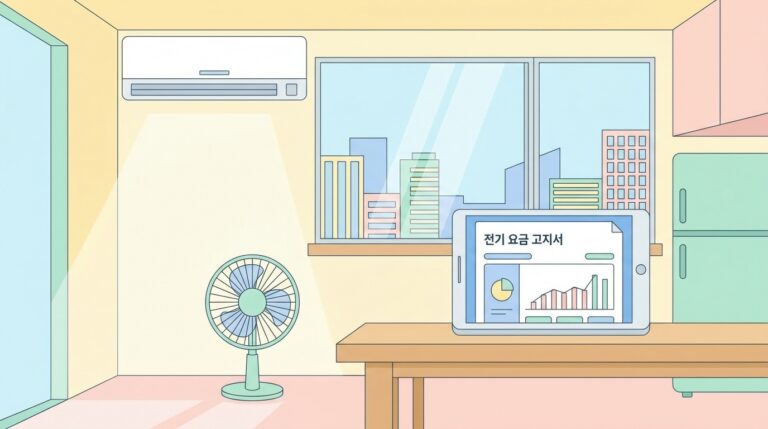
Surviving Korea’s Summer AC Bills: How to Dodge the Infamous Utility Bomb
Phase 1: Empathy (Story-Driven Opening)
안녕하세요! 매일한글 에디터입니다.
Imagine this: It’s mid-July in Seoul. Outside, the midday humidity feels as thick as a steaming bowl of Samgyetang (ginseng chicken soup). You finally get back to your cozy studio apartment (one-room or officetel) near Sinchon, kick off your sneakers, and immediately grab the air conditioner remote. You press that wonderful power button and drop the temperature all the way down to a frosty 18°C. Ah, pure bliss! You let it blast 24/7 for three weeks straight because, well, back home your monthly utilities were flat-rate or included in the rent.
Then, mid-August rolls around. You open your mailbox or get a notification on KakaoTalk from your building manager (gwanrisil). You glance at the total amount due, and your heart stops. The bill is 350,000 KRW ($270 USD)—more than triple your expected budget! You’ve just experienced what every Korean dreads: the infamous 요금 폭탄 (yogeum poktan – bill bomb).
Here at Daily Hangul, we hear this exact horror story from international students, expats, and working holiday travelers every single summer. Korea’s residential electricity uses a progressive tier system called 누진세 (nujinse). If your usage crosses certain thresholds, the rate per kilowatt-hour skyrockets exponentially! Today, we’re not just learning vocabulary; we are giving you real-world life skills. By learning how to discuss your bills, ask about account transfers (myeong-ui byeongyeong), and adjust settings like a native, you will keep your home comfortable without blowing your food budget on kilowatt-hours.
Phase 2: Core Expressions Deep Dive
Here are the 3 essential expressions you must know when dealing with utilities and summer heat in Korea.
1. 누진세가 적용되니까 온도 좀 올려요 (Nujinse-ga jeok-yong-doe-ni-kka on-do jom ol-lyeo-yo)
- Pronunciation: Noo-jeen-seh-gah jeok-yong-dweh-nee-kkah on-doh jom ohl-lyuh-yoh (Sounds like “noo-jean-say” followed by “on-dough johm”).
- Meaning: Literal: “Progressive tax/rates apply, so please raise the temperature a bit.” | Real Nuance: “Don’t freeze the room, or we’re going to pay a fortune!”
- K-Culture Moment: Seen in relatable lifestyle K-Dramas like Because This Is My First Life where roommates bicker over apartment maintenance fees.
- Editor’s Insight: The connective particle -니까 (-nikka) indicates a clear reason or justification (“because/since”). In shared flats or homestays, this phrase softens a command into a sensible suggestion.
- Situation Spectrum: Casual: ✅ (누진세 붙으니까 온도 올려 / Nujinse bicheunikka ondo ollyeo) | Semi-formal: ✅ | Formal: ✅ (누진세가 적용되므로 적정 온도를 유지해 주시기 바랍니다 / Nujinsega jeok-yong-doemeuro jeokjeong ondoreul yujihae jusigi baramnida)
- 🤔 Think About It: In many Western countries, cooling is billed on a flat usage curve. How does Korea’s community-minded energy policy influence everyday roommate conversations?
2. 이번 달 관리비 폭탄 맞았어요 (Ibeon dal gwan-ri-bi pok-tan ma-jas-seo-yo)
- Pronunciation: Ee-beon dahl gwahn-ree-bee pohk-tahn mah-jahs-suh-yoh (Rhymes with “gwan-lee-bee poke-tahn”).
- Meaning: Literal: “I got hit by a maintenance fee bomb this month.” | Real Nuance: “My apartment utility bill was insanely high!”
- K-Culture Moment: Frequently shouted on Korean variety shows like I Live Alone (Na Honja Sanda) when single celebrities open their summer utility envelopes.
- Editor’s Insight: Koreans love the vivid metaphor 폭탄 맞다 (poktan matda – to be hit by a bomb) for unexpected disasters (e.g., sugje poktan = homework bomb, yogeum poktan = bill bomb).
- Situation Spectrum: Casual: ✅ | Semi-formal: ✅ | Formal: ⚠️ (Use ‘관리비가 예상보다 많이 청구되었습니다’ in official emails).
- 🤔 Think About It: Why do you think Korean slang leans toward intense, high-impact figurative words like ‘bomb’ to describe everyday surprises?
3. 전기랑 수도 명의 변경하려고 하는데요 (Jeon-gi-rang su-do myeong-ui byeon-gyeong-ha-ryeo-go ha-neun-de-yo)
- Pronunciation: Juhn-gee-rahng soo-doh myuhng-eui byuhn-gyuhng-hah-ryuh-goh hah-neun-deh-yoh.
- Meaning: Literal: “I’m calling because I want to change the names on the electricity and water accounts.” | Real Nuance: “Hi, I just moved in and need to transfer the utility accounts into my name.”
- K-Culture Moment: An essential milestone for expats renting their very first studio or apartment across Seoul.
- Editor’s Insight: Ending a sentence with -ㄴ/은/는데요 (-n/eun/deyo) acts as an acoustic shock absorber. It signals polite intent and leaves the door open for the customer service agent to ask for your details.
- Situation Spectrum: Casual: 🚫 | Semi-formal: ✅ | Formal: ✅
- 🤔 Think About It: Notice how Korean customer requests rarely end with direct imperatives like “Change this.” Instead, speakers describe their background context first.
Phase 3: Textbook Korean vs. Real Native Korean
Situation 1: Telling your roommate to save electricity
- 📖 교과서 한국어 (Textbook Korean): “여름철에는 전기를 절약해야 합니다.” (Yeoreumcheoreneun jeongireul jeoryakhaeya hamnida. – One must save electricity in summer.)
- 🗣️ 진짜 한국어 (Real Korean): “에어컨 희망 온도 26도로 맞춰 놔요. 누진세 나와요!” (Ee-eo-keon huimang ondo isibyungdo-ro matchwo nwayo. Nujinse nawayo! – Set the target AC temp to 26°C. We’ll get progressive billing!)
- 💡 왜 다를까? (Why is it different?): Textbook phrases sound like government public service campaigns. Real roommates name specific numbers (26°C is the national standard recommended setting) and cite the exact reason (nujinse).
Situation 2: Opening a surprisingly high bill
- 📖 교과서 한국어 (Textbook Korean): “전기요금이 생각보다 많이 청구되었습니다.” (Jeongiyogeumi saenggakboda mani cheonggudoeeotseumnida. – The electricity fee has been billed higher than expected.)
- 🗣️ 진짜 한국어 (Real Korean): “헐, 이번 달 전기세 완전 폭탄 맞았네!” (Heol, ibeon dal jeongise wanjeon poktan majanne! – What the heck, our electric bill totally blew up this month!)
- 💡 왜 다를까? (Why is it different?): Koreans use 헐 (Heol – OMG/Woah) and 전기세 (jeongise – electric tax/fee) colloquially instead of the formal term jeongiyogeum in spoken conversations.
Phase 4: K-Culture Deep Dive & Non-Verbal Manners
4-1. 눈치 (Nunchi) & Gestures
When visiting a Korean friend’s home in the summer, never touch their air conditioner remote without asking first. Touching the remote directly can be perceived as inconsiderate (nunchi eopda), because you might trigger their next billing tier!
* Polite Gesture: If you’re feeling warm, fan yourself lightly using your hand or a portable fan (son-seon-pung-gi), and say: “조금 더운데 에어컨 틀어도 괜찮아요?” (Jogeum deounde ee-eo-keon teureodo gwaenchannayo? – It’s a bit warm, is it okay if we turn on the AC?).
* The Inverter Awareness: Most modern units in Korea are ‘Inverter’ (inbeoteo) models. Koreans know that turning inverter ACs on and off repeatedly consumes more electricity than keeping them steady at 25–26°C with a circulating fan (seonpung-gi).
4-2. Culture Code: The “Ondol in Winter, Hanil Fan in Summer” Mentality
Korea experienced rapid economic development where resource conservation was national policy. You will often spot a small green and yellow circular energy efficiency rating sticker on every appliance (enerji sobik hyoyul deunggeup). Tier 1 (1등급) is prized, while Tier 5 (5등급) is dreaded. In K-Dramas, whenever a son or daughter leaves the refrigerator door open or sets the AC to 18°C, the mother instantly appears with a swift slap on the back, warning about gwanribi. Keeping the temperature at 26°C isn’t just frugality; it’s an ingrained cultural respect for shared energy grids.
Phase 5: Real-Life Roleplay Scenario
Setting: You have just moved into an officetel in Mapo-gu. Your landlord, Mr. Park (박 아저씨), is showing you how the utilities and boiler work.
Characters:
* You (유학생 / 외국인 세입자 – Foreign Tenant)
* Mr. Park (친절한 집주인 아저씨 – The Kind Landlord)
Turn 1
* 🎭 Mr. Park points at the wall-mounted air conditioner remote mounted near the kitchen counter.
* Mr. Park: “여름에 덥다고 에어컨 18도로 계속 틀면 안 돼요.” (Yeoreume deopdago ee-eo-keon sibpaldoro gyesok teulmyeon an dwaeyo. / You can’t just keep running the AC at 18 degrees all summer because it’s hot.)
Turn 2
* 🎭 You nod with curiosity and tilt your head slightly.
* You: “아, 한국은 전기요금 누진세가 있다고 들었어요.” (A, hangugeun jeongiyogeum nujinsega itdago deoreosseoyo. / Ah, I heard Korea has progressive tiers for electricity bills.)
Turn 3
* 🎭 Mr. Park smiles proudly that you know this.
* Mr. Park: “맞아요! 2단계 넘어가면 요금 폭탄 맞아요. 26도로 맞추고 선풍기 같이 틀어요.” (Majayo! Idan-gye neomeogamyeon yogeum poktan majayo. Isibyungdoro matchugo seonpung-gi gachi teureoyo. / Exactly! If it crosses into tier 2, you get a huge bill bomb. Set it to 26 degrees and run an electric fan together.)
Turn 4
* 🎭 You take out your smartphone to note down the utility steps.
* You: “그렇군요. 그럼 전기랑 수도 명의 변경은 어떻게 해요?” (Geureokun-yo. Geureom jeongirang sudo myeong-ui byeon-gyeong-eun eotteoke haeyo? / I see. Then how do I transfer the electricity and water accounts to my name?)
Turn 5
* 🎭 Mr. Park points to the electricity meter outside the door.
* Mr. Park: “한전 123번에 전화해서 계량기 번호 알려주면 바로 돼요.” (Hanjeon il-i-sambone jeonhwahaeseo gyeryang-gi beonho allyeojumyeon baro dwaeyo. / Call KEPCO at 123 and give them your meter number, and it’s done right away.)
Turn 6
* 🎭 You check the gas connection as well.
* You: “도시가스 전입 연결도 제가 따로 신청해야 하죠?” (Dosigaseu jeon-ip yeon-gyeoldo jega ttaro sincheonghaeya hajyo? / I need to apply for the city gas move-in connection separately too, right?)
Turn 7
* 🎭 Mr. Park hands you a sticky note with the regional gas center number.
* Mr. Park: “네, 가스는 기사님이 직접 방문해서 밸브를 열어줘야 하니까 미리 예약해요.” (Ne, gaseuneun gisannimi jikjeop bangmunhaeseo baelbeureul yeoreojwoya hanikka miri yeyakhaeyo. / Yes, a technician must visit in person to unlock the valve, so make an appointment in advance.)
Turn 8
* 🎭 You bow slightly with both hands together in front of you.
* You: “네, 친절하게 알려주셔서 정말 감사합니다!” (Ne, chinjeolhage allyeojusyeoseo jeongmal gamsahamnida! / Yes, thank you so much for explaining everything so kindly!)
🔀 Interactive Decision Point
Your room is stifling hot on your first night, but you are terrified of getting a 300,000 KRW bill. What do you do?
- Option A: Turn the AC to 18°C and leave it running all day and night with all room windows closed.
- Option B: Turn the AC to 26°C on “Cooling Mode” (Naengbang), place a fan circulating the air, and close your curtains to block the sun.
- Option C: Refuse to use the AC at all, open the windows during a humid 35°C Seoul night, and turn on three portable desk fans.
Outcome Feedback:
* Choice A (Risk): You will stay cool for 30 days, but your wallet will weep when the 250,000+ KRW poktan bill lands in your hands!
* Choice B (Best): Pure genius! Modern inverters use the least energy when reaching and sustaining 26°C. The fan speeds up cooling, keeping your bill around 30,000–45,000 KRW.
* Choice C (Bad): You risk heat exhaustion! Seoul’s summer nights often trigger tropical night alerts (yeoldaeya), where humidity reaches 90%. Use your AC smartly instead of suffering.
Phase 6: 10-Second Emotional Shadowing Drill
Practice these with the rhythm breaks marked by /.
[😰 Worried & Anxious]
“누진세 때문에… / 요금 폭탄 맞을까 봐 / 너무 걱정돼요.”
(Nujinse ttaemune… / yogeum poktan majeulkka bwa / neomu geokjeongdwaeyo. / Because of progressive tiers… / I’m so worried / I might get hit with a crazy bill.)-
[💡 Cheerful & Informative]
“에어컨은 26도로 맞추고! / 선풍기를 같이 틀면 / 전기세 훨씬 아껴요!”
(Ee-eo-keoneun isibyungdoro matchugo! / seonpung-gireul gachi teulmyeon / jeonggise hwolssin akkyeoyo! / Set the AC to 26 degrees! / And if you run the fan together / you save way more on electric bills!) -
[📞 Polite & Businesslike]
“안녕하세요, / 이사 왔는데요, / 전기요금 명의 변경 / 부탁드립니다.”
(Annyeonghaseyo, / isa wanneundeyo, / jeongiyogeum myeong-ui byeon-gyeong / butakdeurimnida. / Hello, / I just moved in, / so utility account transfer / please.)
Phase 7: K-Culture Mini Dictionary
- 누진세 (Nujinse – Progressive Rate / Tiered Pricing)
Usage: The residential electricity pricing structure in Korea where unit cost jumps after specific usage brackets (e.g., exceeding 200kWh or 400kWh during summer). - 관리비 (Gwanribi – Building Maintenance Fee)
Usage: The monthly lump sum bill for studio apartments and officetels covering cleaning, elevator maintenance, and often water, internet, or shared electricity. - 실외기 (Sil-oegi – Outdoor AC Compressor Unit)
Usage: Often located on apartment verandas or dedicated exterior ledges. Keeping the airflow around the sil-oegi unobstructed prevents energy waste and fire hazards. - 명의 변경 (Myeong-ui Byeongyeong – Name/Account Transfer)
Usage: The essential administrative process upon moving in (jeon-ip) or moving out (jeon-chul) to ensure you only pay for the utilities consumed during your actual tenancy.
Phase 8: Expat & Traveler Survival Kit
Top 3 Survival Phrases
- “에어컨 온도 좀 올려도 돼요?” (Ee-eo-keon ondo jom ollyeodo dwaeyo?)
Pro Tip: Perfect when sitting in an icy cafe or your shared apartment living room. - “전기요금 계량기 어디 있어요?” (Jeongiyogeum gyeryang-gi eodi isseoyo?)
Pro Tip: Use this when talking to the building security guard (gyeongbihajeossi) to read your meter digits. - “도시가스 기사님 언제 방문하시나요?” (Dosigaseu gisannim eonje bangmunhasinayo?)
Pro Tip: Ask your regional gas branch to confirm your move-in inspection appointment time.
Editor’s Moving & Settling Note
- KEPCO Customer Center: Dial 123 from your mobile phone (without area code) to speak with the Korea Electric Power Corporation. Press 7 for English service!
- Apps to Install: Download the Smart KEPCO App on Google Play or iOS Store to monitor your real-time electricity consumption and calculate estimated tiers before the bill arrives.
- City Gas Notice: Unlike electricity, which automatically flows, city gas for your stove and hot water is physically turned off when the previous tenant moves out. You must schedule an in-person technician visit 2–3 days before moving in.
Phase 9: “Going Deeper” (Cultural Perspective)
In many parts of the world, personal comfort inside one’s private apartment is purely an individual financial choice. If you want to pay extra for an Arctic chill, that’s your prerogative. In Korea, however, energy is deeply intertwined with national self-sufficiency and collective consciousness. Since Korea imports the vast majority of its energy resources, conserving power during peak seasonal surges is treated as a civic responsibility. When your Korean landlord or coworker reminds you to set your AC to 26°C, they aren’t trying to micromanage your life—they are sharing an instinctive community mindset designed to protect both the national power grid and your monthly bank balance.
💬 Your Turn: What temperature do you usually set your thermostat to back home? Have you ever experienced an unexpected utility shock in another country? Share your stories below!
Phase 10: FAQ & Common Pitfalls
Q: What is the ideal AC temperature to avoid the progressive tax in Korea?
A: The Korea Energy Agency strongly recommends 26°C (78.8°F). Pairing 26°C with a circulator fan feels as cool as 23°C while preventing your electrical usage from crossing into Tier 3 pricing.
Q: Does turning the AC on and off save money?
A: No, not with modern Inverter ACs! Older models (정속형 / fixed speed) saved power when turned off, but almost all units manufactured after 2011 in Korea are inverter models (인버터). Inverters consume 70% of their energy just bringing the room down to temperature; constantly turning them off and on forces the compressor to restart at maximum load repeatedly.
Q: How do I change the name on my electricity bill when moving into a one-room?
A: Take a photo of your electrical meter outside your door on move-in day. Call 123, provide your address and the exact meter reading, and state: “명의 변경해 주세요” (Myeong-ui byeongyeonghae juseyo). They will register your phone number for digital billing.
🚨 Common Mistakes Alert
- Mistake: Forgetting to check whether your AC is an Inverter (Inbeoteo) or Fixed-Speed (Jeongsokhyeong).
Correct Action: Look at the side of the indoor unit. If it says “Inverter” or has an energy rating of 1 to 3, leave it running at a stable 26°C instead of cycling it every hour. - Mistake: Assuming the building maintenance fee (gwanribi) includes all electricity and gas.
Correct Action: In most officetels, gwanribi only covers shared building maintenance and water. Electricity and gas are billed separately based on your personal meter. - Mistake: Leaving the outdoor unit closet (sil-oegi-sil) closed.
Correct Action: Always open the exterior louver windows in your AC compressor closet before turning the AC on. Trapped heat can trip the safety fuse or trigger an emergency shutdown.
Phase 11: Action Missions
- 🥉 Bronze Mission (Solo Practice): Walk over to your air conditioner or refrigerator, find the energy efficiency sticker, and say aloud: “우리 집 에어컨은 몇 등급이지?” (Uri jip ee-eo-keoneun myeot deunggeubiji? / What tier is our house AC?).
- 🥈 Silver Mission (Social Media): Take a picture of your AC remote showing 26°C, post it on Instagram or Threads with the caption: “누진세 안 맞으려고 26도 유지 중! ❄️ #매일한글 #DailyHangul”.
- 🥇 Gold Mission (Real Life): Call 123 (KEPCO) or talk to your building manager to check your meter reading or ask: “이번 달 전기요금 명의 변경 완료됐나요?” (Ibeon dal jeongiyogeum myeong-ui byeongyeong wanryodwaennayo?).
- 🎮 K-Culture Mission: Watch an episode of I Live Alone (나 혼자 산다) or a Korean house-tour vlog on YouTube, and spot how Korean creators position their electric fans next to their air conditioners!
Phase 12: Interactive Quiz Challenge
1. Situation Scenario
You come back from a jog, and your room is burning hot. You want to cool the room fast without paying a fortune. Which combination is correct?
* A) Set the AC to 16°C and leave the window cracked open.
* B) Set the AC to 25–26°C, set the fan speed to High, and turn on an electric fan facing into the room.
* C) Turn the AC on for 10 minutes at 18°C, turn it off for 20 minutes, and repeat.
2. Fill in the Blank
“전기요금 ( )가 적용되니까 에어컨 온도를 너무 낮추지 마세요.”
* A) 할인율 (Hal-in-yul)
* B) 누진세 (Nu-jin-se)
* C) 영수증 (Yeong-su-jeung)
3. True or False
City gas (Dosigaseu) connects automatically without scheduling an appointment when you move into a new rental unit in Korea. (True / False)
👉 Click to view answers and explanations!
- Answer: B. Setting the temperature to 25–26°C with strong airflow and a fan cools the room just as fast while preventing the compressor from running continuously in the high-cost progressive tier.
- Answer: B (누진세 – Nujinse). Progressive pricing tiers apply to residential electricity in Korea.
- Answer: False. For safety reasons, city gas lines are shut with a physical lock when a tenant moves out. A gas technician must visit your apartment in person to verify connections and unlock the valve.







